K-MAX is the Marine's first unmanned helicopter. Photo courtesy of Lockheed Martin
A new era in unmanned aviation began earlier this month when Marine Unmanned Aerial Vehicle Squadron 1 operated a K-MAX unmanned helicopter during its historic 90-minute flight, Dec. 17. K-MAX is the Marine's first unmanned helicopter designed for resupplying troops in remote locations. During its maiden flight, K-MAX successfully delivered about 3,500 pounds of food and supplies to troops at a forward operating base in Afghanistan without risk to a pilot.
Two Colorado-based aerospace operations are among five companies chosen by NASA to develop concepts for demonstrating solar electric propulsion in space.
NASA said this week that Lockheed Martin Space Systems of Littleton and Ball Aerospace & Technologies of Boulder were chosen for the project.
NASA says contracts still have to be negotiated. They would be worth up to $600,000 each.
Each company would provide a report on how to demonstrate solar electric propulsion technologies, capabilities and infrastructure for human space travel.
Also chosen for the project were Analytical Mechanics Associates in Hampton, Va., Boeing in Huntington Beach, Calif., and Northrop Grumman Systems in Redondo Beach, Calif.
Inspired by a maple seed, Lockheed Martin's Samarai handheld vehicle flew publically for the first time today at the Association for Unmanned Vehicle Systems International conference.
Weighing less than half a pound, Samarai demonstrated vertical takeoff and landing, stable hover, and on-board video streaming. While the aircraft flew a series of flights in the roughly 40 foot test area, it streamed live video from a camera that rotated around its center providing a 360 degree view without a gimbal.
"Our team has taken the basic shape and design of the naturally aerodynamic maple seed and harnessed it with flight controls and avionics," said Kingsley Fregene, principal investigator for Samarai at Lockheed Martin's Advanced Technology Laboratories. "We've learned a great deal about biologically inspired vehicles that we can apply across the laboratory, including a better understanding of micro-robots and the devices that control their movement."
Samarai is mechanically simple with only two moving parts. Because its 16 inches long and weighs less than half a pound, an operator can easily carry the vehicle in a backpack and launch it from the ground or like a boomerang. The design is scalable to meet different missions, including surveillance and reconnaissance and payload delivery.
Lockheed Martin tested the first 3-D printed Samarai last week. The vehicle was produced by "printing" successive small layers of plastic to create a single form. The printer eliminates expensive production costs, allowing engineers to quickly and affordably produce Samarai tailored to specific missions.
Biomechanical testing of the Lockheed Martin ruggedized HULC exoskeleton is now underway at the U.S. Army Natick Soldier Research, Development and Engineering Center in Natick, Mass. The testing is expected to help shape future requirements for the HULC based on feedback from soldiers.
For seven weeks, U.S. Army warfighters will be evaluated to assess the effects of load carriage with and without use of the HULC exoskeleton. Biomechanical testing will measure changes in energy expended by users, assessing how quickly individuals acclimate to the system and whether there is a reduction in metabolic cost.
Testing will also determine if there is an improvement in metabolic efficiency as measured by oxygen consumption per unit total mass, when wearing the ruggedized HULC as compared to not wearing the device under identical load, speed, grade and duration conditions. To read more click here...
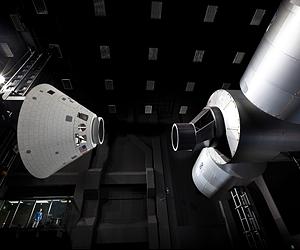
Forging a new path forward to ensure safe, affordable and sustainable human exploration beyond low Earth orbit, Lockheed Martin has unveiled the first Orion spacecraft and a spacious state-of-the-art Space Operations Simulation Center (SOSC). These two major projects, located at Lockheed Martin's Waterton Facility near Denver, Colo., showcase the NASA-industry teams' progress for human space flight, the Orion Project and NASA's Multi-Purpose Crew Vehicle. To read more click here...
Lockheed Martin and Technology Management Inc. for the first time have operated a fuel-cell generator for 1,000 hours using the military’s standard fuel, JP-8. This milestone paves the way to field fuel-cell generators in theater to create a more efficient, safe and affordable method to convert expensive fuel into electricity. To read more click here...