Pages

Subscribe:

Labels

038628037504 (1) 10150 (1) 10BURIED (1) 10Count (1) 110011040 (1) 115Ounce (1) 1200mg (1) 12BSN (1) 12Count (2) 12CountNutricor (1) 12CountWWSN (1) 12Fresh (1) 12Stacker (3) 12VPX (1) 140243 (1) 14Servings (1) 158Ounce (1) 15Ounce (1) 16Ounce (2) 1716 (1) 17Skque (1) 1lbinLife (1) 2000Hrs (1) 2000mg (1) 200Watt (1) 2021A (1) 20OunceNatures (1) 2412Ounce (1) 24Count (1) 24EAS59134 (1) 24FRS (1) 24Guru (1) 24Guru01GR124 (2) 24Nestle (2) 24Pediasure (2) 24Peptamen (1) 24PieceDisplay (1) 24Solis (2) 27ReSource (2) 2Biochem (1) 2Dynamic (1) 2Jarrow (1) 2Muscle (1) 2Natures (1) 2Ounce (3) 2Pound (1) 30Day (1) 328601 (1) 334928 (1) 336gOptimum (1) 37Ounce (1) 3Ensure (1) 3M (1) 414 (1) 432500 (1) 48Boost (1) 48Fluid (1) 48ml (1) 4Ensure (1) 4Isopure (1) 5000mg (1) 527408 (1) 5511786 (1) 574400 (1) 5Hour (2) 5Ounces (1) 600Kendall (1) 662380 (1) 6Beneprotein (1) 6Proteinex (1) 70951 (1) 750mlNutriPrima (1) 845Ounce (1) 84Fluid (2) 84OuncesLiquid (1) 89Inch (1) 8nuun (2) 8Ounce (7) 99369FR (1) ABB (3) Academy (1) ACCENTS (1) Acia162Ounces (1) Acsry (1) Active (2) Adapter (1) AdapterBattery (1) Advance (1) Advanced (1) Advantage (1) AdvantEdge (1) Africa (29) African (1) Agaricus (1) AiCoco (1) AIDSTrustex (1) Airbrush (1) Airbus (6) Aircraft (94) AISI (1) Ajmeras (1) Alchohol (1) Alertness (1) Alfalfa (2) Alive (1) Allergy (1) Allspice (8) Alpine (1) Alstom (2) Alternative (1) Amarillo (1) Amazing (3) Amazon (2) American (1) animal (11) Annual Reports (155) Antioxidant (1) Anwar Ibrahim (1) Apple (1) Applied Materials (1) Arrowroot (1) AshtonDrake (1) Asia (72) Assorted (1) Atkins (1) Audi (1) Australia (21) Automotive (250) Automotive Technology (183) Ayurvedic (1) BABIES (1) Babys (1) Bacopa (1) BagAtkins2627 (1) BagsTraditional (1) BagSun (1) Balanced (1) Ballard Power System (1) Banaba (2) Baram Dam (1) Baram Regatta (1) Bariatric (1) Barisan Nasional (2) Barisan Nasional Helps Penan (1) Barista (2) Barley (2) barsBiochem (1) Basement (1) BASF (2) Basics (1) Batu Lawi (1) Bayer (1) BEA1017OZ (1) Beachbody (1) Beaded (1) Beaumont (1) beautiful girl image (19) Beauty (2) Beneprotein (2) Berries (3) Berry (4) BerryLiving (1) Beverage (1) Bicycle (1) BioAstin (1) Biochem (4) Biofuel (12) Biogenesis (2) BlackBlender (1) Blend (1) Blender (4) Blueberry (1) BlueStereo (1) BMF (1) BMW (7) BMX (1) BN (1) Boeing (4) Bombardier (4) Book (1) Borneo (6) Bottle (8) BottleProStat (1) Bottles (15) BottleScivation (1) bottlesEnsure (2) BottlesMio (1) BoxChenille (1) BoxDarice140243 (1) BOXESAmerican (1) BoxesFRSPowder (1) BoxPremier (1) BP (2) Brands (1) Brands833667000102 (1) Brazil (10) Brazilian (1) Breeze (3) BrewersBarista (1) BRIC (118) Brikpaks (3) Brownie (1) Bruno Manser (1) Bruno Manser Fund (3) Bruno Manser Fund Fraud (1) Bruno Manser Fund Frauds (1) Bruno Manser Lies (2) BTL410400 (1) Bubbles (1) Burner (1) business (72) Butchers (1) Butter (1) Butterscotch (1) Cable (1) Cables (1) Calcium (2) California (1) Calorie (3) Camera (1) Canada (11) Candela (1) Canister (2) CanisterCLICK (1) Canisters (1) Canning (1) Capramilk (1) CapsSwanson (1) Capsule (5) Capsules (6) CapsulesEAS (1) Caraway (1) Cardio (1) Carnation (1) CaseEnsure (2) CaseNestle (2) Celebrity (22) CellularFactory (1) Celsius (1) Certification (28) Certified (2) Chameleon (1) Charger (1) Charter/Terms of Reference (27) CHEAP (135) Chenille (1) Cherry (1) CherryZydot (1) Chevron (1) Chewing (1) Chile (1) China (99) Chipotle (1) Chlorophyll (1) Chocolate (7) Chocolate8 (1) Choice (2) Cholesterol (1) Chrome (1) Chrysler (1) Chunho (1) Citrifolia (1) Citroen (1) Citroën (1) Citrus (2) Civil Service (1) CK Morris Associates (1) Clare Rewcastle Brown (2) Class (1) Classic (2) Clinical (1) CNST (1) Coenzyme (1) Coffee (4) Coffee11001105 (1) Coffee7DSC2B (1) Coffeehouse (1) Cold Fusion (1) Coldkicker (1) Collectable (1) Collection (1) Colored (1) Colors (1) Communications (14) Company (2) COMPLETE (4) Complex (1) Computer (1) Concentrate (1) Concentrated (1) Concepts645654 (1) Condoms (1) Container (7) CONTROL20BGSee (1) Corrections (3) CosMedix (1) count (1) countAmscan (1) CountMy (1) Crayola (3) Criminal (4) Cruiser (1) Crunch (1) Cytosport (2) Daimler (3) Dam (1) DAP (1) DAP Lies (1) Darice (1) DARPA (18) Dato Roland Sagah Wee Inn (1) Defence (60) Defense (61) Delight (2) description (1) Desert (7) Design (65) DESIGNER (3) Desktop (1) detail (1) Detroit (1) Development (1) Dexatrim (1) diameter (1) diameterGaming (1) Diecast (1) Dinosaur (1) DISCOUNT (4) Discover (1) Disney (1) Doctors (1) DoE (8) DolphinsSticky (1) DOMAGRON (1) Dow Corning Corp (2) DP9260 (1) DRA6329 (1) Dragon (1) Dressing (1) Drink (11) Drinkin (1) drinksNVE (1) Dupont (2) dv9657clSIBCORP (1) Dymatize (3) DYMMGV (1) DYNAMIC (5) EachHager (1) EADS (12) ecigs (1) Eco-Tourism (1) Economy (14) Education (1404) Electra (1) Electric Grid (1) Electrolyte (4) ELP3STSL (1) Endorush (1) Endurox (2) Energizing (1) Energy (540) English Article (20) Enhanced (1) Enhancer (1) Enlive (2) Ensure (12) Enterprise (1) Environment (170) Enzymatic (1) Eraser (1) ERECTION (1) Ergonomics (4) ESA (4) Espresso (1) Essence (2) Essentials (3) EssentialsHSE (1) ethnic group (1) Europe (201) Executive/External Ombuds (2) Extended (2) ExtenderBadger (1) Extension (1) Extern/Intern (20) Extract (5) Extreme (21) Factor (1) Factors (3) Fantastic (1) Fatigued (1) Faucet (1) feature (9) Featuring (1) Fellowes (1) Fillet (1) First Energy (6) Fitera (2) FlatScreen (1) Flavor (1) FlavorBeachbody (1) Focus28 (1) Ford Motors (7) Foreign NGOs (2) Forest (1) formula (5) Formulas (1) Forts (1) FORUM (1) Fragrance (1) France (12) Frappuccino (1) FreeHubner (1) French (2) Friday Poll (13) Frontier (1) Frost (1) Fruits (1) Ft1140Alessco (1) Ft132Alessco (1) FToys (1) Fudge (1) Fuel Cell (26) Fujitsu (2) funny (19) Gadget (6) Galleries (1) Gallon (1) GameJax2000 (1) Games (1) General Electric (21) General Motors (15) Genesis (1) Georges (1) Germany (28) Go02658 (1) Golden (1) Goldfinch (2) Goodyear (1) Google (6) Gordoni (1) Gourmet (1) Government (333) Grape (2) Grape5 (1) Green Energy (544) Greens (2) GripAlex (1) Ground (7) Guarana (1) Halal Hub (1) Hammer (1) Hardware (1) Hasbro (1) Hawaiian (1) health (19) Health Care (87) Healthy (4) Herbal (5) Herbals (1) Himalayan (1) Holiday (1) Honda (4) Honeywell (1) Hoodia (1) HPCompaq (1) Hubner (1) human capital development (1) Humor (18) Hydration (2) hydration8PKNUUNLL (1) Hydrive (1) Hyundai (2) IBM (2) Illegal Demonstrations (1) iMicro (1) IMMICRP (1) India (23) information (8) Infrastructure (44) inLife (1) Inside Invester Ltd (1) Instantized (1) Institute (1) International (338) Internet (7) Intestinal (2) Investment (187) IOA News (168) ISO (1) ISO100 (1) Isolate (2) Isopure (4) Isotonix (1) Italian (2) Italy (1) Jabatan Penerangan (1) Jameson Ahip Nawie (1) Japan (57) JarALTERNATIVE (1) JarDoctors (1) Jarrow (1) Job Postings (339) Johnson Controls (1) Journey (2) Juice (2) JUICECRANBERRYOG2 (1) JuiceTahitian (1) Kangmei (1) KCups (1) Kerlix (1) Kettler (1) Kettler8852600 (1) Keurig (1) Keyboard (1) Kiddio (1) KitBerg (1) KiteSpiderMan (1) KitGoldfinch (1) Kombucha (2) KombuchaKIT (1) Kraft911501 (1) Kuching (1) Laboratories (1) Langnickel (1) LaptopNotebook (1) lbBioGenesisRICE3 (1) lbsNatural (1) Leading Indicators (450) Lean (10) LeapFrog (3) Learning (1) Leaves (2) Leccino (1) Legislation (65) Lemonade (2) Lemonlime (1) Len Talif (1) License (1) Lifetime (2) Light (1) LightHog (1) LINERBLADDER (1) Liquid (20) LiquidDeSouzas (1) Litigation (45) Living (2) Lockheed Martin (6) Looking (1) Lubricants (1) Lubricated (1) Macbook (1) Malaysia (4) MaleFemale (1) Management (16) Manufacturing (394) Marine Technology (2) Materials (446) Mazda (2) Medical (84) Medicinals (1) MEGAWING (1) Mental (1) Mercedes-Benz (3) Merdeka (2) Metabolic (1) MetaboLife (1) Metallic (1) Metamucil (1) MetersCables (1) Middle East (16) Miniatures (1) MioEnergy (1) Miradent (1) Miri (1) MIRROR (1) Mitsubishi (4) Monkey (2) Monster (1) Morinda (1) Morton (1) Mosacis (1) Mosaics (1) Mothers (1) MountScotty245 (1) MultiPackCELSIUS (1) MultiPackDYNAMIC (2) MultiPackLILY (1) MultiPackLIQUID (1) MultiPackMACA (1) MultiPackONLY (1) Multiracial (1) Mulu (1) Muscle (1) Muscletech (2) Myoplex (1) Nanotechnology (279) NASA (22) National Laboratory (46) Natural (12) natural phenomena (11) Naturally (1) Naturals (3) Natures (6) Naturessunshine (4) nc8000 (1) nc8220 (1) nc8230 (1) Nesting (1) Nestle (2) Netbook (1) New Programs (133) New Zealand (2) NGO's (213) NGOs (1) Nickel Hydrogen (1) Nissan (8) NIST (5) North America (18) Northrop Grumman (1) Norway (1) NovoAndina (2) Noxide (1) NREL (8) NSF (3) NTT Data (1) Nuclear (45) Numbers (1) Nuspeed (1) Nutrex (1) Nutricor (1) Nutrient (2) Nutrients (1) NutriPrima (1) Nutrition (15) Nutritional (5) NutritionON45 (1) nw8000 (1) nw8240 (1) Offshore (7) OilsAWM (1) OintmentWounded (1) Olives (1) Onshore (2) Optical Technology (28) Optimum (4) Optisource (2) Orang Ulu (1) Orange (7) OrangeHigh5 (1) Organic (12) Original (2) Other Ombuds (145) Otomotif (2) ounce (1) Ounces (5) OuncesSea (1) OunceThe (1) Outside the Standards (62) Oxford Business Group (1) OyToys (1) OzAfrican (1) ozNatures (1) Packages (1) Packet (1) Packets (1) PacketsNatures (1) PacketsUltima (1) Packs (2) PackStarbucks (1) PadCrayola (1) Paradise (1) Parazyme (1) Parents (1) Parmigiani (1) Pavilion (1) Pecan (1) Pediasure (3) Pehin Sri Haji Abdul Taib Mahmud (1) Penan (9) Pepper (1) Peppermint (1) Peptamen (1) Peter Jaban (2) Pharma (1) Pharmaceuticals (1) Phillips (1) Pickling (1) Pieces (1) PineappleGU (1) PinkBlender (2) PKR (1) PlantBased (1) Plantiva (1) Plastic (8) PN0223 (1) Pomegranate (1) PomegranateGU (1) Porsche (1) PostCXDNSR105 (1) Poundlb (1) Pounds (1) PoundsClif (1) Powder (20) Powdered (1) PowderEndurox (1) PP1235BBS (1) Practice Pointers (185) Prebio (1) PregNatal (1) Premier (1) Premium (3) preservatives (1) Preston (1) Private Sector (174) Proasis (1) Products (2) Professional Devt. (254) Profiles (257) Projector (1) Proscience (1) ProStat (2) protein (14) Proteinex (1) Protidiet (1) Proxima (1) Pudding (1) Punch (1) Purpose (1) Puzzle (1) R. Palan and Sabariah Putit (1) R4Lemon (1) Rail (41) RAINBOW (1) Rainforest (2) Raspberry (1) REA6048 (1) ReadytoDrink (1) Reaper (1) Recovery (2) Regional Events (101) Regular (2) Release (2) Remedies (1) REMEDIES4582008 (1) Replacement (2) Replenisher (3) ReplenisherUltima (1) Research (1) Research and Development (825) ReSource (4) Results (1) Revitalization (1) Roasted (1) Robotic Technology (124) Rocket (2) Rolls royce (7) Rooibos (1) Rosemary (1) ROSSLARE (1) Russell (1) Russia (17) Safety (15) Sains (20) SaltFree (1) Samalaju (4) Sammons (1) Samsung (1) Sarawak (13) Sarawak 10th State Election (1) Sarawak Borneo (7) Sarawak Budget 2012 (1) Sarawak Corridor of Renewable Energy (SCORE) (8) Sarawak Development (1) Sarawak Economics (1) Sarawak Economy (6) Sarawak ethnic groups (1) Sarawak Forest Corporation (2) Sarawak Politics (4) Sarawak Rainforest (2) Sarawakian (7) Satellite (6) Saudi Aramco (1) ScaledStar (1) Scholarly Articles/Research (102) science (50) Scivation (1) ScottishPower Renewables (1) Scotty (1) Seasoning (1) SEB (1) Secura (1) Seks (12) Senior Citizens (1) Series (1) serving (2) Servings (2) servingsBariatric (1) Shades (1) shake (4) Shaker (1) SHEETSHygloss (1) Shell (1) ShotCL27752 (1) Siemens (8) Silicone (1) Silver (1) Singapore (2) Single (1) Sleeve (1) SlimFast (1) Slimming (1) SlimStyles (1) SM005Grey (1) Smart (1) smartphone (1) Smoke (1) Smoothie (2) Smore (1) SoftCarpets (2) Softgels (1) Sony (1) Souffle (1) Source (2) South Africa (11) South America (11) South Korea (1) Space Technology (69) Sparkling (1) SpiderMan (1) Sponge (1) SpongeSammons (1) Sport (8) Sports (7) Springtime (1) Stacker (4) Starbucks (1) Starwest (2) Stems (1) Stereo (1) Sterile (1) Sticker (1) Sticky (1) Stomach (2) Strawberry (3) Strength (3) Strive (1) SumoMESUMO66897 (1) Sundries (5) Sunkist (1) Sunwarrior (1) SuperGreens (1) Supplement (4) Supplier (1) supply (3) Support (4) Supreme (2) Sustainable Forest Management Policy (2) Switzerland (2) System (3) Tablet (2) Tablets (3) TabletsTwinlab (1) Tahatian (1) Tahitian (1) Taib Mahmud (6) Taisho (1) Tanjung Manis (1) Tanjung Manis Halal Hub (1) Tartar (2) Tata (4) Tattoos (1) Technology (562) Temporary (2) Temptations (1) Tesla (1) Testors (1) Thalgo (1) The Report 2011 (1) Therapeutic (1) TinTea (1) Tips (25) Tokuyama (1) Topical (1) totalBoost (1) Toyota (15) Toys21030000 (1) ToyTote (1) Transitions (255) Transphorm (1) Transport (135) TREASURE (1) TrikeKiddio (1) Tropical (2) Trumans (1) Trustex (1) Tubes30 (1) Twinlab (2) Twistables (1) Two Hats (2) Uganda (1) UK (107) Ulticare (1) Ultima (3) Ultimate (1) Ulu Baram (1) Unflavored (1) Unibody (1) Unique (53) United States (281) University (1) Unknown (1) Uranium (1) USDA (1) Vale (1) Vanilla (10) Vanilla8 (1) Varcho (1) Variety (3) VegCap (3) Vehicle (1) Video (30) Viennese (1) Visitor Advice (70) VIT033 (1) Vitacost (5) Vitalyte (1) Volkswagen (5) Volvo (2) VTL200CIR (1) Warrior (3) WarsATST (1) Water resources (1) Water Technology (28) Watermelon (1) Wedding (1) Weight (2) Whole (2) Wild10650 (1) Wooden (1) World news (67) Worldwide (1) Wounded (1) Xtend (1) Xtreme (1) Xylitol (1) ZeroCherry (1) ZipFizz (1) ZoomOxo4113600 (1) ZZP88103 (1)

Showing posts with label BRIC. Show all posts

Thursday, January 26, 2012

Research in Asia heats up

Nature
Jan 24, 2012


Source: NSF

It is a mantra that plays readily to US competitive fears: Asia, led by China, is on track to displace the United States as the world’s science and technology powerhouse. That message is loud and clear in the 2012 edition of Science and Engineering Indicators, a nearly 600-page snapshot of the state of global research that looks at education, academic infrastructure, the knowledge-based workforce and international markets. Yet some policy experts say that the trends reveal opportunities for partnerships that could benefit the United States.

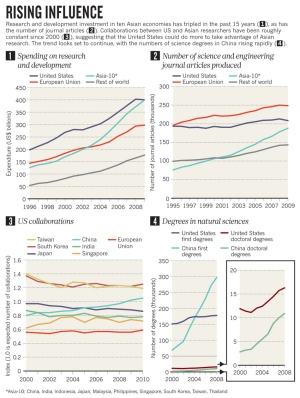
“Our country needs to worry about science and innovation when so much is being done out of the country. Long-term, this might be harmful to our competitiveness,” says Ray Bowen, chairman of the US National Science Board, which produced the report and oversees one of the US government’s main research funding agencies, the National Science Foundation (NSF). The report, released on 17 January, finds that by 2009, the combined research and development (R&D) investment from a group of ten Asian economies including China and India, had caught up with that of the United States (see ‘Rising influence’). “One hopes that the new data will help to reinforce the message that the US government (as well as industry) needs to keep R&D investments at the top of its priorities, despite current fiscal constraints,” says Claude Canizares, vice-president for research at the Massachusetts Institute of Technology in Cambridge.
To read more click...

Friday, December 16, 2011

The world’s largest plant producing high capacity lithium-ion batteries has been launched in Novosibirsk region

Engineerblogger
Dec 16, 2011

The world’s largest plant producing high capacity lithium-ion batteries has been launched in Novosibirsk region today. The plant belongs to the LIOTECH Company – a joint venture between Russian Corporation of Nanotechnologies (RUSNANO) and the International holding Thunder Sky Limited. The total investment in the project has amounted more than 13,5 billion rubles. The plant which overall area of production facility is over 40 000 sq. m. has been built in a record-breaking period, just in 9 months.

Alexey Homlyaskiy, the Deputy Governor of Novosibirsk Region, Anatoly Chubais, the Chairman the Board of RUSNANO, Alexander Erokhin, the CEO of LIOTECH LLC took part in the ceremony of opening of a new plant.

Using ecofriendly nanostructured cathode lithium – ferrum – phosphate material (LiFePO4), the LIOTECH Plant will output batteries with different nominal capacity: 200, 300 and 700 A*hr. As of today, this material allows to achieve the best performance of the batteries within the frame of their industrial manufacturing.

The planned capacity of new plant will amount over 1 GWh or about 1 mln. batteries per year. This enables to equip with the batteries about 5, 000 electric buses annually.

The LIOTECH lithium-ion batteries differ with high-power density, do not need secondary service and have a wide temperature range of usage. These characteristics enable us to use them widely in electrical transport, as well as in power industry as energy storage devices and uninterruptible power supplies. Moreover, after batteries have been used in electric transport, they still can be utilized as accumulators in power industry during 10-15 years more. Also, it is necessary to note that recycling of such a type of accumulators is completely safe for environment.

The fact that the LIOTECH LLC has already concluded delivery contracts for batteries before the manufacturing has been launched, emphasizes being in demand of a new product. One of the main consumers of new batteries in Russia will be the MOBEL LLC; 3 billion rubles contract has already been sighed with this company.

"The new plant is a successful example of foreign high-technologies’ transfer, allowing to create a modern manufacture, in which, after reaching full production capacity over 500 people will be employed. By implementing the program of import substitution, we will create a whole cluster of new high-tech manufacturing of related materials and components as well as an Engineering Center ", - emphasizes Sergey Polikarpov, RUSNANO Managing Director.

“Implementation of public electric vehicle equipped with lithium-ion batteries of our production will significantly improve the environment situation in large cities of Russia. Utilizing of batteries together with alternative energy sources will boost the development of "green technologies" and increase the energy efficiency of the economy of the Russian Federation. Russian Railway Company and Moscow underground rapid transport system, electricity supply network and power generation companies, military industrial enterprises as well as housing and communal services, telecommunication companies have already shown a great interest towards energy storage units of our batteries”, - notes LIOTECH CEO, Alexander Erokhin.

Source: Liotech

Thursday, December 8, 2011

Gates discussing new nuclear reactor with China

Engineerblogger
Dec 8, 2011

Microsoft Corp. co-founder Bill Gates speaks to the media after delivering a speech at the Ministry of Science and Technology in Beijing Wednesday, Dec. 7, 2011. Gates confirmed Wednesday he is in discussions with China to jointly develop a new kind of nuclear reactor. (AP Photo/Andy Wong)


Microsoft co-founder Bill Gates confirmed Wednesday he is in discussions with China to jointly develop a new and safer kind of nuclear reactor.

"The idea is to be very low cost, very safe and generate very little waste," said the billionaire during a talk at China's Ministry of Science and Technology.

Gates said he had largely funded a Washington state-based company, TerraPower, that is developing a Generation IV nuclear reactor that can run on depleted uranium. TerraPower says it has discussed its plans with India, Russia and other countries with nuclear energy programs.

The general manager of state-owned China National Nuclear Corporation, Sun Qin, was quoted in Chinese media last week saying Gates was working with it to research and develop a reactor.

"TerraPower is having very good discussions with CNNC and various people in the Chinese government," said Gates, cautioning the talks were at an early stage.

Gates says perhaps as much as a billion dollars will be put into research and development over the next five years.

TerraPower says its traveling wave reactor would run for decades on depleted uranium and produce significantly smaller amounts of nuclear waste than conventional reactors.

"All these new designs are going to be incredibly safe," Gates told the audience. "They require no human action to remain safe at all times."

He said they also benefit from an ability to simulate earthquake and tidal wave conditions. "It takes safety to a new level," he said.

Since leaving Microsoft Corp., Gates has concentrated on philanthropy and advocating on public health, education and clean energy issues. He is an investor and strategic adviser to TerraPower.

Gates was at the Ministry of Science and Technology to talk about a joint project between China and the Bill & Melinda Gates Foundation to support innovative research and development to help alleviate poverty.

Gates said the ministry will help identify entrepreneurs and companies to manufacture new products in global health and agriculture to "change the lives of poor people," including new vaccines and diagnostics and genetically modified seeds.

"China has a lot to contribute because it's solved many of the problems of poverty, not all of them but a lot of them, itself, and many Asian, south Asian and African countries are well behind, whether it's agriculture or health," said Gates.

No specific poverty alleviation projects were mentioned.

Source: The Associated Press

Friday, October 7, 2011

Automotive Manufacturing in China: Low-Cost Production Image Fades

Engineerblogger
Oct 07, 2011


Wage inflation is hitting the Chinese automotive manufacturing market, doubling in a recent seven-year period (and are expected to double again by 2015 based on 2010 levels) according to a recent WSJ analysis that considers the evolution of Hyundai's consideration of the Chinese market. Moreover, the wage and labor climate for foreign producers in China appears to underpin a double standard between domestic and state-owned enterprises and those owned or operated by outside interests.

In this regard, a Hyundai executive cited in the article "pointed to a series of high-profile labor strikes that hit Japanese-run auto factories and others in China last year. Normally quick to break up organized worker walkouts, the government tolerated those strikes to a large extent last year, and minimum wages in some parts of China have been rising steadily since." Of course don't think for a minute that rising wages will deter the export ambitions of Chinese automotive manufacturing organizations (both OEM and lower tier suppliers).

As anyone who has studied how China manipulates export prices via currency controls and other methods (e.g., VAT rebate changes and incentives), it is no surprise that, "China's auto exports will continue to increase in part because of excess auto-production capacity in the country," according to the story. After all, if there is not a large enough middle class to consume the voracious state-sponsored output within domestic automotive production in China, then of course we all know what that will mean for the rest of the world.

Given this broader climate, when it comes to building total cost models for manufacturing in the region or working with Chinese automotive suppliers, companies should plan for large degrees of uncertainty in their forecast models for 2012 and beyond. After all, it's hard to know what the landed price (domestic or export) will be when it's really only up to one organization that sets it -- the politburo. Remember, the standard laws of supply and demand don't apply in a mercantilist state that exists to preserve the status quo for its leaders.

Source: Spendmatters.com

Russia's solar potential

Engineerblogger
Oct 07, 2011


Russia is the biggest country in the world and one of biggest suppliers of oil and gas has not yet seen a real need to develop a market for solar technologies.

This might change during the next few years - says Tomasz Slusarz, CEO of Solar PV Consulting - observing the policy and market situation on the global markets for the past 8 years and comparing it to the current situation in Russia, he is confident that cumulative solar installed capacity in Russia can reach above 1 or even 2 GW by 2020. He is even ready to bet on it. Here are his three arguments to back the claim.

Argument 1: Growing energy demand

In 2009, the Russian Energy Agency was forecasting that 51.7 GW of capacity would be decommissioned by 2020, requiring more than 150 GW of new capacity to meet consumption growth during the current decade.

I also notice a growing understanding from Russian policy makers and the private sector that increased use of renewable energy technologies can help meet the growing demand.

The Energy Strategy of Russia has set a target of 4.5% for the installed renewable electricity generation by 2020 (including small hydro up to 25 MW), which means a requirement of 22 GW for the new installed capacity.

As there are no sectorial targets within the 4.5% target, theoretically, quasi whole renewable energy capacity can be built from small hydro, wind, biomass or geothermic sources. However, in my opinion, solar PV with its more and more competitive prices can become a quite an important piece of the 22 GW cake.

Increasingly competitive prices of solar PV generation will be confronted with rapidly growing electricity prices in the country. According to the 2010 Budget of the Russian Federation, in 2020 the average electricity tariffs for all users will reach a level of 10.5cents/kWh and residential tariffs 15.3cents/kWh, compared to today's 7cents/kWh.

Argument 2: Huge investments in production capacities

Russian solar industry and RUSNANO, a state-owned fund, have invested billions of dollars in new manufacturing facilities such as Hevel Solar (thin-film PV), and Nitol (large-scale polysilicon and monosilane manufacturing).

When looking at the increasingly competitive global solar markets, they realize the urgent need to establish a sustainable domestic market in order to help the Russian industry grow and be able to compete on export markets.

Few weeks ago we heard that Russia's North Caucasus region is about to set up its own Silicon Valley with a joint venture between the regional government and private businesses. The cost of the project would be around 1 billion USD with pre-estimated production volume of 12 billion USD per year, and 2 to 7 years of return on investments.

Polycrystalline silicon production would be located in Stavropol region, with monocrystalline silicon production set up in Kabardino-Balkaria. The final production of photovoltaic cells and solar modules would be located in Karachay-Cherkessia and Dagestan respectively.

I am quite sure that if the project is successful, a lot of modules will be installed not only in the region but also all over the country.

Argument 3: Russia - sunny country!

The technical potential of solar energy was estimated as 1.870 TWh, with an economic potential of around 101 GWh per year in the national report titled "Role of renewable energy sources in energy strategy of Russia".

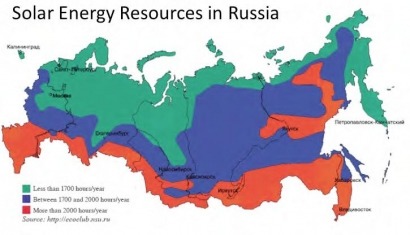
The southern parts of Russia, especially the North Caucasus, have the greatest potential for solar energy. The Krasnodar Region and most parts of Siberia have insolation levels comparable to the south of France and central Italy while the Zabaikalsky Region gets more solar energy than Spain.

Argument 4: Big giants start to understand that solar PV can be a good business

It is worth to mention that today not only Renova group of companies, one of the largest diversified business groups in Russia, understand that solar energy can be a profitable investment.

Renova is a major shareholder of Oerlikon and controlling shareholder of Avelar Energy Group as well as a shareholder of previously mentioned Hevel Solar. It has also recently established NAVI Capital Management, a fund that is going to invest 200 million dollars in clean-tech innovation with an important focus on solar PV.

Lukoil, a major Russian oil company, in partnership with the government of Uzbekistan and the Asian Development Bank, is planning to construct Uzbekistan's largest solar plant, which will have an initial capacity of 100 MW, to expand eventually to 1 GW. Earlier this year Lukoil started to build its first 4 million dollar solar plant in Bulgaria.

These examples show that a growing number of Russian giant companies, with available financial resources, feel that investing in solar energy can be a good business strategy.

Moreover, I have heard from many companies exhibiting at 26EUPVSEC that their booths were visited by representatives from some of the biggest energy companies in Russia, which were potentially interested in investing in solar parks in Italy, Greece or Bulgaria. I am quite sure that at the end of the day these big companies will strongly support the development of a domestic solar market.

Source: Solardaily.com

Additional Information:

Monday, October 3, 2011

Thinking Big: To meet Our Future Energy Demands

Engineerblogger
Oct 03, 2011

The world needs new energy resources—not only to offset the decline of our existing reserves but to support the rapid growth of emerging economies like those of China, India, Brazil, and Russia. The International Energy Agency estimates that resources yet to be developed or discovered could be needed to account for 50 percent of conventional oil production by 2035.

Discovering and unlocking those new resources will require a new generation of technology to be deployed at a global scale, and this technology must use existing infrastructure. That's not only a tough technical challenge but one accompanied by often overlooked challenges of industry culture.

Whether our innovation ecosystem can meet those challenges is an open question. The energy industry has a (perhaps undeserved) reputation for deploying innovations more slowly than others. Most important, it is not yet known whether the model of combining university research with venture capital—so successful in semiconductors and Internet services—will deliver real innovations in energy.

Part of the problem is that for energy technology to reach its full potential, it must be introduced, tested, and deployed at a scale attained only by major industry players invested in methods that already have a long track record. Conventional wisdom has it that those companies are not receptive to adopting new technology or working with emerging companies, but behind this reluctance are cultural differences that can be overcome. Working hard to master these differences has enabled our company to find experienced partners open to commercializing new technology.

The challenge stems from the fact that the skills required to raise venture capital and start a company are different from—sometimes contradictory to—the skills needed to partner successfully with a large energy company. The teams at startups working on energy innovation will need both sets of skills, and they need to know that the swagger that helps attract venture capitalists hurts more than it helps with people at the energy giants. These established players won't alter their existing methods without a high level of proof. To reach that point, energy entrepreneurs must patiently develop longer-term relationships with these companies.

The shale gas revolution illustrates that energy giants are quite capable of rapidly adopting new technologies that dramatically change the energy landscape. In just five years, the combination of horizontal drilling and hydraulic fracturing in unconventional shale resources has generated a surge in both proven reserves and production. Those techniques are being exported from Texas and Pennsylvania to the rest of the world.

Our vision is that future dramatic changes in energy resources will result when emerging companies connect with established players in an industry that has been the most competent in the world when it comes to deploying technologies at scale.

Source:  Technology Review

Tuesday, September 27, 2011

Building innovation in India

MIT News
Sept 26, 2011

Despite a global economic downturn that has rippled across India, the country remains one of the world’s fastest growing economies, second only to China. India is also the planet’s second most populous nation, expected to overtake China by 2030.

In the first ever MIT-India Conference, held Friday, Sept. 23, at the MIT Media Lab, speakers from both MIT and India explored the challenges associated with India’s rapid expansion, including energy distribution, rural access to health care, and efforts to curb governmental corruption. One theme was prevalent throughout: India’s many hurdles also provide unprecedented opportunity for innovation.

N.R. Narayana Murthy, the conference’s keynote speaker and founder and chairman emeritus of Infosys Limited, said the time is right for those who choose to work in India.

“They can be part of an era where there’s so much confidence, there is so much hope, there is so much ambition,” Murthy said. “And there is so much that needs to be done.”

The conference featured entrepreneurs, venture capitalists, finance experts and government officials from India, as well as MIT faculty working on India-related projects. The one-day event sought to strengthen the relationship between MIT and India, which MIT Chancellor Eric L. Grimson characterized at the event as a “century-long friendship.”

In his opening remarks, Grimson noted that the friendship began in 1906 when Ishwar Das Varshnei became the first Indian to graduate from MIT. In 2010, his great-grandsons, twins Kush and Lav, followed in his footsteps, earning PhDs in electrical engineering and computer science. Today, more than 270 students of Indian descent attend MIT; Grimson cited the Institute’s many India-related projects — fifteen of which were featured in a Technology Showcase during the conference — as a strong bridge between the Institute and India.

“If MIT wants to stay on the forefront of technology, it has to maintain ties with India,” Grimson said.

The conference got underway with a panel discussion on energy and the environment. Panelists noted that as India’s population continues to expand, so too will its energy demands.

E.A.S. Sarma, former secretary of economic affairs in India, cautioned that the country “can’t go in a wanton manner for megawatts.” Sarma, now a social activist working to protect rural communities from pollution created by local powerplants, insists that communities should have a say when it comes to building new plants.

“If you bring people into discussions from the start, they may help develop benign processes,” Sarma said.

However, Robert Stoner, associate director of the MIT Energy Initiative, pointed out that above and beyond meeting the energy needs of India’s projected population growth, nearly 400 million current citizens already lack access to electricity.

While panelists discussed the potential contributions of solar, natural gas and nuclear energy, the overall consensus was that it would take a combination of approaches to solve India’s energy problem. And in many cases, those solutions will have to be extremely affordable.

“There’s opportunity for low-cost innovation in lots of areas,” Stoner said.
To read more click here...

Friday, September 23, 2011

GE, GM in push on EV infrastructure for China

Engineerblogger
Sept 23, 2011

General Electric and General Motors Co. agreed Thursday on a pilot installation of electric vehicle charging stations in Shanghai, the latest step in the automaker's plan to develop infrastructure in China to support sales of its Chevrolet Volt electric car.

As part of the agreement, GE also agreed to buy the extended range electric cars for use at its corporate campus in Shanghai. GM plans to launch the Volt in December in China, where it has made electric vehicles a core part of its strategy for expansion despite doubts Chinese consumers will snap up such cars.

The companies gave no details about investment in the charging stations, which will include both GE's WattStations and Durastations, two different specifications for charging electric vehicles.

China is a linchpin market for GM. Earlier this week it announced plans for developing a new electric vehicle with its local partner Shanghai Automotive Industrial Corp. It also has just opened an advanced technology center to support its efforts to build more energy efficient and safer automobiles, with a lab devoted to developing new battery cells for EVs.

GE builds natural gas-fired generators for utilities, electric motors, advanced electric meters and electric car charging stations, all of which could be in higher demand if drivers buy electric cars. The company estimates the expanding market could bring it up to $500 million in revenue over the next three years.

China, the world's biggest market for new vehicles, is seen as a promising market for electric vehicles because of its keenness on limiting its dependence on costly imports of crude oil and reducing severe pollution from auto emissions.

The government has made development of so-called "new energy" vehicles a key part of its current five-year economic plan, promising subsidies and billions of dollars in new investments.

But spurring demand for electric and hybrid vehicles will hinge on providing the charging infrastructure, and bringing costs down to affordable levels, those working in the industry say.

Thursday's agreement calls for the two big U.S. companies to coordinate work with government agencies on developing EV standards.

In August, GE Energy also announced a partnership with car rental company Hertz Corp. for advancing the rollout of EVs and charging stations in China.

Source:  The Associated Press

Thursday, September 22, 2011

Graphene can be strengthened by folding

Engineerblogger
Sept 22, 2011

The researchers, Yongping Zheng and Zhigao Huang of Fujian Normal University in China; Ning Wei and Zheyong Fan of Xiamen University in China; and Lanqing Xu of both universities, have published their study in a recent issue of Nanotechnology.

“The results of this work provide a new route for tailoring the properties of graphene-based nanomaterials,” Zheng told PhysOrg.com. “Currently, many researchers and engineers are concerned with doping, alchemy, etc. We have demonstrated here that structure re-construction could also lead to interesting results.”

In their study, the researchers used molecular dynamics simulations to investigate grafold. They compared graphene with grafold in two areas: tension (the force that pulls the material apart) and compression (the force that pushes the material together). The ability to be both elongated and squeezed without damage is very helpful for engineering applications. However, as the researchers explain, graphene only has a high tensile strength; because of its two-dimensional nature, it is “soft” under compression and can’t be squeezed.

In contrast, the researchers’ simulations showed that grafold is “harder” than graphene and can withstand much larger amounts of compression (10-25 GPa depending on the structure of grafold compared with less than 2 GPa for graphene). While its compressive strength is significantly higher than that of graphene, grafold’s tensile strength approaches that of graphene. The Young’s modulus (a measure of elasticity) and fracture strain of grafold are a little lower than those of graphene. The scientists noted that several other materials can withstand greater compression than grafold, including carbon nanotubes, which can be both elongated and squeezed like grafold.

“As is well known, graphene can’t withstand any compression,” Zheng said. “Via folding, graphene transforms into grafold and can be compressed to a certain amount. Even when highly compressed, it won’t break down, just be squeezed into a shorter folded belt. Furthermore, the deformation is elastic. As we know, if the strength exceeds carbon nanotubes’ breaking point, it will crash and never return to its original form.”

Among grafold’s advantages is that folding a graphene nanoribbon to create grafold will be much easier than rolling it up to create a carbon nanotube. Plus, grafold’s mechanical properties can be tuned by the modifying the folding design, such as changing the size, shape, and number of folds.

Overall, the results of the simulations provide a new route for tailoring the properties of graphene-based nanomaterials, which could lead to advanced mechanical applications. The researchers hope to experimentally fabricate grafold in the near future. “There could be versatile applications,” Zheng said. “Say, one could utilize the elastic and low-to-mid stiffness of grafold in applications where a large damping is required.”

Source: Physorg.com

Additional Information:

Wednesday, September 21, 2011

GM expands technology investments in China

Engineerblogger
Sept 21, 2011

General Motors Co. says it is seeking to buy back a 1 percent stake sold to its main Chinese joint venture partner, as it expands its technology investments in a market where it is maneuvering to keep its edge.

The Detroit company opened an advanced technology center in Shanghai on Wednesday meant to help it design lighter, safer and more efficient cars for China, a market that has proved crucial to its survival.

The center opened a day after GM announced plans to develop a brand new electric vehicle "architecture" with flagship venture partner, Shanghai Automotive Industrial Corp.

While the China market has cooled considerably in recent months, following the expiration of tax incentives and subsidies meant to spur sales during the financial crisis, it remains the world's largest and fastest growing major market for sales of new vehicles.

GM expects total vehicle sales in China to grow by about 5 percent to 19 million units or just a bit higher, said GM China President Kevin Wale. Sales of passenger vehicles, excluding large buses, should grow by double-digits, he said, after jumping by a third last year to 13.7 million vehicles.

GM's own sales in China have risen 5.4 percent so far this year to 1.6 million units as of the end of August.

Wale confirmed GM is seeking to buy back a 1 percent stake in its originally 50-50 joint venture, Shanghai GM, that it sold to SAIC in 2009 for $84.5 million as it faced bankruptcy. That would end SAIC's majority control and allow GM to reclaim its equal share.

"We have a contractual right to buy that back. We are having discussions but we have nothing further we can add at this point," he said.

GM is adamant about its commitment to developing electric vehicles specifically for the China market. The next generation battery-driven vehicle to be developed with SAIC will be designed and made in China, the company says.

That would qualify the car for government subsidies, amounting to about $19,000 per car, that the imported Chevrolet Volt will not be eligible for after its planned launch in China in December. China also imposes hefty tariffs on imported vehicles.

Under the agreement with SAIC, the two companies will equally share the cost of developing a new all-electric vehicle, reducing GM's cost and risk.

The Detroit company denies that the agreement is linked to China's desire to acquire more advanced technology that its own automakers have yet to develop. The Volt can travel about 35 miles on battery power, and a gas-powered generator kicks in to run the car when the batteries are depleted. The generator technology eliminates anxiety over whether a driver will run out of electricity.

The Volt and the new car to be developed with SAIC are engineered for very different customers.

"This is more about making sure we have the right product for China," Wale said.

GM likewise recently agreed with Korean battery maker LG Group to design and engineer electric vehicles that may be marketed to other parts of the world, he noted.

Source: The Associated Press

Monday, September 5, 2011

Toyota to make key hybrid parts in China

AFP
Sept 4, 2011

Toyota Motor will manufacture the Prius hybrid and its key parts in China in a bid to boost sales in the world's largest car market, a company spokeswoman said Sunday.

This will mark the first time the Japanese automaker has produced key components such as motors and batteries for the petrol-electric hybrid in a facility outside Japan.

Toyota manufactured the second model of the Prius in China, with key components exported from Japan, but stopped the operation in 2009.

"The company has a business policy to expand sales of environmentally friendly cars in China," said Toyota spokeswoman Shiori Hashimoto, adding production of the car in the country had been approved by Chinese authorities.

The Nikkei business daily reported that production of the third Prius model is set to begin in China at 2012 at the earliest.

The Nikkei said that it will be a joint venture with China FAW Group Corp, a major Chinese automaker.

The car's major components will be produced at the company's research and development facility in Changshu, in eastern China, but the Toyota spokeswoman would not say where in China the car would be assembled.

Toyota would also not disclose which parts would be made in China.

Volkswagen and General Motors plan to produce environmentally friendly vehicles in China, but are reluctant to talk about local production of key parts due to concerns over technology leaks, the Nikkei said.


Related Articles:

Wednesday, August 24, 2011

China Tops 2011 Index Rankings for Renewable Energy

Renewable Energy World
Aug 23, 2011

Influential commentators in Japan, Germany, Russia, the US, China, Spain, Italy, Thailand, Yemen and numerous other nations have all weighed in on the need to de-emphasise nuclear and focus on renewables in the wake of the Japanese tsunami and nuclear disaster. So concludes the Ernst & Young 2011 All Renewables Index.

At the same time, recent unrest and the risk of further conflict in the Middle East and North Africa region have highlighted crucial issues around energy supply security and oil price volatility. European governments have slashed budgets and reduced feed-in tariffs (FiTs), causing solar cell prices to fall while solar manufacturers' margins are being squeezed due to rising silicon and other commodity costs.

RANKINGS OVERVIEW

China has climbed to its highest ever score in the Index, principally by diversifying its renewables portfolio through an increased focus on offshore wind and CSP.

While China surpassed the US to become the world's largest energy consumer in 2010, environmental targets set out in the 12th Five-Year Plan include an increase in the proportion of energy from non-fossil fuels to 11.3 percent by 2015, from the current 8.3 percent. To meet this target, China says it intends to build at least 70 GW of new wind farms and 5 GW of new solar farms.

According to the report, the latest statistics indicate that, in 2010, the China Development Bank (CDB) made around $35 billion in low-interest credit available to Chinese renewables companies. This compares with the $4 billion of grants and $16 billion in loan guarantees awarded to clean-tech companies in the US.

China overtook the US at the end of 2010 to become the world leader in wind power, having installed around 16 GW in 2010 or almost half of global installations - taking cumulative installed capacity to 42 GW. This is contrasted with an additional 5 GW installed in the US last year and a total of 40 GW.

However, China ranks second globally in terms of grid-connected capacity; more than a third of wind capacity had yet to be connected to the national grid at the end of 2010.
To read more click here...

Thursday, August 18, 2011

China Debuts a Drone at Robotics Show

Wall Street Journal
Aug 17, 2011

China made its debut this week at the world's largest robotics trade show when a Shenzhen-based firm showcased its F50, a small drone with a high-definition video camera that a company brochure billed as a tool for monitoring protests, or responding to building fires.

The appearance of AEE Technology Co.'s relatively small, short-range drone—about the size of a pizza pan—in the drone market underscores the burgeoning international competition in the market for unmanned aerial vehicles and military robots.

State-run and private Chinese companies have invested heavily in recent years in developing drones both for export and for China's military and domestic security needs.

Western defense officials and experts were taken by surprise in November, when at least 25 Chinese drone models were on display at an air show in south China. Several models were also shown at an exhibition of police and antiterrorism equipment in Beijing in May.

"The market for military robotics has gone global, and China is looking to be a major producer and exporter in that market, just like the U.S.," said P.W. Singer, the author of "Wired for War," a book about the revolution in military robotics.

Tuesday, July 26, 2011

Manufactured Goods Lead Surge in Indian Exports

New York Times
July 25, 2011

When Ranjit Date returned to India 20 years ago after earning a doctorate in robotics from an American university, he hoped to help automate factory assembly lines in his home country.

His company, Precision Automation and Robotics India, has done that. But more recently it has also begun selling robots to Western manufacturers like Caterpillar, Ford and Chrysler. This year, in fact, a third of Precision Automation’s sales will come from exports, up from almost nothing five years ago.

Mr. Date’s company is emblematic of a recent surge in exports of engineered and other sophisticated goods from India — a country perhaps better known for exports of skilled services like software outsourcing.

But in fact, Indian exports of goods are now nearly double exports of services, growing 37.5 percent, to $245.9 billion, in the 12 months that ended in March. Leading the way are high-value products like industrial machinery, automobiles and car parts, and refined petroleum products.

Indian exports are following a different path from that taken by other Asian countries like Japan, Korea and China. Those countries started by exporting products like garments and toys made by large numbers of low-paid, low-skilled workers, before moving to more sophisticated products like cars and industrial machinery.
To read more click here...

Monday, July 25, 2011

Location Matters in Manufacturing

Technology Review
July 24, 2011


The migration of manufacturing from the United States to Asia could be having a significant impact on which advanced technologies are commercialized. Specifically, there is evidence that the shift in manufacturing is curtailing the development of emerging technologies in areas such as optoelectronics and advanced materials for the automotive industry.

In studies with colleagues at MIT, Erica Fuchs, an assistant professor of engineering and public policy at Carnegie Mellon University in Pittsburgh, shows that the relocation of component manufacturing from the United States to East Asia in optoelectronics and to China in composite body parts for automobiles changed the economics of producing the technologies. The result in both cases is that emerging technologies developed in the United States were not economically viable to produce in the Asian countries because of differences in manufacturing practices. And Fuchs suspects similar effects are happening more generally as production shifts to the developing world. Location matters for "which products will be economically viable, which products countries will be most competitive in producing, and which products countries and companies globally are most likely to develop," she says.

The findings add to a growing awareness that manufacturing plays a critical role in driving innovation. Harvard Business School professors David Pisano and Willy Shih argue, for example, that innovation capacity often disappears if a country loses its manufacturing sector, because the knowledge and abilities needed to develop new technologies are often closely linked to the skills and expertise associated with manufacturing (see "Innovation Depends on a Robust Manufacturing Sector"). Fuchs builds on this idea by showing that regional manufacturing differences can cause the most advanced technologies to fall by the wayside. "Manufacturing locations can affect the evolution of technology globally," she says.
To read more click here...

Friday, July 22, 2011

China makes nuclear power breakthrough

AFP
July 22, 2011

China said Friday it had hooked its first so-called "fourth generation" nuclear reactor to the grid, a breakthrough that could eventually reduce its reliance on uranium imports

The experimental fast-neutron reactor is the result of more than 20 years of research and could also help minimise radioactive waste from nuclear energy, the state-run China Institute of Atomic Energy (CIAE) said.

China is the ninth country to develop a fast-neutron reactor, which uses uranium 60 times more efficiently than a normal reactor, helping the country to reduce its reliance on imports of the mineral.

Beijing has stepped up investment in nuclear power in an effort to slash its world-leading carbon emissions and scale down the country's heavy reliance on coal, which accounts for 70 percent of its energy needs.

But China's uranium reserves are limited, and it will have to import increasingly large amounts as its civilian nuclear programme gathers speed.

China -- the world's second largest economy -- currently has 14 nuclear reactors and is building more than two dozen others. It aims to get 15 percent of its power from renewable sources by 2020.

According to the World Nuclear Association, it aims to increase nuclear power capacity to 80 gigawatts by 2020 from 10.8 gigawatts in 2010.

The fourth-generation reactor, located just outside Beijing, has a capacity of just 20 megawatts. Other recently launched nuclear reactors in China had a capacity of more than one gigawatt, or 1,000 megawatts.

The latest technological step comes after China succeeded in reprocessing spent nuclear fuel in an experimental reactor in the northwestern province of Gansu in January.

Authorities said this would help extend the lifespan of proven uranium deposits to 3,000 years from the current forecast of 50-70 years.

Beijing has also pledged to improve emergency procedures and construction standards at its nuclear power plants, after Japan's devastating earthquake and ensuing tsunami triggered an atomic crisis.

Copyright © 2011 AFP

Friday, July 15, 2011

Nanostructures Could Result In Cheaper Electric-Car Batteries

Technology Review
July 12, 2011

A Beijing startup called Wuhe is making electrode materials and batteries that could lower the cost of electric vehicles. The company uses nanostructures for battery materials that, like other recent nanostructures, let the materials deliver the large bursts of power needed for acceleration while maintaining energy storage capacity. But the Wuhe advance also makes the materials easier to work with than similar electrode materials, and as a result, it could cut battery-cell manufacturing costs by 10 percent.

Battery packs are the most expensive item on electric cars such as the Tesla Roadster and the Nissan Leaf. The cost either makes electric cars too expensive for most people, or it prompts automakers to use small battery packs, which limits the range of the cars.

To reduce battery costs and improve their performance, Wuhe founder Yu-Guo Guo, a professor of chemistry at the Chinese Academy of Sciences in Beijing, has developed new, low-cost ways to improve the properties of lithium-iron phosphate, one of the leading lithium-ion battery electrode materials, and other promising electrode materials.

Ordinarily, the conductivity of lithium-iron phosphate is too low to be useful. The conductivity can be increased by milling it into extremely fine nanoscale powders—as companies such as A123 Systems do. Because the particles are small, electrons or lithium ions—both of which are necessary to create current—can move in and out of them quickly. But this powder is difficult to work with, which raises manufacturing costs.

Thursday, July 14, 2011

Industrial Robotics Market Opportunities in Russia

Robotic Industries Association
July 13, 2011

Spanning nine time zones and over 17 million square miles, Russia is not only the largest country in the world, geographically, but also the richest on a per capita basis of the so-called “BRIC” countries (Brazil, Russia, India and China). Its $1.465 trillion economy is forecast to grow at 4.5 percent this year, and industrial production and manufacturing continue to increase. (Last year industrial production grew 8.3 percent, and through the first four months of 2011 year-over-year growth has run 5.6 percent.) With economic indicators like these, what’s not to like about the Russian market?

These statistics become especially compelling, when you consider that the Russian economy is underserved by robotics with comparatively few companies with a major presence in this market. But this may soon change. Russia’s top leaders, including President Dmitry Medvedev and Prime Minister Putin, have acknowledged the need for economic modernization. If Russia is to compete globally and insure a level of national income largely independent of oil exports, it must deploy automation technologies such as robotics that enable the necessary cost efficiencies, productivity and product quality.

The size of the Russian economy, its performance, and the fact that it is generally underserved by automation companies suggest that it is an attractive target for robotics sales. But is it?

In a recent study entitled “Market Opportunities for Automation Companies in Russia, available free to RIA members and for sale to non-members in RIA’s online bookstore, RIA addressed this issue. For its analysis of the robotics market, the study considered not just the economy and robotic sales volumes but also the ins and outs of doing business in Russia. The picture that emerged from the study is of a country in great need of robotics technology but lacking in the basic underpinnings and protections of business that are taken for granted elsewhere. In short, while the Russian economy has made great strides in its transition from a centralized, publicly-owned economy, it still has a ways to go in creating fertile ground for businesses to flourish.
To read more click here...

Friday, July 8, 2011

University invents heat-regulating building material

The University of Nottingham Ningbo China (UNNC)
July 8, 2011

In a major scientific breakthrough with important long-term environmental consequences, researchers at The University of Nottingham Ningbo China (UNNC) have developed a material that will cut the amount of energy a building uses by more than one-third.

The material has the remarkable quality of being able to retain and release heat according to the specific temperature requirements for a building and will help dramatically reduce heating and cooling bills.

It has the unique advantage of possessing a larger energy storage capacity with faster thermal response than existing materials and could be cheaply manufactured.

If, for example, the required optimum temperature in a room is 22°C, the material can be fixed so that it starts absorbing any excess heat above that temperature.

The heat-regulating material can be used in existing buildings as well as during the construction of new real estate and could be applied anywhere, from walls and roofs to wallpaper.

The material looks like a circular tablet with the circumference of a large coin in the laboratory. It can be manufactured in a variety of shapes and sizes, including so small that it can be sprayed as an unobtrusive microscopic film to surfaces.

The building material was recently awarded a patent application approval in China, the University was in a position to announce this week, and patent applications are in the pipeline in other countries.

It was invented by researchers at the University’s Centre for Sustainable Energy Technologies.

The scientists responsible for the invention are: project leader Professor Jo Darkwa, who is Director of the Centre for Sustainable Energy Technologies; Research Associate Oliver Su; and, PhD student Tony Zhou.
To read more click here...

Exploiting China's Coal While It's Still Underground

Technology Review
July 8, 2011

China is pushing forward with a new strategy for expanding access to coal energy that could also reduce its environmental impact: turning coal into clean-burning gases in the ground.

At a U.K.-Chinese summit in Beijing late last month that included British prime minister David Cameron and Chinese premier Wen Jiabao, a $1.5-billion commercial partnership was launched to gasify six million tons of buried coal per year and generate 1,000 megawatts of power.

The project in Inner Mongolia's Yi He coal field is being advanced by the state-owned China Energy Conservation and Environmental Protection Group, and U.K.-basedSeamwell International, a newly formed developer of underground coal gasification (UCG) technology. It is the most high-profile of several such proposed projects in China. More than a dozen similar large-scale projects are under development in other countries, including the U.S., Canada, Australia, and Hungary.

UCG is promoted as a relatively clean method of exploiting coal seams that are too deep or thin to be tapped economically using conventional mining. Such seams in Inner Mongolia hold an estimated 280 billion tons, according to Seamwell. That's more than double the tonnage of recoverable coal in China recognized by the London-based World Energy Council. UCG can also generate electricity from coal with less air pollution, greenhouse gas emissions, and water consumption than existing coal-fired power plants.
To read more click here...