Pages

Subscribe:

Labels

038628037504 (1) 10150 (1) 10BURIED (1) 10Count (1) 110011040 (1) 115Ounce (1) 1200mg (1) 12BSN (1) 12Count (2) 12CountNutricor (1) 12CountWWSN (1) 12Fresh (1) 12Stacker (3) 12VPX (1) 140243 (1) 14Servings (1) 158Ounce (1) 15Ounce (1) 16Ounce (2) 1716 (1) 17Skque (1) 1lbinLife (1) 2000Hrs (1) 2000mg (1) 200Watt (1) 2021A (1) 20OunceNatures (1) 2412Ounce (1) 24Count (1) 24EAS59134 (1) 24FRS (1) 24Guru (1) 24Guru01GR124 (2) 24Nestle (2) 24Pediasure (2) 24Peptamen (1) 24PieceDisplay (1) 24Solis (2) 27ReSource (2) 2Biochem (1) 2Dynamic (1) 2Jarrow (1) 2Muscle (1) 2Natures (1) 2Ounce (3) 2Pound (1) 30Day (1) 328601 (1) 334928 (1) 336gOptimum (1) 37Ounce (1) 3Ensure (1) 3M (1) 414 (1) 432500 (1) 48Boost (1) 48Fluid (1) 48ml (1) 4Ensure (1) 4Isopure (1) 5000mg (1) 527408 (1) 5511786 (1) 574400 (1) 5Hour (2) 5Ounces (1) 600Kendall (1) 662380 (1) 6Beneprotein (1) 6Proteinex (1) 70951 (1) 750mlNutriPrima (1) 845Ounce (1) 84Fluid (2) 84OuncesLiquid (1) 89Inch (1) 8nuun (2) 8Ounce (7) 99369FR (1) ABB (3) Academy (1) ACCENTS (1) Acia162Ounces (1) Acsry (1) Active (2) Adapter (1) AdapterBattery (1) Advance (1) Advanced (1) Advantage (1) AdvantEdge (1) Africa (29) African (1) Agaricus (1) AiCoco (1) AIDSTrustex (1) Airbrush (1) Airbus (6) Aircraft (94) AISI (1) Ajmeras (1) Alchohol (1) Alertness (1) Alfalfa (2) Alive (1) Allergy (1) Allspice (8) Alpine (1) Alstom (2) Alternative (1) Amarillo (1) Amazing (3) Amazon (2) American (1) animal (11) Annual Reports (155) Antioxidant (1) Anwar Ibrahim (1) Apple (1) Applied Materials (1) Arrowroot (1) AshtonDrake (1) Asia (72) Assorted (1) Atkins (1) Audi (1) Australia (21) Automotive (250) Automotive Technology (183) Ayurvedic (1) BABIES (1) Babys (1) Bacopa (1) BagAtkins2627 (1) BagsTraditional (1) BagSun (1) Balanced (1) Ballard Power System (1) Banaba (2) Baram Dam (1) Baram Regatta (1) Bariatric (1) Barisan Nasional (2) Barisan Nasional Helps Penan (1) Barista (2) Barley (2) barsBiochem (1) Basement (1) BASF (2) Basics (1) Batu Lawi (1) Bayer (1) BEA1017OZ (1) Beachbody (1) Beaded (1) Beaumont (1) beautiful girl image (19) Beauty (2) Beneprotein (2) Berries (3) Berry (4) BerryLiving (1) Beverage (1) Bicycle (1) BioAstin (1) Biochem (4) Biofuel (12) Biogenesis (2) BlackBlender (1) Blend (1) Blender (4) Blueberry (1) BlueStereo (1) BMF (1) BMW (7) BMX (1) BN (1) Boeing (4) Bombardier (4) Book (1) Borneo (6) Bottle (8) BottleProStat (1) Bottles (15) BottleScivation (1) bottlesEnsure (2) BottlesMio (1) BoxChenille (1) BoxDarice140243 (1) BOXESAmerican (1) BoxesFRSPowder (1) BoxPremier (1) BP (2) Brands (1) Brands833667000102 (1) Brazil (10) Brazilian (1) Breeze (3) BrewersBarista (1) BRIC (118) Brikpaks (3) Brownie (1) Bruno Manser (1) Bruno Manser Fund (3) Bruno Manser Fund Fraud (1) Bruno Manser Fund Frauds (1) Bruno Manser Lies (2) BTL410400 (1) Bubbles (1) Burner (1) business (72) Butchers (1) Butter (1) Butterscotch (1) Cable (1) Cables (1) Calcium (2) California (1) Calorie (3) Camera (1) Canada (11) Candela (1) Canister (2) CanisterCLICK (1) Canisters (1) Canning (1) Capramilk (1) CapsSwanson (1) Capsule (5) Capsules (6) CapsulesEAS (1) Caraway (1) Cardio (1) Carnation (1) CaseEnsure (2) CaseNestle (2) Celebrity (22) CellularFactory (1) Celsius (1) Certification (28) Certified (2) Chameleon (1) Charger (1) Charter/Terms of Reference (27) CHEAP (135) Chenille (1) Cherry (1) CherryZydot (1) Chevron (1) Chewing (1) Chile (1) China (99) Chipotle (1) Chlorophyll (1) Chocolate (7) Chocolate8 (1) Choice (2) Cholesterol (1) Chrome (1) Chrysler (1) Chunho (1) Citrifolia (1) Citroen (1) Citroën (1) Citrus (2) Civil Service (1) CK Morris Associates (1) Clare Rewcastle Brown (2) Class (1) Classic (2) Clinical (1) CNST (1) Coenzyme (1) Coffee (4) Coffee11001105 (1) Coffee7DSC2B (1) Coffeehouse (1) Cold Fusion (1) Coldkicker (1) Collectable (1) Collection (1) Colored (1) Colors (1) Communications (14) Company (2) COMPLETE (4) Complex (1) Computer (1) Concentrate (1) Concentrated (1) Concepts645654 (1) Condoms (1) Container (7) CONTROL20BGSee (1) Corrections (3) CosMedix (1) count (1) countAmscan (1) CountMy (1) Crayola (3) Criminal (4) Cruiser (1) Crunch (1) Cytosport (2) Daimler (3) Dam (1) DAP (1) DAP Lies (1) Darice (1) DARPA (18) Dato Roland Sagah Wee Inn (1) Defence (60) Defense (61) Delight (2) description (1) Desert (7) Design (65) DESIGNER (3) Desktop (1) detail (1) Detroit (1) Development (1) Dexatrim (1) diameter (1) diameterGaming (1) Diecast (1) Dinosaur (1) DISCOUNT (4) Discover (1) Disney (1) Doctors (1) DoE (8) DolphinsSticky (1) DOMAGRON (1) Dow Corning Corp (2) DP9260 (1) DRA6329 (1) Dragon (1) Dressing (1) Drink (11) Drinkin (1) drinksNVE (1) Dupont (2) dv9657clSIBCORP (1) Dymatize (3) DYMMGV (1) DYNAMIC (5) EachHager (1) EADS (12) ecigs (1) Eco-Tourism (1) Economy (14) Education (1404) Electra (1) Electric Grid (1) Electrolyte (4) ELP3STSL (1) Endorush (1) Endurox (2) Energizing (1) Energy (540) English Article (20) Enhanced (1) Enhancer (1) Enlive (2) Ensure (12) Enterprise (1) Environment (170) Enzymatic (1) Eraser (1) ERECTION (1) Ergonomics (4) ESA (4) Espresso (1) Essence (2) Essentials (3) EssentialsHSE (1) ethnic group (1) Europe (201) Executive/External Ombuds (2) Extended (2) ExtenderBadger (1) Extension (1) Extern/Intern (20) Extract (5) Extreme (21) Factor (1) Factors (3) Fantastic (1) Fatigued (1) Faucet (1) feature (9) Featuring (1) Fellowes (1) Fillet (1) First Energy (6) Fitera (2) FlatScreen (1) Flavor (1) FlavorBeachbody (1) Focus28 (1) Ford Motors (7) Foreign NGOs (2) Forest (1) formula (5) Formulas (1) Forts (1) FORUM (1) Fragrance (1) France (12) Frappuccino (1) FreeHubner (1) French (2) Friday Poll (13) Frontier (1) Frost (1) Fruits (1) Ft1140Alessco (1) Ft132Alessco (1) FToys (1) Fudge (1) Fuel Cell (26) Fujitsu (2) funny (19) Gadget (6) Galleries (1) Gallon (1) GameJax2000 (1) Games (1) General Electric (21) General Motors (15) Genesis (1) Georges (1) Germany (28) Go02658 (1) Golden (1) Goldfinch (2) Goodyear (1) Google (6) Gordoni (1) Gourmet (1) Government (333) Grape (2) Grape5 (1) Green Energy (544) Greens (2) GripAlex (1) Ground (7) Guarana (1) Halal Hub (1) Hammer (1) Hardware (1) Hasbro (1) Hawaiian (1) health (19) Health Care (87) Healthy (4) Herbal (5) Herbals (1) Himalayan (1) Holiday (1) Honda (4) Honeywell (1) Hoodia (1) HPCompaq (1) Hubner (1) human capital development (1) Humor (18) Hydration (2) hydration8PKNUUNLL (1) Hydrive (1) Hyundai (2) IBM (2) Illegal Demonstrations (1) iMicro (1) IMMICRP (1) India (23) information (8) Infrastructure (44) inLife (1) Inside Invester Ltd (1) Instantized (1) Institute (1) International (338) Internet (7) Intestinal (2) Investment (187) IOA News (168) ISO (1) ISO100 (1) Isolate (2) Isopure (4) Isotonix (1) Italian (2) Italy (1) Jabatan Penerangan (1) Jameson Ahip Nawie (1) Japan (57) JarALTERNATIVE (1) JarDoctors (1) Jarrow (1) Job Postings (339) Johnson Controls (1) Journey (2) Juice (2) JUICECRANBERRYOG2 (1) JuiceTahitian (1) Kangmei (1) KCups (1) Kerlix (1) Kettler (1) Kettler8852600 (1) Keurig (1) Keyboard (1) Kiddio (1) KitBerg (1) KiteSpiderMan (1) KitGoldfinch (1) Kombucha (2) KombuchaKIT (1) Kraft911501 (1) Kuching (1) Laboratories (1) Langnickel (1) LaptopNotebook (1) lbBioGenesisRICE3 (1) lbsNatural (1) Leading Indicators (450) Lean (10) LeapFrog (3) Learning (1) Leaves (2) Leccino (1) Legislation (65) Lemonade (2) Lemonlime (1) Len Talif (1) License (1) Lifetime (2) Light (1) LightHog (1) LINERBLADDER (1) Liquid (20) LiquidDeSouzas (1) Litigation (45) Living (2) Lockheed Martin (6) Looking (1) Lubricants (1) Lubricated (1) Macbook (1) Malaysia (4) MaleFemale (1) Management (16) Manufacturing (394) Marine Technology (2) Materials (446) Mazda (2) Medical (84) Medicinals (1) MEGAWING (1) Mental (1) Mercedes-Benz (3) Merdeka (2) Metabolic (1) MetaboLife (1) Metallic (1) Metamucil (1) MetersCables (1) Middle East (16) Miniatures (1) MioEnergy (1) Miradent (1) Miri (1) MIRROR (1) Mitsubishi (4) Monkey (2) Monster (1) Morinda (1) Morton (1) Mosacis (1) Mosaics (1) Mothers (1) MountScotty245 (1) MultiPackCELSIUS (1) MultiPackDYNAMIC (2) MultiPackLILY (1) MultiPackLIQUID (1) MultiPackMACA (1) MultiPackONLY (1) Multiracial (1) Mulu (1) Muscle (1) Muscletech (2) Myoplex (1) Nanotechnology (279) NASA (22) National Laboratory (46) Natural (12) natural phenomena (11) Naturally (1) Naturals (3) Natures (6) Naturessunshine (4) nc8000 (1) nc8220 (1) nc8230 (1) Nesting (1) Nestle (2) Netbook (1) New Programs (133) New Zealand (2) NGO's (213) NGOs (1) Nickel Hydrogen (1) Nissan (8) NIST (5) North America (18) Northrop Grumman (1) Norway (1) NovoAndina (2) Noxide (1) NREL (8) NSF (3) NTT Data (1) Nuclear (45) Numbers (1) Nuspeed (1) Nutrex (1) Nutricor (1) Nutrient (2) Nutrients (1) NutriPrima (1) Nutrition (15) Nutritional (5) NutritionON45 (1) nw8000 (1) nw8240 (1) Offshore (7) OilsAWM (1) OintmentWounded (1) Olives (1) Onshore (2) Optical Technology (28) Optimum (4) Optisource (2) Orang Ulu (1) Orange (7) OrangeHigh5 (1) Organic (12) Original (2) Other Ombuds (145) Otomotif (2) ounce (1) Ounces (5) OuncesSea (1) OunceThe (1) Outside the Standards (62) Oxford Business Group (1) OyToys (1) OzAfrican (1) ozNatures (1) Packages (1) Packet (1) Packets (1) PacketsNatures (1) PacketsUltima (1) Packs (2) PackStarbucks (1) PadCrayola (1) Paradise (1) Parazyme (1) Parents (1) Parmigiani (1) Pavilion (1) Pecan (1) Pediasure (3) Pehin Sri Haji Abdul Taib Mahmud (1) Penan (9) Pepper (1) Peppermint (1) Peptamen (1) Peter Jaban (2) Pharma (1) Pharmaceuticals (1) Phillips (1) Pickling (1) Pieces (1) PineappleGU (1) PinkBlender (2) PKR (1) PlantBased (1) Plantiva (1) Plastic (8) PN0223 (1) Pomegranate (1) PomegranateGU (1) Porsche (1) PostCXDNSR105 (1) Poundlb (1) Pounds (1) PoundsClif (1) Powder (20) Powdered (1) PowderEndurox (1) PP1235BBS (1) Practice Pointers (185) Prebio (1) PregNatal (1) Premier (1) Premium (3) preservatives (1) Preston (1) Private Sector (174) Proasis (1) Products (2) Professional Devt. (254) Profiles (257) Projector (1) Proscience (1) ProStat (2) protein (14) Proteinex (1) Protidiet (1) Proxima (1) Pudding (1) Punch (1) Purpose (1) Puzzle (1) R. Palan and Sabariah Putit (1) R4Lemon (1) Rail (41) RAINBOW (1) Rainforest (2) Raspberry (1) REA6048 (1) ReadytoDrink (1) Reaper (1) Recovery (2) Regional Events (101) Regular (2) Release (2) Remedies (1) REMEDIES4582008 (1) Replacement (2) Replenisher (3) ReplenisherUltima (1) Research (1) Research and Development (825) ReSource (4) Results (1) Revitalization (1) Roasted (1) Robotic Technology (124) Rocket (2) Rolls royce (7) Rooibos (1) Rosemary (1) ROSSLARE (1) Russell (1) Russia (17) Safety (15) Sains (20) SaltFree (1) Samalaju (4) Sammons (1) Samsung (1) Sarawak (13) Sarawak 10th State Election (1) Sarawak Borneo (7) Sarawak Budget 2012 (1) Sarawak Corridor of Renewable Energy (SCORE) (8) Sarawak Development (1) Sarawak Economics (1) Sarawak Economy (6) Sarawak ethnic groups (1) Sarawak Forest Corporation (2) Sarawak Politics (4) Sarawak Rainforest (2) Sarawakian (7) Satellite (6) Saudi Aramco (1) ScaledStar (1) Scholarly Articles/Research (102) science (50) Scivation (1) ScottishPower Renewables (1) Scotty (1) Seasoning (1) SEB (1) Secura (1) Seks (12) Senior Citizens (1) Series (1) serving (2) Servings (2) servingsBariatric (1) Shades (1) shake (4) Shaker (1) SHEETSHygloss (1) Shell (1) ShotCL27752 (1) Siemens (8) Silicone (1) Silver (1) Singapore (2) Single (1) Sleeve (1) SlimFast (1) Slimming (1) SlimStyles (1) SM005Grey (1) Smart (1) smartphone (1) Smoke (1) Smoothie (2) Smore (1) SoftCarpets (2) Softgels (1) Sony (1) Souffle (1) Source (2) South Africa (11) South America (11) South Korea (1) Space Technology (69) Sparkling (1) SpiderMan (1) Sponge (1) SpongeSammons (1) Sport (8) Sports (7) Springtime (1) Stacker (4) Starbucks (1) Starwest (2) Stems (1) Stereo (1) Sterile (1) Sticker (1) Sticky (1) Stomach (2) Strawberry (3) Strength (3) Strive (1) SumoMESUMO66897 (1) Sundries (5) Sunkist (1) Sunwarrior (1) SuperGreens (1) Supplement (4) Supplier (1) supply (3) Support (4) Supreme (2) Sustainable Forest Management Policy (2) Switzerland (2) System (3) Tablet (2) Tablets (3) TabletsTwinlab (1) Tahatian (1) Tahitian (1) Taib Mahmud (6) Taisho (1) Tanjung Manis (1) Tanjung Manis Halal Hub (1) Tartar (2) Tata (4) Tattoos (1) Technology (562) Temporary (2) Temptations (1) Tesla (1) Testors (1) Thalgo (1) The Report 2011 (1) Therapeutic (1) TinTea (1) Tips (25) Tokuyama (1) Topical (1) totalBoost (1) Toyota (15) Toys21030000 (1) ToyTote (1) Transitions (255) Transphorm (1) Transport (135) TREASURE (1) TrikeKiddio (1) Tropical (2) Trumans (1) Trustex (1) Tubes30 (1) Twinlab (2) Twistables (1) Two Hats (2) Uganda (1) UK (107) Ulticare (1) Ultima (3) Ultimate (1) Ulu Baram (1) Unflavored (1) Unibody (1) Unique (53) United States (281) University (1) Unknown (1) Uranium (1) USDA (1) Vale (1) Vanilla (10) Vanilla8 (1) Varcho (1) Variety (3) VegCap (3) Vehicle (1) Video (30) Viennese (1) Visitor Advice (70) VIT033 (1) Vitacost (5) Vitalyte (1) Volkswagen (5) Volvo (2) VTL200CIR (1) Warrior (3) WarsATST (1) Water resources (1) Water Technology (28) Watermelon (1) Wedding (1) Weight (2) Whole (2) Wild10650 (1) Wooden (1) World news (67) Worldwide (1) Wounded (1) Xtend (1) Xtreme (1) Xylitol (1) ZeroCherry (1) ZipFizz (1) ZoomOxo4113600 (1) ZZP88103 (1)

Showing posts with label UK. Show all posts

Thursday, March 8, 2012

Fuel cell technology could be under your car bonnet by 2017

Engineerblogger
March 8, 2012


Credit: Carbon Trust

Carbon Trust has given a £1m boost to four UK fuel cell pioneers. Their cutting-edge technology could be used under the bonnet of mass-produced hydrogen-powered cars as early as 2017. Major manufacturers have already built hydrogen-powered fuel cell cars, but the real challenge is to bring down the costs and, in the global race to do this, UK technologies are now in pole position.

Having identified an opportunity to combine innovative technology from Runcorn-based ACAL Energy and Sheffield-based ITM Power, the Carbon Trust is providing £500k of funding to the companies to develop a new hybrid high-power, low-cost fuel cell design.

Carbon Trust is also backing a project based at Imperial College London (Imperial) and University College London (UCL) with £500k to develop a fuel cell that could offer significant cost savings by using existing high-volume manufacturing techniques employed in the production of printed circuit boards.

The funding comes from the Carbon Trust’s Polymer Fuel Cells Challenge (PFCC) which was launched in 2009 to support the Department for Energy and Climate Change’s objectives to develop lower cost fuel cells and coincides with the recent launch of the Government’s UKH2Mobility project to ensure the UK is well positioned for the commercial roll-out of hydrogen fuel cell vehicles.

Dr Ben Graziano, Technology Commercialisation Manager at the Carbon Trust, said:

“The UK’s home-grown automotive industry hasn’t been the runaway success story many would have hoped for, but British technology is in pole position to be under the bonnet of a next generation of mass-produced hydrogen-powered cars. After a lot of hype, fuel cell technology is now a great growth opportunity for the UK. The funding that we have received from the Department for Energy and Climate Change has enabled us to support the development of some truly world-class British technologies that could slash the costs of fuel cells and transform how we all get about; by 2017 British fuel cell technologies could be powering your car.”

Simon Bourne, CTO, ITM Power Plc, said:

“The PFCC has afforded ITM the opportunity to build on its ground breaking laboratory results via a structured programme to de-risk its membrane technology. With the high level introductions the Carbon Trust has made with commercial end users and the continued success of subsequent material evaluation studies, ITM is in a very strong position to exploit this exciting new fuel cell technology.”

Amanda Lyne, VP of Strategic Business Development and Marketing, ACAL Energy Ltd said:

"It is excellent news that automotive OEMs are committed to the launch of hydrogen fuel cell electric vehicles in 2015 timescales, and that the UK will be among the early adopters. However it is clear that continuous efforts to reduce cost will be necessary to ensure that H2FC vehicles are affordable for mass markets. This funding from the Carbon Trust PFCC is perfectly targeted to ensure that British innovation can be at the forefront of the process to get the economics of the technology right."

Carbon Trust’s Polymer Fuel Cells Challenge aims to speed the UK towards world-beating fuel cell solutions that can grab a significant share of a market that the Carbon Trust has estimated to be worth $26bn in 2020. About the projects:

ACAL Energy/ITM Power

Carbon Trust, which has already supported ACAL Energy and ITM Power in de-risking their unique technologies, saw an opportunity to combine these innovations to demonstrate a fuel cell that could be far cheaper to manufacture, more efficient, produce the required power and be compact enough to fit under the bonnet of tomorrow’s cars. ACAL Energy brings a revolutionary new design of fuel cell inspired by the human lung and bloodstream that is highly durable, virtually platinum-free and also significantly cheaper to produce. ITM Power brings a unique membrane technology (which has been evaluated by several global companies), proven to produce world-beating power density (widely recognised as the single most important factor in reducing fuel cell costs), which could be in fuel cell cars by as early as 2017.

ITM’s current order book for delivery in the current financial year is £0.5m. The company has recruited seven staff in the last 12 months and is currently seeking to recruit ten more. ACAL Energy has raised £6.1m of investment since March 2010 and its staff is set to increase from 25 at that time to 35 by April 2012.

Imperial/UCL

The Imperial and UCL project is developing a fuel cell stack that could offer significant cost savings by using existing high-volume manufacturing techniques employed in the production of printed circuit boards. By simplifying the design and manufacture, this could reduce the costs of a fuel cell stack by more than 20%. Imperial Innovations and UCL Business are collaborating with the project to assist commercialisation of the technology.

Source:  Carbon Trust

Related Information:

Thursday, March 1, 2012

National Grid, Advanced Plasma Power and Progressive Energy announce new project to transform waste into Bio Substitute Natural Gas

Engineerblogger
March 1, 2012


Project will deliver an end-to-end process for converting waste to Bio-SNG, using Gasplasma® technology

The first pilot project that demonstrates the use of waste to produce bio-substitute natural gas (Bio-SNG) has today been announced by National Grid, Advanced Plasma Power and Progressive Energy.

The project, which uses waste as a feedstock to produce Bio-SNG, will be based at the Advanced Plasma Power Gasplasma® facility in Swindon, UK. It will demonstrate the technical feasibility and commercial viability of the waste to Bio-SNG process. The three partners will work together to design, install and test the operation of a demonstration plant.

The plant will take the waste-derived and energy rich synthesis gas from the existing Gasplasma® process, and convert it to meet the specification for injecting it into the gas network. Bio-SNG could play a crucial role in the decarbonisation of heating and help reach the UK's binding carbon reduction targets. As part of its work on future energy scenarios, National Grid has forecast that renewable gas could be a vital part of the energy mix in the coming decades.


APP’s process converts commercial waste into high-quality syngas, which can then be converted into methane. Credit: APP

Marcus Stewart, Future Distribution Networks Manager at National Grid said, “This project is a great opportunity to look at the potential of Bio-SNG from both a technical and commercial perspective. The project underlines our commitment to seeking economic and innovative ways to decarbonise energy, while making the best use of the existing network. ”

It is estimated that renewable gas, of which Bio-SNG may be a major source, could account for as much as one fifth of the UK’s heat requirement by 2050.

Rolf Stein, Chief Executive, Advanced Plasma Power said, “The development and implementation of a process to derive Bio-SNG from waste using our unique Gasplasma® process has significant global implications for sustainable waste management and low carbon energy solutions. We look forward to demonstrating the process on our plant in Swindon.”

Phillip Cozens, Progressive Energy said, “"This project is a significant step towards greater resource efficiency in our economy, exploiting the capacity of the existing gas infrastructure and demonstrating the potential to deliver renewable heat at a cost that is competitive with other renewable heat options. The partnership has put together a strong project execution team to deliver a practical demonstration of Bio-SNG production from residual wastes. Successful demonstration would provide a blue-print for general deployment.”

National Grid:
National Grid is an electricity and gas company that connects consumers to energy sources through its networks. The company is at the heart of one of the greatest challenges facing our society - to create new, sustainable energy solutions for the future and developing an energy system that underpins economic prosperity in the 21st century. National Grid holds a vital position at the centre of the energy system and we ‘join everything up’. In Britain, we run the gas and electricity systems that our society is built on, delivering gas and electricity across the country. In the North Eastern US, we connect more than seven million gas and electric customers to vital energy sources, essential for our modern lifestyles.

Advanced Plasma Power:
Advanced Plasma Power Limited (APP) is a leading technology provider for advanced waste to energy plants, showcasing its globally patented Gasplasma® technology. After the removal of valuable recyclates, the Gasplasma® process treats a wide range of feedstocks including residual municipal solid waste and commercial/industrial waste converting it all into two high value outputs: a clean, high quality, energy rich synthesis gas (syngas) and a solid, vitrified product each with multiple applications. The syngas can be used to generate electricity directly in gas engines, gas turbines and fuel cells or it can be converted to Bio-SNG or liquid fuels. The solid product, Plasmarok®, has a variety of valuable end uses, for instance, as a building material. The process is clean, modular and scalable, delivering high efficiency and maximising landfill diversion whilst minimising visual and environmental impact.

Progressive Energy:
Progressive Energy is a market leading project development company, specialising in clean energy and carbon abatement in the energy sector through the deployment of carbon capture and storage and renewable energy technologies. 

Source: National Grid

Composite plastics have high conductivity and strength

Engineerblogger
March 1, 2012


A London-based start-up company has created composite plastics with both high conductivity and tensile strength.

The material, which can be made into fibres or sheets, could find a use in strain monitoring and has already been tested to this end in the sails of high-end yachts competing in the Americas Cup.

Conductive polymers have existed for some time, but are generally made from exotic semi-conducting organics, and restricted to organic solar cells, printing electronic circuits, and organic light-emitting diodes.

A team at NanoForce, a spin-off from Queen Mary University of London, set about creating robust plastics that could conduct at near-metallic levels.

‘You can just use normal polypropylene or polyamide, so they’re much more stable than these fancy semi-conducting polymers,’ Ton Peijs, technical director, told The Engineer.

The team uses additive multi-walled carbon nanotubes at a weight percentage of around one per cent. In isolation, the nanotubes show excellent metallic conduction, but the challenge has been to incorporate them into composites.

‘If I want to make a conductive polymer composite I need to mix in these nanoparticles and you don’t want them to be all agglomerated here and all agglomerated there because then they are too far apart and never form a network — but if they are all perfectly and evenly dispersed, then they are also quite far apart,’ Peijs said.

NanoForce’s solution was a post-processing technique that involves annealing and hot pressing — basically re-melting the polymer after extrusion — allowing the nanotubes to migrate into a self-organising ‘dynamic network’ that is conductive. The process can be tuned by temperature and time of annealing, and can also align the polymer units to increase the strength.

Crucially, when the resulting fibre or sheet is stretched and placed under strain, the nanotube networks that has been in place previously gets pulled apart and deforms, breaking down the connections and creating electrical resistance of several orders of magnitude. This is particularly useful for in situ monitoring of strain in various critical structures.

Indeed, NanoForce has recently done some work with North Sails for certain teams competing in the Americas Cup yacht competition.

‘It’s sort of the Formula One of sailing — actually they spend more than than Formula One — and they do a lot of analysis,’ Peijs said. ‘Using our technology they could analyse the load in the sails, what are the local strains… then, of course, you can optimise performances.’

Applied as a thin-film layer it could also be used for condition monitoring in the aerospace industry and wind turbines, for example.

Source: The Engineer

Wednesday, February 29, 2012

New laser can point the way to new energy harvesting

Engineerblogger
Feb 29, 2012


Ismael Heisler next to a diffractive optic polarisation spectrometer. Credit: EPRSC


New ultrafast laser equipment, capable of generating intense pulses of light as short as a few femtoseconds from the UV to the Infra Red, will help scientists at the University of East Anglia (UEA) measure how energy is transferred from molecule to molecule and point the way to molecular structures for exploiting solar radiation.

Funded by a £466,000 grant from the Engineering and Physical Sciences Research Council, the new laser will be used for 2D electronic spectroscopy experiments that look at the very fastest reactions. By studying how energy transfers in natural and artificial systems such as proteins and molecular materials, researchers will in turn be able to help the design of new nanomachines and solar power collectors.

Steve Meech, Professor of Chemistry at UEA’s said:

"With this equipment we will be able to develop experiments which probe in exquisite detail the link between the efficiency of light driven processes in natural and synthetic systems and the underlying molecular architecture."

2D electronic spectroscopy is in many ways analogous to the much better known 2D Nuclear Magnetic Resonance method. It uses ultra fast visible light pulses to reveal coupling between electronic states whereas NMR uses radio frequency pulses to measure couplings between nuclear spins.

Twenty years ago most ultrafast experiments relied upon amplified dye lasers. These difficult to use and unstable devices severely limited the range of experiments possible. Starting with the discovery of the Titanium Sapphire laser, a whole new family of experiments became possible.

"It is because of the amazing stability and reliability of these modern devices that we can even consider 2D optical experiments, which may take days to run", added Meech.

Lesley Thompson, EPSRC’s Director of Research Base, said:

"The grant for equipment made by our strategic equipment panel will give UEA the tools they need, but EPSRC has also allocated a further £613,000 for staff and collaborations to drive this research forward."

The announcement coincides with the inaugural lecture by Professor Alf Adams at the Royal Society in London, to mark the 25th anniversary of his work on strained quantum well lasers, recently named as one of the Top Ten greatest UK scientific breakthroughs of all time.

The lecture, entitled Semiconductor Lasers TakeThe Strain, is the first in a series named in his honour.

Source: Engineering and Physical Sciences Research Council (EPSRC)

Monday, February 27, 2012

How to measure solar cell efficiency correctly

Engineerblogger
Feb 29, 2012


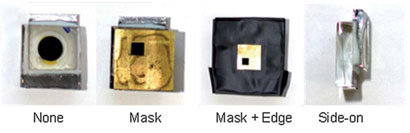
Photographs of liquid electrolyte-based dye-sensitised solar cells with different masking configurations, including no mask and set on its side. The active area of None is taken to be the area of the screen printed dye-sensitised TiO2 dot, Mask and Mask + Edge are taken to be the area of the square mask aperture and Side-on is the same as None

The significance of new solar cell technologies tends to rest heavily on their measured efficiency. But compounding small mistakes in measuring that efficiency can lead to values up to five times higher than the true reading, says Henry Snaith from the University of Oxford, UK.

Snaith has therefore set out a guide that illustrates the factors that should be taken into consideration when measuring efficiency, and outlines the potential sources of error. It is an attempt to restore confidence in literature claims and make them more easily comparable - both within fields and across different types of cells including dye-sensitised solar cells (DSSCs), organic photovoltaics and hybrid solar cells. The guidance includes how to mask cells to get an accurate measure of the test area; the type of lamps to use and how to calibrate them; and the importance of positioning the cell in exactly the same place as the calibration reference.

'There's an ongoing stream of papers in which it's not entirely clear exactly how the measurements have been made,' says Snaith. And worse than that, some papers claim values that appear to be grossly overinflated. That has an impact on genuine claims, Snaith explains. 'If, for example, someone claims their hybrid solar cell has an efficiency of 4% when it's really more like 1%, that makes it problematic for someone else to write an exciting paper when they've genuinely improved something to 1.5%.'

However, Snaith is quick to point out that his intention is not to point the finger of blame. 'The field has grown rapidly, so there are a lot of people coming in - without much device experience - who want to be able to make a solar cell and test it to see if their systems have made improvements,' he adds. This influx brings new ideas and approaches, which is definitely to be encouraged. Unfortunately, there are some easy-to-make mistakes that can have drastic effects on measurements. 'There's nothing particularly new or complex in the paper - the idea is to provide a clear protocol for how to get a value that accurately reflects the efficiency of the solar cell, and to point out the common pitfalls that can occur.'

Nicolas Tétreault, who develops DSSCs at the Swiss Federal Polytechnic School in Lausanne, agrees that having a single reference point for best practice will be very useful, especially one showing the possibility of such huge variations and illustrating how they relate to what's going on in the cell. 'One of the benefits of showing these extremes is that it shows that the consequence of not doing it correctly can introduce errors that border on cheating!' Tétreault adds that accurate measurements are even more important when trying to claim a new efficiency record. Snaith agrees, although in that case, he says, measurements should be independently certified by one of the national laboratories such as the US National Renewable Energy Laboratory.

Source: Royal Society of Chemistry - Chemistry World


Additional Information:

Saturday, February 25, 2012

Aircraft of the future could capture and re-use some of their own power

Engineerblogger
Feb 25, 2012


Credit: Lincoln University

Tomorrow's aircraft could contribute to their power needs by harnessing energy from the wheel rotation of their landing gear to generate electricity, according to research by the University of Lincoln.

Planes could use this to power their taxiing to and from airport buildings, reducing the need to use their jet engines. This would save on aviation fuel, cut emissions and reduce noise pollution at airports.

The feasibility of this has been confirmed by a team of engineers from the University of Lincoln with funding from the Engineering and Physical Sciences Research Council (EPSRC).

The energy produced by a plane's braking system during landing – currently wasted as heat produced by friction in the aircraft's disc brakes - would be captured and converted into electricity by motor-generators built into the landing gear. The electricity would then be stored and supplied to the in-hub motors in the wheels of the plane when it needed to taxi.

'Engine-less taxiing' could therefore become a reality. ACARE (the Advisory Council for Aeronautics Research in Europe) has made engine-less taxiing one of the key objectives beyond 2020 for the European aviation industry.

"Taxiing is a highly fuel-inefficient part of any trip by plane with emissions and noise pollution caused by jet engines being a huge issue for airports all over the world," said Professor Paul Stewart, who led the research.
"If the next generation of aircraft that emerges over the next 15 to 20 years could incorporate this kind of technology, it would deliver enormous benefits, especially for people living near airports. Currently, commercial aircraft spend a lot of time on the ground with their noisy jet engines running. In the future this technology could significantly reduce the need to do that."

The University of Lincoln's research formed part of a project that aimed to assess the basic feasibility of as many ways of capturing energy from a landing aircraft as possible.

"When an Airbus 320 lands, for example, a combination of its weight and speed gives it around three megawatts peak available power," Professor Stewart explained. "We explored a wide variety of ways of harnessing that energy, such as generating electricity from the interaction between copper coils embedded in the runway and magnets attached to the underside of the aircraft, and then feeding the power produced into the local electricity grid."

Unfortunately, most of the ideas weren't technically feasible or simply wouldn't be cost-effective. But the study showed that capturing energy direct from a plane's landing gear and recycling it for the aircraft's own use really could work, particularly if integrated with new technologies emerging from current research related to the more-electric or all-electric aircraft.

A number of technical challenges would need to be overcome. For example, weight would be a key issue, so a way of minimising the amount of conductors and electronic power converters used in an on-board energy recovery system would need to be identified.

The project was carried out under the auspices of the EPSRC-funded Airport Energy Technologies Network (AETN) established in 2008 to undertake low-carbon research in the field of aviation, and was undertaken in collaboration with researchers at the University of Loughborough.

Source: Lincoln University

Tuesday, February 21, 2012

New carbon fibre polymer pipe will recover hydrocarbons from the most challenging offshore fields

Engineerblogger
Feb 21, 2012


Alumni Charles Tavner (left) and Ed Vernon-Harcourt

Deepwater production is the fastest growing source of oil and gas reserves. Cambridge engineers are currently solving many of the formidable challenges in accessing these fields. One group, at Magma Global, is leading the work to improve the reliability and operating envelope of sub-sea pipe. Magma's work is simplifying subsea architecture and lowering costs.

Magma is building on some of Professor James Gordon's pioneering work at Cambridge on composites to develop a monolithic carbon fibre polymer pipe to deliver the world's most reliable risers, jumpers, spools and flowlines for sub-sea exploration and production. Magma is working with the University of Cambridge's Department of Engineering to build their team and continue to develop their products.

Magma already employs several alumni from the Department of Engineering including Charles Tavner, their IP & Qualification Director and Ed Vernon-Harcourt, Robotic Production Manager. Magma has worked closely with the Department's Institute for Manufacturing to optimise their manufacturing processes and continues to identify individuals and research to extend their offering.

Magma's patented product, m-pipe™, exploits the benefits of carbon fibre to enable the reliable recovery of hydrocarbons from the most challenging offshore fields. m-pipe™ is lighter, stronger, more fatigue resistant, more resistant to sour service and better insulated than current solutions. Magma is backed by energy specialists Kern Partners and NES Partners.


Magma has developed a unique manufacturing process 
that produces high performance oil and gas pipes from
carbon and Victrex PEEK™ polymer. Called m-pipe™,
these pipes offer improved reliability, increased
performance, lighter weight and longer life than
conventional unbonded flexible pipe or steel solutions

Martin Jones, Magma's CEO, commented 'we are delighted to be working with the University of Cambridge's Department of Engineering. m-pipe™ will help unlock the next stages of deep water production and the University of Cambridge and its alumni are helping us address these challenges.'

Source: Cambridge University

Additional Information:

Damage detection: Using vibration monitoring to pick up signs of wear

The Engineer
Feb 20, 2012

Eight of the 16 axles on a Desiro train are driven by their own motor

Siemens is reaping the benefits of using vibration monitoring to pick up signs of wear to the bearings of train traction motors. Stuart Nathan reports

Keeping Britain’s trains running is a concern close to the hearts of a very large proportion of the working population and Siemens, supplier of many of the trains on the UK’s rail network, takes it very seriously. Condition monitoring is an important part of the toolkit.

The company has recently begun using an innovative technique to pick up signs of wear to the bearings of its train traction motors, enabling it to overhaul the motor before it breaks down and saving both time and money.

’If we can detect signs of wear to traction motor bearings, we can repair or replace that motor at our own convenience before more significant damage occurs,’ explained Peter Ridgway, production support engineer at Siemens Mobility, Rolling Stock. ’The cost of repairing a damaged traction motor would be many times the cost of a standard overhaul.’

The method used by Siemens is vibration monitoring, which is becoming more widespread within the industry. The company turned to specialist Schaeffler - which Ridgway found on an Internet search - to solve a problem that had arisen in the traction motors of its Desiro electrical trains.

Desiro trains normally comprise four coaches, each with two bogies that hold two axles. On each train, eight axles are driven via their own asynchronous traction motor.

Thursday, February 16, 2012

Gas2 to build next generation plant for liquid hydrocarbon conversion

Engineerblogger
Feb 16, 2012


Scottish gas reforming company Gas2 has secured £5.5 million of funding to further the development of the next generation of gas-to-liquids (GTL) technology including the construction of a pilot reactor plant.

Gas2’s proprietary technology enables the conversion of natural gas to liquid hydrocarbon more economically and cleanly than has previously been possible with conventional large scale GTL technologies.

The company has developed a catalytic ceramic based porous membrane (pMRTM) that is used in its gas reforming (Syngas) reactors and fluid forming (Fischer Tropsch) reactors to create liquid hydrocarbons. This is an alternative technical solution to other developers of small to medium GTL who are using micro-channel technology.

The Gas2 approach is expected to result in considerably lower capital (CAPEX) and operational (OPEX) expenditure and a smaller environmental footprint compared to conventional GTL technologies.

Simmons & Company International Ltd were corporate finance advisors to the fundraising from existing shareholders including Lime Rock Partners LLP, Robert Gordon University and a group of private investors with substantial interests in the oil, gas and hydrocarbons processing industries

The investment will leverage further funding that will enable the construction of a pilot reactor plant to further test and demonstrate the technology on a 0.4 acre site at the specialist petrochemical research Wilton Centre in Cleveland in the North-east of England, and further laboratory work and computerised modelling in Aberdeen.

The company has recently increased its employee numbers to 16 people in Aberdeen. A further four operative jobs will be created in Wilton as the plant is commissioned. Existing Gas2 staff will work between the pilot plant and the operations in Aberdeen.

Mike Fleming, co founder & managing director of Gas2 said: “We are entering a new and exciting phase with the build of the pilot plant which will validate on a larger scale the commercial viability of the Gas2 process. We have a unique technology and process, and the commercial prize is great for a successful outcome.”

Applications for the Gas2 GTL technology include:
  • stranded gas: transforming the economic viability of smaller, more remote gas reserves as well as shale and unconventional reservoirs;
  • offshore ‘associated’ gas: offering a ‘gas disposal’ solution for unwanted associated gas thereby preventing flaring and enabling the development of remote oilfields where flaring is prohibited and /or gas reinjection wells are expensive or detrimental to reservoir performance;
  • gas conversion to alternative end products including gasoline, diesel, waxes, ammonia, methanol, hydrogen and ethylene for industrial use.

Saad Bagach, managing director of Lime Rock said: “Gas2 has a new technology that has the potential to fundamentally disrupt the gas-to-liquids market. The global demand for new solutions is vast and the ability of Gas2 to secure this level of funding in today’s economic climate is a powerful indicator of confidence in the company and the potential of its technology.”

The pilot plant will be constructed in 2012 with testing underway by the end of the year. The commercialisation phase will commence in 2013. The technology will be commercialised as an integrated GTL system and as standalone Syngas and Fischer Tropsch reactors available on the market.

Source: Gas2

European project investment in nuclear waste recycling

Engineerblogger
Feb 16, 2012


Christian Ekberg Credit:Chalmers University of Technology


With a 9,4 million euro budget, a group of European researchers are collaborating to investigate nuclear fuel manufacturing and recycling for the fourth generation nuclear power systems. The aim is to produce safe fuel that can be 80 per cent recycled, compared to the current 1 per cent. Chalmers University of Technology is in charge of the initiative.

Fourth generation nuclear power systems can lead to a reduction of the amount of high-level, long-lived nuclear waste to a tenth of what it is today, while energy output can increase hundredfold. Many researchers believe the new technology will have a commercial breakthrough within 20 years. Germany is at present the only European country that has decided to phase out nuclear power.

"The technology needed for the fourth generation already exists," says Christian Ekberg, professor and nuclear chemistry research team leader at Chalmers. "What is needed now is for the different parts to be connected. One important aspect involves integrating nuclear waste recycling into the cycle so that nuclear power plants can be built with facilities to recycle waste and produce new nuclear fuel on site."
Christian Ekberg is also the inaugural holder of Stena Metall’s professorship in Industrial Materials Recycling, and is the coordinator of the new research project called Asgard, which has received 5,5 million euro in EU grants. Around 50 European researchers will take part in the project over four years.

"Traditionally, three different groups have worked separately on the fourth generation nuclear power systems: reactor physicists, fuel chemists and separation chemists. The groups will cooperate within the Asgard project to tie their previous findings together. We will also perform research on entirely new reactor fuels that are safer, use resources more effectively and that enable a more comprehensive approach to the waste issue."

Oxides currently dominate among the nuclear fuels that are produced from recycled nuclear waste. One example is MOX fuel. During the course of the Asgard project, researchers will examine other types of chemical compounds with uranium or plutonium. Examples include nitrides and carbides. These chemical compounds are safer to use in reactors, amongst other things because their high melting point and thermal conductivity offer a higher safety margin in terms of a nuclear meltdown.

Researchers will now investigate whether the new fuels' qualities are as positive in terms of recycling and production. At Chalmers – the European university best equipped to perform research on the entire nuclear fuel cycle – researchers will primarily concentrate on nitrides.

"If it is possible to recycle as much as we think, at least 80 per cent of nuclear waste will be possible to recycle," says Christian Ekberg. "This would also mean that eight times as much of the remaining waste could be included in the final repository, since heat generation is reduced. In addition, the amount of long-lived nuclides in residual waste is reduced, which results in a significantly shorter storage period. However, it is important to remember that the final repository is still an important part of the fuel cycle."


Information about the Asgard project
Asgard is a four-year EU project that is addressing new and innovative fuels for nuclear reactors. Of the budgeted 9,4 million euro, 5,5 million euro is being provided by EU grants. The project got started in January and comprises 16 organisations in 10 countries across Europe. In addition to Chalmers, other Swedish participants include the Royal Institute of Technology and Westinghouse.

From an overall financial perspective, the Asgard project is the biggest project ever at Chalmers' largest department, the Department of Chemical and Biological Engineering. Christian Ekberg (professor and Asgard coordinator), Gunnar Skarnemark (professor), Teodora Retegan (PhD) and Emma Aneheim and Marcus Hedberg (doctoral students) are the Chalmers researchers taking part in the project.

Information about the Genius project
The nuclear chemistry research team at Chalmers is also involved in the Swedish Genius cooperation project with the Royal Institute of Technology and Uppsala University. They are working on developing advanced nuclear fuel, performing research on materials for lead cooled reactors and performing safety analyses. The project aims to develop fourth generation nuclear power systems.
Read more about Genius

Source: Chalmers University of Technology

Wednesday, February 15, 2012

Shear stiffness and friction mechanics of single-layer graphene measured for the first time

Engineerblogger
Feb 15, 2012

Graphene is an atomic-scale honeycomb lattice made of carbon atoms
Image by Alexander Alus

Graphene is a material that has many potential groundbreaking uses in the electronics and composites industry. Researchers from the University of Bristol have measured and identified for the first time the stress and strain shear modulus and internal friction of graphene sheets.

The research, in collaboration with the US Office of Naval Research, is published in Nano Letters.

Graphene is made up of a single layer of carbon atoms arranged in a hexagonal lattice. It is a promising material for the production of next-generation displays or solar cells because it is flexible, transparent and conductive.

For graphene to be used as nanoelectromechanical resonators or nanosensors, it is essential to know its structural behaviour and limitations as a mechanical material.

Fabrizio Scarpa, Professor of Smart Materials and Structures in the University of Bristol’s Advanced Composites Centre for Innovation and Science (ACCIS), said: “To improve the design of graphene nanosensors it is important to understand the mechanical behaviour and the natural intrinsic damping and internal friction of graphene. Our findings indicate that graphene produced using chemical vapor deposition could be a vital alternative for nanomechanical sensor applications.”

The researchers, using a technique called chemical vapour deposition (CVD), grew graphene films on copper foil in a quartz tube furnace at 1030 oC using a mixture of methane and hydrogen.

The research established some of the elastic properties of CVD-grown, single-layer graphene films on copper. The results revealed a striking difference between single- and multilayered graphene films in both shear modulus and internal friction. This difference may be due to the transition of the shear restoring force from chemical bonding within a layer to interlayer interactions.

The average shear modulus of the films studied compared well with most of the theoretical calculations based on single-layer pristine graphene structures. The high shear modulus and low internal friction point to a low defect density structure approaching that of the pristine graphene.

The findings suggest the use of CVD material in nanomechanical sensor applications could be a vital alternative.

Source: University of Bristol

Additional Information:

Friday, February 10, 2012

New battery could lead to cheaper, more efficient solar energy

Engineerblogger
Feb 10, 2012


A joint research project between the University of Southampton and lithium battery technology company REAPsystems has found that a new type of battery has the potential to improve the efficiency and reduce the cost of solar power.

The research project, sponsored by REAPsystems, was led by MSc Sustainable Energy Technologies student, Yue Wu and his supervisors Dr Carlos Ponce de Leon, Professor Tom Markvart and Dr John Low (currently working at the University’s Research Institute for Industry, RIfI). The study looked specifically into the use of lithium batteries as an energy storage device in photovoltaic systems.

Student Yue Wu says, “Lead acid batteries are traditionally the energy storage device used for most photovoltaic systems. However, as an energy storage device, lithium batteries, especially the LiFePO4 batteries we used, have more favourable characteristics.”

Data was collected by connecting a lithium iron phosphate battery to a photovoltaic system attached to one of the University’s buildings, using a specifically designed battery management system supplied by REAPsystems.

Yue adds, “the research showed that the lithium battery has an energy efficiency of 95 per cent whereas the lead-acid batteries commonly used today only have around 80 per cent. The weight of the lithium batteries is lower and they have a longer life span than the lead-acid batteries reaching up to 1,600 charge/discharge cycles, meaning they would need to be replaced less frequently.”

Although the battery will require further testing before being put into commercial photovoltaic systems the research has shown that the LiFePO4 battery has the potential to improve the efficiency of solar power systems and help to reduce the costs of both their installation and upkeep. Dr Carlos Ponce de Leon and Dr. John Low now plan to take this project further with a new cohort of Masters students.

Dr Dennis Doerffel, founder of REAPsystems and former researcher at the University of Southampton, says; "For all kinds of energy source (renewable or non-renewable), the energy storage device - such as a battery – plays an important role in determining the energy utilisation. Compared with traditional lead acid batteries, LiFePO4 batteries are more efficient, have a longer lifetime, are lighter and cost less per unit. We can see the potential of this battery being used widely in photovoltaic application, and other renewable energy systems.”

Source:  University of Southampton

Thursday, February 9, 2012

New solar cells could increase the maximum efficiency of solar panels by over 25%

Engineerblogger
Feb 9, 2012


Solar Cell: Cambridge University


Scientists from the Cavendish Laboratory, the University’s Department of Physics, have developed a novel type of solar cell which could harvest energy from the sun much more efficiently than traditional designs. The research, published today in the journal NanoLetters, could dramatically improve the amount of useful energy created by solar panels.

Solar panels work by absorbing energy from particles of light, called photons, which then generate electrons to create electricity. Traditional solar cells are only capable of capturing part of the light from the sun and much of the energy of the absorbed light, particularly of the blue photons, is lost as heat. This inability to extract the full energy of all of the different colours of light at once means that traditional solar cells are incapable of converting more than 34% of the available sunlight into electrical power.

The Cambridge team, led by Professor Neil Greenham and Professor Sir Richard Friend, has developed a hybrid cell which absorbs red light and harnesses the extra energy of blue light to boost the electrical current. Typically, a solar cell generates a single electron for each photon captured. However, by adding pentacene, an organic semiconductor, the solar cells can generate two electrons for every photon from the blue light spectrum. This could enable the cells to capture 44% of the incoming solar energy.

Bruno Ehrler, the lead author on the paper, said: “Organic and hybrid solar cells have an advantage over current silicon-based technology because they can be produced in large quantities at low cost by roll-to-roll printing. However, much of the cost of a solar power plant is in the land, labour, and installation hardware. As a result, even if organic solar panels are less expensive, we need to improve their efficiency to make them competitive. Otherwise, it’d be like buying a cheap painting, only to find out you need an expensive frame.”

Mark Wilson, another author on the paper, said: “I think it’s very important that we move towards sustainable sources of energy, and it’s exciting to help explore possible solutions.”

Dr. Akshay Rao, co-author on the paper noted: “This is just the first step towards a new generation of solar cells and we are very excited to be a part of this effort.”

The research was funded by the Engineering and Physical Sciences Research Council (EPSRC).

Source: Cambridge University

Wednesday, February 8, 2012

Allen-Vanguard to co-develop world’s first Wireless Underground Robots for First Responders (WURFR)

Engineerblogger
Feb 8, 2012


A new robot that can communicate wirelessly from underground could be used to rescue people trapped in inaccessible places. Credit: The Engineer


Allen-Vanguard, trusted global leader in providing solutions for defeating terrorist/extremist threats, announced today its collaboration with WFS Defense, leading supplier of through-ground and through-water wireless communications technology, to develop and demonstrate the industry’s first Wireless Underground Robots for First Responders (WURFR) robotic vehicle. The announcement was made on the opening day of the Security & Policing Exhibition 2012, in Farnborough, UK, where Allen-Vanguard is displaying its latest Counter-Threat solutions.

During emergency incidents, First Responders deploy Remotely Operated Vehicles (ROVs) to avoid exposing themselves to unnecessary risks in hostile or challenging environments, such as clandestine tunnels, subway systems and underground structures. The WURFR project, co-funded by the United Kingdom Technology Strategy Board, will alleviate the logistics currently posed by hardwire tethers or multiple repeaters needed to control a robot in these situations. This will be achieved through the seamless integration of WFS’s through-ground wireless communications into Allen-Vanguard’s Digital Vanguard robot.

Allen-Vanguard President & CEO, Dennis Morris, commented, “Our WURFR-generation robot will improve First Responder safety by enabling operators to remain above ground while reliably communicating with their ROV as it conducts visual reconnaissance, detects hazardous substances and mitigates threats.” He continued, “This unprecedented capability will greatly simplify on site operations and reduce costs for
inspecting and clearing high risk underground locations.”

The WURFR-enabled ROV will use WFS’ wireless modems to provide 2-way communications, track its
location, stream video and convey data from sensors. The Digital Vanguard is the ideal platform for this project based on its outstanding operational capabilities and widespread user base of First Responders and
security agencies.

About Allen-Vanguard
Allen-Vanguard is a trusted global leader in providing solutions for defeating terrorist and extremist threats. With an unrivaled expertise in counter-threat solutions, systems, and technologies, we deliver battle-proven equipment for defeating IEDs and other terrorist incidents at the technical, operational, and national policy levels.

About the UK Technology Strategy Board
The UK Technology Strategy Board is a business-led government body which works to create economic growth by ensuring that the UK is a global leader in innovation. Sponsored by the UK government’s Department for Business, Innovation and Skills (BIS), the Technology Strategy Board brings together business, research and the public sector, supporting and accelerating the development of innovative products and services to meet market needs, tackle major societal challenges and help build the future economy.

About WFS Defense
WFS Defense is the world's leading supplier of through-water and through-ground wireless technology for
communication, navigation and power transfer. Utilizing radio, acoustic and inductive power transfer technologies, our field proven expertise in wireless connectivity is delivering cost savings and new capabilities to the Homeland Security and Defense industries.

Source: Allen-Vanguard

Monday, February 6, 2012

Human Waste-Powered Robots May Be Future of Machines

Scientific American
Feb 5, 2012
 
EcoBot-III was able to both eat and crap inside its lab environment. Image: Bristol Robotics Laboratory, UK

Today's robots that fly, jump or roll around must refuel or recharge as does any gadget that runs out of energy. Tomorrow's new generation of self-sustaining robots might keep going nearly forever by grazing on dead insects, rotting plant matter or even human waste.

The vision of robots capable of plugging themselves into the natural world of living organisms has begun taking shape in several labs around the world, and even NASA has shown renewed interest in powering space robots with microbes. But one British lab has already been building on the work of robotics pioneers to create small "EcoBots" that extract energy from microbial fuel cells since 2002.

"Robots that eat biological fuels could find enough fuel almost anywhere," said John Greenman, a microbiologist at the Bristol Robotics Laboratory, a joint venture between the University of the West of England and the University of Bristol. "There is organic matter anywhere on Earth — leaves and soil in the forest, or even human waste such as urine and feces."

The first EcoBot (created in 2003) was powered by E. coli bacteria feeding on refined sugar. Then "EcoBot-II" (2005) harnessed sludge microbes to break down dead flies, prawn shells and rotten apples. Finally, "EcoBot-III" (2010) showed how a "digesting" robot could also dump its leftover waste, so that its microbes wouldn't be poisoned by their own filth and could keep powering the robot.

"EcoBot-III is a robot that collects its own food and water from the environment," said Ioannis Ieropoulos, a roboticist at the Bristol Robotics Laboratory (BRL). "It performs the task we design it to do, and at the end of the day, it gets rid of its own waste. It literally craps into its own 'litter' tray."

Ieropoulos, Greenman and BRL Director Chris Melhuish, give credit to other researchers for first showing how robots could use bacteria, and for pioneering the development of microbial fuel cells powered by sludge. But they have pushed the field forward by making robots capable of performing tasks — such as maintaining a circulatory system and wirelessly reporting on their environment while moving toward food, water or light — when solely powered by microbial fuel cells (MFCs) to digest organic matter and dump any waste.

"We know MFCs will last as long as they're fed; there's nothing mechanical to go wrong with them," Greenman told InnovationNewsDaily. "They could go 20 or 30 years. As long as the microbes grow, they can keep going."

The EcoBot team's work with such technology has not gone unnoticed. They received funding from the Bill & Melinda Gates Foundation in late 2011 so that they could push the limits of stacking microbial fuel cells that help tackle sanitation and energy needs by turning human urine or waste into useful electricity for radios or other gadgets.

Human waste might also someday help power space robots that accompany astronauts on long-distance space missions or to planetary colonies, Ieropoulos said. On Earth, the robots might crawl through the debris of growing cities, or survive on their own for years in the great outdoors.
To read more click here...

Related Information:

Friday, February 3, 2012

Graphene electronics moves into a third dimension

Engineerblogger
Feb 3, 2012


Graphene nanofabric. SEM micrograph of a strongly crumpled graphene sheet on a Si wafer. Note that it looks just like silk thrown over a surface. Lateral size of the image is 20 microns. Si wafer is at the bottom-right corner. Credit: University of Manchester

In a paper published this week in Science, a Manchester team lead by Nobel laureates Professor Andre Geim and Professor Konstantin Novoselov has literally opened a third dimension in graphene research. Their research shows a transistor that may prove the missing link for graphene to become the next silicon.

Graphene – one atomic plane of carbon – is a remarkable material with endless unique properties, from electronic to chemical and from optical to mechanical.

One of many potential applications of graphene is its use as the basic material for computer chips instead of silicon. This potential has alerted the attention of major chip manufactures, including IBM, Samsung, Texas Instruments and Intel. Individual transistors with very high frequencies (up to 300 GHz) have already been demonstrated by several groups worldwide.

Unfortunately, those transistors cannot be packed densely in a computer chip because they leak too much current, even in the most insulating state of graphene. This electric current would cause chips to melt within a fraction of a second.

This problem has been around since 2004 when the Manchester researchers reported their Nobel-winning graphene findings and, despite a huge worldwide effort to solve it since then, no real solution has so far been offered.

The University of Manchester scientists now suggest using graphene not laterally (in plane) – as all the previous studies did – but in the vertical direction. They used graphene as an electrode from which electrons tunnelled through a dielectric into another metal. This is called a tunnelling diode.

Then they exploited a truly unique feature of graphene – that an external voltage can strongly change the energy of tunnelling electrons. As a result they got a new type of a device – vertical field-effect tunnelling transistor in which graphene is a critical ingredient.

Dr Leonid Ponomarenko, who spearheaded the experimental effort, said: “We have proved a conceptually new approach to graphene electronics. Our transistors already work pretty well. I believe they can be improved much further, scaled down to nanometre sizes and work at sub-THz frequencies.”

“It is a new vista for graphene research and chances for graphene-based electronics never looked better than they are now”, adds Professor Novoselov.

Graphene alone would not be enough to make the breakthrough. Fortunately, there are many other materials, which are only one atom or one molecule thick, and they were used for help.

The Manchester team made the transistors by combining graphene together with atomic planes of boron nitride and molybdenum disulfide. The transistors were assembled layer by layer in a desired sequence, like a layer cake but on an atomic scale.

Such layer-cake superstructures do not exist in nature. It is an entirely new concept introduced in the report by the Manchester researchers. The atomic-scale assembly offers many new degrees of functionality, without some of which the tunnelling transistor would be impossible.

“The demonstrated transistor is important but the concept of atomic layer assembly is probably even more important,” explains Professor Geim.

Professor Novoselov added: “Tunnelling transistor is just one example of the inexhaustible collection of layered structures and novel devices which can now be created by such assembly.

“It really offers endless opportunities both for fundamental physics and for applications. Other possible examples include light emission diodes, photovoltaic devices, and so on.”

Source: University of Manchester

Additional Information:

Tuesday, January 31, 2012

Smart paint could revolutionise structural safety

Engineerblogger
Jan 31, 2012


Dr Mohamed Saafi. Credit: University of Strathclyde

An innovative low-cost smart paint that can detect microscopic faults in wind turbines, mines and bridges before structural damage occurs is being developed by researchers at the University of Strathclyde in Glasgow.

The environmentally-friendly paint uses nanotechnology to detect movement in large structures, and could shape the future of safety monitoring.

Traditional methods of assessing large structures are complex, time consuming and use expensive instrumentation, with costs spiraling into millions of pounds each year.

However, the smart paint costs just a fraction of the cost and can be simply sprayed onto any surface, with electrodes attached to detect structural damage long before failure occurs.

Dr Mohamed Saafi, of the University’s Department of Civil Engineering, said: “The development of this smart paint technology could have far-reaching implications for the way we monitor the safety of large structures all over the world.

“There are no limitations as to where it could be used and the low-cost nature gives it a significant advantage over the current options available in the industry. The process of producing and applying the paint also gives it an advantage as no expertise is required and monitoring itself is straightforward.”

The paint is formed using a recycled waste product known as fly ash and highly aligned carbon nanotubes. When mixed it has a cement-like property which makes it particularly useful in harsh environments.

Dr Saafi explained: “The process of monitoring involves in effect a wireless sensor network. The paint is interfaced with wireless communication nodes with power harvesting and warning capability to remotely detect any unseen damage such as micro-cracks in a wind turbine concrete foundation.

“Wind turbine foundations are currently being monitored through visual inspections. The developed paint with the wireless monitoring system would significantly reduce the maintenance costs and improve the safety of these large structures.

“Current technology is restricted to looking at specific areas of a structure at any given time, however, smart paint covers the whole structure which is particularly useful to maximise the opportunity of preventing significant damage.”

The research has been carried out at Strathclyde with Dr Saafi working alongside David McGahon, who initiated the work as part of his PhD project. With fly ash being the main material used to make the paint, it costs just one percent of the alternative widely used inspection methods.


David McGahon Credit: University of Strathclyde

A prototype has been developed and tests have shown the paint to be highly effective. It is hoped further tests will be carried out in Glasgow in the near future.

Dr Saafi added: “We are able to carry out the end-to-end process at the University and we are hoping that we can now demonstrate its effectiveness on a large structure.

“The properties of the fly ash give the paint a durability that will allow it to be used in any environment which will be a massive advantage in areas where the weather can make safety monitoring particularly difficult.

“The smart paint represents a significant development and is one that has possibly been overlooked as a viable solution because research tends to focus on high-tech options that look to eliminate human control. Our research shows that by maintaining the human element the costs can be vastly reduced without an impact on effectiveness.”

Source: University of Strathclyde

Friday, January 27, 2012

Graphene: The Supermaterial goes superpermeable

Engineerblogger
Jan 27, 2012


Credit: University of Manchester

Wonder material graphene has revealed another of its extraordinary properties - University of Manchester researchers have found that it is superpermeable with respect to water.

Graphene is one of the wonders of the science world, with the potential to create foldaway mobile phones, wallpaper-thin lighting panels and the next generation of aircraft. The new finding at The University of Manchester gives graphene’s potential a most surprising dimension – graphene can also be used for distilling alcohol.

In a report published in Science, a team led by Professor Sir Andre Geim shows that graphene-based membranes are impermeable to all gases and liquids (vacuum-tight). However, water evaporates through them as quickly as if the membranes were not there at all.

This newly-found property can now be added to the already long list of superlatives describing graphene. It is the thinnest known material in the universe and the strongest ever measured. It conducts electricity and heat better than any other material. It is the stiffest one too and, at the same time, it is the most ductile. Demonstrating its remarkable properties won University of Manchester academics the Nobel Prize in Physics in 2010.

Now the University of Manchester scientists have studied membranes from a chemical derivative of graphene called graphene oxide. Graphene oxide is the same graphene sheet but it is randomly covered with other molecules such as hydroxyl groups OH-. Graphene oxide sheets stack on top of each other and form a laminate.

The researchers prepared such laminates that were hundreds times thinner than a human hair but remained strong, flexible and were easy to handle.

When a metal container was sealed with such a film, even the most sensitive equipment was unable to detect air or any other gas, including helium, to leak through.

It came as a complete surprise that, when the researchers tried the same with ordinary water, they found that it evaporates without noticing the graphene seal. Water molecules diffused through the graphene-oxide membranes with such a great speed that the evaporation rate was the same independently whether the container was sealed or completely open.

Dr Rahul Nair, who was leading the experimental work, offers the following explanation: “Graphene oxide sheets arrange in such a way that between them there is room for exactly one layer of water molecules. They arrange themselves in one molecule thick sheets of ice which slide along the graphene surface with practically no friction.

“If another atom or molecule tries the same trick, it finds that graphene capillaries either shrink in low humidity or get clogged with water molecules.”

“Helium gas is hard to stop. It slowly leaks even through a millimetre -thick window glass but our ultra-thin films completely block it. At the same time, water evaporates through them unimpeded. Materials cannot behave any stranger,” comments Professor Geim. “You cannot help wondering what else graphene has in store for us”.

“This unique property can be used in situations where one needs to remove water from a mixture or a container, while keeping in all the other ingredients”, says Dr Irina Grigorieva who also participated in the research.

“Just for a laugh, we sealed a bottle of vodka with our membranes and found that the distilled solution became stronger and stronger with time. Neither of us drinks vodka but it was great fun to do the experiment”, adds Dr Nair.

The Manchester researchers report this experiment in their Science paper, too, but they say they do not envisage use of graphene in distilleries, nor offer any immediate ideas for applications.

However, Professor Geim adds ‘The properties are so unusual that it is hard to imagine that they cannot find some use in the design of filtration, separation or barrier membranes and for selective removal of water’.

Source: The University of Manchester

Additional Information:

New uses for diesel by-products

Engineerblogger
Jan 27, 2012


A new catalytic process discovered by the Cardiff Catalysis Institute could unleash a range of useful new by-products from diesel fuel production.

More sustainable production of sulphur-free diesel from natural gas and biomass is increasing. However the by-products, hydrocarbons like decane and other low value alkanes have little practical use.

Now a discovery by the Institute, part of the School of Chemistry, has found a potential route for upgrading these by-products into more useful chemicals.

In the past, synthetic reactions starting from alkanes like decane have been fraught with difficulty. They tend either to over-dehydrogenate or to combust, depending on whether oxygen is present in the reaction. Now a Cardiff Catalysis Institute team has reported the use of a mixed-metal catalyst to convert decane to a range of oxygenated aromatics.

The breakthrough, published in Nature Chemistry, came when the team fed a gas mixture of decane and air through an iron molybdate catalyst. At higher temperatures, the reaction formed water and decene, which is used in the production of detergents. At lower temperatures, however, the reaction took a different route to create oxygenated aromatic molecules. These included phthalic anhydride, used in the dyeing industry, and coumarin which helps in the production of anti-coagulant drugs.

Professor Stan Golunski, a member of the Institute team behind the discovery said: "This discovery breaks new ground as it implies the involvement of oxygen that has not yet made the full transition from its molecular form to its ionic form. This overturns a widely-held view that this type of oxygen was too reactive to form anything other than carbon monoxide and carbon dioxide in reactions with hydrocarbons."

"While the increased production of sulphur-free diesel has been a positive move, the glut of low value by-products will become a problem. We hope our new process will lead to less waste and the creation of more useful chemicals for a range of industries."

Source: Cardiff University

Thursday, January 26, 2012

Sensor Sensibility - better protection for concrete coastal structures

Engineerblogger
Jan 26, 2012

The research will dramatically improve the ability to spot early warning signs of corrosion in concrete. Credit:


Innovative sensors have been developed that will dramatically improve the ability to spot early warning signs of corrosion in concrete.

More resilient and much longer lasting than traditional corrosion sensors they will make monitoring the safety of structures such as bridges and vital coastal defences much more effective.

The carbon steel bars used to reinforce submerged concrete in tidal zone areas are at particular risk of corrosion caused by wet conditions (see note).

The breakthrough has been made by researchers based at City University London and Queen's University Belfast following several research projects funded by the Engineering and Physical Sciences Research Council (EPSRC).

Because the sensors can withstand long-term placement within concrete - unlike any equivalent sensors currently available - they can constantly monitor conditions, enabling a warning to be sent when conditions for corrosion threshold have been crossed.

Thanks to an internet connection, the notification can be sent in the form of an email or text to the structure's maintenance team.

A trio of novel, robust probes is at the heart of the team's work: one that monitors temperature, one for humidity while the other senses chloride and pH levels. Changes in these factors indicate the onset of the potentially destructive corrosion. Within the probes are advanced optical sensors specifically designed and built for this project in City's laboratories. These have been patented for potential commercial exploitation.

Tong Sun, Professor of Sensor Engineering at City and Principal Investigator on the project says: "Key to this successful prototype is our monitoring the variation of the sensor signals of a sample as an indicator of corrosion levels. This means we can use optical sensors made of polymer, which is much more resistant to the high alkaline environments of these structures than sensors currently on the market."

Traditional optical corrosion sensors have only a limited lifetime, usually of several weeks, because of the corrosive alkaline levels within concrete. The new sensors are expected to last for several years, with proper protection, even where pH levels are higher than 12. For comparison, domestic bleach has a pH value of between 12 and 13.

"Our design means several probes can be installed semi-permanently in a structure and then connected to a computer data logger, which will constantly collect readings. This can be left until the readings indicate conditions have changed enough to warrant a full investigation. Remedial work will be simpler, cheaper and more effective at this stage, rather than waiting until there is visible damage, such as parts of the concrete coming away," said Professor Sun.

Source: The Engineering and Physical Sciences Research Council (EPSRC)