Engineerblogger
Dec 16, 2011
The world’s largest plant producing high capacity lithium-ion batteries has been launched in Novosibirsk region today. The plant belongs to the LIOTECH Company – a joint venture between Russian Corporation of Nanotechnologies (RUSNANO) and the International holding Thunder Sky Limited. The total investment in the project has amounted more than 13,5 billion rubles. The plant which overall area of production facility is over 40 000 sq. m. has been built in a record-breaking period, just in 9 months.
Alexey Homlyaskiy, the Deputy Governor of Novosibirsk Region, Anatoly Chubais, the Chairman the Board of RUSNANO, Alexander Erokhin, the CEO of LIOTECH LLC took part in the ceremony of opening of a new plant.
Using ecofriendly nanostructured cathode lithium – ferrum – phosphate material (LiFePO4), the LIOTECH Plant will output batteries with different nominal capacity: 200, 300 and 700 A*hr. As of today, this material allows to achieve the best performance of the batteries within the frame of their industrial manufacturing.
The planned capacity of new plant will amount over 1 GWh or about 1 mln. batteries per year. This enables to equip with the batteries about 5, 000 electric buses annually.
The LIOTECH lithium-ion batteries differ with high-power density, do not need secondary service and have a wide temperature range of usage. These characteristics enable us to use them widely in electrical transport, as well as in power industry as energy storage devices and uninterruptible power supplies. Moreover, after batteries have been used in electric transport, they still can be utilized as accumulators in power industry during 10-15 years more. Also, it is necessary to note that recycling of such a type of accumulators is completely safe for environment.
The fact that the LIOTECH LLC has already concluded delivery contracts for batteries before the manufacturing has been launched, emphasizes being in demand of a new product. One of the main consumers of new batteries in Russia will be the MOBEL LLC; 3 billion rubles contract has already been sighed with this company.
"The new plant is a successful example of foreign high-technologies’ transfer, allowing to create a modern manufacture, in which, after reaching full production capacity over 500 people will be employed. By implementing the program of import substitution, we will create a whole cluster of new high-tech manufacturing of related materials and components as well as an Engineering Center ", - emphasizes Sergey Polikarpov, RUSNANO Managing Director.
“Implementation of public electric vehicle equipped with lithium-ion batteries of our production will significantly improve the environment situation in large cities of Russia. Utilizing of batteries together with alternative energy sources will boost the development of "green technologies" and increase the energy efficiency of the economy of the Russian Federation. Russian Railway Company and Moscow underground rapid transport system, electricity supply network and power generation companies, military industrial enterprises as well as housing and communal services, telecommunication companies have already shown a great interest towards energy storage units of our batteries”, - notes LIOTECH CEO, Alexander Erokhin.
Source: Liotech
Showing posts with label Russia. Show all posts
Friday, December 16, 2011
Friday, October 7, 2011
Russia's solar potential
Engineerblogger
Oct 07, 2011
Russia is the biggest country in the world and one of biggest suppliers of oil and gas has not yet seen a real need to develop a market for solar technologies.
This might change during the next few years - says Tomasz Slusarz, CEO of Solar PV Consulting - observing the policy and market situation on the global markets for the past 8 years and comparing it to the current situation in Russia, he is confident that cumulative solar installed capacity in Russia can reach above 1 or even 2 GW by 2020. He is even ready to bet on it. Here are his three arguments to back the claim.
Argument 1: Growing energy demand
In 2009, the Russian Energy Agency was forecasting that 51.7 GW of capacity would be decommissioned by 2020, requiring more than 150 GW of new capacity to meet consumption growth during the current decade.
I also notice a growing understanding from Russian policy makers and the private sector that increased use of renewable energy technologies can help meet the growing demand.
The Energy Strategy of Russia has set a target of 4.5% for the installed renewable electricity generation by 2020 (including small hydro up to 25 MW), which means a requirement of 22 GW for the new installed capacity.
As there are no sectorial targets within the 4.5% target, theoretically, quasi whole renewable energy capacity can be built from small hydro, wind, biomass or geothermic sources. However, in my opinion, solar PV with its more and more competitive prices can become a quite an important piece of the 22 GW cake.
Increasingly competitive prices of solar PV generation will be confronted with rapidly growing electricity prices in the country. According to the 2010 Budget of the Russian Federation, in 2020 the average electricity tariffs for all users will reach a level of 10.5cents/kWh and residential tariffs 15.3cents/kWh, compared to today's 7cents/kWh.
Argument 2: Huge investments in production capacities
Russian solar industry and RUSNANO, a state-owned fund, have invested billions of dollars in new manufacturing facilities such as Hevel Solar (thin-film PV), and Nitol (large-scale polysilicon and monosilane manufacturing).
When looking at the increasingly competitive global solar markets, they realize the urgent need to establish a sustainable domestic market in order to help the Russian industry grow and be able to compete on export markets.
Few weeks ago we heard that Russia's North Caucasus region is about to set up its own Silicon Valley with a joint venture between the regional government and private businesses. The cost of the project would be around 1 billion USD with pre-estimated production volume of 12 billion USD per year, and 2 to 7 years of return on investments.
Polycrystalline silicon production would be located in Stavropol region, with monocrystalline silicon production set up in Kabardino-Balkaria. The final production of photovoltaic cells and solar modules would be located in Karachay-Cherkessia and Dagestan respectively.
I am quite sure that if the project is successful, a lot of modules will be installed not only in the region but also all over the country.
Argument 3: Russia - sunny country!
The technical potential of solar energy was estimated as 1.870 TWh, with an economic potential of around 101 GWh per year in the national report titled "Role of renewable energy sources in energy strategy of Russia".
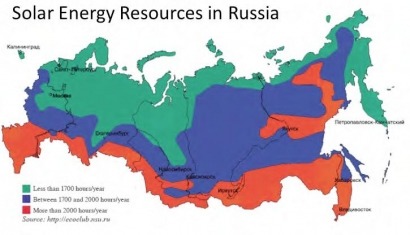
The southern parts of Russia, especially the North Caucasus, have the greatest potential for solar energy. The Krasnodar Region and most parts of Siberia have insolation levels comparable to the south of France and central Italy while the Zabaikalsky Region gets more solar energy than Spain.
Argument 4: Big giants start to understand that solar PV can be a good business
It is worth to mention that today not only Renova group of companies, one of the largest diversified business groups in Russia, understand that solar energy can be a profitable investment.
Renova is a major shareholder of Oerlikon and controlling shareholder of Avelar Energy Group as well as a shareholder of previously mentioned Hevel Solar. It has also recently established NAVI Capital Management, a fund that is going to invest 200 million dollars in clean-tech innovation with an important focus on solar PV.
Lukoil, a major Russian oil company, in partnership with the government of Uzbekistan and the Asian Development Bank, is planning to construct Uzbekistan's largest solar plant, which will have an initial capacity of 100 MW, to expand eventually to 1 GW. Earlier this year Lukoil started to build its first 4 million dollar solar plant in Bulgaria.
These examples show that a growing number of Russian giant companies, with available financial resources, feel that investing in solar energy can be a good business strategy.
Moreover, I have heard from many companies exhibiting at 26EUPVSEC that their booths were visited by representatives from some of the biggest energy companies in Russia, which were potentially interested in investing in solar parks in Italy, Greece or Bulgaria. I am quite sure that at the end of the day these big companies will strongly support the development of a domestic solar market.
Source: Solardaily.com
Additional Information:
Oct 07, 2011
Russia is the biggest country in the world and one of biggest suppliers of oil and gas has not yet seen a real need to develop a market for solar technologies.
This might change during the next few years - says Tomasz Slusarz, CEO of Solar PV Consulting - observing the policy and market situation on the global markets for the past 8 years and comparing it to the current situation in Russia, he is confident that cumulative solar installed capacity in Russia can reach above 1 or even 2 GW by 2020. He is even ready to bet on it. Here are his three arguments to back the claim.
Argument 1: Growing energy demand
In 2009, the Russian Energy Agency was forecasting that 51.7 GW of capacity would be decommissioned by 2020, requiring more than 150 GW of new capacity to meet consumption growth during the current decade.
I also notice a growing understanding from Russian policy makers and the private sector that increased use of renewable energy technologies can help meet the growing demand.
The Energy Strategy of Russia has set a target of 4.5% for the installed renewable electricity generation by 2020 (including small hydro up to 25 MW), which means a requirement of 22 GW for the new installed capacity.
As there are no sectorial targets within the 4.5% target, theoretically, quasi whole renewable energy capacity can be built from small hydro, wind, biomass or geothermic sources. However, in my opinion, solar PV with its more and more competitive prices can become a quite an important piece of the 22 GW cake.
Increasingly competitive prices of solar PV generation will be confronted with rapidly growing electricity prices in the country. According to the 2010 Budget of the Russian Federation, in 2020 the average electricity tariffs for all users will reach a level of 10.5cents/kWh and residential tariffs 15.3cents/kWh, compared to today's 7cents/kWh.
Argument 2: Huge investments in production capacities
Russian solar industry and RUSNANO, a state-owned fund, have invested billions of dollars in new manufacturing facilities such as Hevel Solar (thin-film PV), and Nitol (large-scale polysilicon and monosilane manufacturing).
When looking at the increasingly competitive global solar markets, they realize the urgent need to establish a sustainable domestic market in order to help the Russian industry grow and be able to compete on export markets.
Few weeks ago we heard that Russia's North Caucasus region is about to set up its own Silicon Valley with a joint venture between the regional government and private businesses. The cost of the project would be around 1 billion USD with pre-estimated production volume of 12 billion USD per year, and 2 to 7 years of return on investments.
Polycrystalline silicon production would be located in Stavropol region, with monocrystalline silicon production set up in Kabardino-Balkaria. The final production of photovoltaic cells and solar modules would be located in Karachay-Cherkessia and Dagestan respectively.
I am quite sure that if the project is successful, a lot of modules will be installed not only in the region but also all over the country.
Argument 3: Russia - sunny country!
The technical potential of solar energy was estimated as 1.870 TWh, with an economic potential of around 101 GWh per year in the national report titled "Role of renewable energy sources in energy strategy of Russia".
The southern parts of Russia, especially the North Caucasus, have the greatest potential for solar energy. The Krasnodar Region and most parts of Siberia have insolation levels comparable to the south of France and central Italy while the Zabaikalsky Region gets more solar energy than Spain.
Argument 4: Big giants start to understand that solar PV can be a good business
It is worth to mention that today not only Renova group of companies, one of the largest diversified business groups in Russia, understand that solar energy can be a profitable investment.
Renova is a major shareholder of Oerlikon and controlling shareholder of Avelar Energy Group as well as a shareholder of previously mentioned Hevel Solar. It has also recently established NAVI Capital Management, a fund that is going to invest 200 million dollars in clean-tech innovation with an important focus on solar PV.
Lukoil, a major Russian oil company, in partnership with the government of Uzbekistan and the Asian Development Bank, is planning to construct Uzbekistan's largest solar plant, which will have an initial capacity of 100 MW, to expand eventually to 1 GW. Earlier this year Lukoil started to build its first 4 million dollar solar plant in Bulgaria.
These examples show that a growing number of Russian giant companies, with available financial resources, feel that investing in solar energy can be a good business strategy.
Moreover, I have heard from many companies exhibiting at 26EUPVSEC that their booths were visited by representatives from some of the biggest energy companies in Russia, which were potentially interested in investing in solar parks in Italy, Greece or Bulgaria. I am quite sure that at the end of the day these big companies will strongly support the development of a domestic solar market.
Source: Solardaily.com
Additional Information:
Labels:
BRIC,
Energy,
Green Energy,
Russia
Wednesday, August 17, 2011
Russia set to show off its first stealth fighter
AFP
Aug 16, 2011
Russia was due Tuesday to unveil its first stealth fighter to the public, lifting the curtain on a secret project designed to flood the market with cheaper versions of veteran US jets.
The Sukhoi Tu-50, being developed jointly by Russia and India, made its maiden flight at a Far East air base on January 29, 2010 but is being presented to the public at the MAKS airshow outside Moscow for the first time.
Two prototypes of the single-seater fighter are expected to fly over the Zhukovsky air field in a show of Russian military confidence in the much-delayed project.
Russian officials said the final version of the jet will not be ready until the end of 2016. India was reported to be interested in up to 200 T-50 fighters for its air force while Russia was planning to order at least 150.
"The T-50 jet will provide the backbone not only of the Russian air force but also that of India," said Mikhail Pogosyan, president of the United Aircraft Corporation state aviation holding company.
"Russia's cooperation with India on this project will help it promote the fifth-generation jet on the foreign market," the RIA Novosti news agency quoted Pogosyan as saying.
Pogosyan had previously voiced plans to develop up to 1,000 jets over the coming decades, while state television said Russia hoped to control up to a third of the stealth fighter market in the coming year.
India, Russia's biggest arms client, agreed to develop the project in tandem with Moscow during a December 2010 visit to New Delhi by President Dmitry Medvedev.
The agreement put new life into a project that was first mooted in the late 1980s, when the Soviet Union identified a need to replace its existing Mig-29 and Su-27 jets.
The first US prototype of a stealth fighter -- the F-22 Raptor -- emerged nearly two decades ago and Russia only awarded the development contract in 2003.
Russia's state media reports last year said up to $10 billion was being poured into the jet's development but that the fighter would cost no more than $100 million.
The US raptor sells at $140 million a piece, a price tag that prompted Washington to order a halt in new jet purchases in 2009.
Copyright © 2011 AFP.
Aug 16, 2011
Russia was due Tuesday to unveil its first stealth fighter to the public, lifting the curtain on a secret project designed to flood the market with cheaper versions of veteran US jets.
The Sukhoi Tu-50, being developed jointly by Russia and India, made its maiden flight at a Far East air base on January 29, 2010 but is being presented to the public at the MAKS airshow outside Moscow for the first time.
Two prototypes of the single-seater fighter are expected to fly over the Zhukovsky air field in a show of Russian military confidence in the much-delayed project.
Russian officials said the final version of the jet will not be ready until the end of 2016. India was reported to be interested in up to 200 T-50 fighters for its air force while Russia was planning to order at least 150.
"The T-50 jet will provide the backbone not only of the Russian air force but also that of India," said Mikhail Pogosyan, president of the United Aircraft Corporation state aviation holding company.
"Russia's cooperation with India on this project will help it promote the fifth-generation jet on the foreign market," the RIA Novosti news agency quoted Pogosyan as saying.
Pogosyan had previously voiced plans to develop up to 1,000 jets over the coming decades, while state television said Russia hoped to control up to a third of the stealth fighter market in the coming year.
India, Russia's biggest arms client, agreed to develop the project in tandem with Moscow during a December 2010 visit to New Delhi by President Dmitry Medvedev.
The agreement put new life into a project that was first mooted in the late 1980s, when the Soviet Union identified a need to replace its existing Mig-29 and Su-27 jets.
The first US prototype of a stealth fighter -- the F-22 Raptor -- emerged nearly two decades ago and Russia only awarded the development contract in 2003.
Russia's state media reports last year said up to $10 billion was being poured into the jet's development but that the fighter would cost no more than $100 million.
The US raptor sells at $140 million a piece, a price tag that prompted Washington to order a halt in new jet purchases in 2009.
Copyright © 2011 AFP.
Labels:
Aircraft,
Defence,
Defense,
Russia,
Space Technology
Thursday, July 14, 2011
Industrial Robotics Market Opportunities in Russia
Robotic Industries Association
July 13, 2011
Spanning nine time zones and over 17 million square miles, Russia is not only the largest country in the world, geographically, but also the richest on a per capita basis of the so-called “BRIC” countries (Brazil, Russia, India and China). Its $1.465 trillion economy is forecast to grow at 4.5 percent this year, and industrial production and manufacturing continue to increase. (Last year industrial production grew 8.3 percent, and through the first four months of 2011 year-over-year growth has run 5.6 percent.) With economic indicators like these, what’s not to like about the Russian market?
These statistics become especially compelling, when you consider that the Russian economy is underserved by robotics with comparatively few companies with a major presence in this market. But this may soon change. Russia’s top leaders, including President Dmitry Medvedev and Prime Minister Putin, have acknowledged the need for economic modernization. If Russia is to compete globally and insure a level of national income largely independent of oil exports, it must deploy automation technologies such as robotics that enable the necessary cost efficiencies, productivity and product quality.
The size of the Russian economy, its performance, and the fact that it is generally underserved by automation companies suggest that it is an attractive target for robotics sales. But is it?
In a recent study entitled “Market Opportunities for Automation Companies in Russia, available free to RIA members and for sale to non-members in RIA’s online bookstore, RIA addressed this issue. For its analysis of the robotics market, the study considered not just the economy and robotic sales volumes but also the ins and outs of doing business in Russia. The picture that emerged from the study is of a country in great need of robotics technology but lacking in the basic underpinnings and protections of business that are taken for granted elsewhere. In short, while the Russian economy has made great strides in its transition from a centralized, publicly-owned economy, it still has a ways to go in creating fertile ground for businesses to flourish.
To read more click here...
July 13, 2011
These statistics become especially compelling, when you consider that the Russian economy is underserved by robotics with comparatively few companies with a major presence in this market. But this may soon change. Russia’s top leaders, including President Dmitry Medvedev and Prime Minister Putin, have acknowledged the need for economic modernization. If Russia is to compete globally and insure a level of national income largely independent of oil exports, it must deploy automation technologies such as robotics that enable the necessary cost efficiencies, productivity and product quality.
The size of the Russian economy, its performance, and the fact that it is generally underserved by automation companies suggest that it is an attractive target for robotics sales. But is it?
In a recent study entitled “Market Opportunities for Automation Companies in Russia, available free to RIA members and for sale to non-members in RIA’s online bookstore, RIA addressed this issue. For its analysis of the robotics market, the study considered not just the economy and robotic sales volumes but also the ins and outs of doing business in Russia. The picture that emerged from the study is of a country in great need of robotics technology but lacking in the basic underpinnings and protections of business that are taken for granted elsewhere. In short, while the Russian economy has made great strides in its transition from a centralized, publicly-owned economy, it still has a ways to go in creating fertile ground for businesses to flourish.
To read more click here...
Labels:
BRIC,
Economy,
Investment,
Robotic Technology,
Russia
Monday, July 11, 2011
Soviet automotive relic enjoys revival
Journal Gazette
July 10, 2011
Lada, the car of the Soviet proletariat, survived the transition to capitalism and is now expanding to fend off General Motors and Fiat two decades after the collapse of communism.
Lada’s parent OAO Avto VAZ, which is 25 percent-owned by Renault, plans to invest about $5.4 billion to introduce seven models in the next three years. The cars will in some cases replace vehicles that were developed before Mikhail Gorbachev came to power in 1985 and presided over the collapse of the Soviet Union.
Lada, Russia’s dominant brand with a 24 percent market share, is under pressure to defend that position. GM, Volkswagen and Ford are pushing into the market, which is poised to become Europe’s largest within three years. GM has an 8.9 percent share and VW 7.5 percent, with both reporting faster sales growth than Lada in the first five months.
The Russian carmaker’s hopes rest on customers like Sergei Chernikh. The 35-year-old retail manager from Voronezh, about 440 miles south of Moscow, bypassed Fiat and Chevrolet models to buy a Lada 2107 sedan because it was cheap and easy to maintain.
To read more click here...
July 10, 2011
Lada’s parent OAO Avto VAZ, which is 25 percent-owned by Renault, plans to invest about $5.4 billion to introduce seven models in the next three years. The cars will in some cases replace vehicles that were developed before Mikhail Gorbachev came to power in 1985 and presided over the collapse of the Soviet Union.
Lada, Russia’s dominant brand with a 24 percent market share, is under pressure to defend that position. GM, Volkswagen and Ford are pushing into the market, which is poised to become Europe’s largest within three years. GM has an 8.9 percent share and VW 7.5 percent, with both reporting faster sales growth than Lada in the first five months.
The Russian carmaker’s hopes rest on customers like Sergei Chernikh. The 35-year-old retail manager from Voronezh, about 440 miles south of Moscow, bypassed Fiat and Chevrolet models to buy a Lada 2107 sedan because it was cheap and easy to maintain.
To read more click here...
Labels:
Automotive,
Investment,
Russia
Friday, June 17, 2011
Russia, Korea and Singapore announce launch of a $100 million Asia Nanotechnology Fund
Engneerblogger
June 17, 2011
The parties entered into a Memorandum of Understanding today as part of the St. Petersburg World Economic Forum. The memorandum was signed by RUSNANO CEO Anatoly Chubais, KIAT Vice President Yeong Cheol Seok, 360ip President and CEO Glenn Kline and SGI President & CEO Taesoo Yang. Also participating in the announcement and expressing their support for the Fund were the Honorable Simon Tensing de Cruz, Singapore Ambassador to Russia, and St. Petersburg Governor Valentina Matviyenko.
The Fund – which is being formed as a limited partnership in the Republic of Korea and which will have its Russia team based in St. Petersburg -- will have a total capitalization of US$100 million of which RUSNANO Capital LLC, the investment vehicle of RUSNANO, is investing US$50 million and KIAT is investing KRW20 billion (about $18 million). The EDB will support the Singapore-based business of the Fund's portfolio companies with grants aggregating to US$20 million. No less than 50 percent of the fund will be invested in the Fund's Russia-based projects.
The Fund will make investments in nanotechnology-related projects, primarily in growth and expansion stage companies and in a select number of early stage companies with the potential for significant returns. The selected companies will have a strong intellectual property position and seek to grow rapidly and expand their market access.
"The fund is a mechanism for finding promising technologies in Russia and Asia alike. This strategic partnership will help us promote Russian high-tech products in international markets," declared Anatoly CHUBAIS, CEO and Chairman of the Executive Board of RUSNANO.
KIAT Executive Vice President Mr. Yeong Cheol SEOK commented, "Nanotechnology is one of the key new growth engine industries for Korea and KIAT is very excited to be a significant investor in the Asia Nanotechnology Fund to support cooperation between the nations and to promote international market opportunities."
"We are pleased that the Asia Nanotechnology Fund has attracted new investors. This is a significant milestone since the Memorandum of Understanding signed last year between RUSNANO, 360IP and Singapore EDB. The Fund will enable promising nanotechnology companies setting up in Singapore to accelerate their growth, particularly leveraging Singapore's cosmopolitan environment and support mechanisms," said Mr. Choon Shian TAN, Deputy Managing Director, Singapore Economic Development Board (EDB).
KIAT Executive Vice President Mr. Yeong Cheol SEOK commented, "Nanotechnology is one of the key new growth engine industries for Korea and KIAT is very excited to be a significant investor in the Asia Nanotechnology Fund to support cooperation between the nations and to promote international market opportunities."
"We are pleased that the Asia Nanotechnology Fund has attracted new investors. This is a significant milestone since the Memorandum of Understanding signed last year between RUSNANO, 360IP and Singapore EDB. The Fund will enable promising nanotechnology companies setting up in Singapore to accelerate their growth, particularly leveraging Singapore's cosmopolitan environment and support mechanisms," said Mr. Choon Shian TAN, Deputy Managing Director, Singapore Economic Development Board (EDB).
"Nanotechnology is a key enabler technology for many sectors, providing for tremendous growth opportunities. Through the Asia Nanotechnology Fund, both 360ip and SGI will play an active role in investing and developing nanotechnology companies with high growth potential and the ability to make a strong impact in the marketplace. Russia, Korea and Singapore are hubs for nanotechnology and there is a strong deal pipeline coming from these countries and throughout Asia," added 360ip President & CEO Mr. Glenn KLINE and SGI President Mr. Taesoo YANG.
St. Petersburg Governor Valentina MATVIYENKO stated, "I am very pleased that the Asia Nanotechnology Fund, in partnership with Rusnano, is establishing its fund operations in St. Petersburg, making it the largest venture capital fund to be based in St. Petersburg. We are prepared to provide all the support necessary to make the Fund's portfolio companies a success and believe they will benefit from all the strong technology resources available in St. Petersburg."
Source: RUSNANO
Source: RUSNANO
Labels:
Asia,
BRIC,
Investment,
Nanotechnology,
Russia
Tuesday, June 7, 2011
China Daily Articles, "China will expand solar power" and "China creates market for Russia energy exports"
China Daily
June 6, 2011
China will expand solar power
China will issue a five-year proposal to guide the country's renewable energy development, in which the goal for installed generating capacity of photovoltaic (PV) power is set at 10 gigawatts, China Securities Journal reported on Friday.
The report said the draft for the 12th Five-Year Plan period (2011-2015) has been submitted to the State Council for approval. The goal for solar power capacity generation is double that submitted in an earlier version.
Industry insiders said the plan also will promote the related industries such as polycrystalline silicon and PV component sectors, the newspaper reported.
The insiders also said China should give support to its PV industry and expand the domestic market, because it relies heavily on exports and will lose competitiveness when the importing country gives subsidies to its domestic PV sector.
China creates market for Russia energy exports
China's rapid economic growth creates a huge market for Russia's energy exports, said Chinese Vice-Premier Wang Qishan on Wednesday.
Economic development needs energy while energy exports have to look for markets, said Wang while visiting an oil field in Russia's Udermurt Republic on Wednesday.
Wang started his visit to Russia on Monday and attended the seventh round of the Sino-Russian energy negotiators' meeting.
Russia, which is rich in energy resources and enjoys advantages in such sectors as oil and gas exploration and extraction, as well as chemical industry, could be China's secure, long-term and reliable energy supplier, Wang said.
The vice-premier hailed China-Russia oil cooperation, noting that the joint adventure set up by Sinopec, China's oil giant, and Russia's Rosneft since 2006 has not only benefited the local people, but also China's companies.
Also on Wednesday, Wang met Rustam Minnikhanov, president of Russia's Tatarstan Republic.
During his stay in Russia, Wang also met with Russian Prime Minister Vladimir Putin in Moscow. After the meeting, the two nations signed a document on gas cooperation.
June 6, 2011
China will expand solar power
China will issue a five-year proposal to guide the country's renewable energy development, in which the goal for installed generating capacity of photovoltaic (PV) power is set at 10 gigawatts, China Securities Journal reported on Friday.
The report said the draft for the 12th Five-Year Plan period (2011-2015) has been submitted to the State Council for approval. The goal for solar power capacity generation is double that submitted in an earlier version.
Industry insiders said the plan also will promote the related industries such as polycrystalline silicon and PV component sectors, the newspaper reported.
The insiders also said China should give support to its PV industry and expand the domestic market, because it relies heavily on exports and will lose competitiveness when the importing country gives subsidies to its domestic PV sector.
China creates market for Russia energy exports
China's rapid economic growth creates a huge market for Russia's energy exports, said Chinese Vice-Premier Wang Qishan on Wednesday.
Economic development needs energy while energy exports have to look for markets, said Wang while visiting an oil field in Russia's Udermurt Republic on Wednesday.
Wang started his visit to Russia on Monday and attended the seventh round of the Sino-Russian energy negotiators' meeting.
Russia, which is rich in energy resources and enjoys advantages in such sectors as oil and gas exploration and extraction, as well as chemical industry, could be China's secure, long-term and reliable energy supplier, Wang said.
The vice-premier hailed China-Russia oil cooperation, noting that the joint adventure set up by Sinopec, China's oil giant, and Russia's Rosneft since 2006 has not only benefited the local people, but also China's companies.
Also on Wednesday, Wang met Rustam Minnikhanov, president of Russia's Tatarstan Republic.
During his stay in Russia, Wang also met with Russian Prime Minister Vladimir Putin in Moscow. After the meeting, the two nations signed a document on gas cooperation.
Labels:
BRIC,
China,
Energy,
Green Energy,
Investment,
Russia
Nuclear energy vital for economic growth: Russia
Engineerblogger
June 7, 2011
The use of nuclear energy is vital for the future development of the world economy, the head of Russia's state nuclear agency said Monday in an impassioned defence of atomic power.
Sergei Kiriyenko, the head of Rosatom, described nuclear energy as a "locomotive" of development, despite the concerns about its viability raised by the radiation leak from the quake-damaged Fukushima nuclear plant in Japan.
"In the next 10 years, nuclear power is a necessary condition for the safe and stable development of the world economy," Kiriyenko said in opening remarks to a major international conference on atomic power in Moscow.
"Nuclear power is the locomotive of the innovative development of mankind," he said at the start of the three-day conference, called "The development of atomic energy -- pause or continuation?"
"For many people in the world, access to energy is a condition for normal life and development," Kiriyenko said.
"Nobody has the right to stop a country from gaining access to this reliable and stable source of energy," he added.
Kiriyenko was speaking as the German cabinet signed off Monday on a bill phasing out nuclear power in Europe's biggest economy by 2022 after the disaster in March at Japan's Fukushima plant.
Russia has emerged as one of the champions of nuclear energy after the Fukushima accident while President Dmitry Medvedev has drawn up proposals for a new convention on nuclear safety.
"The world has to have absolute guarantees that nuclear energy has to be safe. This will necessitate systematic solutions starting with changes in international legislation," Kiriyenko said.
The chairman of the World Association of Nuclear Operators, Laurent Stricker, said that "it is clear that the nuclear landscape will be different" after Fukushima and called for greater oversight over nuclear plants.
The chief of the nuclear safety forum of experts, which was established after the Chernobyl catastrophe in 1986, said nuclear plant reviews should look closely at spent fuel storage and emergency preparedness in case of a power failure.
"It is a difficult time for the nuclear industry and I believe there will be a pause in nuclear development in many countries," he said. "The lessons from Fukushima events are only beginning to be known."
Copyright from AFP
June 7, 2011
The use of nuclear energy is vital for the future development of the world economy, the head of Russia's state nuclear agency said Monday in an impassioned defence of atomic power.
Sergei Kiriyenko, the head of Rosatom, described nuclear energy as a "locomotive" of development, despite the concerns about its viability raised by the radiation leak from the quake-damaged Fukushima nuclear plant in Japan.
"In the next 10 years, nuclear power is a necessary condition for the safe and stable development of the world economy," Kiriyenko said in opening remarks to a major international conference on atomic power in Moscow.
"Nuclear power is the locomotive of the innovative development of mankind," he said at the start of the three-day conference, called "The development of atomic energy -- pause or continuation?"
"For many people in the world, access to energy is a condition for normal life and development," Kiriyenko said.
"Nobody has the right to stop a country from gaining access to this reliable and stable source of energy," he added.
Kiriyenko was speaking as the German cabinet signed off Monday on a bill phasing out nuclear power in Europe's biggest economy by 2022 after the disaster in March at Japan's Fukushima plant.
Russia has emerged as one of the champions of nuclear energy after the Fukushima accident while President Dmitry Medvedev has drawn up proposals for a new convention on nuclear safety.
"The world has to have absolute guarantees that nuclear energy has to be safe. This will necessitate systematic solutions starting with changes in international legislation," Kiriyenko said.
The chairman of the World Association of Nuclear Operators, Laurent Stricker, said that "it is clear that the nuclear landscape will be different" after Fukushima and called for greater oversight over nuclear plants.
The chief of the nuclear safety forum of experts, which was established after the Chernobyl catastrophe in 1986, said nuclear plant reviews should look closely at spent fuel storage and emergency preparedness in case of a power failure.
"It is a difficult time for the nuclear industry and I believe there will be a pause in nuclear development in many countries," he said. "The lessons from Fukushima events are only beginning to be known."
Copyright from AFP
Thursday, June 2, 2011
China creates market for Russia energy exports
Engineerblogger
June 2, 2011
China's rapid economic growth creates a huge market for Russia's energy exports, said Chinese Vice-Premier Wang Qishan on Wednesday.
Economic development needs energy while energy exports have to look for markets, said Wang while visiting an oil field in Russia's Udermurt Republic on Wednesday.
Wang started his visit to Russia on Monday and attended the seventh round of the Sino-Russian energy negotiators' meeting.
Russia, which is rich in energy resources and enjoys advantages in such sectors as oil and gas exploration and extraction, as well as chemical industry, could be China's secure, long-term and reliable energy supplier, Wang said.
The vice-premier hailed China-Russia oil cooperation, noting that the joint adventure set up by Sinopec, China's oil giant, and Russia's Rosneft since 2006 has not only benefited the local people, but also China's companies.
Also on Wednesday, Wang met Rustam Minnikhanov, president of Russia's Tatarstan Republic.
China's rapid economic growth creates a huge market for Russia's energy exports, said Chinese Vice-Premier Wang Qishan on Wednesday.
Economic development needs energy while energy exports have to look for markets, said Wang while visiting an oil field in Russia's Udermurt Republic on Wednesday.
Wang started his visit to Russia on Monday and attended the seventh round of the Sino-Russian energy negotiators' meeting.
Russia, which is rich in energy resources and enjoys advantages in such sectors as oil and gas exploration and extraction, as well as chemical industry, could be China's secure, long-term and reliable energy supplier, Wang said.
The vice-premier hailed China-Russia oil cooperation, noting that the joint adventure set up by Sinopec, China's oil giant, and Russia's Rosneft since 2006 has not only benefited the local people, but also China's companies.
Also on Wednesday, Wang met Rustam Minnikhanov, president of Russia's Tatarstan Republic.
Copyrighted from China Daily
During his stay in Russia, Wang also met with Russian Prime Minister Vladimir Putin in Moscow. After the meeting, the two nations signed a document on gas cooperation.
Wednesday, May 11, 2011
Optical Control of Magnetic Effects at the Nanoscale
Technische Universitaet Dortmund
May 11, 2011
Magneto-optical effects, which exploit the interaction between light and magnetic materials, have only been relevant for fundamental research and up to now rarely used for applications. Plasmons – electronic excitations in metals with dimensions at the nanoscale – recently opened a new way to concentrate light at nanoscale. This allows plasmonic circuits to be built with electrical as well as optical control at this dimension scale. It would be ideal to apply such optical control for processing data on hard drives. This way writing and scanning frequencies of up to one billion operations per second, impossible so far, can be achieved. For this purpose it should be possible to optically switch the magnetic storage elements of a nanometer size on such hard drives. Optical excitation of plasmons could also be used here. Physicists at TU Dortmund around Dr. Ilya Akimov and colleagues from Russia and India now succeeded in developing a procedure to merge magneto-optics and plasmonics.
To read more click here...
May 11, 2011
Magneto-optical effects, which exploit the interaction between light and magnetic materials, have only been relevant for fundamental research and up to now rarely used for applications. Plasmons – electronic excitations in metals with dimensions at the nanoscale – recently opened a new way to concentrate light at nanoscale. This allows plasmonic circuits to be built with electrical as well as optical control at this dimension scale. It would be ideal to apply such optical control for processing data on hard drives. This way writing and scanning frequencies of up to one billion operations per second, impossible so far, can be achieved. For this purpose it should be possible to optically switch the magnetic storage elements of a nanometer size on such hard drives. Optical excitation of plasmons could also be used here. Physicists at TU Dortmund around Dr. Ilya Akimov and colleagues from Russia and India now succeeded in developing a procedure to merge magneto-optics and plasmonics.
To read more click here...
Labels:
BRIC,
Education,
India,
Nanotechnology,
Optical Technology,
Research and Development,
Russia
Thursday, April 14, 2011
ESA May Use Russian Technology In Nuke-Spaceship Project
RIA Novosti
April 11, 2011
The European Space Agency (ESA) has no immediate plans for cooperation with Russia in creating nuclear-powered spacecraft for future missions to Mars, but is considering using Russian experience and technology in its developments, the agency's head, Jean-Jacques Dorden, said on Monday.
To read more click here...
April 11, 2011
To read more click here...
Labels:
ESA,
Russia,
Space Technology
Monday, April 11, 2011
US Leaves Space For Russia
Moscow (RIA Novosti)
April 11, 2011
By the end of this year, NASA will no longer be able to send humans into space. According to Barack Obama's plan, responsibility will go to private companies, which are expected to come up with cheaper ways to ferry astronauts to low-Earth orbit.
To read more click here...
April 11, 2011
To read more click here...
Labels:
Russia,
Space Technology,
United States
Monday, March 7, 2011
EADS to join aerospace research effort in Moscow
The Engineer
March 3, 2011
EADS has signed an agreement that will see the company participate in the Skolkovo Innovation Centre, a high-technology business hub to be built in the Moscow area.
March 3, 2011
Labels:
BRIC,
EADS,
Research and Development,
Russia,
Space Technology,
Technology
Friday, March 4, 2011
Russian Stealth' PAK FA T-50 2nd Prototype Makes Maiden Flight
Youtube.com
March 3, 2011
The second prototype of the future of Russia's fighter jet programme, the PAK -FA (T-50) has successfully completed its maiden flight. The Sukhoi-made plane took to the skies for about an hour. It is equipped with some of the most advance avionics on the planet. It will be able to land on short runways and fly in any weather. It can carry up to eight medium range or two long-range missiles in its two internal bays. The jet's first prototype performed its maiden flight last January, and carried out 36 test flights. The fifth generation fighter's expected to enter service in Russia in 2015. The price tag is estimated at US $100 million.
Additional Informaton:
March 3, 2011
The second prototype of the future of Russia's fighter jet programme, the PAK -FA (T-50) has successfully completed its maiden flight. The Sukhoi-made plane took to the skies for about an hour. It is equipped with some of the most advance avionics on the planet. It will be able to land on short runways and fly in any weather. It can carry up to eight medium range or two long-range missiles in its two internal bays. The jet's first prototype performed its maiden flight last January, and carried out 36 test flights. The fifth generation fighter's expected to enter service in Russia in 2015. The price tag is estimated at US $100 million.
Additional Informaton:
Wednesday, February 23, 2011
India, Russia Exploring JV in Solar Photovoltaic Cells
Russia and India Report
Feb 21, 2011
Faced with burgeoning demand for silicon wafers, India is exploring possibilities of setting up a joint venture company in Russia to source the key component required for its fledgling solar energy initiatives.
Feb 21, 2011
Labels:
Brazil,
Green Energy,
India,
Nanotechnology,
Russia,
Technology
Tuesday, February 22, 2011
Ford plans to Team with Sollers in Russia
Associated Press
Feb 18, 2011
Ford Motor Co. is teaming up with Russian automaker Sollers to make and distribute cars in Russia, one of the fastest growing auto markets.
Feb 18, 2011
Labels:
Automotive,
BRIC,
Ford Motors,
Investment,
Russia
Friday, January 28, 2011
Skolkovo: Russia's Emerging Silicon Valley
Knowledge@Wharton
Jan 26, 2011
In all of Russia's tumultuous history, the last 100 years have seen perhaps the most influential political and social upheavals, which have had a dramatic effect on the Russian psyche. Communist leaders Vladimir Lenin and Joseph Stalin radically transformed a poor country with centuries of outdated agrarian traditions into one of the most modernized industrial nations in the world. The rapid industrialization catapulted the Soviet Union to the forefront of the global political economy, making it a superpower comparable to the United States. Yet the Soviet Union's demise was a result of its sustained path to industrialization and its underestimation of the vital importance of diversifying its base of technologies in a new information age -- one focused on computers and nanotechnology.
Jan 26, 2011
In all of Russia's tumultuous history, the last 100 years have seen perhaps the most influential political and social upheavals, which have had a dramatic effect on the Russian psyche. Communist leaders Vladimir Lenin and Joseph Stalin radically transformed a poor country with centuries of outdated agrarian traditions into one of the most modernized industrial nations in the world. The rapid industrialization catapulted the Soviet Union to the forefront of the global political economy, making it a superpower comparable to the United States. Yet the Soviet Union's demise was a result of its sustained path to industrialization and its underestimation of the vital importance of diversifying its base of technologies in a new information age -- one focused on computers and nanotechnology.
Labels:
BRIC,
Investment,
Russia,
Technology
Subscribe to:
Posts (Atom)