Pages

Subscribe:

Labels

038628037504 (1) 10150 (1) 10BURIED (1) 10Count (1) 110011040 (1) 115Ounce (1) 1200mg (1) 12BSN (1) 12Count (2) 12CountNutricor (1) 12CountWWSN (1) 12Fresh (1) 12Stacker (3) 12VPX (1) 140243 (1) 14Servings (1) 158Ounce (1) 15Ounce (1) 16Ounce (2) 1716 (1) 17Skque (1) 1lbinLife (1) 2000Hrs (1) 2000mg (1) 200Watt (1) 2021A (1) 20OunceNatures (1) 2412Ounce (1) 24Count (1) 24EAS59134 (1) 24FRS (1) 24Guru (1) 24Guru01GR124 (2) 24Nestle (2) 24Pediasure (2) 24Peptamen (1) 24PieceDisplay (1) 24Solis (2) 27ReSource (2) 2Biochem (1) 2Dynamic (1) 2Jarrow (1) 2Muscle (1) 2Natures (1) 2Ounce (3) 2Pound (1) 30Day (1) 328601 (1) 334928 (1) 336gOptimum (1) 37Ounce (1) 3Ensure (1) 3M (1) 414 (1) 432500 (1) 48Boost (1) 48Fluid (1) 48ml (1) 4Ensure (1) 4Isopure (1) 5000mg (1) 527408 (1) 5511786 (1) 574400 (1) 5Hour (2) 5Ounces (1) 600Kendall (1) 662380 (1) 6Beneprotein (1) 6Proteinex (1) 70951 (1) 750mlNutriPrima (1) 845Ounce (1) 84Fluid (2) 84OuncesLiquid (1) 89Inch (1) 8nuun (2) 8Ounce (7) 99369FR (1) ABB (3) Academy (1) ACCENTS (1) Acia162Ounces (1) Acsry (1) Active (2) Adapter (1) AdapterBattery (1) Advance (1) Advanced (1) Advantage (1) AdvantEdge (1) Africa (29) African (1) Agaricus (1) AiCoco (1) AIDSTrustex (1) Airbrush (1) Airbus (6) Aircraft (94) AISI (1) Ajmeras (1) Alchohol (1) Alertness (1) Alfalfa (2) Alive (1) Allergy (1) Allspice (8) Alpine (1) Alstom (2) Alternative (1) Amarillo (1) Amazing (3) Amazon (2) American (1) animal (11) Annual Reports (155) Antioxidant (1) Anwar Ibrahim (1) Apple (1) Applied Materials (1) Arrowroot (1) AshtonDrake (1) Asia (72) Assorted (1) Atkins (1) Audi (1) Australia (21) Automotive (250) Automotive Technology (183) Ayurvedic (1) BABIES (1) Babys (1) Bacopa (1) BagAtkins2627 (1) BagsTraditional (1) BagSun (1) Balanced (1) Ballard Power System (1) Banaba (2) Baram Dam (1) Baram Regatta (1) Bariatric (1) Barisan Nasional (2) Barisan Nasional Helps Penan (1) Barista (2) Barley (2) barsBiochem (1) Basement (1) BASF (2) Basics (1) Batu Lawi (1) Bayer (1) BEA1017OZ (1) Beachbody (1) Beaded (1) Beaumont (1) beautiful girl image (19) Beauty (2) Beneprotein (2) Berries (3) Berry (4) BerryLiving (1) Beverage (1) Bicycle (1) BioAstin (1) Biochem (4) Biofuel (12) Biogenesis (2) BlackBlender (1) Blend (1) Blender (4) Blueberry (1) BlueStereo (1) BMF (1) BMW (7) BMX (1) BN (1) Boeing (4) Bombardier (4) Book (1) Borneo (6) Bottle (8) BottleProStat (1) Bottles (15) BottleScivation (1) bottlesEnsure (2) BottlesMio (1) BoxChenille (1) BoxDarice140243 (1) BOXESAmerican (1) BoxesFRSPowder (1) BoxPremier (1) BP (2) Brands (1) Brands833667000102 (1) Brazil (10) Brazilian (1) Breeze (3) BrewersBarista (1) BRIC (118) Brikpaks (3) Brownie (1) Bruno Manser (1) Bruno Manser Fund (3) Bruno Manser Fund Fraud (1) Bruno Manser Fund Frauds (1) Bruno Manser Lies (2) BTL410400 (1) Bubbles (1) Burner (1) business (72) Butchers (1) Butter (1) Butterscotch (1) Cable (1) Cables (1) Calcium (2) California (1) Calorie (3) Camera (1) Canada (11) Candela (1) Canister (2) CanisterCLICK (1) Canisters (1) Canning (1) Capramilk (1) CapsSwanson (1) Capsule (5) Capsules (6) CapsulesEAS (1) Caraway (1) Cardio (1) Carnation (1) CaseEnsure (2) CaseNestle (2) Celebrity (22) CellularFactory (1) Celsius (1) Certification (28) Certified (2) Chameleon (1) Charger (1) Charter/Terms of Reference (27) CHEAP (135) Chenille (1) Cherry (1) CherryZydot (1) Chevron (1) Chewing (1) Chile (1) China (99) Chipotle (1) Chlorophyll (1) Chocolate (7) Chocolate8 (1) Choice (2) Cholesterol (1) Chrome (1) Chrysler (1) Chunho (1) Citrifolia (1) Citroen (1) Citroën (1) Citrus (2) Civil Service (1) CK Morris Associates (1) Clare Rewcastle Brown (2) Class (1) Classic (2) Clinical (1) CNST (1) Coenzyme (1) Coffee (4) Coffee11001105 (1) Coffee7DSC2B (1) Coffeehouse (1) Cold Fusion (1) Coldkicker (1) Collectable (1) Collection (1) Colored (1) Colors (1) Communications (14) Company (2) COMPLETE (4) Complex (1) Computer (1) Concentrate (1) Concentrated (1) Concepts645654 (1) Condoms (1) Container (7) CONTROL20BGSee (1) Corrections (3) CosMedix (1) count (1) countAmscan (1) CountMy (1) Crayola (3) Criminal (4) Cruiser (1) Crunch (1) Cytosport (2) Daimler (3) Dam (1) DAP (1) DAP Lies (1) Darice (1) DARPA (18) Dato Roland Sagah Wee Inn (1) Defence (60) Defense (61) Delight (2) description (1) Desert (7) Design (65) DESIGNER (3) Desktop (1) detail (1) Detroit (1) Development (1) Dexatrim (1) diameter (1) diameterGaming (1) Diecast (1) Dinosaur (1) DISCOUNT (4) Discover (1) Disney (1) Doctors (1) DoE (8) DolphinsSticky (1) DOMAGRON (1) Dow Corning Corp (2) DP9260 (1) DRA6329 (1) Dragon (1) Dressing (1) Drink (11) Drinkin (1) drinksNVE (1) Dupont (2) dv9657clSIBCORP (1) Dymatize (3) DYMMGV (1) DYNAMIC (5) EachHager (1) EADS (12) ecigs (1) Eco-Tourism (1) Economy (14) Education (1404) Electra (1) Electric Grid (1) Electrolyte (4) ELP3STSL (1) Endorush (1) Endurox (2) Energizing (1) Energy (540) English Article (20) Enhanced (1) Enhancer (1) Enlive (2) Ensure (12) Enterprise (1) Environment (170) Enzymatic (1) Eraser (1) ERECTION (1) Ergonomics (4) ESA (4) Espresso (1) Essence (2) Essentials (3) EssentialsHSE (1) ethnic group (1) Europe (201) Executive/External Ombuds (2) Extended (2) ExtenderBadger (1) Extension (1) Extern/Intern (20) Extract (5) Extreme (21) Factor (1) Factors (3) Fantastic (1) Fatigued (1) Faucet (1) feature (9) Featuring (1) Fellowes (1) Fillet (1) First Energy (6) Fitera (2) FlatScreen (1) Flavor (1) FlavorBeachbody (1) Focus28 (1) Ford Motors (7) Foreign NGOs (2) Forest (1) formula (5) Formulas (1) Forts (1) FORUM (1) Fragrance (1) France (12) Frappuccino (1) FreeHubner (1) French (2) Friday Poll (13) Frontier (1) Frost (1) Fruits (1) Ft1140Alessco (1) Ft132Alessco (1) FToys (1) Fudge (1) Fuel Cell (26) Fujitsu (2) funny (19) Gadget (6) Galleries (1) Gallon (1) GameJax2000 (1) Games (1) General Electric (21) General Motors (15) Genesis (1) Georges (1) Germany (28) Go02658 (1) Golden (1) Goldfinch (2) Goodyear (1) Google (6) Gordoni (1) Gourmet (1) Government (333) Grape (2) Grape5 (1) Green Energy (544) Greens (2) GripAlex (1) Ground (7) Guarana (1) Halal Hub (1) Hammer (1) Hardware (1) Hasbro (1) Hawaiian (1) health (19) Health Care (87) Healthy (4) Herbal (5) Herbals (1) Himalayan (1) Holiday (1) Honda (4) Honeywell (1) Hoodia (1) HPCompaq (1) Hubner (1) human capital development (1) Humor (18) Hydration (2) hydration8PKNUUNLL (1) Hydrive (1) Hyundai (2) IBM (2) Illegal Demonstrations (1) iMicro (1) IMMICRP (1) India (23) information (8) Infrastructure (44) inLife (1) Inside Invester Ltd (1) Instantized (1) Institute (1) International (338) Internet (7) Intestinal (2) Investment (187) IOA News (168) ISO (1) ISO100 (1) Isolate (2) Isopure (4) Isotonix (1) Italian (2) Italy (1) Jabatan Penerangan (1) Jameson Ahip Nawie (1) Japan (57) JarALTERNATIVE (1) JarDoctors (1) Jarrow (1) Job Postings (339) Johnson Controls (1) Journey (2) Juice (2) JUICECRANBERRYOG2 (1) JuiceTahitian (1) Kangmei (1) KCups (1) Kerlix (1) Kettler (1) Kettler8852600 (1) Keurig (1) Keyboard (1) Kiddio (1) KitBerg (1) KiteSpiderMan (1) KitGoldfinch (1) Kombucha (2) KombuchaKIT (1) Kraft911501 (1) Kuching (1) Laboratories (1) Langnickel (1) LaptopNotebook (1) lbBioGenesisRICE3 (1) lbsNatural (1) Leading Indicators (450) Lean (10) LeapFrog (3) Learning (1) Leaves (2) Leccino (1) Legislation (65) Lemonade (2) Lemonlime (1) Len Talif (1) License (1) Lifetime (2) Light (1) LightHog (1) LINERBLADDER (1) Liquid (20) LiquidDeSouzas (1) Litigation (45) Living (2) Lockheed Martin (6) Looking (1) Lubricants (1) Lubricated (1) Macbook (1) Malaysia (4) MaleFemale (1) Management (16) Manufacturing (394) Marine Technology (2) Materials (446) Mazda (2) Medical (84) Medicinals (1) MEGAWING (1) Mental (1) Mercedes-Benz (3) Merdeka (2) Metabolic (1) MetaboLife (1) Metallic (1) Metamucil (1) MetersCables (1) Middle East (16) Miniatures (1) MioEnergy (1) Miradent (1) Miri (1) MIRROR (1) Mitsubishi (4) Monkey (2) Monster (1) Morinda (1) Morton (1) Mosacis (1) Mosaics (1) Mothers (1) MountScotty245 (1) MultiPackCELSIUS (1) MultiPackDYNAMIC (2) MultiPackLILY (1) MultiPackLIQUID (1) MultiPackMACA (1) MultiPackONLY (1) Multiracial (1) Mulu (1) Muscle (1) Muscletech (2) Myoplex (1) Nanotechnology (279) NASA (22) National Laboratory (46) Natural (12) natural phenomena (11) Naturally (1) Naturals (3) Natures (6) Naturessunshine (4) nc8000 (1) nc8220 (1) nc8230 (1) Nesting (1) Nestle (2) Netbook (1) New Programs (133) New Zealand (2) NGO's (213) NGOs (1) Nickel Hydrogen (1) Nissan (8) NIST (5) North America (18) Northrop Grumman (1) Norway (1) NovoAndina (2) Noxide (1) NREL (8) NSF (3) NTT Data (1) Nuclear (45) Numbers (1) Nuspeed (1) Nutrex (1) Nutricor (1) Nutrient (2) Nutrients (1) NutriPrima (1) Nutrition (15) Nutritional (5) NutritionON45 (1) nw8000 (1) nw8240 (1) Offshore (7) OilsAWM (1) OintmentWounded (1) Olives (1) Onshore (2) Optical Technology (28) Optimum (4) Optisource (2) Orang Ulu (1) Orange (7) OrangeHigh5 (1) Organic (12) Original (2) Other Ombuds (145) Otomotif (2) ounce (1) Ounces (5) OuncesSea (1) OunceThe (1) Outside the Standards (62) Oxford Business Group (1) OyToys (1) OzAfrican (1) ozNatures (1) Packages (1) Packet (1) Packets (1) PacketsNatures (1) PacketsUltima (1) Packs (2) PackStarbucks (1) PadCrayola (1) Paradise (1) Parazyme (1) Parents (1) Parmigiani (1) Pavilion (1) Pecan (1) Pediasure (3) Pehin Sri Haji Abdul Taib Mahmud (1) Penan (9) Pepper (1) Peppermint (1) Peptamen (1) Peter Jaban (2) Pharma (1) Pharmaceuticals (1) Phillips (1) Pickling (1) Pieces (1) PineappleGU (1) PinkBlender (2) PKR (1) PlantBased (1) Plantiva (1) Plastic (8) PN0223 (1) Pomegranate (1) PomegranateGU (1) Porsche (1) PostCXDNSR105 (1) Poundlb (1) Pounds (1) PoundsClif (1) Powder (20) Powdered (1) PowderEndurox (1) PP1235BBS (1) Practice Pointers (185) Prebio (1) PregNatal (1) Premier (1) Premium (3) preservatives (1) Preston (1) Private Sector (174) Proasis (1) Products (2) Professional Devt. (254) Profiles (257) Projector (1) Proscience (1) ProStat (2) protein (14) Proteinex (1) Protidiet (1) Proxima (1) Pudding (1) Punch (1) Purpose (1) Puzzle (1) R. Palan and Sabariah Putit (1) R4Lemon (1) Rail (41) RAINBOW (1) Rainforest (2) Raspberry (1) REA6048 (1) ReadytoDrink (1) Reaper (1) Recovery (2) Regional Events (101) Regular (2) Release (2) Remedies (1) REMEDIES4582008 (1) Replacement (2) Replenisher (3) ReplenisherUltima (1) Research (1) Research and Development (825) ReSource (4) Results (1) Revitalization (1) Roasted (1) Robotic Technology (124) Rocket (2) Rolls royce (7) Rooibos (1) Rosemary (1) ROSSLARE (1) Russell (1) Russia (17) Safety (15) Sains (20) SaltFree (1) Samalaju (4) Sammons (1) Samsung (1) Sarawak (13) Sarawak 10th State Election (1) Sarawak Borneo (7) Sarawak Budget 2012 (1) Sarawak Corridor of Renewable Energy (SCORE) (8) Sarawak Development (1) Sarawak Economics (1) Sarawak Economy (6) Sarawak ethnic groups (1) Sarawak Forest Corporation (2) Sarawak Politics (4) Sarawak Rainforest (2) Sarawakian (7) Satellite (6) Saudi Aramco (1) ScaledStar (1) Scholarly Articles/Research (102) science (50) Scivation (1) ScottishPower Renewables (1) Scotty (1) Seasoning (1) SEB (1) Secura (1) Seks (12) Senior Citizens (1) Series (1) serving (2) Servings (2) servingsBariatric (1) Shades (1) shake (4) Shaker (1) SHEETSHygloss (1) Shell (1) ShotCL27752 (1) Siemens (8) Silicone (1) Silver (1) Singapore (2) Single (1) Sleeve (1) SlimFast (1) Slimming (1) SlimStyles (1) SM005Grey (1) Smart (1) smartphone (1) Smoke (1) Smoothie (2) Smore (1) SoftCarpets (2) Softgels (1) Sony (1) Souffle (1) Source (2) South Africa (11) South America (11) South Korea (1) Space Technology (69) Sparkling (1) SpiderMan (1) Sponge (1) SpongeSammons (1) Sport (8) Sports (7) Springtime (1) Stacker (4) Starbucks (1) Starwest (2) Stems (1) Stereo (1) Sterile (1) Sticker (1) Sticky (1) Stomach (2) Strawberry (3) Strength (3) Strive (1) SumoMESUMO66897 (1) Sundries (5) Sunkist (1) Sunwarrior (1) SuperGreens (1) Supplement (4) Supplier (1) supply (3) Support (4) Supreme (2) Sustainable Forest Management Policy (2) Switzerland (2) System (3) Tablet (2) Tablets (3) TabletsTwinlab (1) Tahatian (1) Tahitian (1) Taib Mahmud (6) Taisho (1) Tanjung Manis (1) Tanjung Manis Halal Hub (1) Tartar (2) Tata (4) Tattoos (1) Technology (562) Temporary (2) Temptations (1) Tesla (1) Testors (1) Thalgo (1) The Report 2011 (1) Therapeutic (1) TinTea (1) Tips (25) Tokuyama (1) Topical (1) totalBoost (1) Toyota (15) Toys21030000 (1) ToyTote (1) Transitions (255) Transphorm (1) Transport (135) TREASURE (1) TrikeKiddio (1) Tropical (2) Trumans (1) Trustex (1) Tubes30 (1) Twinlab (2) Twistables (1) Two Hats (2) Uganda (1) UK (107) Ulticare (1) Ultima (3) Ultimate (1) Ulu Baram (1) Unflavored (1) Unibody (1) Unique (53) United States (281) University (1) Unknown (1) Uranium (1) USDA (1) Vale (1) Vanilla (10) Vanilla8 (1) Varcho (1) Variety (3) VegCap (3) Vehicle (1) Video (30) Viennese (1) Visitor Advice (70) VIT033 (1) Vitacost (5) Vitalyte (1) Volkswagen (5) Volvo (2) VTL200CIR (1) Warrior (3) WarsATST (1) Water resources (1) Water Technology (28) Watermelon (1) Wedding (1) Weight (2) Whole (2) Wild10650 (1) Wooden (1) World news (67) Worldwide (1) Wounded (1) Xtend (1) Xtreme (1) Xylitol (1) ZeroCherry (1) ZipFizz (1) ZoomOxo4113600 (1) ZZP88103 (1)

Showing posts with label NREL. Show all posts

Wednesday, February 15, 2012

Thermal Storage Gets More Solar on the Grid

Engineerblogger
Feb 15, 2012


Abengoa is erecting more than 3,200 mirrored parabolic troughs at its Solana plant near Gila Bend, Ariz. When at full operation, the CSP plant will serve more than 70,000 homes. Credit: Dennis Schroeder

It's 4:45 on a sweltering August afternoon, and the rooftop solar panels are starting to lose juice. The sun's lower angles and that huge cottonwood tree are interfering with the efficient photon-to-electricity transfer.

What is an environmentally conscious — but air-conditioning-loving — homeowner to do?

Peak demand for electricity in the United States typically hits between 4 p.m. and 8 p.m., which doesn't quite line up with the sun's schedule. It's fortunate that the sun is high in the sky during many of the hours when the air conditioning is in demand. But in summer, people tend to need air conditioning during the dinner hour and beyond, when kitchen appliances are whirring, lights are on, and TVs are blaring.

To the rescue comes concentrating solar power (CSP), a technology being tested and deployed by utilities in America's deserts and southern Spain.

New analysis at the U.S. Department of Energy's (DOE) National Renewable Energy Laboratory (NREL) has found that CSP, with its greater grid flexibility and ability to store energy for as long as 15 hours, can enhance total solar power generation and actually give photovoltaic (PV) systems a greater presence on the grid.

PV panels convert photons from the sun directly into electrons for electricity — and are grabbing real estate on rooftops across the Americas, Europe, and Asia.

CSP technologies use mirrors to reflect and concentrate sunlight onto receivers that collect the sun's heat. This thermal energy can then be used to drive a steam turbine that produces electricity for utilities.

Thermal Storage Can Even Out the Bumps

Like Edison and Tesla or Dempsey and Tunney, the two major solar energy technologies never meant to play nice. Each had its niche — and its dreams of market share.

But that's changing, said NREL analyst Paul Denholm, co-author with Mark Mehos of the study "Enabling Greater Penetration of Solar Power via Use of CSP with Thermal Energy Storage."

Think of power from PV as a roller coaster of highs and lows, and power from CSP, via thermal energy storage, as a gently rolling train.

PV panels and wind turbines contribute electricity to the grid, but without the ability to store that power, they cannot supply the grid after the sun sets, or after the wind dies. Even passing clouds can cause drops in the amount of solar energy that gets on the grid.

Large fossil-fueled and nuclear power plants can't be quickly stopped or started to accommodate variable energy sources such as solar and wind energy.

CSP can even out these ebbs and flows because it can store power and ramp up output when the amount of direct wind or solar power drops.
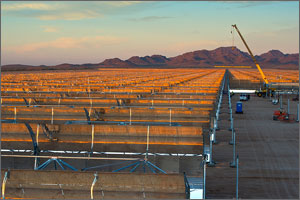
Crews work around the clock installing mirrored parabolic trough collectors — built on site — that will cover 3 square miles at Abengoa's Solana Plant. When finished, the plant will generate 280 megawatts of clean, sustainable power.
Credit: Dennis Schroeder

Grid Flexibility is the Key

"It all gets down to grid flexibility," Denholm said. "What sets of grid technologies do you deploy to make the grid respond faster and over a greater range to the input of variable energy such as solar and wind?

"If you can't respond quickly, you end up potentially throwing away wind and solar energy.

"We know that the more wind and solar you add to the grid, the harder it is to balance the grid and maintain reliability."

A CSP plant works by heating a heat transfer fluid that is used to boil water to make steam. But because of thermal inertia, by the time that fluid gets through the system's pipes to the power plant, perhaps 10 or 15 minutes have passed.

When a cloud passes over a PV panel, the drop in energy production is immediate. But because of the 10 or 15 minutes of thermal inertia, a cloud passing over a CSP tower doesn't cause this immediate drop. Nor is there the immediate surge when sunlight returns.

"The change is more gradual," Denholm said. "That's one reason CSP can bring a greater quality to the grid."

Still, the greater potential for CSP — and for CSP helping PV to expand its role on the grid — is its capacity to store the energy it captures from the sun for several hours, making it a source of reliable energy after the sun sets.

"CSP can fill in that gap in the evening when there's peak demand for electricity," Denholm said. "Together, the solar resource can provide all that peak demand. And together they can reduce or eliminate the need to build new power plants for those peak periods."

Molten Salts a Low-Cost Solution

Thermal energy storage at CSP plants "is low-cost because it's not exotic," Denholm said. "It's some large tanks with some media to store energy before you use it to boil the water." The best medium for storage available today is molten salt, NREL's Greg Glatzmaier said.

Molten salts are abundant and not very costly. They behave themselves, neither decomposing nor volatizing at the high temperature needed in a CSP plant — about 565 degrees Celsius (°C).

At a typical molten-salt CSP plant, the salts are stored in two tanks, one much hotter than the other.

In the case of a power tower CSP plant, in which the mirrors focus the sun's rays on one receiver atop a tower, the lower-temperature tank is at about 293°C, while the higher-temperature tank is at 565°C, Glatzmaier said.

The salt is pumped from the "cold" tank to the power tower, where it collects the solar energy that's focused on the receiver, raising its average temperature. The salts then descend into the "hot" tank, where they can maintain this very hot temperature for several days, though typically they are used within hours.

The salt in the hot tank is then sent to a heat exchanger that generates the steam needed to turn the turbines at a power plant. The turbines generate electricity that goes to homes and businesses.

As they exit the steam generator, the salts cool, and by the time they return to the cold tank, they measure at about 293°C.

When the sun is shining, the CSP plant can take the salts out of the cold tank, heat them up at the tower's receiver, and then dump them into the hot tank for storage, Glatzmaier said. "If you come to the end of the day and the hot tank is pretty full, you can keep generating electricity by withdrawing the salts from the hot tank to generate steam."

It's a continual balancing act. If all the salt is in the cold tank, no stored energy is available. If it's all in the hot tank, there's plenty of energy stored for later use, but nothing to replenish the system.

Molten salts tend to freeze at about 200°C, so as long as the two tanks range between 293°C and 565°C, the salts are in no danger of reverting to a solid state. At room temperature, the salts look like powdery white table salt. At the higher temperatures in a CSP plant, the salts look like water.

The molten salts used for storage are a mix of sodium nitrate and potassium nitrate. Sodium nitrate is mined from dry lake beds in Chile, in surroundings similar to the Utah salt flats. Potassium nitrate also occurs in nature and is mined in Chile, Ethiopia, and elsewhere.
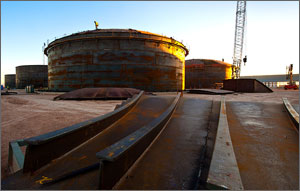
The tanks that hold the molten salts at Abengoa's Solana Plant are enormous. The salts can keep the solar-heated fluids very hot for several hours, so they can be transferred to turbines to produce electricity even when the sun isn't shining. Credit: Dennis Schroeder

Plants with Storage in Spain, Nevada, Arizona, California

Abengoa Solar is building a 250-megawatt CSP plant near Gila Bend, Ariz., that will cover 1,900 acres and use 900,000 mirrors to direct sunlight to heat a working fluid inside its tubes. The plant's six hours of thermal storage mean it can deliver electricity after the sun sets to approximately 70,000 homes.

The 19.9-megawatt power tower run by Gemasolar near Granada in southern Spain is configured to store enough energy during the summer to provide solar-generated electricity 24 hours a day, Glatzmaier said. In the winter, when there's less sunshine, electricity comes from more conventional sources a few hours each day. The system aims to power 25,000 homes and reduce carbon dioxide emissions by more than 30,000 tons a year.

SolarReserve is building the 110-megawatt Crescent Dunes Solar Energy Project near Tonopah, Nev., which will use molten salt to store the sun's energy as heat for several hours. It will include more than 17,000 mirrors to focus the sun's light on a tower 640 feet high.

BrightSource is building an even larger CSP project in the Mojave Desert near Needles, Calif., that will have storage for just a couple of hours a day — but this will be enough to serve more than 140,000 homes during peak hours. Company executives say the plant will reduce carbon dioxide emissions by more than 400,000 tons per year.

PV/CSP Symbiosis Makes Economic Sense

The cost of PV has been plummeting, and it has a cost advantage over CSP. But CSP has the advantage of storage, and so teamed with PV can improve the benefits and bottom lines of both technologies. Storage does raise the price of a CSP plant, but "if you're running your turbine more hours in a day, you're amortizing your turbine cost over more generation time, and there's a real cost benefit there," Glatzmaier said. The bottom line: when storage is added to a CSP plant, it increases the value of its electricity — both its energy value and its capacity value.

Solar plants also can store energy in batteries, but at least for now, that approach is quite expensive. Other thermal storage technologies being investigated by researchers include phase-change or thermal-chemical storage.

Denholm and Mehos caution that the preliminary analysis in their study will require more advanced grid simulations to verify the actual ability of CSP to help wind and PV gain a larger presence on the grid. An important next step, they say, would be more complete simulations using utility-grade software. That will answer questions on the realistic performance of the generation fleet, transmission constraints, and actual CSP operations.

Source: National Renewable Energy Laboratory (NREL)


Related Information:
 

Thursday, December 15, 2011

Tiny Solar Cell Could Make a Big Difference

Engineerblogger
Dec 15, 2011


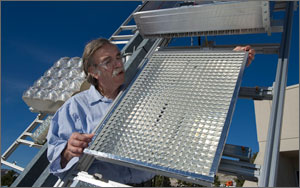
NREL scientist Keith Emery examines a Semprius solar module at the laboratory's Outdoor Test Facility. NREL helped Semprius characterize and test its tiny solar cells, which are the diameter of a dot made by a ballpoint pen.
Credit: Dennis Schroeder

How small can a solar cell be and still be a powerhouse?  How about six hundred microns wide — about the diameter of a dot made by a ballpoint pen?
The U.S. Department of Energy's National Renewable Energy Laboratory recently validated greater than 41 percent efficiency at a concentration of 1,000 suns for tiny cells made by Semprius — one of the highest efficiencies recorded at this concentration. The energy conversion efficiency of a solar cell is the percentage of sunlight converted by the cell into electricity.

Seed money from DOE, together with the experts at the NREL-based SunShot Incubator Program, lifted Semprius from a small electronics start-up with a novel idea to a real difference-maker in the solar cell world.

Semprius' triple-junction cells are made of gallium arsenide. Low-cost lenses concentrate the sun light onto the tiny cells 1,100 times. Their tiny size means they occupy only one-one thousandth of the entire solar module area, reducing the module cost. In addition, the use of a large number of small cells helps to distribute unwanted heat over the cell's structure, so there's no need for expensive thermal management hardware such as heat fins.

Semprius engineers use the company's patented micro-transfer printing process to allow the micro-cells to be transferred from the growth substrate to a wafer. In a massive parallel process, thousands of cells are transferred simultaneously. This allows the original substrate to be used again and again, dramatically cutting costs. It also provides a way to handle very small cells.

This low-cost approach, which Semprius executives say can cut manufacturing expense by 50 percent, caught the eye of energy giant Siemens, which this year took a 16 percent stake in Semprius, as part of a $20 million investment from venture capitalists.

Sunshot Incubator Program Spurs Private Investment

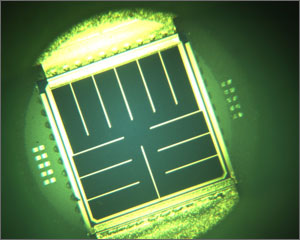
NREL's state-of-the-art testing and characterization instruments scrutinize the quality and efficiency of solar cells, such as on this module made by Semprius.
Credit: NREL staff

Since 2007, DOE has invested $50 million for 35 solar start-ups to participate in the PV Incubator program — now the SunShot Incubator — at NREL. Private investment in those firms now totals more than $1.3 billion, a 25-to-1 multiple.

DOE and NREL selected Semprius to be one of their PV Incubator companies in 2010. Incubator companies get $1 million to $3 million to develop their concepts into actual working prototypes or pilot projects. And they also get the expertise of NREL scientists to help overcome obstacles and test for reliability and validity.

Transfer Printing Technology Evolves to Innovative Solar-Cell Use

Semprius' back story, though, begins at the University of Illinois where Professor John Rogers and his team developed the transfer-printing process initially intended for flexible electronics.

Soon, Rogers realized that applying the technology to a concentrated photovoltaic (CPV) design could be much more lucrative.

Semprius grows a temporary layer on the original gallium-arsenide substrate, and then grows the multi-junction solar cell structure on top of that layer. Then, after the wafer is processed, the transfer printing process is used to remove the cells from the gallium-arsenide substrate and transfer them to an interposer wafer.

"We're using a completely different approach to what has been practiced," said Kanchan Ghosal, CPV Applications Engineering Manager and the principal investigator for Semprius' PV Incubator Award. "This approach uses micro-cells and transfer printing to significantly reduce the use of materials in highly concentrated PV modules. And it provides a highly parallel method to manufacture the module, based on established microelectronics processes and equipment."


NREL's state-of-the-art testing and characterization instruments scrutinize the quality and efficiency of solar cells, such as on this module made by Semprius. Credit: NREL staff
Demand for Concentrated PV Expected to Double Each Year 

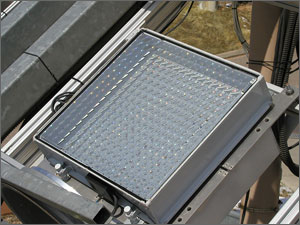
This solar cell module made by Semprius is being tested at NREL's Outdoor Test Facility.
Credit: NREL staff

Semprius broke ground on a manufacturing plant in Henderson, N.C., this year. The state of North Carolina and local agencies kicked in $7.9 million for the 50,000-square foot plant, which is expected to employ 256 people at full build-out.

North Carolina Gov. Bev Perdue cited her state's "investments in education and job training" as the reason the company chose to locate there. The plant is expected to start operating next year, with an initial capacity of 5 megawatts, eventually growing to 35 megawatts.

The available market for highly-concentrated photovoltaics is expected to double or more each year over the next nine years, reaching greater than 10 gigawatts of power by 2020, according to Semprius CEO Joe Carr.

Partnership with DOE and NREL Proves Fruitful

Semprius first looked at using its micro-transfer printing for solar cells in 2007, with the help of a "Next-Gen" grant from DOE's Office of Energy Efficiency and Renewable Energy.

In 2010, Semprius earned one of four spots in what is now the SunShot Incubator, which is funded by DOE and run out of NREL.


This solar cell module made by Semprius is being tested at NREL's Outdoor Test Facility. Credit: NREL staff

Ghosal laughs when he remembers the frantic moments finishing the application for the PV Incubator.

"We barely met the criteria," Ghosal said. "The rules said that you had to have a module ready to be eligible, but we only had small squares with a couple of cells, not a real module."

So, the Semprius engineers "worked feverishly day and night to make our first module."

"Two days before the deadline, we were able to get good results from that first module," Ghosal said. "We applied for the Incubator grant with the results from this module and a scale-up plan."

When Ghosal asked the company's engineers about whether they could meet the hard deadlines and aggressive goals laid down by NREL, "I was met with a lot of apprehension," he recalled. "NREL was asking for a lot of deliverables that had not been done before."

But it all worked out, and Semprius became the latest Incubator company to achieve more than it thought it could via the strict dictates of the NREL contract.

"It looked like a tall order, but we met all our goals," Ghosal said.

Kaitlyn VanSant, NREL's technical monitor for Semprius, said the company is being too modest.

"They actually met the goals a lot faster than originally anticipated," VanSant said. "The goals were definitely aggressive, but they accomplished them quicker than the timeline."

The modules to be made in the North Carolina plant starting next year will be 24 inches by 18 inches, and about 2 and a half inches deep, have a concentration of more than 1,100 suns and an efficiency of more than 31 percent. These modules would be cost competitive with fossil fuel technology at high volume.

NREL's role was critical, Ghosal said.

"A lot of the early benefits were from the testing NREL could do. NREL has an internationally recognized testing program," Ghosal said. "It's one thing to claim a particular output, but something different to say that it was validated at NREL. It gives that stamp of credibility.

"Also, we learned from NREL how vigorous we had to be in terms of the materials we are using," Ghosal said. "We got an understanding of how it would perform in the field and got some important pointers of what to watch for."

Source: National Renewable Energy Laboratory(NREL)


Related Information:

Wednesday, December 14, 2011

A Brighter Way to Make Solar Cells

Technology Review
Dec 13, 2011


Bright idea: This furnace uses lightbulbs, not heating elements, to treat silicon wafers. Credit: NREL/Dennis Schroeder


Making solar cells involves subjecting silicon wafers to temperatures in excess of 1,000 °C. The process normally involves the use of heating elements, and requires a lot of energy.

A new optical furnace developed by researchers at the National Renewable Energy Laboratory in Golden, Colorado, heats up solar wafers by focusing light on them—a much more efficient process that uses about half the energy of a conventional furnace. More importantly, the new design also uses light to remove certain impurities from the silicon wafers, a step that can improve the power output of finished cells.

The work is at an early stage—so far the researchers have only improved the efficiency of the resulting solar cells by half a percentage point. But based on lab tests, they think they can increase the efficiency by four percentage points, from about 16 percent efficient to 20 percent, which would be a big deal in the solar industry, which celebrates even half-a-percent increases.

High temperatures are needed at more than one step during solar-cell manufacturing. Furnaces are used to introduce dopants into the silicon to create electric fields within the material, to create electrical contacts, and to oxidize surfaces to improve efficiency. The new furnace also allows for better control of some of these processes, which can improve a solar cell's efficiency.
To read more click here...

Thursday, December 8, 2011

Researchers Releases Report on Testing Electric Vehicles to Optimize their Performance with Power Grids

Engineerblogger
Dec 8, 2011


Researchers at the U.S. Department of Energy’s National Renewable Energy Laboratory (NREL) have released a technical report that could help improve the performance of electric vehicles (EVs) and the efficiency of the electric utility grids that power them.

The report documents a series of test procedures designed to enable engineers, designers and utilities to evaluate the performance of various EVs and hybrids to optimize how they connect with electric utility grids today – and “smart grids” in the future. As more vehicles with large batteries come into use and smart grid technology advances, grid operators in the future may be able to take advantage of the two-way flow of power from EVs and hybrids plugged into utility grids to smooth spikes in demand and improve the reliability of their systems. Evaluating today’s vehicle technologies will advance the goal of transforming the nation’s transportation system to maximize efficiency and use of clean energy.

Engineering vehicles capable of interconnecting to the power system for bi-directional power flow is a key component of emerging “vehicle-to-grid” systems, in which plug-in EVs communicate with the power grid to deliver electricity or modulate their charging rates. The global vehicle-to-grid (V2G) market is expected to grow at a rapid pace, reaching the $2.25 billion mark in 2012 and accelerating to $40.4 billion by 2020, according to a new market analysis from GlobalData.

“This report offers the first nationally available set of test procedures for V2G applications,” NREL Director of Energy Systems Integration Ben Kroposki said. “Unleashing the potential of electric vehicles to optimize grid performance will be instrumental as the world moves to a smart grid with much higher use of renewables, energy storage and load control.

The NREL report, Interim Test Procedures for Evaluating Electrical Performance and Grid Integration of Vehicle-to-Grid Applications, documents a series of tests developed to evaluate various V2G capable electric and hybrid electric vehicles to determine their ability to store and provide power to the utility grid and to connect and disconnect from the utility grid, while complying with IEEE standards. The report includes a general discussion on safety requirements and general test setup, as well as an overview of vehicle characteristics and test equipment. Each test scenario discusses the purpose of the test, test procedure, corresponding standards, and how the results are reported.

“NREL has developed these procedures based on our experience testing V2G-capable electric and hybrid vehicles,” said Sudipta Chakraborty, NREL research engineer and lead author of the report. “As we test additional vehicles, we expect that the test procedure will evolve to become more universal.”

The intent of this report is to provide a way to evaluate V2G applications for utility interconnection – helping pave the way for wider use of EV’s and hybrids, as well as clean renewable energy for transportation – in the future. The test procedures also might become the industry standard down the road.

“We developed the test procedures in this report using actual prototype vehicles equipped with advanced power electronics and advanced energy storage technologies,” said Bill Kramer, acting group manager for NREL’s Distributed Energy Systems Integration Group. “Once testing is expanded to a wider variety of vehicles, these procedures could become the foundation for testing standards for V2G applications.”

Source:  National Renewable Energy Laboratory(NREL)

Additional Information:

Wednesday, October 26, 2011

Breakthrough Furnace Can Cut Solar Costs

Engineerblogger
Oct 26, 2011

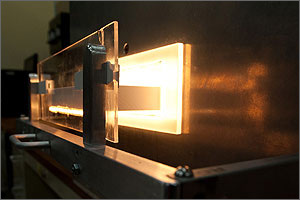
The cavity inside the Solar Optical Furnace glows white hot during a simulated firing of a solar cell.
Credit: Dennis Schroeder


Solar cells, the heart of the photovoltaic industry, must be tested for mechanical strength, oxidized, annealed, purified, diffused, etched, and layered.

Heat is an indispensable ingredient in each of those steps, and that's why large furnaces dot the assembly lines of all the solar cell manufacturers. The state of the art has been thermal or rapid-thermal-processing furnaces that use radiant or infrared heat to quickly boost the temperature of silicon wafers.

Now, there's something new.

A game-changing Optical Cavity Furnace developed by the U.S. Department of Energy's National Renewable Energy Laboratory uses optics to heat and purify solar cells at unmatched precision while sharply boosting the cells' efficiency.

The Optical Cavity Furnace (OCF) combines the assets that photonics can bring to the process with tightly controlled engineering to maximize efficiency while minimizing heating and cooling costs.

NREL's OCF encloses an array of lamps within a highly reflective chamber to achieve a level of temperature uniformity that is unprecedented. It virtually eliminates energy loss by lining the cavity walls with super-insulating and highly reflective ceramics, and by using a complex optimal geometric design. The cavity design uses about half the energy of a conventional thermal furnace because in the OCF the wafer itself absorbs what would otherwise be energy loss. Like a microwave oven, the OCF dissipates energy only on the target, not on the container.

Different configurations of the Optical Cavity Furnace use the benefits of optics to screen wafers that are mechanically strong to withstand handling and processing, remove impurities (called impurity gettering), form junctions, lower stress, improve electronic properties, and strengthen back-surface fields.

Making 1,200 Highly Efficient Solar Cells per Hour


NREL researchers continue to improve the furnace and expect it to be able soon to hike the efficiency by 4 percentage points, a large leap in an industry that measures its successes a half a percentage point at a time. "Our calculations show that some material that is at 16 percent efficiency now is capable of reaching 20 percent if we take advantage of these photonic effects," NREL Principal Engineer Bhushan Sopori said. "That's huge."

Meanwhile, NREL and its private-industry partner, AOS Inc., are building a manufacturing-size Optical Cavity Furnace capable of processing 1,200 wafers an hour.

At about a quarter to half the cost of a standard thermal furnace, the OCF is poised to boost the solar cell manufacturing industry in the United States by helping produce solar cells with higher quality and efficiency at a fraction of the cost.

The furnace's process times also are significantly shorter than conventional furnaces. The Optical Cavity Furnace takes only a few minutes to process a solar wafer.

NREL has cooperative research and development agreements with several of the world's largest solar-cell manufacturers, all intrigued by the OCF's potential to boost quality and lower costs.

R&D 100 Award Winner

NREL and AOS shared a 2011 R&D 100 Award for the furnace. The awards, from R&D Magazine, honor the most important technological breakthroughs of the year.

Billions of solar cells are manufactured each year. A conventional thermal furnace heats up a wafer by convection; a Rapid-Thermal-Processing furnace uses radiative heat to boost the temperature of a silicon wafer up to 1,000 degrees Celsius within several seconds.

In contrast to RTP furnaces, the Optical Cavity Furnace processing involves wafer heating at a relatively slower rate to take advantage of photonic effects. Slower heating has an added advantage of significantly lowering the power requirements and the energy loss, so it can boost efficiency while lowering costs.

"With all solar cells, optics has a big advantage because solar cells are designed to absorb light very efficiently," NREL Principal Engineer Bhushan Sopori said. "You can do a lot of things. You can heat it very fast and tailor its temperature profile so it's almost perfectly uniform."

In fact, the OCF is so uniform, with the help of the ceramic walls, that when the middle of the wafer reaches 1,000 degrees Celsius, every nook and cranny of it is between 999 and 1,001 degrees.

"The amazing thing about this is that we don't use any cooling, except some nitrogen to cool the ends of the 1-kilowatt and 2-kilowatt lamps," Sopori said. That, of course, dramatically lowers the energy requirements of the furnace.

The use of photons also allows junctions to be formed quicker and at lower temperatures.

As America strives to reach the goal of 80 percent clean energy by 2035, the White House and the U.S. Department of Energy are challenging the solar industry to reach the goal of $1 per watt for installed solar systems. To reach that goal, manufacturers need better, less expensive ways to make solar cells. At $250,000, the Optical Cavity Furnace can do more, do it quicker, and do it at a lower capital cost than conventional furnaces.

Twenty Years of Great Ideas

For more than two decades, Sopori had great ideas for making a better furnace.

He knew that incorporating optics could produce a furnace that could heat solar cells, purify them, ease their stress, form junctions and diffuse just the right amount of dopants to make them more efficient.

"It's always easy on paper," Sopori said recently, recalling the innovations that worked well on paper and in the lab, but not so well in the real world. "There are moments … you realize that no one has ever done something like this. Hopefully it will work, but there are always doubts."

Trouble was, he'd come up with some elegant theoretical solutions involving optics, but wasn't able to combine them with the optimal geometry and materials of a furnace. "We've had a whole bunch of patents (12) to do these things, but what we were missing was an energy-efficient furnace to make it possible," Sopori said.

And then, combining his expertise in optics with some ingenious engineering with ceramics, he had his ah-ha moment:

NREL's Optical Cavity Furnace uses visible and infrared light to uniformly heat crystalline silicon wafers, especially at the edges, which are prone to cooling or heat loss, at unprecedented precision. The rays heat the sample, but the wafer never physically contacts the lamps.

The Optical Cavity Furnace is versatile. Each step in the solar cell manufacturing process typically requires a different furnace configuration and temperature profile. However, with the OCF, a solar cell manufacturer simply tells a computer (using NREL proprietary software) what temperature profile is necessary for processing a solar cell.

So, the OCF can perform five different process steps without the retooling and reconfiguration required by the furnaces used today, all the while incrementally improving the sunlight-to-electricity conversion efficiency of each solar cell.


Source: National Renewable Energy Laboratory (NREL)

Thursday, September 29, 2011

Silicon Ink Is Spot On, NREL Experiments Show

National Renewable Energy Laboratory (NREL)
Sept 29, 2011

Ink can cause a mess, but the Silicon Ink developed by Innovalight behaves itself so well that when it is added to a solar cell it doesn't clump or spill, instead it boosts the cell's power by a startling, profit-boosting 5 to 7 percent.

Both solar cells and T-shirts can be enhanced with a screen printer, some ink and a squeegee.

But it takes a real special ink to suspend silicon nanoparticles so uniformly that it can lay down the precise microns-thick lines needed to dope the silicon emitter exactly under the front metal contacts. Those contacts make a solar cell work.

Innovalight, a small start-up from Sunnyvale, Calif., came up with an ingenious way to suspend silicon in a solution without the tiny particles glomming onto one another or sinking to the bottom of the container.

But could that Silicon Ink prove useful for solar cells?

Researchers at the U.S. Department of Energy's (DOE) National Renewable Energy Laboratory (NREL) proved that the answer is "yes." And the winners could be the solar cell industry and the environment, because Silicon Ink, when added to the manufacturing process, can make solar cells more efficient and save a large plant hundreds of millions of dollars each year.

NREL and Innovalight shared a coveted R&D 100 award for 2011 for the Silicon Ink technology. Given by R&D 100 Magazine, the R&D 100 awards are referred to in the industry as the "Oscars of Invention." Silicon Ink's ability to boost efficiency in such a low-cost way prompts some in the industry to label it "liquid gold."

Impurities in Silicon Are Key to Making Contacts, Making Electricity

Silicon is the key ingredient in most of the billions of solar cells made each year worldwide.

Dopants or impurities are used to change the conductivity of silicon and to create the internal electric fields that are needed to turn photons into electrons and thus into electricity. One of the great challenges is to distribute the exact concentrations of dopants in precisely the correct locations throughout the device.

Innovalight scored big with Silicon Ink because it found a way to suspend silicon nanoparticles evenly in a solution. Those silicon nanoparticles contain dopant atoms that can be driven into silicon solar cell to form a selective emitter.

What Innovalight's potential customers and investors wanted to know was whether the ink can deliver high concentrations of dopants to extremely localized regions of the emitter and increase a solar cell's efficiency.

NREL Senior Scientists Kirstin Alberi and David Young listened to what Innovalight wanted to prove and then suggested some experiments that could help them prove it.

"The question was, 'can you print this ink in very well defined lines and drive in dopants only in the material underneath the lines to create a well-defined selective emitter," said Alberi, who began at NREL three years ago as a post-doctorate researcher. If so, the increased concentration of dopants right under the contacts would lower the resistance at the metal contact, while the rest of the cell contained low-doped silicon — and that would mean jumps in efficiency and savings of huge amounts of money.

"On some level, you want the emitter to be highly doped so it makes a better contact with the metal," Alberi said. "But if it's too heavily doped elsewhere, that's bad."

That's why a "selective emitter" that is heavily doped only in precise portions of a solar cell is such a promising technology.
To read more click here...

Friday, August 19, 2011

Low Emission Cars Under NREL's Microscope

National Renewable Energy Laboratory (NREL)
Aug 18, 2011

Cars that plug into solar panels for electricity or run on hydrogen may sound like something found only on the pages of science fiction novels, but engineers at the U.S. Department of Energy's (DOE) National Renewable Energy Laboratory (NREL) are driving these futuristic vehicles today.

Recently, NREL engineers were able to spend six weeks kicking the tires on a Kia Borrego Hydrogen Fuel Cell Electric Vehicle (FCEV) and ongoing agreements with Toyota and Mitsubishi mean a plug-in Prius and Mitsubishi i MiEV electric vehicle will be demonstrated and tested at NREL for the foreseeable future.

"DOE wants people to see that these vehicles are not just drawings on some designer's table," NREL Vehicle Systems Engineer Mike Simpson said. "These technologies are practical, real and getting out into the marketplace."

Simpson is leading a DOE/NREL program to acquire advanced technology vehicles to support research at NREL with a secondary goal of displaying and demonstrating the technologies to consumers. "We have displayed all of these vehicles at public events this summer to help consumers see how all of these technologies can meet the needs of today's drivers," Simpson said.

Vehicles in NREL's fleet feature promising technologies designed to increase efficiency, reduce emissions, and use renewable resources without sacrificing safety or comfort.

NREL engineers collect real-world data on these vehicles to evaluate their performance. The research findings are made available to vehicle manufacturers along with the DOE and other national laboratories. In addition to the Prius and i MiEV, NREL has evaluated a Mercedes-Benz A-Class F-Cell vehicle and is actively looking to expand.

"We are currently working with a number of manufacturers to bring more plug-in and fuel call vehicles to NREL," Simpson said. "We are bringing them in to support testing in areas unique to NREL like grid integration and thermal effects on comfort and batteries."

Monday, July 11, 2011

NREL Supports Industry to Develop Computer-Aided Engineering Tools for Car Batteries

National Renewable Energy Laboratory (NREL)
July 7, 2011

The U.S. Department of Energy’s (DOE) National Renewable Energy Laboratory (NREL) recently awarded three industry teams, after a competitive procurement process, a total of $7 million for the development of computer-aided software design tools to help produce the next generation of electric drive vehicle (EDV) batteries.

These projects support DOE’s Computer-Aided Engineering for Electric Drive Vehicle Batteries (CAEBAT) program. The objective is to help the automotive and battery industries design and develop a wide array of advanced EDV batteries more quickly, resulting in less expensive batteries.

EDVs — hybrid electric vehicles, plug-in hybrid electric vehicles, and electric vehicles — have the potential to significantly reduce petroleum consumption and greenhouse gas emissions. Project goals for the selected teams include:
Developing battery engineering tools to design cells and battery packs
Shortening the battery prototyping and manufacturing processes
Improving overall battery performance, safety, and battery life
Reducing battery costs.

Each team will independently develop and validate computer-aided engineering tools, with an emphasis on electrochemical, electrical, mechanical, and thermal issues. They also will integrate different chemistries, cell geometries, and battery pack configurations. NREL anticipates that the resulting systems will become competitive marketplace offerings in the near term. The three industry teams working with NREL are:
EC Power, Penn State University, Johnson Controls, Inc., and Ford
General Motors, ANSYS, and ESim
CD-adapco, Battery Design LLC, A123 Systems, and Johnson Controls-Saft.

Selected teams will contribute 50 percent of the costs of the project over the next three years bringing the overall project budget to $14 million. In addition to funding, NREL will provide technical support on battery electrochemical –thermal modeling and testing to the teams.

This activity is funded by DOE’s Vehicle Technologies Program at the Office of Energy Efficiency and Renewable Energy.

NREL is the Department of Energy’s primary national laboratory for renewable energy and energy efficiency research and development. NREL is operated for DOE by The Alliance for Sustainable Energy, LLC.

Visit NREL online at www.nrel.gov