Pages

Subscribe:

Labels

038628037504 (1) 10150 (1) 10BURIED (1) 10Count (1) 110011040 (1) 115Ounce (1) 1200mg (1) 12BSN (1) 12Count (2) 12CountNutricor (1) 12CountWWSN (1) 12Fresh (1) 12Stacker (3) 12VPX (1) 140243 (1) 14Servings (1) 158Ounce (1) 15Ounce (1) 16Ounce (2) 1716 (1) 17Skque (1) 1lbinLife (1) 2000Hrs (1) 2000mg (1) 200Watt (1) 2021A (1) 20OunceNatures (1) 2412Ounce (1) 24Count (1) 24EAS59134 (1) 24FRS (1) 24Guru (1) 24Guru01GR124 (2) 24Nestle (2) 24Pediasure (2) 24Peptamen (1) 24PieceDisplay (1) 24Solis (2) 27ReSource (2) 2Biochem (1) 2Dynamic (1) 2Jarrow (1) 2Muscle (1) 2Natures (1) 2Ounce (3) 2Pound (1) 30Day (1) 328601 (1) 334928 (1) 336gOptimum (1) 37Ounce (1) 3Ensure (1) 3M (1) 414 (1) 432500 (1) 48Boost (1) 48Fluid (1) 48ml (1) 4Ensure (1) 4Isopure (1) 5000mg (1) 527408 (1) 5511786 (1) 574400 (1) 5Hour (2) 5Ounces (1) 600Kendall (1) 662380 (1) 6Beneprotein (1) 6Proteinex (1) 70951 (1) 750mlNutriPrima (1) 845Ounce (1) 84Fluid (2) 84OuncesLiquid (1) 89Inch (1) 8nuun (2) 8Ounce (7) 99369FR (1) ABB (3) Academy (1) ACCENTS (1) Acia162Ounces (1) Acsry (1) Active (2) Adapter (1) AdapterBattery (1) Advance (1) Advanced (1) Advantage (1) AdvantEdge (1) Africa (29) African (1) Agaricus (1) AiCoco (1) AIDSTrustex (1) Airbrush (1) Airbus (6) Aircraft (94) AISI (1) Ajmeras (1) Alchohol (1) Alertness (1) Alfalfa (2) Alive (1) Allergy (1) Allspice (8) Alpine (1) Alstom (2) Alternative (1) Amarillo (1) Amazing (3) Amazon (2) American (1) animal (11) Annual Reports (155) Antioxidant (1) Anwar Ibrahim (1) Apple (1) Applied Materials (1) Arrowroot (1) AshtonDrake (1) Asia (72) Assorted (1) Atkins (1) Audi (1) Australia (21) Automotive (250) Automotive Technology (183) Ayurvedic (1) BABIES (1) Babys (1) Bacopa (1) BagAtkins2627 (1) BagsTraditional (1) BagSun (1) Balanced (1) Ballard Power System (1) Banaba (2) Baram Dam (1) Baram Regatta (1) Bariatric (1) Barisan Nasional (2) Barisan Nasional Helps Penan (1) Barista (2) Barley (2) barsBiochem (1) Basement (1) BASF (2) Basics (1) Batu Lawi (1) Bayer (1) BEA1017OZ (1) Beachbody (1) Beaded (1) Beaumont (1) beautiful girl image (19) Beauty (2) Beneprotein (2) Berries (3) Berry (4) BerryLiving (1) Beverage (1) Bicycle (1) BioAstin (1) Biochem (4) Biofuel (12) Biogenesis (2) BlackBlender (1) Blend (1) Blender (4) Blueberry (1) BlueStereo (1) BMF (1) BMW (7) BMX (1) BN (1) Boeing (4) Bombardier (4) Book (1) Borneo (6) Bottle (8) BottleProStat (1) Bottles (15) BottleScivation (1) bottlesEnsure (2) BottlesMio (1) BoxChenille (1) BoxDarice140243 (1) BOXESAmerican (1) BoxesFRSPowder (1) BoxPremier (1) BP (2) Brands (1) Brands833667000102 (1) Brazil (10) Brazilian (1) Breeze (3) BrewersBarista (1) BRIC (118) Brikpaks (3) Brownie (1) Bruno Manser (1) Bruno Manser Fund (3) Bruno Manser Fund Fraud (1) Bruno Manser Fund Frauds (1) Bruno Manser Lies (2) BTL410400 (1) Bubbles (1) Burner (1) business (72) Butchers (1) Butter (1) Butterscotch (1) Cable (1) Cables (1) Calcium (2) California (1) Calorie (3) Camera (1) Canada (11) Candela (1) Canister (2) CanisterCLICK (1) Canisters (1) Canning (1) Capramilk (1) CapsSwanson (1) Capsule (5) Capsules (6) CapsulesEAS (1) Caraway (1) Cardio (1) Carnation (1) CaseEnsure (2) CaseNestle (2) Celebrity (22) CellularFactory (1) Celsius (1) Certification (28) Certified (2) Chameleon (1) Charger (1) Charter/Terms of Reference (27) CHEAP (135) Chenille (1) Cherry (1) CherryZydot (1) Chevron (1) Chewing (1) Chile (1) China (99) Chipotle (1) Chlorophyll (1) Chocolate (7) Chocolate8 (1) Choice (2) Cholesterol (1) Chrome (1) Chrysler (1) Chunho (1) Citrifolia (1) Citroen (1) Citroën (1) Citrus (2) Civil Service (1) CK Morris Associates (1) Clare Rewcastle Brown (2) Class (1) Classic (2) Clinical (1) CNST (1) Coenzyme (1) Coffee (4) Coffee11001105 (1) Coffee7DSC2B (1) Coffeehouse (1) Cold Fusion (1) Coldkicker (1) Collectable (1) Collection (1) Colored (1) Colors (1) Communications (14) Company (2) COMPLETE (4) Complex (1) Computer (1) Concentrate (1) Concentrated (1) Concepts645654 (1) Condoms (1) Container (7) CONTROL20BGSee (1) Corrections (3) CosMedix (1) count (1) countAmscan (1) CountMy (1) Crayola (3) Criminal (4) Cruiser (1) Crunch (1) Cytosport (2) Daimler (3) Dam (1) DAP (1) DAP Lies (1) Darice (1) DARPA (18) Dato Roland Sagah Wee Inn (1) Defence (60) Defense (61) Delight (2) description (1) Desert (7) Design (65) DESIGNER (3) Desktop (1) detail (1) Detroit (1) Development (1) Dexatrim (1) diameter (1) diameterGaming (1) Diecast (1) Dinosaur (1) DISCOUNT (4) Discover (1) Disney (1) Doctors (1) DoE (8) DolphinsSticky (1) DOMAGRON (1) Dow Corning Corp (2) DP9260 (1) DRA6329 (1) Dragon (1) Dressing (1) Drink (11) Drinkin (1) drinksNVE (1) Dupont (2) dv9657clSIBCORP (1) Dymatize (3) DYMMGV (1) DYNAMIC (5) EachHager (1) EADS (12) ecigs (1) Eco-Tourism (1) Economy (14) Education (1404) Electra (1) Electric Grid (1) Electrolyte (4) ELP3STSL (1) Endorush (1) Endurox (2) Energizing (1) Energy (540) English Article (20) Enhanced (1) Enhancer (1) Enlive (2) Ensure (12) Enterprise (1) Environment (170) Enzymatic (1) Eraser (1) ERECTION (1) Ergonomics (4) ESA (4) Espresso (1) Essence (2) Essentials (3) EssentialsHSE (1) ethnic group (1) Europe (201) Executive/External Ombuds (2) Extended (2) ExtenderBadger (1) Extension (1) Extern/Intern (20) Extract (5) Extreme (21) Factor (1) Factors (3) Fantastic (1) Fatigued (1) Faucet (1) feature (9) Featuring (1) Fellowes (1) Fillet (1) First Energy (6) Fitera (2) FlatScreen (1) Flavor (1) FlavorBeachbody (1) Focus28 (1) Ford Motors (7) Foreign NGOs (2) Forest (1) formula (5) Formulas (1) Forts (1) FORUM (1) Fragrance (1) France (12) Frappuccino (1) FreeHubner (1) French (2) Friday Poll (13) Frontier (1) Frost (1) Fruits (1) Ft1140Alessco (1) Ft132Alessco (1) FToys (1) Fudge (1) Fuel Cell (26) Fujitsu (2) funny (19) Gadget (6) Galleries (1) Gallon (1) GameJax2000 (1) Games (1) General Electric (21) General Motors (15) Genesis (1) Georges (1) Germany (28) Go02658 (1) Golden (1) Goldfinch (2) Goodyear (1) Google (6) Gordoni (1) Gourmet (1) Government (333) Grape (2) Grape5 (1) Green Energy (544) Greens (2) GripAlex (1) Ground (7) Guarana (1) Halal Hub (1) Hammer (1) Hardware (1) Hasbro (1) Hawaiian (1) health (19) Health Care (87) Healthy (4) Herbal (5) Herbals (1) Himalayan (1) Holiday (1) Honda (4) Honeywell (1) Hoodia (1) HPCompaq (1) Hubner (1) human capital development (1) Humor (18) Hydration (2) hydration8PKNUUNLL (1) Hydrive (1) Hyundai (2) IBM (2) Illegal Demonstrations (1) iMicro (1) IMMICRP (1) India (23) information (8) Infrastructure (44) inLife (1) Inside Invester Ltd (1) Instantized (1) Institute (1) International (338) Internet (7) Intestinal (2) Investment (187) IOA News (168) ISO (1) ISO100 (1) Isolate (2) Isopure (4) Isotonix (1) Italian (2) Italy (1) Jabatan Penerangan (1) Jameson Ahip Nawie (1) Japan (57) JarALTERNATIVE (1) JarDoctors (1) Jarrow (1) Job Postings (339) Johnson Controls (1) Journey (2) Juice (2) JUICECRANBERRYOG2 (1) JuiceTahitian (1) Kangmei (1) KCups (1) Kerlix (1) Kettler (1) Kettler8852600 (1) Keurig (1) Keyboard (1) Kiddio (1) KitBerg (1) KiteSpiderMan (1) KitGoldfinch (1) Kombucha (2) KombuchaKIT (1) Kraft911501 (1) Kuching (1) Laboratories (1) Langnickel (1) LaptopNotebook (1) lbBioGenesisRICE3 (1) lbsNatural (1) Leading Indicators (450) Lean (10) LeapFrog (3) Learning (1) Leaves (2) Leccino (1) Legislation (65) Lemonade (2) Lemonlime (1) Len Talif (1) License (1) Lifetime (2) Light (1) LightHog (1) LINERBLADDER (1) Liquid (20) LiquidDeSouzas (1) Litigation (45) Living (2) Lockheed Martin (6) Looking (1) Lubricants (1) Lubricated (1) Macbook (1) Malaysia (4) MaleFemale (1) Management (16) Manufacturing (394) Marine Technology (2) Materials (446) Mazda (2) Medical (84) Medicinals (1) MEGAWING (1) Mental (1) Mercedes-Benz (3) Merdeka (2) Metabolic (1) MetaboLife (1) Metallic (1) Metamucil (1) MetersCables (1) Middle East (16) Miniatures (1) MioEnergy (1) Miradent (1) Miri (1) MIRROR (1) Mitsubishi (4) Monkey (2) Monster (1) Morinda (1) Morton (1) Mosacis (1) Mosaics (1) Mothers (1) MountScotty245 (1) MultiPackCELSIUS (1) MultiPackDYNAMIC (2) MultiPackLILY (1) MultiPackLIQUID (1) MultiPackMACA (1) MultiPackONLY (1) Multiracial (1) Mulu (1) Muscle (1) Muscletech (2) Myoplex (1) Nanotechnology (279) NASA (22) National Laboratory (46) Natural (12) natural phenomena (11) Naturally (1) Naturals (3) Natures (6) Naturessunshine (4) nc8000 (1) nc8220 (1) nc8230 (1) Nesting (1) Nestle (2) Netbook (1) New Programs (133) New Zealand (2) NGO's (213) NGOs (1) Nickel Hydrogen (1) Nissan (8) NIST (5) North America (18) Northrop Grumman (1) Norway (1) NovoAndina (2) Noxide (1) NREL (8) NSF (3) NTT Data (1) Nuclear (45) Numbers (1) Nuspeed (1) Nutrex (1) Nutricor (1) Nutrient (2) Nutrients (1) NutriPrima (1) Nutrition (15) Nutritional (5) NutritionON45 (1) nw8000 (1) nw8240 (1) Offshore (7) OilsAWM (1) OintmentWounded (1) Olives (1) Onshore (2) Optical Technology (28) Optimum (4) Optisource (2) Orang Ulu (1) Orange (7) OrangeHigh5 (1) Organic (12) Original (2) Other Ombuds (145) Otomotif (2) ounce (1) Ounces (5) OuncesSea (1) OunceThe (1) Outside the Standards (62) Oxford Business Group (1) OyToys (1) OzAfrican (1) ozNatures (1) Packages (1) Packet (1) Packets (1) PacketsNatures (1) PacketsUltima (1) Packs (2) PackStarbucks (1) PadCrayola (1) Paradise (1) Parazyme (1) Parents (1) Parmigiani (1) Pavilion (1) Pecan (1) Pediasure (3) Pehin Sri Haji Abdul Taib Mahmud (1) Penan (9) Pepper (1) Peppermint (1) Peptamen (1) Peter Jaban (2) Pharma (1) Pharmaceuticals (1) Phillips (1) Pickling (1) Pieces (1) PineappleGU (1) PinkBlender (2) PKR (1) PlantBased (1) Plantiva (1) Plastic (8) PN0223 (1) Pomegranate (1) PomegranateGU (1) Porsche (1) PostCXDNSR105 (1) Poundlb (1) Pounds (1) PoundsClif (1) Powder (20) Powdered (1) PowderEndurox (1) PP1235BBS (1) Practice Pointers (185) Prebio (1) PregNatal (1) Premier (1) Premium (3) preservatives (1) Preston (1) Private Sector (174) Proasis (1) Products (2) Professional Devt. (254) Profiles (257) Projector (1) Proscience (1) ProStat (2) protein (14) Proteinex (1) Protidiet (1) Proxima (1) Pudding (1) Punch (1) Purpose (1) Puzzle (1) R. Palan and Sabariah Putit (1) R4Lemon (1) Rail (41) RAINBOW (1) Rainforest (2) Raspberry (1) REA6048 (1) ReadytoDrink (1) Reaper (1) Recovery (2) Regional Events (101) Regular (2) Release (2) Remedies (1) REMEDIES4582008 (1) Replacement (2) Replenisher (3) ReplenisherUltima (1) Research (1) Research and Development (825) ReSource (4) Results (1) Revitalization (1) Roasted (1) Robotic Technology (124) Rocket (2) Rolls royce (7) Rooibos (1) Rosemary (1) ROSSLARE (1) Russell (1) Russia (17) Safety (15) Sains (20) SaltFree (1) Samalaju (4) Sammons (1) Samsung (1) Sarawak (13) Sarawak 10th State Election (1) Sarawak Borneo (7) Sarawak Budget 2012 (1) Sarawak Corridor of Renewable Energy (SCORE) (8) Sarawak Development (1) Sarawak Economics (1) Sarawak Economy (6) Sarawak ethnic groups (1) Sarawak Forest Corporation (2) Sarawak Politics (4) Sarawak Rainforest (2) Sarawakian (7) Satellite (6) Saudi Aramco (1) ScaledStar (1) Scholarly Articles/Research (102) science (50) Scivation (1) ScottishPower Renewables (1) Scotty (1) Seasoning (1) SEB (1) Secura (1) Seks (12) Senior Citizens (1) Series (1) serving (2) Servings (2) servingsBariatric (1) Shades (1) shake (4) Shaker (1) SHEETSHygloss (1) Shell (1) ShotCL27752 (1) Siemens (8) Silicone (1) Silver (1) Singapore (2) Single (1) Sleeve (1) SlimFast (1) Slimming (1) SlimStyles (1) SM005Grey (1) Smart (1) smartphone (1) Smoke (1) Smoothie (2) Smore (1) SoftCarpets (2) Softgels (1) Sony (1) Souffle (1) Source (2) South Africa (11) South America (11) South Korea (1) Space Technology (69) Sparkling (1) SpiderMan (1) Sponge (1) SpongeSammons (1) Sport (8) Sports (7) Springtime (1) Stacker (4) Starbucks (1) Starwest (2) Stems (1) Stereo (1) Sterile (1) Sticker (1) Sticky (1) Stomach (2) Strawberry (3) Strength (3) Strive (1) SumoMESUMO66897 (1) Sundries (5) Sunkist (1) Sunwarrior (1) SuperGreens (1) Supplement (4) Supplier (1) supply (3) Support (4) Supreme (2) Sustainable Forest Management Policy (2) Switzerland (2) System (3) Tablet (2) Tablets (3) TabletsTwinlab (1) Tahatian (1) Tahitian (1) Taib Mahmud (6) Taisho (1) Tanjung Manis (1) Tanjung Manis Halal Hub (1) Tartar (2) Tata (4) Tattoos (1) Technology (562) Temporary (2) Temptations (1) Tesla (1) Testors (1) Thalgo (1) The Report 2011 (1) Therapeutic (1) TinTea (1) Tips (25) Tokuyama (1) Topical (1) totalBoost (1) Toyota (15) Toys21030000 (1) ToyTote (1) Transitions (255) Transphorm (1) Transport (135) TREASURE (1) TrikeKiddio (1) Tropical (2) Trumans (1) Trustex (1) Tubes30 (1) Twinlab (2) Twistables (1) Two Hats (2) Uganda (1) UK (107) Ulticare (1) Ultima (3) Ultimate (1) Ulu Baram (1) Unflavored (1) Unibody (1) Unique (53) United States (281) University (1) Unknown (1) Uranium (1) USDA (1) Vale (1) Vanilla (10) Vanilla8 (1) Varcho (1) Variety (3) VegCap (3) Vehicle (1) Video (30) Viennese (1) Visitor Advice (70) VIT033 (1) Vitacost (5) Vitalyte (1) Volkswagen (5) Volvo (2) VTL200CIR (1) Warrior (3) WarsATST (1) Water resources (1) Water Technology (28) Watermelon (1) Wedding (1) Weight (2) Whole (2) Wild10650 (1) Wooden (1) World news (67) Worldwide (1) Wounded (1) Xtend (1) Xtreme (1) Xylitol (1) ZeroCherry (1) ZipFizz (1) ZoomOxo4113600 (1) ZZP88103 (1)

Showing posts with label Rail. Show all posts

Thursday, March 1, 2012

Materials: Building lightweight trains

Engineerblogger
March 1, 2012


These diesel trains for housing is manufactured from a light polyurethane-based material, yet extremely durable. Source:  Fraunhofer ICT

The less trains weigh, the more economical they are to run. A new material capable of withstanding even extreme stresses has now been developed. It is suitable for a variety of applications, not least diesel engine housings on trains – and it makes these components over 35 percent lighter than their steel and aluminum counterparts.

In their efforts to render cars and trains more economical, manufacturers are trying to find lighter materials to replace those currently used. But there is a problem: Lighter materials tend not to be as tough as steel or aluminum, so they cannot simply be used in place of these metals. Rather, it is a question of manufacturers deciding which components can really afford to have weight shaved off and how to integrate them into the overall systems.

Working together with Bombardier GmbH, KraussMaffei Kunststofftechnik GmbH, Bayer MaterialScience AG, DECS GmbH, the DLR’s Institute for Vehicle Concepts, the University of Stuttgart and the Karlsruhe Institute for Technology, researchers at the Fraunhofer Institute for Chemical Technology ICT in Pfinztal have now developed a polyurethane-based sandwich material that is extremely resilient. “To demonstrate the material, we manufactured a component that is subject to significant stresses and which has to fulfill a number of requirements – the diesel engine housing for a train,” says Jan Kuppinger, a scientist at the ICT. This housing is located beneath the passenger compartment, i.e. between the car and the tracks. Not only does it shield the engine against flying stones and protect the environment from any oil that might escape, but in the event of a fire, it also stops the flames from spreading, thus meeting the flame retardant and fire safety standards for railway vehicles. Kuppinger adds: “By using this new material, we can reduce the component’s weight by over 35 percent – and cut costs by 30 percent.”

The researchers opted for a sandwich construction to ensure component stability: Glass fiber reinforced polyurethane layers form the outer facings, while the core is made of paper honeycomb. Polyurethane is a bulk plastic combining two substances. Since it can be adapted to fulfill various requirements, it is referred to as a ‘customizable material’. In foamed form it is soft, and can be used for example as a material for mattresses; in compact form it is strong and hard. The researchers began by incorporating various additives into their polyurethane, altering it in such a way as to ensure it would meet fire safety standards. Then, the partners optimized the standard manufacturing process, fiber spraying, by developing a mixing chamber which allows even more complex structures to be produced in any required size. The diesel engine housing they made is approximately 4.5 meters long and more than 2 meters wide. “This is the first time it has proved possible to use this process to manufacture such a large and complex component that also satisfies the structural requirements,” states Kuppinger. Previously, one problem encountered with fiber spraying was that it was impossible to determine the precise thickness of the polyurethane top layers. But now the researchers have found a way to do this, using computer tomography to inspect the manufactured layers and then applying a specially-adapted evaluation routine to establish their exact thickness. This information helps to simulate the strength of the component, as well as its ability to withstand stresses.

The scientists produced their diesel engine housing demonstrator as part of the PURtrain project, which is funded by the German Federal Ministry of Education and Research (BMBF). The demonstrator passed its first strength test – in which the scientists placed it in a test rig and then applied forces to it at various locations, measuring the extent to which it deformed – with flying colors. In the next stage, the researchers want to trial the component in a proper field test. If that, too, proves successful, it will then be possible to use the material to make roof segments, side flaps and wind deflectors for the automobile and commercial vehicle industry, and to ramp up the manufacturing process to produce medium volumes of between 250 and 30,000 units.

Source: Fraunhofer-Gesellschaft

Tuesday, February 21, 2012

Damage detection: Using vibration monitoring to pick up signs of wear

The Engineer
Feb 20, 2012

Eight of the 16 axles on a Desiro train are driven by their own motor

Siemens is reaping the benefits of using vibration monitoring to pick up signs of wear to the bearings of train traction motors. Stuart Nathan reports

Keeping Britain’s trains running is a concern close to the hearts of a very large proportion of the working population and Siemens, supplier of many of the trains on the UK’s rail network, takes it very seriously. Condition monitoring is an important part of the toolkit.

The company has recently begun using an innovative technique to pick up signs of wear to the bearings of its train traction motors, enabling it to overhaul the motor before it breaks down and saving both time and money.

’If we can detect signs of wear to traction motor bearings, we can repair or replace that motor at our own convenience before more significant damage occurs,’ explained Peter Ridgway, production support engineer at Siemens Mobility, Rolling Stock. ’The cost of repairing a damaged traction motor would be many times the cost of a standard overhaul.’

The method used by Siemens is vibration monitoring, which is becoming more widespread within the industry. The company turned to specialist Schaeffler - which Ridgway found on an Internet search - to solve a problem that had arisen in the traction motors of its Desiro electrical trains.

Desiro trains normally comprise four coaches, each with two bogies that hold two axles. On each train, eight axles are driven via their own asynchronous traction motor.

Friday, January 6, 2012

Radar could detect objects that have fallen on railway tracks

Engineerblogger
Jan 6, 2012


Radar devices could soon be fitted in railway stations to prevent accidents by detecting luggage or people that fall onto the tracks.

Researchers from French research centres IFSTTAR and IEMN have demonstrated a system that uses ultra-wideband radio waves to detect and characterise objects that fall on train tracks and alert station operators to reduce delays and avoid accidents.

‘With the possibility of trains, passengers and even poor lighting, in some instances, obscuring the view of CCTV cameras, radar techniques could certainly be effective in these scenarios,’ said Ali Mroué, lead author of the research published in the journal Measurement Science and Technology.

The Automatic Target Recognition (ATR) procedure defines and simplifies the characteristics of an object when it is detected, and then compares the information to a database to determine what the object is.

Using a computer simulation, the researchers initially tested out a number of objects, ranging from suitcases to glass bottles, and several models of the human body: an adult, a teenager and a child.


Real-life experiments were then performed in a small, echo-free chamber, using a 3m-long waveguide — a solid beam-like structure that guides the radio waves in a certain direction, in this case towards the object being measured. These showed the system was able to differentiate between luggage and people.

‘We hope these devices will be used in the near future since they are very complementary to existing video systems and have a similar final cost,’ said Mroué.

‘The complementary use of video and radar systems could lead to low levels of false detection, which is mandatory for this application, and maximise the chance of survival for passengers who have fallen on the line.’

Source: The Engineer

Monday, December 19, 2011

Boarding a moving train: The way to speed up rail travel?

Engineerblogger
Dec 19, 2011

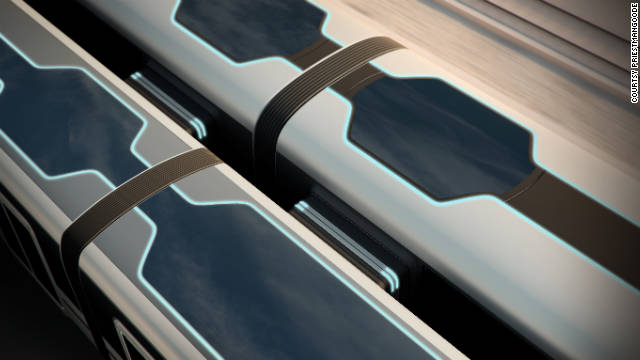
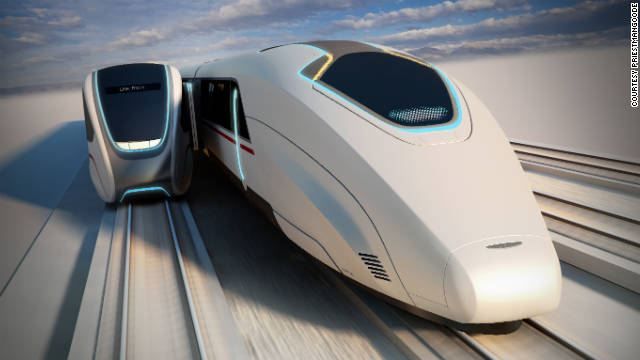
The 'Moving Platforms' concept envisions city-wide tram networks that are integrated with a high-speed rail service.  Credit: CNN

A designer has come up with a unique and futuristic solution for speeding up rail travel: he doesn't want to change the engines, or the tracks -- he wants to get rid of the stations.

Determined to take rail transport into the 21st century, Paul Priestman, director of British design group Priestmangoode, is the man behind the "Moving Platforms" concept, which he believes could potentially revolutionize the rail industry.

His scheme would see travelers served by a carousel of trams and high-speed trains that would take passengers from their homes to their destinations without them ever having to use a bus, car or taxi.

"The idea with Moving Platforms is that ... if you were going on holiday or on business for instance, you could get onto a tram on your street and then seamlessly travel from that onto the high-speed line and then get off at your destination in another city, then onto a tram and then end up at your destination without ever having gone in your car or perhaps got on a bus," says Priestman.

"It's totally integrated into a sort of larger transport system," he adds.

The idea is to have a city-wide network of trams that travel in a loop and connect with a high-speed rail service.

But instead of passengers having to get off the tram at a rail station and wait for the next HSR service to arrive, the moving tram would "dock" with a moving train, allowing passengers to cross between tram and train without either vehicle ever stopping.

"The trams speed up and the high-speed train slows down and they join, so they dock at high speed," explains Priestman.

"They stay docked for the same amount of time that it would stop at a station," he adds.

Credit: CNN
 "There are big doors, there are wide doors, they're all the same level so you can seamlessly go between the two vehicles quite peacefully; there's no hurry.

"Then, when everyone's done that, the doors shut and then the trains separate and the tram then goes back into the city or town and picks up more passengers and drops off passengers."

Instead of using paper tickets to pass through a barrier, passengers would used an RFID (radio-frequency identification) system to transfer from tram to train. Similar systems that let passengers scan pre-paid smartcards are already used on many public transport networks.

While Priestman admits that it will be some time before his vision could be implemented, he says the time has come to rethink how we travel.

"This idea is a far-future thought but wouldn't it be brilliant to just re-evaluate and just re-think the whole process?" he says.

Source: CNN

Related Information:

Monday, November 21, 2011

Research could boost durability, cut cost of railroad tracks

Engineerblogger
Nov 21, 2011


Every year, companies that own railroad track across the United States spend millions of dollars maintaining ballast, the crushed rock underneath railroad ties and steel rails. In addition to the high cost, railroads must reroute trains around operations that maintain ballast, delaying the delivery of freight.

Now, research at the University of Kansas may help to extend the useful life of ballast, with the aim of saving time, money and the need to quarry new rock. Investigators in the School of Engineering are conducting a study on the promise of making ballast more durable using “geogrid,” a type of polypropylene netting typically employed in reinforcement of soil.

“Ballast helps to redistribute the load from the trains,” said Bob Parsons, professor of civil, environmental and architectural engineering at KU. “Ballast is composed of large rock, but over time it gets contaminated from finer particles from rock dust, natural dust and coal dust from coal trains. And you have the soils from underneath coming up. So the fine particles fit between the larger stones of the ballast and contaminate it.”

Parsons said that the dust that infiltrates the ballast — a process called “fouling” — prevents water from properly draining from the ballast.

“If the water is allowed to stand there and soak in, the soils under the railroad are going to get soft and weak — then the ballast sinks down, and the track moves and gets out of alignment,” said Parsons.

To maintain track integrity, railroad companies must remove, clean and replace ballast in a laborious process called “undercutting.”

“Undercutting is a significant maintenance action where a railroad will lift up the track and a chainsaw-like device will saw out the upper layer of ballast.” Parsons said. “That ballast is run thorough a sieve where the fines are taken out, so you have just the larger pieces left, and that’s recycled and put back on the track.”

With nearly 150,000 miles of freight railroad track crisscrossing the U.S., improvements to the resilience of ballast could result in huge cost savings.

The KU researcher and his team have constructed a test segment of railroad track reinforced with triaxial geogrid made by the Tensar Corporation based in Alpharetta, Ga. The mesh material with triangular openings is used to reinforce the ballast and trap the larger rocks in a layer that could prevent fouling by dust and small particles.

“It’s a netting made of triangles. The ballast is placed on top of the geogrid,” said Parsons. “It will help with the rock breaking down and help lock the ballast into place and keep it from moving. By providing a framework, and making it more rigid and fixed and stronger in general, it prevents the ballast from breaking down into smaller particles.”

To test the performance of the geogrid, Parsons, along with colleagues and graduate students, built a test section of railroad under a specialized H-frame on a reinforced concrete base that supports a hydraulic cylinder with a 200,000-pound capacity. The researchers applied weight to the track section using ballast with geogrid and without.

“We built a railroad test section with two feet of sub-grade natural clay soil, and two feet of ballast with the railroad section sitting on those two feet,” Parson said. “Then we loaded it with a series that started with around 25,000 pounds for 100 cycles, and then we stepped that load up to about 95,000 pounds. We measured the settlement that caused. Then we soaked it with water, then came back and loaded it again, and that caused a significant amount of additional settlement.”

The researchers measured rock breakage and accumulated dust resulting from the test loads. They are still analyzing the data, but Parsons said at first glance the ballast without the geogrid looked wet and had broken down into smaller pieces, while the ballast with geogrid did not appear to be as fouled by small particles.

“There’s a need for something to improve the performance of the ballast,” he said.

Source: University of Kansas

Monday, September 19, 2011

Train technology to save time, energy and money

Engineerblogger
Sept 17, 2011


Research at the University of Salford is on track to solve the age-old problem of leaves on the line delaying trains.

Leaves, as well as snow and rain, cause problems for trains because they reduce traction and cause wheels to spin on acceleration or to lock when slowing down.

Wheel slip/slide protection (WSP) measures in traction and braking systems are currently used to overcome the problems, but do not give instant data about the conditions of the track to the drivers and train operators. This means that drivers rely on rough estimates based on weather reports or track-side sensors which tell them to drive more carefully.

Salford scientists are working on a solution using sensors on the train that will show contact characteristics and conditions of the track - including the maximum adhesion available in real time.

The information obtained can not only be used by drivers to determine the maximum acceleration or braking forces they can apply, but also to enhance the advanced control and condition monitoring for trains of the future that are also being researched by the scientists at Salford.

Professor of Control and Mechatronics at Salford, TX Mei, said: "Train driving isn't like driving a car. Loss of traction is much more difficult to feel and more difficult to compensate for.

"The contact mechanics at the wheel-rail interface are extremely complex and difficult problems demand sophisticated solutions in order to deliver reliable and accurate results."

The technology being developed by the Salford team involves the use of a number of carefully selected mathematical models of a rail vehicle to mimic train dynamic behaviours in response to different track conditions.

Those models are compared with the real vehicle (through the measurement output of vehicle mounted inertial sensors) and the best matched outputs are then processed using an artificial intelligence decision making method to give live information about the track conditions.

The result is that wheels don't spin on the tracks, preventing damage and increased costs. It also saves time because drivers can be optimally efficient in the speeds they travel at rather than using the current guidelines.

Furthermore, the system will make better use of energy - which will save on carbon emissions and fuel consumption. Trains will also be able to stop more precisely at stations and won't overshoot platforms.  The Salford team is currently at the final stage of the study and looking for an industry partner to help develop the system further.

Source: Salford University

Monday, July 25, 2011

Rail News, "BART and BMW Unit Partner to Make New Generation Train Cars"and "South Korea to Invest $3.7bn in High-speed Rail"

Engineerblogger
July 25, 2011

BART and BMW Unit Partner to Make New Generation Train Cars


Bay Area Rapid Transit (BART) in San Francisco has signed an agreement with DesignworksUSA, a subsidiary of BMW Group, to create a new generation of train cars known as the Fleet of the Future.


Together DesignworksUSA and BART will create a concept for the next generation BART trains from the inside out that reflects the needs of customers and the future of transportation in the Bay Area.


DesignworksUSA will utilise the public input on the project gathered by BART's Seat Labs to design new generation cars.

The public will have an opportunity to review the resulting work this summer.

The new generation of train cars will be in service from early 2017, replacing most of BART's original train cars that are in operation today.


South Korea to Invest $3.7bn in High-speed Rail

South Korea has unveiled plans to invest $3.7bn in the expansion of the country's high-speed rail network in preparation for the country hosting the 2018 Olympic Games.

The rail project spanning 113km will link the central city of Wonju to host cities Pyeongchang and Gangneung in the east.

The proposed high-speed train connecting Wonju with Pyeongchang and Gangneung would travel at a speed of about 250km/h and will cut travel time from two hours to 68 minutes, while going to Gangneung will be reduced to 12 minutes.

The construction of the new Wonju-Gangneung railway will commence by the end of this year and is estimated to be completed by 2017, according to Bloomberg.

Samsung C&T Corporation and Hyundai Rotem Company are reported to have expressed interest in bidding for the rail contracts.

Thursday, July 21, 2011

Philippines to Trial Mass Railway Transit

Rail Technology
July 21, 2011

The Department of Science and Technology (DoST) and the University of the Philippines in Diliman, Quezon City, have signed a deal to build an environmentally friendly mass railway transit called the automated guideway transit (AGT).

The pilot monorail project is a collaborative study to determine the feasibility of the AGT as a low-cost transportation service to be trialled on a 2km stretch across key spots within the vicinity of the university.

The AGT will be similar to the conventional metro rail transit and light rail transit, except that it is fully automated, driverless and runs on a single rail that acts as its only support and guideway.

The first AGT prototype tested on DOST has secured approval for commercial deployment from Philippines.

DoST notes that the second prototype, to initially run on a 500m track, will be capable of speeds of 50-60km/h, but will later increase to 100-120 km/h in the next phase.

DoST expects that if the project is proven to be viable, the AGT could provide solutions to transport problems and will have the potential of being replicated nationwide.

Construction of AGT will be completed in about six to nine months and the project is estimated to cost about P25m ($583,700), which will be funded entirely by DoST.

Thursday, June 30, 2011

France Funds Rail Research Initiative

Engineerblogger
June 30, 2011

France has extended €550m funding to the European Institute for Technological Research in Rail Infrastructure to support research and development, innovation and engineering training in rail infrastructure.

As part of the project, a main campus will be set up in Valenciennes and the surrounding area, while a secondary site will be set up in the Lille area in northern France.

The campus will have a 5km rail test loop, a tramway test track, a fatigue simulation track, running trial facilities and service structures.

The project will focus on developing a sustainable infrastructure that is more reliable and intelligent, performs better and is more easily certifiable.

Work on building the research centre will start in 2015 and it is expected to be operational by 2017.

Wednesday, June 29, 2011

Rail News " Singapore and Malaysia to Build Rapid Rail by 2018", "Construction Begins on Iran-Turkmenistan Railway" and "Alstom to Build High-Speed Railway in Iraq"

Rail Technology

Singapore and Malaysia to Build Rapid Rail by 2018June 29, 2011

Singapore and Malaysia have agreed to open a rapid transit rail service by 2018 to connect the city state with the southern Malaysian city of Johor Bahru.

Both agreed last year to develop the link, but hadn't set a timetable for its opening.

The electric rail will replace the current conventional railway line, which is being relocated to the northern part of Singapore from the central business district from next month, freeing the land for the project.

The rapid transit deal is part of a broader land swap beginning on 1 July that gives Singapore control of a railroad and stations owned by Malaysia; in return, Malaysia will receive six land parcels in Singapore. The two countries separated in 1965.


Construction Begins on Iran-Turkmenistan RailwayJune 29, 2011

Construction on the Iran-Turkmenistan railway project has started in the city of Ganbad Kavoos in northern Iran.

The 960km-long railroad, including 150km in Iran, will transport 3-5Mt of goods per year.

The railway project will aid tge transportation of goods throughout the region and also connect the central Asian countries to the Persian Gulf states.

An initial agreement on the Iran-Turkmenistan-Kazakhstan railway project was signed in 2008 and the final agreement was signed by three countries in June 2010.


Alstom to Build High-Speed Railway in IraqJune 29, 2011

Iraq has signed a preliminary deal with Alstom to construct a high-speed railway between Basra and Baghdad.

Alstom will now hold talks with Iraqi officials over the next twelve months to finalise the final agreement.

The project involves construction of a 650km rail network to allow trains to run at a speed of 250km/h through the cities of Karbala, Najaf, Moussayeb and Samawah, including trains and services.

Alstom signed another agreement in May to build a 25km elevated commuter train network in Baghdad.

Friday, June 24, 2011

China's High-speed technology eyes US patents

People's Daily Online
June 23, 2011

CSR Corporation Limited, one of China's two manufacturers of high-speed trains, is mulling over whether to apply for patents for its CRH380A train in the United States, a senior company technician said.

Ma Yunshuang, deputy general manager and technology director of CSR Qingdao Sifang Co Ltd, which developed the CRH380A train, said that the company has hired US lawyers to assess its intellectual property rights for the train and compare them to existing patents in the US.

"The result of their initial assessment came out good, which means China can apply for patents (for the train) in the US. We are now planning on this," he told China Daily, without giving more details.

However, whether the patents will be granted is not under the company's control, he added.

If China is granted patents for the CRH380A train in the US, it will help CSR take part in US high-speed railway projects, industry insiders have said.

Ma said the train's technologies are rooted in Japanese technologies, but the CRH380A train is no longer the train imported from Japan years ago and is safe to use on the Beijing-Shanghai high-speed railway, which will soon open.
To read more click here...

Hydrail – The Green Transport Solution We've All Been Waiting For?

Rail Technology
June 21, 2011

The hydrail concept promises cleaner rail travel in the future thanks to a new breed of hydrogen-powered train. With Japan, the US, China and the EU all having announced research into this relatively new technology, Rowan Watt-Pringle examines the potential for a lean, green new transport sector.

"Hydrail is simply rail that uses hydrogen to carry energy onboard," states Stan Thompson, director of the annual International Hydrail Conference, first held in 2005, chairman of the Hydrogen Economy Advancement Team (HEAT). "This means is that intermittent renewables energy sources including wind, tide and sunlight can be harnessed to power something running on exact schedules, such as a train," he continues.

"The primary advantage of hydrail is that it runs on ordinary track and the only new infrastructure needed is trains and/or locomotives and a very few fuelling points along select lines using the technology," explains Thompson.

Thursday, June 23, 2011

Indian Rail to Raise Funds for Expansion

Engineerblogger
June 23, 2011

Indian Rail is planning to raise Rs100bn ($2.2bn) in tax-free bonds by September to expand the country's rail network.

State-owned Indian Rail plans to use Rs53bn ($1.1bn) to lay additional rail tracks, Rs21bn ($460.5m) to widen of rail tracks and Rs8.5bn ($186m) for electrification.

Indian Rail intends to raise Rs205bn ($4.4bn) this year, including a record $750m from overseas, as the ministry improves facilities to lure traffic from roads.

The overseas plans include $200m from loans and a $300m bond sale, which will be mainly used to buy 18,000 cars for hauling iron, steel, cement and other cargo.

Indian Rail is planning to lay about 1,300km of new lines this year to cater to an increase in freight and passenger demand.

The country is expanding its rail network as it is aiming for rail to account for 50% of inland freight movement by 2020, compared with its 35% share in 2009, according to Bloomberg.

Tuesday, June 21, 2011

In search of a safer, more profitable and more efficient railway system

Carlos III University of Madrid
June 20, 2011

In spite of the fact that the railway industry has two centuries of experience behind it, in order to continue improving the research being done on the safety, profitability and efficiency of railroads, it will be necessary to develop and strengthen the relationship between universities and companies in the sector. This is one of the main conclusions that have come out of an international forum on the subject that was recently held at Carlos III University of Madrid (UC3M).

The forum, the First European Forum on Railway Running Gears, organized by the European Association of Railway Personnel, UC3M’s Pedro Juan de Lastanosa Institute of Technology, and the MAQLAB research group of the University’s Mechanical Engineering Department, was the first of its kind dedicated exclusively to railway running gears, with the hope that it would be the beginning of a scientific discussion and the exchange of ideas, leading to advances on a European scale. In this second decade of the 21st century, railroads are presented as a highly competitive solution for transporting both travelers and freight. Trains’ high levels of energy efficiency, reliability, and safety, their excellent integration into the environment, their relatively low costs and, finally, their speed seem to indicate that they will play a key role in society and in the economy.

UK Unveils £1bn Scottish Rail Improvement Plan

Engineerblogger
June 21, 2011

The UK has launched the consultation period for Network Rail's five-year £1bn Edinburgh Glasgow Improvement Programme, which promises to revolutionise central Scotland's rail network.

The public consultation will continue until November 2011 and will cover seven local authorities, which are home to almost two thirds of Scotland's population.

The project will electrify most of the central belt network, reducing journey times on the main Glasgow to Edinburgh route to 37 minutes and more than doubling the number of services.

The improvement will see train services between Glasgow and Edinburgh increase to 13 services per hour, from the current five or six.

The work includes modernisation of Edinburgh's Haymarket station into a modern transport interchange and the electrification of 350km of the existing rail network.

The project is expected to be completed by 2016.

Copyright from Rail Technology

Wednesday, June 15, 2011

China's launch of key high-speed railway imminent

AFP
June 14, 2011

China's much-anticipated high-speed railway linking Beijing and Shanghai is set to open this month, the government said Monday, shrugging off safety concerns after a recent corruption scandal.

"The technologies are advanced, the quality is reliable and safety is guaranteed. It is fully ready for operations and will open in late June," vice rail minister Hu Yadong told a news conference.

One-way ticket prices will range between 410 yuan and 1750 yuan ($63 and $270) subject to further adjustments, he added, compared to about 1,300 yuan for a flight between the two cities.

Hu said the trains would run between 250 and 300 kilometres (155 and 188 miles) per hour on the $33 billion new link, although the line is designed for a maximum speed of 380 kph.

The speed is in line with a nationwide directive made public in April that said all high-speed trains must run at a slower pace than previously announced -- no faster than 300 kph -- to make journeys safer.

This followed a major corruption scandal in February that raised concerns over the costs and safety of China's high-speed rail links.

Then railways minister Liu Zhijun was dismissed after an investigation into "serious disciplinary violations" -- a term that usually results in criminal charges.

He had allegedly taken more than 800 million yuan in kickbacks on contracts linked to China's high-speed rail network.

A month later, China's state auditor revealed that construction companies and individuals had last year siphoned off 187 million yuan in funds meant for the Beijing-Shanghai link.

But the new railway is still highly anticipated, as a journey between the two cities may take only four and three quarter hours -- two hours less than the fastest current trip by train.

The Beijing-Shanghai flight takes about two hours. But travel to the airports is in itself time-consuming, and the busy air route is often subject to delays and cancellations.

China has invested heavily in its high-speed rail network, which reached 8,358 kilometres at the end of 2010 and is expected to exceed 13,000 kilometres by 2012 and 16,000 kilometres by 2020.

Kenya Allocates Funds for Rail Projects

Railway-technology.com
June 14, 2001

The Kenyan Government has earmarked KES3.25bn ($36.6m) to start construction of a standard gauge railway connecting Mombasa and Malaba in western Kenya with a branch to Kisumu.

The project is expected to speed up transportation of goods from the port of Mombasa to western Kenya by four hours and reduce transportation costs.

The Kenyan Government is also negotiating with donors and investors to fund the remaining cost of the project, which is expected to cost a total of $4bn.

The country has allocated another KES1.85bn ($20.8m) to modernise commuter railway services connecting the city centre to the Jomo Kenyatta International Airport.

The project involves construction of about 7km of new track, as well as the rehabilitation or construction of stations and other facilities along the network.

The multiphase project is expected to cost Sh24bn ($271m) and after completion it is expected to link the city centre with outlying areas like Thika, Limuru and Athi River / Lukenya.

The government will spend an extra Sh1bn ($11m) to upgrade commuter railway services linking Nairobi to Thika town.

Monday, June 13, 2011

China's News: "CNR to deliver China's first freight trains to Europe" "More than 200 new cars to show at Beijing import auto expo"

Xinhua News Agency
June 13, 2011

CNR to deliver China's first freight trains to Europe

China CNR Corporation, a leading provider of locomotives, said Monday it has signed an agreement to sell 20 railway ammonia tank cars and another 20 liquified gas tank cars to Atir Rail of France.
The deal will mark the first time that Chinese-made trains are to be exported to Europe, said a statement on the CNR's website.
The statement did not reveal the value of the agreement or the delivery time.
The statement said the deal was significant for CNR and China's transport equipment manufacturing industry for overseas expansion.
In competing with global giants in the railway equipment manufacturing industry, CNR can also accelerate its R&D input and further improve its corporate management, the statement said.
CNR has proved quite successful in Australia, New Zealand, Brazil, Belarus, and Hong Kong, the statement said.
More than 200 new cars to show at Beijing import auto expo

More than 200 new vehicles will be displayed at 2011 Beijing import auto expo which is scheduled to be held from Oct. 31 to Nov. 6, organizer has said.
The exhibition to be held at the China National Convention Center covers a floor space of 26,000 square meters. Organizer said on Friday that leading car makers such as Mercedes Benz and BMW have shown willingness to join the expo.
The expo aims to provide a platform for high-end auto and facilitate the exchanges and cooperation between Chinese and overseas car makers, said Shen Jinjun, deputy chairman of the China Automobile Dealers Association.
China overtook the United States to become the world's largest auto market last year on the back of growing middle class.
Comparing with 8.1 percent growth of homegrown vehicles, the number of import auto rose 42 percent year on year to 234,000 units in the first quarter this year, according to customs data.
China's import auto market would post steady growth in 2011 boosted by consistent demand and consumer's need to upgrade their old sets, said a report released by the China Automobile Trading Co.,Ltd.
Since major metro-cities would implement more rigid emission rules, the second and third-tier cities would become emerging market for import cars, it said.


Tuesday, June 7, 2011

Solar tunnel powers part of Paris-Amsterdam train line

Engneerblogger
June 6, 2011
High-speed international trains linking Paris and Amsterdam as of Monday became the first in Europe to use electricity generated by solar panels installed in a tunnel on the line.

At a cost of 15.6 million euros, project managers say the 3.6-kilometre tunnel crossing Antwerp, in northern Belgium, is fitted with 16,000 solar panels covering 50,000 square metres, roughly eight football pitches.

The panels produce 3,300 megawatts per hour of electricity, or the average annual consumption of nearly 1,000 families.

The first "green train" left Antwerp on Monday for the Dutch border. While it was filled as usual with commuters and students, for a dozen or so kilometres, its engines plugged into the solar energy source fitted along the line.

The electricity produced feeds into the line's infrastructure, for lighting, signals and in-train power points, said Frederic Sacre, spokesman for Infrabel, which runs the rail network.

"By using electricity generated on-site, we eliminate energy losses and transport costs," said Steven De Tollenaere, head of project developers Enfinity, which leans on state subsidies backing energy use that meets clean climate goals.

The company hopes the project will allow it to develop new installations in the United States and other parts of the world, citing train hangars as ideal sites for such charging points in the future.

Copyright from AFP

Monday, June 6, 2011

Alstom delivers its first 3rd generation Duplex TGV train set to SNCF

Engineerblogger
June 6, 2011

Alstom has delivered the first set of third-generation Duplex TGV trains to the French National Railway Corporation (SNCF).

These are interoperable, very high speed trains capable of travelling on all European rail networks.

SNCF had previously ordered 55 train sets from Alstom in June 2007 to operate on the new Rhine-Rhone high-speed line, which is scheduled to open in December 2011.

The trains will be able to travel up to a speed of 320km per hour on networks in France, Germany, Switzerland and Luxembourg.

The new-generation double-decker trains are designed to meet the latest requirements in terms of interoperability, comfort, operation and total cost of ownership.

The entire fleet of trains are scheduled to be delivered by 2014.