Pages

Subscribe:

Labels

038628037504 (1) 10150 (1) 10BURIED (1) 10Count (1) 110011040 (1) 115Ounce (1) 1200mg (1) 12BSN (1) 12Count (2) 12CountNutricor (1) 12CountWWSN (1) 12Fresh (1) 12Stacker (3) 12VPX (1) 140243 (1) 14Servings (1) 158Ounce (1) 15Ounce (1) 16Ounce (2) 1716 (1) 17Skque (1) 1lbinLife (1) 2000Hrs (1) 2000mg (1) 200Watt (1) 2021A (1) 20OunceNatures (1) 2412Ounce (1) 24Count (1) 24EAS59134 (1) 24FRS (1) 24Guru (1) 24Guru01GR124 (2) 24Nestle (2) 24Pediasure (2) 24Peptamen (1) 24PieceDisplay (1) 24Solis (2) 27ReSource (2) 2Biochem (1) 2Dynamic (1) 2Jarrow (1) 2Muscle (1) 2Natures (1) 2Ounce (3) 2Pound (1) 30Day (1) 328601 (1) 334928 (1) 336gOptimum (1) 37Ounce (1) 3Ensure (1) 3M (1) 414 (1) 432500 (1) 48Boost (1) 48Fluid (1) 48ml (1) 4Ensure (1) 4Isopure (1) 5000mg (1) 527408 (1) 5511786 (1) 574400 (1) 5Hour (2) 5Ounces (1) 600Kendall (1) 662380 (1) 6Beneprotein (1) 6Proteinex (1) 70951 (1) 750mlNutriPrima (1) 845Ounce (1) 84Fluid (2) 84OuncesLiquid (1) 89Inch (1) 8nuun (2) 8Ounce (7) 99369FR (1) ABB (3) Academy (1) ACCENTS (1) Acia162Ounces (1) Acsry (1) Active (2) Adapter (1) AdapterBattery (1) Advance (1) Advanced (1) Advantage (1) AdvantEdge (1) Africa (29) African (1) Agaricus (1) AiCoco (1) AIDSTrustex (1) Airbrush (1) Airbus (6) Aircraft (94) AISI (1) Ajmeras (1) Alchohol (1) Alertness (1) Alfalfa (2) Alive (1) Allergy (1) Allspice (8) Alpine (1) Alstom (2) Alternative (1) Amarillo (1) Amazing (3) Amazon (2) American (1) animal (11) Annual Reports (155) Antioxidant (1) Anwar Ibrahim (1) Apple (1) Applied Materials (1) Arrowroot (1) AshtonDrake (1) Asia (72) Assorted (1) Atkins (1) Audi (1) Australia (21) Automotive (250) Automotive Technology (183) Ayurvedic (1) BABIES (1) Babys (1) Bacopa (1) BagAtkins2627 (1) BagsTraditional (1) BagSun (1) Balanced (1) Ballard Power System (1) Banaba (2) Baram Dam (1) Baram Regatta (1) Bariatric (1) Barisan Nasional (2) Barisan Nasional Helps Penan (1) Barista (2) Barley (2) barsBiochem (1) Basement (1) BASF (2) Basics (1) Batu Lawi (1) Bayer (1) BEA1017OZ (1) Beachbody (1) Beaded (1) Beaumont (1) beautiful girl image (19) Beauty (2) Beneprotein (2) Berries (3) Berry (4) BerryLiving (1) Beverage (1) Bicycle (1) BioAstin (1) Biochem (4) Biofuel (12) Biogenesis (2) BlackBlender (1) Blend (1) Blender (4) Blueberry (1) BlueStereo (1) BMF (1) BMW (7) BMX (1) BN (1) Boeing (4) Bombardier (4) Book (1) Borneo (6) Bottle (8) BottleProStat (1) Bottles (15) BottleScivation (1) bottlesEnsure (2) BottlesMio (1) BoxChenille (1) BoxDarice140243 (1) BOXESAmerican (1) BoxesFRSPowder (1) BoxPremier (1) BP (2) Brands (1) Brands833667000102 (1) Brazil (10) Brazilian (1) Breeze (3) BrewersBarista (1) BRIC (118) Brikpaks (3) Brownie (1) Bruno Manser (1) Bruno Manser Fund (3) Bruno Manser Fund Fraud (1) Bruno Manser Fund Frauds (1) Bruno Manser Lies (2) BTL410400 (1) Bubbles (1) Burner (1) business (72) Butchers (1) Butter (1) Butterscotch (1) Cable (1) Cables (1) Calcium (2) California (1) Calorie (3) Camera (1) Canada (11) Candela (1) Canister (2) CanisterCLICK (1) Canisters (1) Canning (1) Capramilk (1) CapsSwanson (1) Capsule (5) Capsules (6) CapsulesEAS (1) Caraway (1) Cardio (1) Carnation (1) CaseEnsure (2) CaseNestle (2) Celebrity (22) CellularFactory (1) Celsius (1) Certification (28) Certified (2) Chameleon (1) Charger (1) Charter/Terms of Reference (27) CHEAP (135) Chenille (1) Cherry (1) CherryZydot (1) Chevron (1) Chewing (1) Chile (1) China (99) Chipotle (1) Chlorophyll (1) Chocolate (7) Chocolate8 (1) Choice (2) Cholesterol (1) Chrome (1) Chrysler (1) Chunho (1) Citrifolia (1) Citroen (1) Citroën (1) Citrus (2) Civil Service (1) CK Morris Associates (1) Clare Rewcastle Brown (2) Class (1) Classic (2) Clinical (1) CNST (1) Coenzyme (1) Coffee (4) Coffee11001105 (1) Coffee7DSC2B (1) Coffeehouse (1) Cold Fusion (1) Coldkicker (1) Collectable (1) Collection (1) Colored (1) Colors (1) Communications (14) Company (2) COMPLETE (4) Complex (1) Computer (1) Concentrate (1) Concentrated (1) Concepts645654 (1) Condoms (1) Container (7) CONTROL20BGSee (1) Corrections (3) CosMedix (1) count (1) countAmscan (1) CountMy (1) Crayola (3) Criminal (4) Cruiser (1) Crunch (1) Cytosport (2) Daimler (3) Dam (1) DAP (1) DAP Lies (1) Darice (1) DARPA (18) Dato Roland Sagah Wee Inn (1) Defence (60) Defense (61) Delight (2) description (1) Desert (7) Design (65) DESIGNER (3) Desktop (1) detail (1) Detroit (1) Development (1) Dexatrim (1) diameter (1) diameterGaming (1) Diecast (1) Dinosaur (1) DISCOUNT (4) Discover (1) Disney (1) Doctors (1) DoE (8) DolphinsSticky (1) DOMAGRON (1) Dow Corning Corp (2) DP9260 (1) DRA6329 (1) Dragon (1) Dressing (1) Drink (11) Drinkin (1) drinksNVE (1) Dupont (2) dv9657clSIBCORP (1) Dymatize (3) DYMMGV (1) DYNAMIC (5) EachHager (1) EADS (12) ecigs (1) Eco-Tourism (1) Economy (14) Education (1404) Electra (1) Electric Grid (1) Electrolyte (4) ELP3STSL (1) Endorush (1) Endurox (2) Energizing (1) Energy (540) English Article (20) Enhanced (1) Enhancer (1) Enlive (2) Ensure (12) Enterprise (1) Environment (170) Enzymatic (1) Eraser (1) ERECTION (1) Ergonomics (4) ESA (4) Espresso (1) Essence (2) Essentials (3) EssentialsHSE (1) ethnic group (1) Europe (201) Executive/External Ombuds (2) Extended (2) ExtenderBadger (1) Extension (1) Extern/Intern (20) Extract (5) Extreme (21) Factor (1) Factors (3) Fantastic (1) Fatigued (1) Faucet (1) feature (9) Featuring (1) Fellowes (1) Fillet (1) First Energy (6) Fitera (2) FlatScreen (1) Flavor (1) FlavorBeachbody (1) Focus28 (1) Ford Motors (7) Foreign NGOs (2) Forest (1) formula (5) Formulas (1) Forts (1) FORUM (1) Fragrance (1) France (12) Frappuccino (1) FreeHubner (1) French (2) Friday Poll (13) Frontier (1) Frost (1) Fruits (1) Ft1140Alessco (1) Ft132Alessco (1) FToys (1) Fudge (1) Fuel Cell (26) Fujitsu (2) funny (19) Gadget (6) Galleries (1) Gallon (1) GameJax2000 (1) Games (1) General Electric (21) General Motors (15) Genesis (1) Georges (1) Germany (28) Go02658 (1) Golden (1) Goldfinch (2) Goodyear (1) Google (6) Gordoni (1) Gourmet (1) Government (333) Grape (2) Grape5 (1) Green Energy (544) Greens (2) GripAlex (1) Ground (7) Guarana (1) Halal Hub (1) Hammer (1) Hardware (1) Hasbro (1) Hawaiian (1) health (19) Health Care (87) Healthy (4) Herbal (5) Herbals (1) Himalayan (1) Holiday (1) Honda (4) Honeywell (1) Hoodia (1) HPCompaq (1) Hubner (1) human capital development (1) Humor (18) Hydration (2) hydration8PKNUUNLL (1) Hydrive (1) Hyundai (2) IBM (2) Illegal Demonstrations (1) iMicro (1) IMMICRP (1) India (23) information (8) Infrastructure (44) inLife (1) Inside Invester Ltd (1) Instantized (1) Institute (1) International (338) Internet (7) Intestinal (2) Investment (187) IOA News (168) ISO (1) ISO100 (1) Isolate (2) Isopure (4) Isotonix (1) Italian (2) Italy (1) Jabatan Penerangan (1) Jameson Ahip Nawie (1) Japan (57) JarALTERNATIVE (1) JarDoctors (1) Jarrow (1) Job Postings (339) Johnson Controls (1) Journey (2) Juice (2) JUICECRANBERRYOG2 (1) JuiceTahitian (1) Kangmei (1) KCups (1) Kerlix (1) Kettler (1) Kettler8852600 (1) Keurig (1) Keyboard (1) Kiddio (1) KitBerg (1) KiteSpiderMan (1) KitGoldfinch (1) Kombucha (2) KombuchaKIT (1) Kraft911501 (1) Kuching (1) Laboratories (1) Langnickel (1) LaptopNotebook (1) lbBioGenesisRICE3 (1) lbsNatural (1) Leading Indicators (450) Lean (10) LeapFrog (3) Learning (1) Leaves (2) Leccino (1) Legislation (65) Lemonade (2) Lemonlime (1) Len Talif (1) License (1) Lifetime (2) Light (1) LightHog (1) LINERBLADDER (1) Liquid (20) LiquidDeSouzas (1) Litigation (45) Living (2) Lockheed Martin (6) Looking (1) Lubricants (1) Lubricated (1) Macbook (1) Malaysia (4) MaleFemale (1) Management (16) Manufacturing (394) Marine Technology (2) Materials (446) Mazda (2) Medical (84) Medicinals (1) MEGAWING (1) Mental (1) Mercedes-Benz (3) Merdeka (2) Metabolic (1) MetaboLife (1) Metallic (1) Metamucil (1) MetersCables (1) Middle East (16) Miniatures (1) MioEnergy (1) Miradent (1) Miri (1) MIRROR (1) Mitsubishi (4) Monkey (2) Monster (1) Morinda (1) Morton (1) Mosacis (1) Mosaics (1) Mothers (1) MountScotty245 (1) MultiPackCELSIUS (1) MultiPackDYNAMIC (2) MultiPackLILY (1) MultiPackLIQUID (1) MultiPackMACA (1) MultiPackONLY (1) Multiracial (1) Mulu (1) Muscle (1) Muscletech (2) Myoplex (1) Nanotechnology (279) NASA (22) National Laboratory (46) Natural (12) natural phenomena (11) Naturally (1) Naturals (3) Natures (6) Naturessunshine (4) nc8000 (1) nc8220 (1) nc8230 (1) Nesting (1) Nestle (2) Netbook (1) New Programs (133) New Zealand (2) NGO's (213) NGOs (1) Nickel Hydrogen (1) Nissan (8) NIST (5) North America (18) Northrop Grumman (1) Norway (1) NovoAndina (2) Noxide (1) NREL (8) NSF (3) NTT Data (1) Nuclear (45) Numbers (1) Nuspeed (1) Nutrex (1) Nutricor (1) Nutrient (2) Nutrients (1) NutriPrima (1) Nutrition (15) Nutritional (5) NutritionON45 (1) nw8000 (1) nw8240 (1) Offshore (7) OilsAWM (1) OintmentWounded (1) Olives (1) Onshore (2) Optical Technology (28) Optimum (4) Optisource (2) Orang Ulu (1) Orange (7) OrangeHigh5 (1) Organic (12) Original (2) Other Ombuds (145) Otomotif (2) ounce (1) Ounces (5) OuncesSea (1) OunceThe (1) Outside the Standards (62) Oxford Business Group (1) OyToys (1) OzAfrican (1) ozNatures (1) Packages (1) Packet (1) Packets (1) PacketsNatures (1) PacketsUltima (1) Packs (2) PackStarbucks (1) PadCrayola (1) Paradise (1) Parazyme (1) Parents (1) Parmigiani (1) Pavilion (1) Pecan (1) Pediasure (3) Pehin Sri Haji Abdul Taib Mahmud (1) Penan (9) Pepper (1) Peppermint (1) Peptamen (1) Peter Jaban (2) Pharma (1) Pharmaceuticals (1) Phillips (1) Pickling (1) Pieces (1) PineappleGU (1) PinkBlender (2) PKR (1) PlantBased (1) Plantiva (1) Plastic (8) PN0223 (1) Pomegranate (1) PomegranateGU (1) Porsche (1) PostCXDNSR105 (1) Poundlb (1) Pounds (1) PoundsClif (1) Powder (20) Powdered (1) PowderEndurox (1) PP1235BBS (1) Practice Pointers (185) Prebio (1) PregNatal (1) Premier (1) Premium (3) preservatives (1) Preston (1) Private Sector (174) Proasis (1) Products (2) Professional Devt. (254) Profiles (257) Projector (1) Proscience (1) ProStat (2) protein (14) Proteinex (1) Protidiet (1) Proxima (1) Pudding (1) Punch (1) Purpose (1) Puzzle (1) R. Palan and Sabariah Putit (1) R4Lemon (1) Rail (41) RAINBOW (1) Rainforest (2) Raspberry (1) REA6048 (1) ReadytoDrink (1) Reaper (1) Recovery (2) Regional Events (101) Regular (2) Release (2) Remedies (1) REMEDIES4582008 (1) Replacement (2) Replenisher (3) ReplenisherUltima (1) Research (1) Research and Development (825) ReSource (4) Results (1) Revitalization (1) Roasted (1) Robotic Technology (124) Rocket (2) Rolls royce (7) Rooibos (1) Rosemary (1) ROSSLARE (1) Russell (1) Russia (17) Safety (15) Sains (20) SaltFree (1) Samalaju (4) Sammons (1) Samsung (1) Sarawak (13) Sarawak 10th State Election (1) Sarawak Borneo (7) Sarawak Budget 2012 (1) Sarawak Corridor of Renewable Energy (SCORE) (8) Sarawak Development (1) Sarawak Economics (1) Sarawak Economy (6) Sarawak ethnic groups (1) Sarawak Forest Corporation (2) Sarawak Politics (4) Sarawak Rainforest (2) Sarawakian (7) Satellite (6) Saudi Aramco (1) ScaledStar (1) Scholarly Articles/Research (102) science (50) Scivation (1) ScottishPower Renewables (1) Scotty (1) Seasoning (1) SEB (1) Secura (1) Seks (12) Senior Citizens (1) Series (1) serving (2) Servings (2) servingsBariatric (1) Shades (1) shake (4) Shaker (1) SHEETSHygloss (1) Shell (1) ShotCL27752 (1) Siemens (8) Silicone (1) Silver (1) Singapore (2) Single (1) Sleeve (1) SlimFast (1) Slimming (1) SlimStyles (1) SM005Grey (1) Smart (1) smartphone (1) Smoke (1) Smoothie (2) Smore (1) SoftCarpets (2) Softgels (1) Sony (1) Souffle (1) Source (2) South Africa (11) South America (11) South Korea (1) Space Technology (69) Sparkling (1) SpiderMan (1) Sponge (1) SpongeSammons (1) Sport (8) Sports (7) Springtime (1) Stacker (4) Starbucks (1) Starwest (2) Stems (1) Stereo (1) Sterile (1) Sticker (1) Sticky (1) Stomach (2) Strawberry (3) Strength (3) Strive (1) SumoMESUMO66897 (1) Sundries (5) Sunkist (1) Sunwarrior (1) SuperGreens (1) Supplement (4) Supplier (1) supply (3) Support (4) Supreme (2) Sustainable Forest Management Policy (2) Switzerland (2) System (3) Tablet (2) Tablets (3) TabletsTwinlab (1) Tahatian (1) Tahitian (1) Taib Mahmud (6) Taisho (1) Tanjung Manis (1) Tanjung Manis Halal Hub (1) Tartar (2) Tata (4) Tattoos (1) Technology (562) Temporary (2) Temptations (1) Tesla (1) Testors (1) Thalgo (1) The Report 2011 (1) Therapeutic (1) TinTea (1) Tips (25) Tokuyama (1) Topical (1) totalBoost (1) Toyota (15) Toys21030000 (1) ToyTote (1) Transitions (255) Transphorm (1) Transport (135) TREASURE (1) TrikeKiddio (1) Tropical (2) Trumans (1) Trustex (1) Tubes30 (1) Twinlab (2) Twistables (1) Two Hats (2) Uganda (1) UK (107) Ulticare (1) Ultima (3) Ultimate (1) Ulu Baram (1) Unflavored (1) Unibody (1) Unique (53) United States (281) University (1) Unknown (1) Uranium (1) USDA (1) Vale (1) Vanilla (10) Vanilla8 (1) Varcho (1) Variety (3) VegCap (3) Vehicle (1) Video (30) Viennese (1) Visitor Advice (70) VIT033 (1) Vitacost (5) Vitalyte (1) Volkswagen (5) Volvo (2) VTL200CIR (1) Warrior (3) WarsATST (1) Water resources (1) Water Technology (28) Watermelon (1) Wedding (1) Weight (2) Whole (2) Wild10650 (1) Wooden (1) World news (67) Worldwide (1) Wounded (1) Xtend (1) Xtreme (1) Xylitol (1) ZeroCherry (1) ZipFizz (1) ZoomOxo4113600 (1) ZZP88103 (1)

Showing posts with label France. Show all posts

Monday, January 16, 2012

One step closer to controlling nuclear fusion

Engineerblogger
Jan 16, 2012


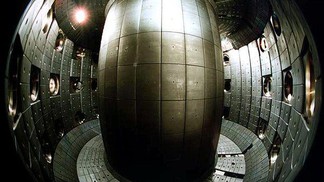
Confined chamber for the plasma © EPFL

Using a heating system, physicists have succeeded for the first time in preventing the development of instabilities in an efficient alternative way relevant to a future nuclear fusion reactor. It’s an important step forward in the effort to build the future ITER reactor.

Scientists have achieved a milestone: they have managed to stop the growth of instabilities inside a nuclear fusion reactor. How? Here’s a look at this energy source, which despite being challenging to control, is nevertheless extremely promising.

Nuclear fusion is an attempt to reproduce the energy of the Sun in an Earth-based reactor system. When gas is heated to several million degrees, it becomes plasma. Sometimes in the plasma, an instability will appear and grow large enough to perturb the plasma, making it vibrate despite the presence of the magnetic field in which it is contained. If the plasma touches the walls of the reactor, it will cool rapidly and create large electromagnetic forces within the structure of the machine.

The challenge is to reduce the instabilities deep within in the interior of the plasma so that they don’t amplify, while at the same time allowing the reactor to continue to function normally. Thus it is necessary to work within the specific configuration of these fusion reactors, where the plasma is strongly confined by a magnetic field. By adjusting an antenna that emits electromagnetic radiation, Jonathan Graves and his colleagues from EPFL’s Center for Research in Plasma Physics were able to quench the instabilities when they appear, in the precise region where they are forming, and without perturbing the rest of the installation.

From theory to practice

The physicists first conducted simulations to verify the extent to which specific radiation frequencies and locations of application would suppress the growth of instabilities. Then they carried out tests to confirm their calculations. The beauty of their approach is that they were able to use antennas that are used as part of the system to heat the plasma, and that are already present in the Joint European Torus (JET), the largest reactor currently in use. Surprisingly, the simulations and the tests showed that heating and instability suppression can be combined, by aiming the radiation slightly off-center in the plasma.

The next step will be to add a detector system that will make it possible to neutralize instabilities in real time over longer time periods. These improvements can then be implemented in the ITER fusion reactor, currently in development in Southern France.

Source: École polytechnique fédérale de Lausanne (EPFL)

Additional Information:

Friday, January 6, 2012

Deciphering communication: learning from robots

Engineerblogger
Jan 6, 2012


An experiment led by Laurent Keller at the University of Lausanne (UNIL) and by Steffen Wischmann and Dario Floreano at EPFL shows that communication systems can evolve differently within the same species and even the same environment. Performed using robots, this research can enable a better understanding of communication within the animal kingdom.

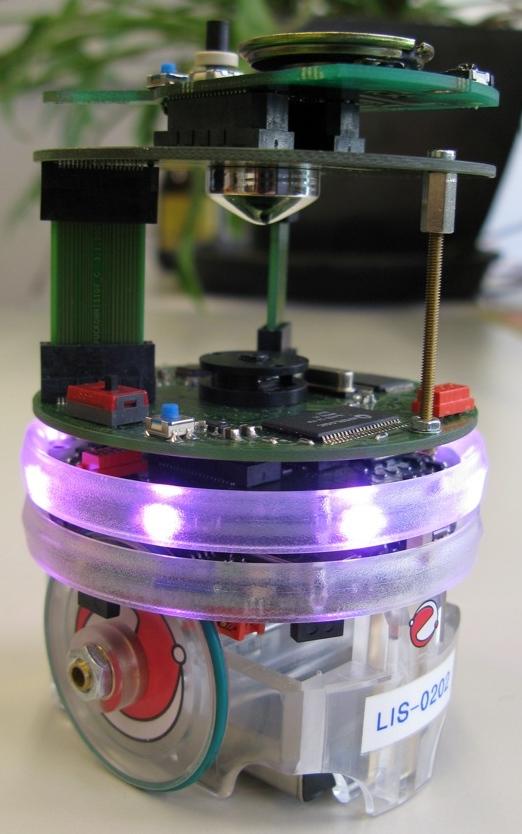
A joint research project conducted at UNIL and EPFL enabled the scientists to follow the evolution of communication in 100 groups of 20 robots over the course of 1000 generations. The robots were equipped with a camera that detected the environment, and also with wheels and a ring enabling them to emit luminous signals of different colors. Positioned in arenas, they had to locate a source of virtual food that was only visible when they came upon it. Their behavior was guided by a “neural network”, which was also controlled by genes that could evolve through mutation and selection in the course of successive generations.

An initial experiment showed that the robots rapidly acquire a communication system that enables them to transmit information about the location of the food to their peers. In fact, two really distinct communication systems evolved, according to the given populations. The simplest mechanism, using a single color to indicate the location of the food, proved more effective that the system using two colors – one pointing towards the food and the other towards the remaining part of the arena.

It also became evident that a population that has evolved towards a relatively effective type of communication doesn’t subsequently change it, as it would then be necessary to simultaneously modify the way the information is transmitted, and also the way of responding. In other words, a communication system, just like a language, cannot change rapidly through generations. In addition, this research underlines the importance of random factors in evolutionary processes. The experiment performed in twenty homogenous groups (with robots of the same type) actually shows that half of them choose the simpler – one color – strategy, whereas the other half opt for the two color system.

Competition requests more complex talking
Finally, a second experiment demonstrated that, even with robots, nothing is perfect. Within a competition context, when groups of robots were confronted with robots of other populations, it was the more complex (two-color) strategy that won the day, in spite of the proven effectiveness of the single-color strategy.

Supported by the Swiss National Science Foundation, this research has been published in the magazine PNAS (Proceedings of the National Academy of Sciences of the United States). It shows that communication strategies can evolve in different ways through generations within an identical environment.

“We know that in the animal kingdom communication systems are very complex”, concludes Laurent Keller, “and this diversity evolved over a very long period of time. Our experiment shows how it occurs, and reveals that environmental factors are not the only ones involved, as one might believe. The robots shed new light on these evolutionary processes.”


Source: École polytechnique fédérale de Lausanne (EPFL)

Additional Information:

Radar could detect objects that have fallen on railway tracks

Engineerblogger
Jan 6, 2012


Radar devices could soon be fitted in railway stations to prevent accidents by detecting luggage or people that fall onto the tracks.

Researchers from French research centres IFSTTAR and IEMN have demonstrated a system that uses ultra-wideband radio waves to detect and characterise objects that fall on train tracks and alert station operators to reduce delays and avoid accidents.

‘With the possibility of trains, passengers and even poor lighting, in some instances, obscuring the view of CCTV cameras, radar techniques could certainly be effective in these scenarios,’ said Ali Mroué, lead author of the research published in the journal Measurement Science and Technology.

The Automatic Target Recognition (ATR) procedure defines and simplifies the characteristics of an object when it is detected, and then compares the information to a database to determine what the object is.

Using a computer simulation, the researchers initially tested out a number of objects, ranging from suitcases to glass bottles, and several models of the human body: an adult, a teenager and a child.


Real-life experiments were then performed in a small, echo-free chamber, using a 3m-long waveguide — a solid beam-like structure that guides the radio waves in a certain direction, in this case towards the object being measured. These showed the system was able to differentiate between luggage and people.

‘We hope these devices will be used in the near future since they are very complementary to existing video systems and have a similar final cost,’ said Mroué.

‘The complementary use of video and radar systems could lead to low levels of false detection, which is mandatory for this application, and maximise the chance of survival for passengers who have fallen on the line.’

Source: The Engineer

Tuesday, December 6, 2011

Robots will soon appear in school classrooms

Engineerblogger
Dec 06, 2011


Thymio II. Credit: EPFL


EPFL scientists have developed an educational robot designed to introduce children to technology in schools. Baptized Thymio II, it was officially presented to teachers in the Canton of Vaud last friday.

Creating an original pedagogical tool to get students interested in technology and robotics: this is the challenge that was undertaken by a group of the researchers led by Fancesco Mondada, in EPFL’s Robotics Systems Laboratory. In collaboration with the University of Art and Design Lausanne (ECAL), they developed Thymio II, a little programmable white robot, jam-packed with sensors and LEDs, that can exhibit a wide range of behaviours. “We worked really hard on the hardware,” Mondada explains. “Each sensor is associated with a coloured LED, which allows the kids to visualize the activation of the sensors during a specific manoeuver.” The Thymio II robots, which made their debut in May during EPFL’s robotics festival, has been presented to teachers on November 25, as part of a course organized by the cantonal teacher’s college (HEP).

Explorer, coward, investigator, friend
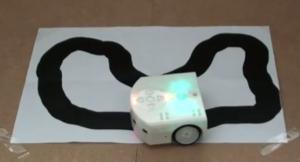
The 11 cm x 11 cm robot is equipped with proximity sensors (it can detect close objects), ground-directed sensors (it can detect the edge of a table around which it’s circulating, or a line to follow), accelerometers (It can measure acceleration, detect impacts and indicate gravity), a microphone and a temperature sensor (an electronic thermometer). It also has a memory card for recording sound. After they’ve turned their Thymio II on using buttons on the surface, users get the robot to adopt one of the basic modes, such as friend (follows an object in front of it), explorer (avoids obstacles), coward (detects impacts and empty space) or investigator (follows a line on the ground).
By hooking it up to a computer via a USB cable, users can invent and program other behaviours. “You could imagine the robot becoming blue when you put it in the fridge, for example,” suggests Mondada. The programming is done using a software called Aseba, which was developed by EPFL. “Aseba is a simple language, but it contains the principle concepts of programming,” Mondada continues. The software code is “open source,” available for modification or downloading over the Internet, and rights free.


Credit: EPFL

 From Lego to programming, by way of physics
Thymio II is not just a teaching tool for robotics professors. Thanks to its many sensors, it can also be used to teach physics, when subjects such as gravity, the properties of light and temperature are on the agenda. And thanks to its engaging character, the robot can also be used by children who are too young to understand programming. “It’s possible to stack Lego bricks on top of the Thymio II. Kids can decorate it and play with it to start with, then discover new kinds of behaviour over the Internet, and start to program it when they’ve gotten a bit older.”

Will Thymio II be a hit in the schools? Philippe Krähenbuhl , a science and robotics teacher at the Collège du Vevey, is enthusiastic. “Thymio II is inexpensive (about 99 francs), accessible, and very complete. It leaves room for creativity,” he says. “I appreciate the fact that you can use it in different ways, whether for building with legos, for teaching physics or for teaching programming skills.” For his part, Mondada says he welcomes suggestions from teachers, in order to improve the small white robot even further.

Source:  École polytechnique fédérale de Lausanne (EPFL)

First Molybdenite Microchip

Engineerblogger
Dec 06, 2011

© 2011 EPFL

Molybdenite, a new and very promising material, can surpass the physical limits of silicon. EPFL scientists have proven this by making the first molybdenite microchip, with smaller and more energy efficient transistors.

After having revealed the electronic advantages of molybdenite, EPFL researchers have now taken the next definitive step. The Laboratory of Nanoscale Electronics and Structures (LANES) has made a chip, or integrated circuit, confirming that molybdenite can surpass the physical limits of silicon in terms of miniaturization, electricity consumption, and mechanical flexibility.

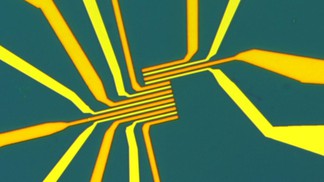
“We have built an initial prototype, putting from two to six serial transistors in place, and shown that basic binary logic operations were possible, which proves that we can make a larger chip,” explains LANES director Andras Kis, who recently published two articles on the subject in the scientific journal ACS Nano.

In early 2011, the lab unveiled the potential of molybdenum disulfide (MoS2), a relatively abundant, naturally occurring mineral. Its structure and semi-conducting properties make it an ideal material for use in transistors. It can thus compete directly with silicon, the most highly used component in electronics, and on several points it also rivals graphene.

Three atoms thick

“The main advantage of MoS2 is that it allows us to reduce the size of transistors, and thus to further miniaturize them,” explains Kis. It has not been possible up to this point to make layers of silicon less than two nanometers thick, because of the risk of initiating a chemical reaction that would oxidize the surface and compromise its electronic properties. Molybdenite, on the other hand, can be worked in layers only three atoms thick, making it possible to build chips that are at least three times smaller. At this scale, the material is still very stable and conduction is easy to control.

Not as greedy

MoS2 transistors are also more efficient. “They can be turned on and off much more quickly, and can be put into a more complete standby mode,” Kis explains.
Molybdenite is on a par with silicon in terms of its ability to amplify electronic signals, with an output signal that is four times stronger than the incoming signal. This proves that there is “considerable potential for creating more complex chips,” Kis says. “With graphene, for example, this amplitude is about 1. Below this threshold, the output voltage would not be sufficient to feed a second, similar chip.”

Built in flexibility

Molybdenite also has mechanical properties that make it interesting as a possible material for use in flexible electronics, such as eventually in the design of flexible sheets of chips. These could, for example, be used to manufacture computers that could be rolled up or devices that could be affixed to the skin.

Source: École polytechnique fédérale de Lausanne (EPFL)

Thursday, November 24, 2011

New revolutionary material can be worked like glass

Engineerblogger
Nov 24, 2011


CNRS Photothèque / ESPCI / Cyril FRÉSILLON
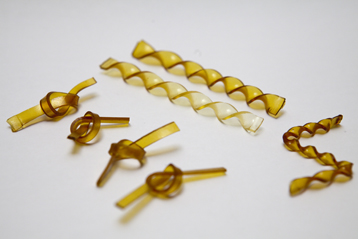
The material can take various forms


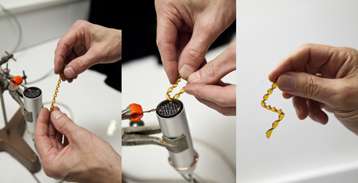
A common feature of sailboards, aircraft and electronic circuits is that they all contain resins used for their lightness, strength and resistance. However, once cured, these resins can no longer be reshaped. Only certain inorganic compounds, including glass, offered this possibility until now. Combining such properties in a single material seemed impossible until a team led by Ludwik Leibler, CNRS researcher at the Laboratoire “Matière Molle et Chimie” (CNRS/ESPCI ParisTech), developed a new class of compounds capable of this remarkable feat. Repairable and recyclable, this novel material can be shaped at will and in a reversible manner at high temperature. And, quite surprisingly, it also retains certain properties specific to organic resins and rubbers: it is light, insoluble and difficult to break. Inexpensive and easy to produce, this material could be used in numerous industrial applications, particularly in the automobile, aeronautics, building, electronics and leisure sectors. This work is published on 18 November 2011 in Science. Replacing metals by lighter but just as efficient materials is a necessity for numerous industries, such as aeronautics, car manufacturing, building, electronics and sports industry. Due to their exceptional mechanical strength and thermal and chemical resistance, composite materials based on thermosetting resins are currently the most suitable. However, such resins must be cured in situ, using from the outset the definitive shape of the part to be produced. In fact, once these resins have hardened, welding and repair become impossible. In addition, even when hot, it is impossible to reshape parts in the manner of a blacksmith or glassmaker.

This is because glass (inorganic silica) is a unique material: once heated, it changes from a solid to a liquid state in a very progressive manner (glass transition), which means it can be shaped as required without using molds. Conceiving highly resistant materials that can be repaired and are infinitely malleable, like glass, is a real challenge both in economic and ecological terms. It requires a material that is capable of flowing when hot, while being insoluble and neither as brittle nor as “heavy” as glass.


© CNRS Photothèque / ESPCI / Cyril FRÉSILLON
Sequence showing how a complex-shaped object is made by successively deforming and heating it.

From ingredients that are currently available and used in industry (epoxy resins, hardeners, catalysts, etc.), researchers from the Laboratoire “Matière Molle et Chimie” (CNRS/ESPCI ParisTech) developed a novel organic material made of a molecular network with original properties: under the action of heat, this network is capable of reorganizing itself without altering the number of cross-links between its atoms. This novel material goes from the liquid to the solid state or vice versa, just like glass. Until now, only silica and some inorganic compounds were known to show this type of behavior. The material thus acts like purely organic silica. It is insoluble even when heated above its glass transition temperature.

Remarkably, at room temperature, it resembles either hard or soft elastic solids, depending on the chosen composition. In both cases, it has the same characteristics as thermosetting resins and rubbers currently used in industry, namely lightness, resistance and insolubility. Most importantly, it has a significant advantage over the latter as it is reshapeable at will and can be repaired and recycled under the action of heat. This property means it can undergo transformations using methods that cannot be envisaged either for thermosetting resins or for conventional plastic materials. In particular, it makes it possible to produce shapes that are difficult or even impossible to obtain by molding or for which making a mold is too expensive for the envisaged purpose.
© CNRS Photothèque / ESPCI / Cyril FRÉSILLON
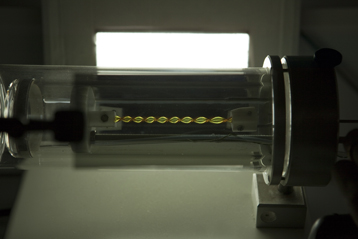
A strip of material is deformed in an oven. It is subjected to torsion stress, clearly visible in bright colors under polarized light. These colors fade away within a few minutes when hot: the material has taken a new, permanent shape.

Used as the basis of composites, this new material could therefore favorably compete with metals and find extensive applications in sectors as diverse as electronics, car manufacturing, construction, aeronautics or printing. In addition to these applications, these results shed unexpected light on a fundamental problem: the physics of glass transition.

Source:  Centre national de la recherche scientifique (CNRS)

Thursday, November 17, 2011

A touchscreen you can really feel

Engineerblogger
Nov 17, 2011


EPFL researchers have invented a new generation of tactile surfaces with relief effects – users can feel actual raised keys under their fingers. This technology could have many applications, particularly in improving access to electronic media for the visually impaired.

Finally a true tactile surface! EPFL researchers have developed a way to control the texture of a screen so that the “feeling” of specific areas can be modified underneath a user’s fingertips. This technology, developed by EPFL’s Integrated Actuators Laboratory (LAI) in Neuchâtel, is being designed for smartphones, tablets, computers, and vending machines.

“We’re adding the sense of touch to tactile surfaces,” says Christophe Winter, a PhD student in the LAI who is writing his thesis on the subject. “The term ‘touch screen’ that’s used to describe current technology is really a misnomer, because they only provide visual and auditory feedback.”

By adding another layer of information to devices, this invention will improve their usability and thus improve the user experience. For example, it could be used to enrich online texts, drawing the reader’s attention to certain elements on the page, or to make video games even more entertaining, by adding an additional sensory dimension. And for the visually impaired, it could truly open up access to smartphones and other electronic devices.

A layer of air

To obtain this relief effect, the scientists used a material that vibrates when a voltage is applied to it. These materials are described as “piezoelectric.” The material expands and then returns to its original shape very rapidly, all at the nanometer scale. “This movement generates micro-vibrations, whose intensity can be controlled mechanically,” explains LAI director Yves Perriard. These vibrations – whose amplitude is only about a micron, or one-hundredth of the thickness of a human hair – are themselves imperceptible to us. But they create a very thin layer of air between the surface and a user’s finger, giving him or her the feeling that there’s something raised underneath it.

Source:  Ecole Polytechnique Federale de Lausanne

Wednesday, November 16, 2011

Watch This Robot Control a Person's Arm Using Electrodes

Spectrum.ieee.org
Nov 15, 2011


When this robot needs a hand, it borrows yours.


In an experiment that opens a new chapter in human-machine interaction, a French research team has demonstrated how a robot can control both its own arm and a person’s arm to manipulate objects in a collaborative manner.

The robot controls the human limb by sending small electrical currents to electrodes taped to the person's forearm and biceps, which allows it to command the elbow and hand to move. In the experiment, the person holds a ball, and the robot a hoop; the robot, a small humanoid, has to coordinate the movement of both arms to successfully drop the ball through the hoop.

The researchers, from the Montpellier Laboratory of Informatics, Robotics, and Microelectronics (known by its French acronym LIRMM), say the approach is still in the proof-of-concept stage, but they are confident that performing more complex tasks is possible. Their goal is to develop robotic technologies that can help people suffering from paralysis and other disabilities to regain some of their motor skills.

To be sure, an advanced, dexterous robot arm would be capable of assisting paralyzed people with daily tasks. And other technologies such as robot teleoperation, brain-machine interfaces, and powered exoskeletons also promise to give physically disabled people more mobility.

But Adorno and his colleagues say there are advantages in having a robot controlling a person's body. The technique they're using to do that, known as functional electrical stimulation (FES), is used in rehabilitation and has physical and psychological benefits to patients.

"Imagine a robot that brings a glass of water to a person with limited movements," says Bruno Vilhena Adorno, the study's lead researcher. "From a medical point of view, you might want to encourage the person to move more, and that's when the robot can help, by moving the person's arm to reach and hold the glass."

Another advantage, he adds, is that capable robotic arms are still big, heavy, and expensive. By relying on a person's physical abilities, robotic arms designed to assist people can have their complexity and cost reduced. Many research teams are teaching robots how to perform bimanual manipulations, and Adorno says it seemed like a natural step to bring human arms into the mix.
To read more click here...

Monday, November 14, 2011

The Delta robot – Swiss-made and fastest in the world!

Engineerblogger
Nov 14, 2011


It’s the story of a long dynasty of industrial robots. Delta’s three arms began by packaging chocolates, before being used in watchmaking, tele-surgery and the processing of materials....
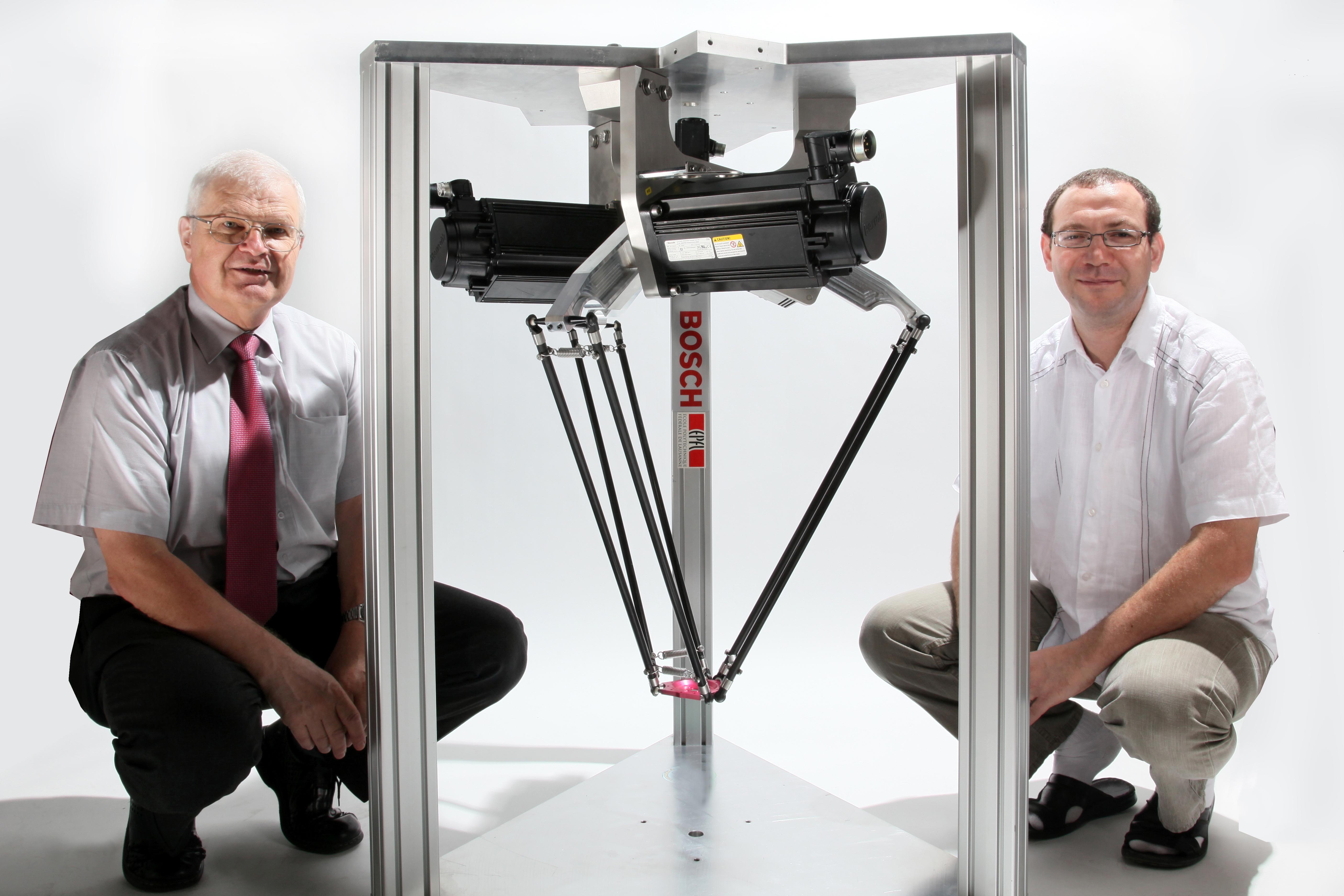
More than 200 operations per minute! It’s not a firearm, but rather an outstanding packaging tool. The Delta robot made light work of hundreds of packets of Smarties at the Triennial Interpack Exhibition in Düsseldorf. The inventor of the concept, Reymond Clavel, was presenting in Germany the most recent version of the Delta robot, resulting of a collaboration with Bosch. The performance of “Delta Direct Drive” is impressive – the robot can achieve acceleration of over 15 g, and this represents an increase in performance of 50% compared to robots of the previous generation.

Increasing speed and maintaining precision

The challenge in developing this new variant was daunting – it involved increasing the speed of the Delta robot, while maintaining its precision. Previously, less powerful motors required the addition of a mechanical component, enabling a more effective transmission of the movement, but this limited the maximum speed of the robot. Scientists have now been able to take advantage of the progress made in motorization – in both power and cost – and this avoids the use of any such linking components. Thus, they have really gone up a gear. Reymond Clavel reveals: “The idea of direct drive had been tucked away in a drawer for ages, but then again, twenty years ago the cost of such motors would have been much too high.”

A success story

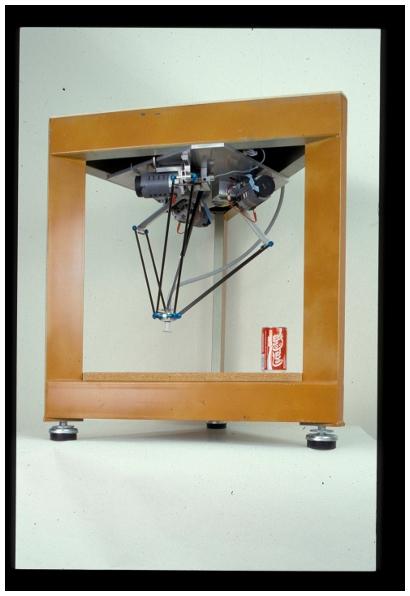
In 1985, the first Delta robot revolutionized the packaging world with its three arms and its gripping device. And – unthinkable at the time – a quarter of a century later, it has become a standard in industrial packaging. Reymond Clavel explains: “In fact, I was astonished to note that around 140 Delta robots were working all around the Düsseldorf fair.” A belated success for this robot, which had taken off rather too slowly for its inventor’s liking. He continues: “To be honest, when we had developed the first Delta, I was so enthusiastic that I expected lots of companies to rush to my office to buy one. Not at all! In fact, two years passed before we signed our first licence transfer, because our robot had scared off the industrialists. Its very fine structure, which looked like an umbrella to them, was disconcerting. They thought that it wasn’t robust enough.” Time has proved them wrong.

From chocolates to neurosurgery

Originally conceived to manipulate small, light objects such as chocolates, over time the Delta has been used for many other applications. Together with the team from the Laboratoire de systèmes robotiques, Mohamed Bouri is developing new variants of the highly dynamic tool: “In particular, we have developed ultra-high-precision robots, designed for use in the areas of electro-erosion, which involves machining very hard materials. These robots are also used in the manipulation and positioning of optical elements.”


Other members of the Delta family have been developed in areas which demand the highest possible speed and precision, for example in watchmaking. Working together with neurosurgeons at the University Hospital Center of the canton of Vaud, a tactile feedback device has been developed to enable the surgeon to perform his hand movements. Reymond Clavel is convinced – the future of the Delta robot is assured. It will be adapted for use in many important areas: processing; packaging, surgery, watchmaking and – wait for it – chocolates!


Source: Ecole Polytechnique Federale de Lausanne (EPFL)

Dye-sensitized solar cells break a new record

Engineerblogger
Nov 14, 2011


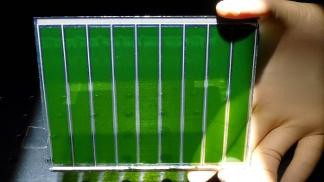
Green dye-sensitized solar cells © 2011 EPFL


Dye-sensitized Grätzel solar cells have just set a new efficiency benchmark. By changing the composition and color of the cells, an EPFL team has increased their efficiency to more than 12%. Their results have just been published in Science.

A group of scientists in EPFL’s Laboratory of Photonics and Interfaces, under the leadership of EPFL professor Michael Grätzel, has improved the efficiency of the famous Grätzel solar cells to 12.3%. This performance is now comparable to silicon-based solar panels that are on the market today. And the costs of using this technology have come down slightly. Their results appeared in an article in the November 4 issue of Science magazine.

The challenge was to increase the efficiency of the dye-sensitized cells, in order to produce more electricity. To do this, the chemists replaced the standard dye components – ruthenium and iodine – with porphyrin and cobalt. This combination allows them to increase the absorption of sunlight and results in a more efficient electron exchange. It’s this exchange of electrons from the dye to the substrate that produces electricity.

Grätzel cells mimic the process of plant photosynthesis, and these new dye-sensitized cells take the imitation even closer -- the new chemical combination gives them a greenish tint. This color increases the efficiency of the process that converts light energy into electricity. To get the most out of the light coming from the Sun, the cell absorbs the colors of the spectrum with the highest energies and rejects the rest, which includes the green wavelengths.

Grätzel cells can be used to create flexible, transparent solar panels. They’re a promising alternative for certain applications in which traditional rigid, silicon-based panels cannot be used. In addition, this new efficiency benchmark brings them well within the efficiency range of silicon cells: the theoretical maximum efficiency of Grätzel cells is now 30%, compared with 26% for silicon.

Source: Ecole Polytechnique Federale de Lausanne (EPFL)


Additional Information:

Thursday, June 30, 2011

France Funds Rail Research Initiative

Engineerblogger
June 30, 2011

France has extended €550m funding to the European Institute for Technological Research in Rail Infrastructure to support research and development, innovation and engineering training in rail infrastructure.

As part of the project, a main campus will be set up in Valenciennes and the surrounding area, while a secondary site will be set up in the Lille area in northern France.

The campus will have a 5km rail test loop, a tramway test track, a fatigue simulation track, running trial facilities and service structures.

The project will focus on developing a sustainable infrastructure that is more reliable and intelligent, performs better and is more easily certifiable.

Work on building the research centre will start in 2015 and it is expected to be operational by 2017.

Thursday, February 17, 2011

South Africa to sign €1bn development deal with France

Reuters
Feb 17, 2011
South Africa's President Jacob Zuma will sign a one billion-euro deal with the French Development Agency during a state visit to France next month that could also touch on a pricey nuclear project, a minister said on Thursday.
To read more click here...