Pages

Subscribe:

Labels

038628037504 (1) 10150 (1) 10BURIED (1) 10Count (1) 110011040 (1) 115Ounce (1) 1200mg (1) 12BSN (1) 12Count (2) 12CountNutricor (1) 12CountWWSN (1) 12Fresh (1) 12Stacker (3) 12VPX (1) 140243 (1) 14Servings (1) 158Ounce (1) 15Ounce (1) 16Ounce (2) 1716 (1) 17Skque (1) 1lbinLife (1) 2000Hrs (1) 2000mg (1) 200Watt (1) 2021A (1) 20OunceNatures (1) 2412Ounce (1) 24Count (1) 24EAS59134 (1) 24FRS (1) 24Guru (1) 24Guru01GR124 (2) 24Nestle (2) 24Pediasure (2) 24Peptamen (1) 24PieceDisplay (1) 24Solis (2) 27ReSource (2) 2Biochem (1) 2Dynamic (1) 2Jarrow (1) 2Muscle (1) 2Natures (1) 2Ounce (3) 2Pound (1) 30Day (1) 328601 (1) 334928 (1) 336gOptimum (1) 37Ounce (1) 3Ensure (1) 3M (1) 414 (1) 432500 (1) 48Boost (1) 48Fluid (1) 48ml (1) 4Ensure (1) 4Isopure (1) 5000mg (1) 527408 (1) 5511786 (1) 574400 (1) 5Hour (2) 5Ounces (1) 600Kendall (1) 662380 (1) 6Beneprotein (1) 6Proteinex (1) 70951 (1) 750mlNutriPrima (1) 845Ounce (1) 84Fluid (2) 84OuncesLiquid (1) 89Inch (1) 8nuun (2) 8Ounce (7) 99369FR (1) ABB (3) Academy (1) ACCENTS (1) Acia162Ounces (1) Acsry (1) Active (2) Adapter (1) AdapterBattery (1) Advance (1) Advanced (1) Advantage (1) AdvantEdge (1) Africa (29) African (1) Agaricus (1) AiCoco (1) AIDSTrustex (1) Airbrush (1) Airbus (6) Aircraft (94) AISI (1) Ajmeras (1) Alchohol (1) Alertness (1) Alfalfa (2) Alive (1) Allergy (1) Allspice (8) Alpine (1) Alstom (2) Alternative (1) Amarillo (1) Amazing (3) Amazon (2) American (1) animal (11) Annual Reports (155) Antioxidant (1) Anwar Ibrahim (1) Apple (1) Applied Materials (1) Arrowroot (1) AshtonDrake (1) Asia (72) Assorted (1) Atkins (1) Audi (1) Australia (21) Automotive (250) Automotive Technology (183) Ayurvedic (1) BABIES (1) Babys (1) Bacopa (1) BagAtkins2627 (1) BagsTraditional (1) BagSun (1) Balanced (1) Ballard Power System (1) Banaba (2) Baram Dam (1) Baram Regatta (1) Bariatric (1) Barisan Nasional (2) Barisan Nasional Helps Penan (1) Barista (2) Barley (2) barsBiochem (1) Basement (1) BASF (2) Basics (1) Batu Lawi (1) Bayer (1) BEA1017OZ (1) Beachbody (1) Beaded (1) Beaumont (1) beautiful girl image (19) Beauty (2) Beneprotein (2) Berries (3) Berry (4) BerryLiving (1) Beverage (1) Bicycle (1) BioAstin (1) Biochem (4) Biofuel (12) Biogenesis (2) BlackBlender (1) Blend (1) Blender (4) Blueberry (1) BlueStereo (1) BMF (1) BMW (7) BMX (1) BN (1) Boeing (4) Bombardier (4) Book (1) Borneo (6) Bottle (8) BottleProStat (1) Bottles (15) BottleScivation (1) bottlesEnsure (2) BottlesMio (1) BoxChenille (1) BoxDarice140243 (1) BOXESAmerican (1) BoxesFRSPowder (1) BoxPremier (1) BP (2) Brands (1) Brands833667000102 (1) Brazil (10) Brazilian (1) Breeze (3) BrewersBarista (1) BRIC (118) Brikpaks (3) Brownie (1) Bruno Manser (1) Bruno Manser Fund (3) Bruno Manser Fund Fraud (1) Bruno Manser Fund Frauds (1) Bruno Manser Lies (2) BTL410400 (1) Bubbles (1) Burner (1) business (72) Butchers (1) Butter (1) Butterscotch (1) Cable (1) Cables (1) Calcium (2) California (1) Calorie (3) Camera (1) Canada (11) Candela (1) Canister (2) CanisterCLICK (1) Canisters (1) Canning (1) Capramilk (1) CapsSwanson (1) Capsule (5) Capsules (6) CapsulesEAS (1) Caraway (1) Cardio (1) Carnation (1) CaseEnsure (2) CaseNestle (2) Celebrity (22) CellularFactory (1) Celsius (1) Certification (28) Certified (2) Chameleon (1) Charger (1) Charter/Terms of Reference (27) CHEAP (135) Chenille (1) Cherry (1) CherryZydot (1) Chevron (1) Chewing (1) Chile (1) China (99) Chipotle (1) Chlorophyll (1) Chocolate (7) Chocolate8 (1) Choice (2) Cholesterol (1) Chrome (1) Chrysler (1) Chunho (1) Citrifolia (1) Citroen (1) Citroën (1) Citrus (2) Civil Service (1) CK Morris Associates (1) Clare Rewcastle Brown (2) Class (1) Classic (2) Clinical (1) CNST (1) Coenzyme (1) Coffee (4) Coffee11001105 (1) Coffee7DSC2B (1) Coffeehouse (1) Cold Fusion (1) Coldkicker (1) Collectable (1) Collection (1) Colored (1) Colors (1) Communications (14) Company (2) COMPLETE (4) Complex (1) Computer (1) Concentrate (1) Concentrated (1) Concepts645654 (1) Condoms (1) Container (7) CONTROL20BGSee (1) Corrections (3) CosMedix (1) count (1) countAmscan (1) CountMy (1) Crayola (3) Criminal (4) Cruiser (1) Crunch (1) Cytosport (2) Daimler (3) Dam (1) DAP (1) DAP Lies (1) Darice (1) DARPA (18) Dato Roland Sagah Wee Inn (1) Defence (60) Defense (61) Delight (2) description (1) Desert (7) Design (65) DESIGNER (3) Desktop (1) detail (1) Detroit (1) Development (1) Dexatrim (1) diameter (1) diameterGaming (1) Diecast (1) Dinosaur (1) DISCOUNT (4) Discover (1) Disney (1) Doctors (1) DoE (8) DolphinsSticky (1) DOMAGRON (1) Dow Corning Corp (2) DP9260 (1) DRA6329 (1) Dragon (1) Dressing (1) Drink (11) Drinkin (1) drinksNVE (1) Dupont (2) dv9657clSIBCORP (1) Dymatize (3) DYMMGV (1) DYNAMIC (5) EachHager (1) EADS (12) ecigs (1) Eco-Tourism (1) Economy (14) Education (1404) Electra (1) Electric Grid (1) Electrolyte (4) ELP3STSL (1) Endorush (1) Endurox (2) Energizing (1) Energy (540) English Article (20) Enhanced (1) Enhancer (1) Enlive (2) Ensure (12) Enterprise (1) Environment (170) Enzymatic (1) Eraser (1) ERECTION (1) Ergonomics (4) ESA (4) Espresso (1) Essence (2) Essentials (3) EssentialsHSE (1) ethnic group (1) Europe (201) Executive/External Ombuds (2) Extended (2) ExtenderBadger (1) Extension (1) Extern/Intern (20) Extract (5) Extreme (21) Factor (1) Factors (3) Fantastic (1) Fatigued (1) Faucet (1) feature (9) Featuring (1) Fellowes (1) Fillet (1) First Energy (6) Fitera (2) FlatScreen (1) Flavor (1) FlavorBeachbody (1) Focus28 (1) Ford Motors (7) Foreign NGOs (2) Forest (1) formula (5) Formulas (1) Forts (1) FORUM (1) Fragrance (1) France (12) Frappuccino (1) FreeHubner (1) French (2) Friday Poll (13) Frontier (1) Frost (1) Fruits (1) Ft1140Alessco (1) Ft132Alessco (1) FToys (1) Fudge (1) Fuel Cell (26) Fujitsu (2) funny (19) Gadget (6) Galleries (1) Gallon (1) GameJax2000 (1) Games (1) General Electric (21) General Motors (15) Genesis (1) Georges (1) Germany (28) Go02658 (1) Golden (1) Goldfinch (2) Goodyear (1) Google (6) Gordoni (1) Gourmet (1) Government (333) Grape (2) Grape5 (1) Green Energy (544) Greens (2) GripAlex (1) Ground (7) Guarana (1) Halal Hub (1) Hammer (1) Hardware (1) Hasbro (1) Hawaiian (1) health (19) Health Care (87) Healthy (4) Herbal (5) Herbals (1) Himalayan (1) Holiday (1) Honda (4) Honeywell (1) Hoodia (1) HPCompaq (1) Hubner (1) human capital development (1) Humor (18) Hydration (2) hydration8PKNUUNLL (1) Hydrive (1) Hyundai (2) IBM (2) Illegal Demonstrations (1) iMicro (1) IMMICRP (1) India (23) information (8) Infrastructure (44) inLife (1) Inside Invester Ltd (1) Instantized (1) Institute (1) International (338) Internet (7) Intestinal (2) Investment (187) IOA News (168) ISO (1) ISO100 (1) Isolate (2) Isopure (4) Isotonix (1) Italian (2) Italy (1) Jabatan Penerangan (1) Jameson Ahip Nawie (1) Japan (57) JarALTERNATIVE (1) JarDoctors (1) Jarrow (1) Job Postings (339) Johnson Controls (1) Journey (2) Juice (2) JUICECRANBERRYOG2 (1) JuiceTahitian (1) Kangmei (1) KCups (1) Kerlix (1) Kettler (1) Kettler8852600 (1) Keurig (1) Keyboard (1) Kiddio (1) KitBerg (1) KiteSpiderMan (1) KitGoldfinch (1) Kombucha (2) KombuchaKIT (1) Kraft911501 (1) Kuching (1) Laboratories (1) Langnickel (1) LaptopNotebook (1) lbBioGenesisRICE3 (1) lbsNatural (1) Leading Indicators (450) Lean (10) LeapFrog (3) Learning (1) Leaves (2) Leccino (1) Legislation (65) Lemonade (2) Lemonlime (1) Len Talif (1) License (1) Lifetime (2) Light (1) LightHog (1) LINERBLADDER (1) Liquid (20) LiquidDeSouzas (1) Litigation (45) Living (2) Lockheed Martin (6) Looking (1) Lubricants (1) Lubricated (1) Macbook (1) Malaysia (4) MaleFemale (1) Management (16) Manufacturing (394) Marine Technology (2) Materials (446) Mazda (2) Medical (84) Medicinals (1) MEGAWING (1) Mental (1) Mercedes-Benz (3) Merdeka (2) Metabolic (1) MetaboLife (1) Metallic (1) Metamucil (1) MetersCables (1) Middle East (16) Miniatures (1) MioEnergy (1) Miradent (1) Miri (1) MIRROR (1) Mitsubishi (4) Monkey (2) Monster (1) Morinda (1) Morton (1) Mosacis (1) Mosaics (1) Mothers (1) MountScotty245 (1) MultiPackCELSIUS (1) MultiPackDYNAMIC (2) MultiPackLILY (1) MultiPackLIQUID (1) MultiPackMACA (1) MultiPackONLY (1) Multiracial (1) Mulu (1) Muscle (1) Muscletech (2) Myoplex (1) Nanotechnology (279) NASA (22) National Laboratory (46) Natural (12) natural phenomena (11) Naturally (1) Naturals (3) Natures (6) Naturessunshine (4) nc8000 (1) nc8220 (1) nc8230 (1) Nesting (1) Nestle (2) Netbook (1) New Programs (133) New Zealand (2) NGO's (213) NGOs (1) Nickel Hydrogen (1) Nissan (8) NIST (5) North America (18) Northrop Grumman (1) Norway (1) NovoAndina (2) Noxide (1) NREL (8) NSF (3) NTT Data (1) Nuclear (45) Numbers (1) Nuspeed (1) Nutrex (1) Nutricor (1) Nutrient (2) Nutrients (1) NutriPrima (1) Nutrition (15) Nutritional (5) NutritionON45 (1) nw8000 (1) nw8240 (1) Offshore (7) OilsAWM (1) OintmentWounded (1) Olives (1) Onshore (2) Optical Technology (28) Optimum (4) Optisource (2) Orang Ulu (1) Orange (7) OrangeHigh5 (1) Organic (12) Original (2) Other Ombuds (145) Otomotif (2) ounce (1) Ounces (5) OuncesSea (1) OunceThe (1) Outside the Standards (62) Oxford Business Group (1) OyToys (1) OzAfrican (1) ozNatures (1) Packages (1) Packet (1) Packets (1) PacketsNatures (1) PacketsUltima (1) Packs (2) PackStarbucks (1) PadCrayola (1) Paradise (1) Parazyme (1) Parents (1) Parmigiani (1) Pavilion (1) Pecan (1) Pediasure (3) Pehin Sri Haji Abdul Taib Mahmud (1) Penan (9) Pepper (1) Peppermint (1) Peptamen (1) Peter Jaban (2) Pharma (1) Pharmaceuticals (1) Phillips (1) Pickling (1) Pieces (1) PineappleGU (1) PinkBlender (2) PKR (1) PlantBased (1) Plantiva (1) Plastic (8) PN0223 (1) Pomegranate (1) PomegranateGU (1) Porsche (1) PostCXDNSR105 (1) Poundlb (1) Pounds (1) PoundsClif (1) Powder (20) Powdered (1) PowderEndurox (1) PP1235BBS (1) Practice Pointers (185) Prebio (1) PregNatal (1) Premier (1) Premium (3) preservatives (1) Preston (1) Private Sector (174) Proasis (1) Products (2) Professional Devt. (254) Profiles (257) Projector (1) Proscience (1) ProStat (2) protein (14) Proteinex (1) Protidiet (1) Proxima (1) Pudding (1) Punch (1) Purpose (1) Puzzle (1) R. Palan and Sabariah Putit (1) R4Lemon (1) Rail (41) RAINBOW (1) Rainforest (2) Raspberry (1) REA6048 (1) ReadytoDrink (1) Reaper (1) Recovery (2) Regional Events (101) Regular (2) Release (2) Remedies (1) REMEDIES4582008 (1) Replacement (2) Replenisher (3) ReplenisherUltima (1) Research (1) Research and Development (825) ReSource (4) Results (1) Revitalization (1) Roasted (1) Robotic Technology (124) Rocket (2) Rolls royce (7) Rooibos (1) Rosemary (1) ROSSLARE (1) Russell (1) Russia (17) Safety (15) Sains (20) SaltFree (1) Samalaju (4) Sammons (1) Samsung (1) Sarawak (13) Sarawak 10th State Election (1) Sarawak Borneo (7) Sarawak Budget 2012 (1) Sarawak Corridor of Renewable Energy (SCORE) (8) Sarawak Development (1) Sarawak Economics (1) Sarawak Economy (6) Sarawak ethnic groups (1) Sarawak Forest Corporation (2) Sarawak Politics (4) Sarawak Rainforest (2) Sarawakian (7) Satellite (6) Saudi Aramco (1) ScaledStar (1) Scholarly Articles/Research (102) science (50) Scivation (1) ScottishPower Renewables (1) Scotty (1) Seasoning (1) SEB (1) Secura (1) Seks (12) Senior Citizens (1) Series (1) serving (2) Servings (2) servingsBariatric (1) Shades (1) shake (4) Shaker (1) SHEETSHygloss (1) Shell (1) ShotCL27752 (1) Siemens (8) Silicone (1) Silver (1) Singapore (2) Single (1) Sleeve (1) SlimFast (1) Slimming (1) SlimStyles (1) SM005Grey (1) Smart (1) smartphone (1) Smoke (1) Smoothie (2) Smore (1) SoftCarpets (2) Softgels (1) Sony (1) Souffle (1) Source (2) South Africa (11) South America (11) South Korea (1) Space Technology (69) Sparkling (1) SpiderMan (1) Sponge (1) SpongeSammons (1) Sport (8) Sports (7) Springtime (1) Stacker (4) Starbucks (1) Starwest (2) Stems (1) Stereo (1) Sterile (1) Sticker (1) Sticky (1) Stomach (2) Strawberry (3) Strength (3) Strive (1) SumoMESUMO66897 (1) Sundries (5) Sunkist (1) Sunwarrior (1) SuperGreens (1) Supplement (4) Supplier (1) supply (3) Support (4) Supreme (2) Sustainable Forest Management Policy (2) Switzerland (2) System (3) Tablet (2) Tablets (3) TabletsTwinlab (1) Tahatian (1) Tahitian (1) Taib Mahmud (6) Taisho (1) Tanjung Manis (1) Tanjung Manis Halal Hub (1) Tartar (2) Tata (4) Tattoos (1) Technology (562) Temporary (2) Temptations (1) Tesla (1) Testors (1) Thalgo (1) The Report 2011 (1) Therapeutic (1) TinTea (1) Tips (25) Tokuyama (1) Topical (1) totalBoost (1) Toyota (15) Toys21030000 (1) ToyTote (1) Transitions (255) Transphorm (1) Transport (135) TREASURE (1) TrikeKiddio (1) Tropical (2) Trumans (1) Trustex (1) Tubes30 (1) Twinlab (2) Twistables (1) Two Hats (2) Uganda (1) UK (107) Ulticare (1) Ultima (3) Ultimate (1) Ulu Baram (1) Unflavored (1) Unibody (1) Unique (53) United States (281) University (1) Unknown (1) Uranium (1) USDA (1) Vale (1) Vanilla (10) Vanilla8 (1) Varcho (1) Variety (3) VegCap (3) Vehicle (1) Video (30) Viennese (1) Visitor Advice (70) VIT033 (1) Vitacost (5) Vitalyte (1) Volkswagen (5) Volvo (2) VTL200CIR (1) Warrior (3) WarsATST (1) Water resources (1) Water Technology (28) Watermelon (1) Wedding (1) Weight (2) Whole (2) Wild10650 (1) Wooden (1) World news (67) Worldwide (1) Wounded (1) Xtend (1) Xtreme (1) Xylitol (1) ZeroCherry (1) ZipFizz (1) ZoomOxo4113600 (1) ZZP88103 (1)

Showing posts with label science. Show all posts

Wednesday, February 29, 2012

New laser can point the way to new energy harvesting

Engineerblogger
Feb 29, 2012


Ismael Heisler next to a diffractive optic polarisation spectrometer. Credit: EPRSC


New ultrafast laser equipment, capable of generating intense pulses of light as short as a few femtoseconds from the UV to the Infra Red, will help scientists at the University of East Anglia (UEA) measure how energy is transferred from molecule to molecule and point the way to molecular structures for exploiting solar radiation.

Funded by a £466,000 grant from the Engineering and Physical Sciences Research Council, the new laser will be used for 2D electronic spectroscopy experiments that look at the very fastest reactions. By studying how energy transfers in natural and artificial systems such as proteins and molecular materials, researchers will in turn be able to help the design of new nanomachines and solar power collectors.

Steve Meech, Professor of Chemistry at UEA’s said:

"With this equipment we will be able to develop experiments which probe in exquisite detail the link between the efficiency of light driven processes in natural and synthetic systems and the underlying molecular architecture."

2D electronic spectroscopy is in many ways analogous to the much better known 2D Nuclear Magnetic Resonance method. It uses ultra fast visible light pulses to reveal coupling between electronic states whereas NMR uses radio frequency pulses to measure couplings between nuclear spins.

Twenty years ago most ultrafast experiments relied upon amplified dye lasers. These difficult to use and unstable devices severely limited the range of experiments possible. Starting with the discovery of the Titanium Sapphire laser, a whole new family of experiments became possible.

"It is because of the amazing stability and reliability of these modern devices that we can even consider 2D optical experiments, which may take days to run", added Meech.

Lesley Thompson, EPSRC’s Director of Research Base, said:

"The grant for equipment made by our strategic equipment panel will give UEA the tools they need, but EPSRC has also allocated a further £613,000 for staff and collaborations to drive this research forward."

The announcement coincides with the inaugural lecture by Professor Alf Adams at the Royal Society in London, to mark the 25th anniversary of his work on strained quantum well lasers, recently named as one of the Top Ten greatest UK scientific breakthroughs of all time.

The lecture, entitled Semiconductor Lasers TakeThe Strain, is the first in a series named in his honour.

Source: Engineering and Physical Sciences Research Council (EPSRC)

Monday, February 27, 2012

New energy storage device based on water: Solution for increasing energy demand

Engineerblogger
Feb 27, 2012


Semiconductor and Energy Conversion”-group (pictured left to right): Alberto Battistel (Ph.D. Student), Dr. Edyta Madej (PostDoc), Dr. Fabio La Mantia (Junior Group Leader), Dr. Jelena Stojadinovic (PostDoc), Mu Fan (Ph.D. Student)

The global energy demand is still increasing. However, today's concepts for power generation aren't able to deliver the amount of electricity, which is needed in the future. Dr. Fabio La Mantia, junior group leader of the “Semiconductor and Energy Conversion”-group (Center for Electrochemical Sciences) of the Ruhr-Universität Bochum, is working on a solution for the problem. In March he and his team are going to start a project, with the ambition to develop an aqueous lithium-ion battery. They want to produce an accumulator, which is working at two volt with a three times decreased cost, compared to conventional ones. The Federal Ministry of Education and Research is going to support the project with 1.424.000 Euro for a duration of five years.

Renewable energies fall short

The current world-wide consumption is predicted by experts to rise up from 13 to 25 terawatt by 2050. Renewable energies are only able to supply ten percent of the need, because they are expensive and not always available in the same extent. This applies especially for solar and wind energy. “Fast and economical systems, to cache the current, are in demand”, explains La Mantia. The idea is to produce batteries, which are appropriate for the application in the power grid.

Higher performance and lifespan

General lithium-ion batteries are based on organic solvents. They are the standard for all portable devices. However, for the use in power supply systems, they are too expensive and unsafe. They overheat too quickly, which can cause short circuits. To improve the performance, lifespan, energy density and the price-performance ratio, the young scientists concentrate themselves on the combination of appropriate materials, separators, cells and aqueous electrolytes (liquid conductor of electricity).

Source: Ruhr-University Bochum

Thursday, February 23, 2012

An Early Start on Innovation: Corporations inspire the next generation of researchers to embrace science and innovation

R&D Magazine
Feb 23, 2012


Girl Scouts in Phoenix work on the Electronic Matching Game, one of 22 Agilent After School kits. Photo: Agilent

In order for technology companies to bring innovative products to market, they need enthusiastic, educated scientists and engineers to drive the process. To inspire the next generation of researchers, some industrial developers are going back to school.

A 2011 Harvard University study found that U.S. students ranked behind 31 other countries in math and science efficiency, and fewer than one in three students are proficient in science after high school.

A recent teleconference held in October by STEM Connects, a curriculum and career development resource from Discovery Education—an educational resource for teachers—reported that 10 to 15% of students in the U.S. enter college as science, technology, engineering, or mathematics (STEM) majors; in China that number is 30 to 40%, paving the way for a scientific and technological advantage for that nation.

"I think people need to realize that a lack of students going into STEM fields not only affects the learning curves in schools, but it also affects our global competitiveness and our ability as a nation to innovate," says Jennifer Harper-Taylor, president of the Siemens Foundation, Iselin, N.J. "If we don’t have a smart workforce, we are not going to have sophisticated R&D happening."

To drive more interest to these fields, industrial companies are helping students understand the importance of science and mathematics, and are promoting STEM education and innovation to the next generation.

From school to scientific discovery
"One of the keys to innovation is engaging the future scientists and engineers of our nation," says Tom Buckmaster, president of Honeywell Hometown Solutions, Morris Township, N.J. "The more students that have an interest in science and math means the possibility of more scientists and engineers our society could have, which will expand our nation’s capacity for innovation."

Agilent Technologies Inc., Santa Clara, Calif., promotes hands-on learning to enhance understanding of basic science concepts. The company has created the Agilent After School program, a hands-on, experimental science program targeted at children from the ages 9 to 13. The program has reached 550,000 students globally; and Agilent has invested around $3.5 million in the program in the past 10 years.

The program features 22 kits or projects that range from simple experiments for elementary school students, to more complex experiments that require advanced critical thinking and measurement skills for high school students. Projects include creating electronic circuit boards and balloon- or solar-powered cars, learning how to clean up oil spills, and solving a crime scene mystery. Held at universities and other local facilities, Agilent employees teach the students the basics about their projects and what they are creating, providing the students with knowledge that they can take back to their classrooms.

"Students really love the hands-on aspect of the projects, and in turn love leaving with what they built," says Terry Lincoln, Agilent Technologies’ global signature programs manager. "They also love the engagement between themselves and the employee running the program and talking about their project, making them want to take their projects outside of the program and into the classroom."

Science hits the road
Morris Township, N.J.-based Honeywell International has partnered with NASA to create FMA Live!, a program that explains Sir Isaac Newton's laws of motion in an exciting and entertaining way. The MTV-style interactive traveling show teaches basic science concepts and engages future engineers and scientists in the seventh to ninth grades.

FMA Live! features high-energy actors, music, videos, and demonstrations to teach Newton's laws of motion and the process of scientific inquiry. During each performance, students, teachers, and school administrators interact with three professional actors on stage in front of a live audience.

The actors use a large Velcro wall to demonstrate inertia when a student jumps off a springboard and is immediately stuck to the wall. Go-carts race across the stage to illustrate action and reaction. Extreme wrestling and a giant soccer ball show how force equals mass multiplied by acceleration. All three laws are shown simultaneously when a participant—usually a teacher or administrator—rides a futuristic hover chair and collides face first with a gigantic cream pie, exciting the students and providing lasting and memorable lessons, says Buckmaster.
To read more click here...

Monday, February 20, 2012

Sandia National Laboratories researchers find energy storage “solutions” in MetILs

Engineerblogger
Feb 20, 2012


Chemical technologist Harry Pratt synthesizes a copper-based ionic liquid. Photo by Randy Montoya

Sandia researchers have developed a new family of liquid salt electrolytes, known as MetILs, that could lead to batteries able to cost-effectively store three times more energy than today’s batteries.

The research, published in Dalton Transactions, might lead to devices that can help economically and reliably incorporate large-scale intermittent renewable energy sources, like solar and wind, into the nation’s electric grid.

The grid was designed for steady power sources, making fluctuating electricity from intermittent renewable energy difficult to accommodate. Better energy storage techniques help even out the flow of such fluctuating sources, and Sandia researchers are studying new ways to develop a more flexible, cost-effective and reliable electric grid with improved energy storage.

“The U.S. and the world need significant breakthroughs in battery technology for renewable energy sources to replace today’s carbon-based energy systems,” said Anthony Medina, director of Sandia’s Energetic Components Realization program. “MetILs are a new, promising battery chemistry that might provide the next generation of stationary storage battery technology, replacing lead-acid and lithium-ion batteries and providing significantly higher energy storage density for these applications.”

For the past 20 years, lithium-ion batteries have been at the forefront of energy storage research. Their compact, lightweight design is well suited for cell phones, laptop computers and personal electronics, but lithium-ion batteries are expensive and degradation issues limit their use in stationary, high-capacity application on the nation’s electric grid.

Sandia researcher and inorganic chemist Travis Anderson is leading a team developing the next generation of flow batteries. A flow battery pumps a solution of free-floating charged metal ions, dissolved in an electrolyte — substance with free-floating ions that conducts electricity — from an external tank through an electrochemical cell to convert chemical energy into electricity. Flow batteries are rapidly charged and discharged by changing the charge state of the electrolyte, and the electroactive material can be easily re-used many times. Anderson said flow batteries can sustain more than 14,000 cycles in the lab, equivalent to more than 20 years of energy storage, which would be unusual in a lithium-ion battery.

However, flow battery grid storage systems are roughly the size of a house and can cost more than equivalent lithium-ion batteries. The goal of researchers is to make flow batteries smaller and cheaper, while increasing the amount of energy stored for a given volume, or energy density.

Flow batteries have been fielded in the U.S., Japan and Australia. A number of systems – up to 25 MW – are in the process of being demonstrated under the American Recovery and Reinvestment Act (ARRA) administered by DOE’s Energy Storage Systems Research program. Zinc bromine and vanadium redox systems are among the top contenders. But the materials involved are moderately toxic, and vanadium is subject to major price fluctuations. In addition, the aqueous solution limits the amount of material that can be dissolved and how much energy can be stored, and outside temperature can hurt performance.

Sandia is pioneering research on flow batteries that avoid these problems by not using water. Anderson assembled a multidisciplinary team of experts from the Labs, including electrochemist David Ingersoll, organic chemist Chad Staiger and chemical technologists Harry Pratt and Jonathan Leonard. What they’ve designed is a new family of electrochemically reversible, metal-based ionic liquids, or MetILs, which are based on inexpensive, non-toxic materials that are readily available within the U.S., such as iron, copper and manganese.

“Instead of dissolving the salt into a solvent, our salt is a solvent,” Anderson said. “We’re able to get a much higher concentration of the active metal because we’re not limited by saturation. It’s actually in the formula. So we can cost-effectively triple our energy density, which drastically reduces the necessary size of the battery, just by the nature of the material.”

The electrochemical efficiency, or ability to reverse charge, in MetILs is far greater than anything else published to date. The team has prepared nearly 200 combinations of cations, anions and ligands, and of those, five outperform the electrochemical efficiency of ferrocene, which has long been considered the gold standard.

A common problem when mixing positively and negatively charged species is that these species will start aggregating together, eventually causing the solution to turn gummy and clog the battery membrane and electrode surfaces. The team addressed that challenge by developing asymmetric cations, or positively charged ions, that resemble a soccer ball. In this analogy, the black pentagons represent negatively charged areas and the white hexagons represent positively charged regions. Such an arrangement lowers the melting point by preventing the ionic liquid constituents from bonding and becoming a solid, while the partial charge still allows electrons to flow freely through the cell to generate a current.


Sandia researchers have discovered a new family of liquid salt electrolytes that could lead to batteries with three times greater energy density than other available storage technologies. The MetILs are, from left to right: copper-based compound, cobalt-based compound, manganese-based compound, iron-based compound, nickel-based compound, and vanadium-based compound. Photo by Randy Montoya

The team is funded by the Department of Energy’s Office of Electricity Delivery and Energy Reliability. Imre Gyuk, energy storage systems program manager for that office, has been a champion of Sandia’s efforts and provided the necessary funding.

“The MetILs approach represents an ingenious, out-of-the-box solution to the cathode/electrolyte paradigm. Because it is based on readily available, inexpensive precursors, it may well lead to innovative, cost-effective storage systems with major impacts on the entire U.S. grid,” said Gyuk.

The findings apply to new flow battery cathode materials. The next step for the Sandia team is to find similar materials for flow battery anodes, and researchers are encouraged by their progress.

“There are three things you’re juggling at the same time, and they aren’t always related: viscosity, electrical conductivity and the fundamental electrochemical efficiency,” Anderson said. “The excitement of having all three things go right at the same time, it’s like finding the treasure, but without the map. We’re creating that map, and we’re very excited by the possibilities.”

Source: Sandia National Laboratories

Researchers find the healing properties of a spider’s web

Engineerblogger
Feb 20, 2012


Here is a close-up view of synthetic beads-on-a-thread. Credit: University of Akron

The study of spider webs has led to a discovery that will generate new kinds of medical sutures embedded with medication. The University of Akron scientists have developed a novel synthetic material similar to a specific kind of silk spun by an orb spider. The specific web design is known as BOAS because it looks like beads-on-a-string in a circular web. The beads are glue droplets. The replication of this design can potentially be used as strong and flexible sutures that contain medication embedded in these bead-like structures.

The researchers developed the new biocompatible thread after meeting with physicians who specialize in wound healing and who expressed the need for better material-related solutions to medical problems.

Novel material to aid healing
The scientists published their findings in the American Chemical Society journal Langmuir in an article titled Spider Silk Inspired Functional Microthreads and will present at two upcoming scientific conferences. The next step is to apply for funding to speed the commercialization process to create medical materials that can help heal injured tendons or tissue.

"We have been very interested in architecture of adhesives produced by spiders and were very intrigued to understand why spiders use the BOAS structure," says Vasav Sahni, UA polymer science graduate student and lead author of the article published in Langmuir.

Sahni and research team members Dr. Ali Dhinojwala, chair of the Department of Polymer Science and Maurice Morton Professor of Polymer Science, and Disha Labhasetwar, an NSF-REU student with the Department of Polymer Science created the BOAS replica by copying techniques used by spiders when they spin silk.

"We used fluid mechanics concepts to vary the size and spacing of the glue beads and mimicked the spider silk threads by using commercially available materials, such as nylon," Sahni says, adding that he and his colleagues designed and fabricated a specialized piece of equipment to develop the threads.

Glue releases medication
Rather than place individual glue drops on a string, the researchers' novel technique coats threads uniformly with glue. The glue forms waves, which morph into beads that create greater-than-average contact areas and also release energy, or adhesive strength, when peeled. The beads can potentially also create a structure in which medication can be placed and released.

Dhinojwala, Sahni and their research colleagues developed the biocompatible thread to address one of the needs identified in a pilot program with the Austin BioInnovation Institute in Akron (ABIA). The scientists shadowed medical experts at the Akron General Hospital wound clinic, the Akron Children's Hospital burn unit and Summa Health System, assessing needs and developing solutions.

The researchers plan to apply for a $25,000 ABIA grant to fund development of a prototype and hope to see it commercialized locally. The researchers say their simple and scalable technique allows for rapid and large-scale fabrication of the new adhesives.


Source: University of Akron

Additional Information:

Friday, February 17, 2012

Rare Earth element found far, far away: Tellurium detected for the first time in ancient stars

MIT News
Feb 17, 2012

An image of an ultra pure tellurium crystal. Credit: MIT News

Nearly 13.7 billion years ago, the universe was made of only hydrogen, helium and traces of lithium — byproducts of the Big Bang. Some 300 million years later, the very first stars emerged, creating additional chemical elements throughout the universe. Since then, giant stellar explosions, or supernovas, have given rise to carbon, oxygen, iron and the rest of the 94 naturally occurring elements of the periodic table.

Today, stars and planetary bodies bear traces of these elements, having formed from the gas enriched by these supernovas over time. For the past 50 years, scientists have been analyzing stars of various ages, looking to chart the evolution of chemical elements in the universe and to identify the astrophysical phenomena that created them.

Now a team of researchers from institutions including MIT has detected the element tellurium for the first time in three ancient stars. The researchers found traces of this brittle, semiconducting alloy — which is very rare on Earth — in stars that are nearly 12 billion years old. The finding supports the theory that tellurium, along with even heavier elements in the periodic table, likely originated from a very rare type of supernova during a rapid process of nuclear fusion. The researchers published their findings online in Astrophysical Journal Letters.

“We want to understand the evolution of tellurium — and by extension any other element — from the Big Bang to today,” says Anna Frebel, an assistant professor of astrophysics at MIT and a co-author on the paper. “Here on Earth, everything’s made from carbon and various other elements, and we want to understand how tellurium on Earth came about.”
To read more click here...

The Indispensable Biomaterial

Engineerblogger
Feb 17, 2012


Introduced in 2011, Biocoat’s HydroSleek coating for medical devices capitalizes on the low-viscosity properties of silicone elastomer. Through specialized construction, Biocoat was able to maximize lubricity performance without impinging on durability. Image: Biocoat Inc.

When we think of biomaterials used in medical devices or for surgery, polymers like polyethylene or similar plastics used in prosthetics or joint repair spring to mind. Or perhaps ceramics used in tooth fillings. Or, possibly, metals like stainless steel that are widely used in mechanical heart valves, stents, and joint replacements.

One of the oldest clinically applied biomaterials, however, is silicone. Its first recorded use as an implant was in 1946, when it was used to repair bile ducts; since then has been used in a tremendous array of medical applications, both in vivo and ex vivo. Silicone is also a polymer, but its specific backbone is built of repeating silicon-to-oxygen bonds. The material can be modified by linking silicon atoms to organic groups.

Cross-linking silicone produces an elastomer, and when it is chemically treated with silanes to enhance matrix integration, it becomes remarkably strong and resistant to tears. Today, silicone elastomers have advanced far beyond their best known application, breast implants, and have become one of the key enabling technologies for medical devices.

Silicone: Indispensable inside the body, and out
In February 2011, Biocoat Inc., Horsham, Pa., introduced its latest product, HydroSleek. Based on the company's HYDAK silicone coatings technology, HydroSleek has been engineered to be extremely slippery to liquids, particularly water, and is intended for medical device firms seeking to reduce surface friction for their devices.

A 21-year-old company, Biocoat was established by technology pioneered at Columbia University, New York, in the early 1980s. Chemist Ellington M. Beavers, PhD, and his team invented a method for immobilizing hyaluronan and other biopolymers. Hyaluronan or hyaluronic acid (HA) was first discovered in the 1930s, and until the 1970s was ingloriously described as a "goo" molecule. The human body has about 15 g of this material at any one time, and it acts as a natural coating around cartilage cells. It's also the naturally lubricating agent in synovial fluid, which separates most surfaces that slide against each other in tendon sheaths and joints.

Interest in HA has increased greatly in recent years with major clinical applications in ophthalmology, the treatment of degenerative joint disease, and adhesion prevention after surgery. Medical-grade HA is now produced globally in more than a dozen countries.

At Biocoat, HA was commercialized shortly after it was immobilized in Beavers’ laboratory. Since then, it has undergone a steady process of improvements. New additives and derivations have allowed Biocoat to make bioactive surfaces that can repel bacteria. HydroSleek is an example.

"The product is actually made possible by the primer coat, or basecoat, technology, which has been developed at Biocoat since 1991," says Josh Simon, senior product manager at Biocoat. "The basecoat is a proprietary polyacrylic co-polymer that uses isocyanate chemistry to reliably and consistently attach species that contain hydroxyl, carboxyl, and/or amine groups. This includes hyaluronic acid, which is the naturally occurring polysaccharide found in cartilage and blood, and in HydroSleek as well."

The basecoat/topcoat combination can be applied to a multitude of substrates, including nylon, silicone, PVC, and polyurethane. The total thickness of both layers can be as thin as 2 to 3 µm when dry, swelling to 10 µm when wet. The application process is the same as Biocoat's HYDAK coatings and is a relatively simple process using conventional coating equipment and curing ovens. Usually coatings are applied by dip-coating or cured with ultraviolet light.

"The coating has a coefficient of friction ranging from 0.01 to 0.05, after sterilization and aging. This is notable because most coatings lose performance after sterilization. This one does not," says Simon.

The main departure from previous coatings is that Biocoat has dealt with the traditional tradeoff between lubricity and durability. Usually, the more durable a coating is, the less lubricious it is, and vice versa. HydroSleek has all of the durability and lubricity of previous coatings, says Simon.

A year after its introduction, the coating has become popular with cardiovascular and neurovascular companies.

"Stent delivery catheters and neurovascular guidewires seem to be the most desired applications to date," says Simon. "However, this coating can be used in any of the applications of Biocoat's current customers, which range from intraocular lens cartridges to catheters used in the fertility industry."

 
Veryst Engineering, a contract design company, performs materials analysis and testing with an emphasis on biomaterials, such as silicone elastomers. One of their most important tools is finite-element software from vendors such as COMSOL, ANSYS, and Simulia. Image: Veryst Engineering

Computation analysis enables biomaterials
Biocoat has achieved market success through decades-long R&D regimens that resulted in successful products. But benchtop science is now giving way to materials design assisted by advanced computer-aided modeling solutions, such as finite-element analysis (FEA). Among biomaterials, elastomers are among the most challenging to design. An FEA solution must deal with highly non-linear material behavior and large deformations.

"We have worked extensively on silicone elastomers for various medical device manufacturers, so we are very familiar with their properties," says Jorgen Bergstrom, PhD, principal engineer at Veryst Engineering, Needham, Mass.

Veryst is a contract engineering and design firm that helps biomaterials manufacturers develop new products. It offers companies or universities the ability to mechanically test materials under a wide variety of formats and a range of environmental conditions, including tension and compression, bending, lap shear, hysteresis, creep, and volumetric compression. Most of these tests can be performed at temperatures from -80 to 280 C.

The company then feeds this data into FEA software from COMSOL, Burlington, Mass., to simulate the actions of materials such as polyethylene, stainless steel, and silicone. Because the bulk of Veryst's client base is in the biomaterials or medical device manufacturing business, engineers like Bergstrom have become familiar with the behavior of silicone.

This knowledge has been used by Veryst to create the PolyUMod library, a series of specialized modules that cover the four main categories of polymeric biomaterials: thermopolymers, thermosets, elastomers, and foams. Bergstrom himself created a model for elastomer while at the Massachusetts Institute of Technology, Boston. That module is now included in the PolyUMod library as the Bergstrom-Boyce model. Silicone is one of the most commonly used biomaterials, he says, although it has not been as thoroughly tested as polyethylene.

Silicone elastomer design requires the expertise provided by Veryst, Bergstrom continues, because they are physically complicated. The materials have a long, non-linear stretching capability, and FEA is one of the quickest ways engineers can predict how much a given formulation can be safely stretched, how much it continues to stretch when relaxed, and what its durability is over time. The PolyUMod tools help capture non-linear elastomeric behavior. The biggest challenge for engineers, Bergstrom says, is the long-term degradation of the material that occurs in some environments. Even in the laboratory, experimental data for how a given elastomer breaks down in biological environments is still quite poor.

However, Bergstrom anticipates this situation to improve. "Finite element [analysis] as a tool has been around for 30 years or more, but because biomaterials are complicated, it hasn’t been easy for design engineers to handle," says Bergstrom. In the last five to 10 years, however, he has seen a dramatic improvement in biomaterials reliability in part because of tools like FEA. "I think in the next five to 10 years we'll see even more of a marked improvement."

Source: R&D Magazine

Friday, February 10, 2012

Chemists Harvest Light to Create 'Green' Tool for Pharmaceuticals

Engineerblogger
Feb 10, 2012


Ryan Spencer Shinabery, Soumitra Maityand Nan Zheng (from left) have created a new, “green” method fordeveloping medicines. (Not shown: Mingzhao Zhu.)

A team of University of Arkansas researchers, including an Honors College undergraduate student, has created a new, “green” method for developing medicines. The researchers used energy from an ordinary 13-watt compact fluorescent light bulb to create an organic molecule that may be useful in the treatment of Alzheimer’s and other brain diseases. The finding, coauthored by Soumitra Maity, Mingzhao Zhu, Ryan Spencer Shinabery and Nan Zheng, is published in the current issue of Angewandte Chemie International Edition, one of the top journals in the field of chemistry.

“Our chemical reaction provides a new structure, a new building block for pharmaceutical companies that has not been available before,” said Zheng, an assistant professor of chemistry in the J. William Fulbright College of Arts and Sciences who leads the team. “It’s a very unusual scaffold, very lipophilic and non-polar, which is what you need to cross the blood brain barrier.”

Visible-light photocatalysis, or chemical reactions sparked by visible light, are rare in organic chemistry, because most organic compounds can’t readily absorb visible light. Instead, organic chemists typically rely on ultraviolet, or UV light, which has disadvantages.

“UV lights heat up very fast and waste a lot of energy. You’ll also get a sunburn if your skin is exposed,” said Shinabery, a senior honors chemistry student.

Postdoctoral student Mingzhao Zhu initiated the research with his effort to use light from a cheap, readily available light source – a supermarket light bulb, in this case, although sunlight would work just as well – to make an organic molecule useful to chemists. Using ruthenium, a metal that is active in the presence of visible light, as a catalyst, Zhu produced an unexpected and unstable organic molecule. Shinabery subsequently worked to identify the structure of the molecule.

“Spencer was able to reproduce the result and help us understand how the molecule was formed, which we needed to design a new reaction,” Zheng said.

Maity, also a postdoctoral student, led the way in developing the new reaction, which is green thanks to efficiency as well as use of visible light.

“All of the atoms are converted to the product. There is no waste, no additives or co-catalysts, which makes the reaction very clean and atom economical,” Maity said. Maity also succeeded in crystallizing one of the products, in effect sketching out its three-dimensional structure, which is critical should it be further developed in pharmaceutical applications.

Zheng and Maity are currently working on a new, even more powerful result: the use of a catalyst with visible light to create a carbon-nitrogen bond, one of the most common and important bonds used in pharmaceuticals and materials.

“People thought carbon-nitrogen bonds couldn’t be formed this way; this will change people’s perception of visible light photochemistry,” Zheng said.

“I am working at all hours,” Maity added. “I lose track of time, because the work is so exciting.”

As for Shinabery, he is writing up his contribution to the finding as his senior honors thesis and weighing multiple offers from top graduate schools.

Source: University of Arkansas

Hydrogen from Acidic Water: Researchers Develop a Potential Low Cost Alternative to Platinum for Splitting Water

Engineerblogger
Feb 10, 2012

Using a molybdenite complex and the PY5Me2 ligand, Berkeley Lab researchers synthesized a molecule that mimics catalytically active triangular molybdenum disulfide edge-sites. The result is an entire layer of catalytically active material. Molybdenum atoms are shown as green, sulfur as yellow.

A technique for creating a new molecule that structurally and chemically replicates the active part of the widely used industrial catalyst molybdenite has been developed by researchers with the U.S. Department of Energy’s Lawrence Berkeley National Laboratory (Berkeley Lab). This technique holds promise for the creation of catalytic materials that can serve as effective low-cost alternatives to platinum for generating hydrogen gas from water that is acidic.

Christopher Chang and Jeffrey Long, chemists who hold joint appointments with Berkeley Lab and the University of California (UC) Berkeley, led a research team that synthesized a molecule to mimic the triangle-shaped molybdenum disulfide units along the edges of molybdenite crystals, which is where almost all of the catalytic activity takes place. Since the bulk of molybdenite crystalline material is relatively inert from a catalytic standpoint, molecular analogs of the catalytically active edge sites could be used to make new materials that are much more efficient and cost-effective catalysts.

“Using molecular chemistry, we’ve been able to capture the functional essence of molybdenite and synthesize the smallest possible unit of its proposed catalytic active site,” says Chang, who is also an investigator with the Howard Hughes Medical Institute (HHMI). “It should now be possible to design new catalysts that have a high density of active sites so we get the same catalytic activity with much less material.”

Says Long, “Inorganic solids, such as molybdenite, are an important class of catalysts that often derive their activity from sparse active edge sites, which are structurally distinct from the inactive bulk of the molecular solid. We’ve demonstrated that it is possible to create catalytically active molecular analogs of these sites that are tailored for a specific purpose. This represents a conceptual path forward to improving future catalytic materials.”

Chang and Long are the corresponding authors of a paper in the journal Science describing this research titled “A Molecular MoS2 Edge Site Mimic for Catalytic Hydrogen Generation.” Other authors are Hemamala Karunadasa, Elizabeth Montalvo, Yujie Sun and Marcin Majda.

Molybdenite is the crystalline sulfide of molybdenum and the principal mineral from which molybdenum metal is extracted. Although commonly thought of as a lubricant, molybdenite is the standard catalyst used to remove sulfur from petroleum and natural gas for the reduction of sulfur dioxide emissions when those fuels are burned. Recent studies have shown that in its nanoparticle form, molybdenite also holds promise for catalyzing the electrochemical and photochemical generation of hydrogen from water. Hydrogen could play a key role in future renewable energy technologies if a relatively cheap, efficient and carbon-neutral means of producing it can be developed.

Currently, the best available technique for producing hydrogen is to split water molecules into molecules of hydrogen and oxygen using platinum as the catalyst. However, with platinum going for more than $2,000 an ounce, the market is wide open for a low cost alternative catalyst. Molybdenite is far more plentiful and about 1/70th the cost of platinum, but poses other problems.

“Molybdenite has a layered structure with multiple microdomains, most of which are chemically inert,” Chang says. “High-resolution scanning tunneling microscopy studies and theoretical calculations have identified the triangular molybdenum disulfide edges as the active sites for catalysis; however, preparing molybdenite with a high density of functional edge sites in a predictable manner is extremely challenging.”

Chang, Long and their research team met this challenge using a pentapyridyl ligand known as PY5Me2 to create a molybdenum disulfide molecule that, while not found in nature, is stable and structurally identical to the proposed triangular edge sites of molybdenite. It was shown that these synthesized molecules can form a layer of material that is analogous to constructing a sulfide edge of molybdenite.

“The electronic structure of our molecular analog can be adjusted through ligand modifications,” Long says. “This suggests we should be able to tailor the material’s activity, stability and required over-potential for proton reduction to improve its performance.”

In 2010, Chang and Long and Hemamala Karunadasa, who is the lead author on this new Science paper, used the PY5Me2 ligand to create a molybdenum-oxo complex that can effectively and efficiently catalyze the generation of hydrogen from neutral buffered water or even sea water. Molybdenite complexes synthesized from this new molecular analog can just as effectively and efficiently catalyze hydrogen gas from acidic water.

“We’re now looking to develop molecular analogs of active sites in other catalytic materials that will work over a range of pH conditions, as well as extend this work to photocatalytic systems” Chang says.

Adds Long, “Our molecular analog for the molybdenite active site might not be a replacement for any existing catalytic materials but it does provide a way to increase the density of active sites in inorganic solid catalytic materials and thereby allow us to do more with less.”

This research was supported by the DOE Office of Science, in part through the Joint Center for Artificial Photosynthesis, a DOE Energy Innovation Hub.


Source: Lawrence Berkeley National Laboratory

Wednesday, February 8, 2012

Scientists 'record' magnetic breakthrough

Engineerblogger
Feb 8, 2012


Experimental images showing the repeated deterministic switching of nano islands. Initially the two nano islands have different magnetic orientation (black and white respectively). After the application of a single pulse, the magnetic direction of both islands changes. Further pulses repeat the process, switching the magnetic state back and forth.  Credit: Johan Mentink and Alexey Kimel, Radboud University Nijmegen; Richard Evans, University of York

An international team of scientists has demonstrated a revolutionary new way of magnetic recording which will allow information to be processed hundreds of times faster than by current hard drive technology.

The researchers found they could record information using only heat – a previously unimaginable scenario. They believe this discovery will not only make future magnetic recording devices faster, but more energy-efficient too.

The results of the research, which was led by the University of York’s Department of Physics, are reported in the February edition of Nature Communications.

York physicist Thomas Ostler said: “Instead of using a magnetic field to record information on a magnetic medium, we harnessed much stronger internal forces and recorded information using only heat. This revolutionary method allows the recording of Terabytes (thousands of Gigabytes) of information per second, hundreds of times faster than present hard drive technology. As there is no need for a magnetic field, there is also less energy consumption.”

The multinational team of scientists included researchers from Spain, Switzerland, Ukraine, Russia, Japan and the Netherlands. Experimental work was carried out at the Paul Scherrer Institut in Switzerland, the Ioffe Physical Technical Institute of the Russian Academy of Sciences and Radboud University Nijmegen, Netherlands.

Dr Alexey Kimel, from the Institute of Molecules and Materials, Radboud University Nijmegen, said: “For centuries it has been believed that heat can only destroy the magnetic order. Now we have successfully demonstrated that it can, in fact, be a sufficient stimulus for recording information on a magnetic medium.”

Modern magnetic recording technology employs the principle that the North pole of a magnet is attracted to the South pole of another and two like poles repulse. Until now it has been believed that in order to record one bit of information – by inverting the poles of a magnet – there was a need to apply an external magnetic field. The stronger the applied field, the faster the recording of a magnetic bit of information.

However, the team of scientists has demonstrated that the positions of both the North and South poles of a magnet can be inverted by an ultrashort heat pulse, harnessing the power of much stronger internal forces of magnetic media.

Source: University of York

Additional Information:

Design of new, highly efficient catalysts: Bronze-Matryoshka, the metal in the metal in the metal

Engineerblogger
Feb 8, 2012


Metal cluster built up like a Russian matryoshka


A doll in a doll, and then one more, enveloping them from the outside – this is how Thomas Faessler explains his molecule. He packs one atom in a cage within an atom framework. With their large surfaces these structures can serve as highly efficient catalysts. Just like in the Russian wooden toy, a hull of twelve copper atoms encases a single tin atom. This hull is, in turn, enveloped by 20 further tin atoms. Professor Faessler’s work group at the Institute of Inorganic Chemistry at the Technische Universitaet Muenchen (TUM) was the first to generate these spatial structures built up in three layers as isolated metal clusters in bronze alloys.

Particularly fascinating are the images the researchers use to explain these chemical compounds and their properties. In the laboratory the substance is an unimpressive, fine, grayish-black powder, yet the structure models are in color and in various nested shapes. These powders, with their large surfaces, are interesting as an interim step for catalysts that transfer hydrogen, for instance. Similar structures made of silicon could be used in solar cells to capture light from the sun more effectively.

Most people view metals as uniform materials with a rather unspectacular structure. The metal compounds from Faessler’s institute are quite the opposite. His desk is piled high with various multicolored cage models with yellow spheres representing copper atoms and blue ones for tin. The analogy to the carbon spheres that caused a sensation as Buckyballs can not be overlooked. Here, too, there are geometric structures made up of triangles, pentagons and hexagons. However, they are not made of carbon: heavier metals such as tin and lead can also form such isolated cage structures.

“We are basically interested in alloy structures that are out of the ordinary,” says Faessler. Bronze, for example: this mixture of copper and tin, which was discovered early on and lent its name to an entire age of humanity, has a crystalline structure; the atoms of the two components are distributed evenly throughout the entire crystal and are densely packed together.

The new bronzes from the Faessler laboratory are different. The PhD candidate Saskia Stegmaier melted a particularly pure form of copper wire and tin granulate under special conditions – protected from air and moisture in an argon atmosphere. The bronze produced in this manner was then sealed into an alkali metal such as potassium in an ampoule made of tantalum. The melting point of tantalum is 3,000 degrees Celsius, making it particularly well suited as a vessel for binging other metals into contact with each other.

This is how the new metal clusters, nested inside each other just like the Russian doll, came into existence. When bronze is heated, together with potassium or sodium, to 600 to 800 degrees Celsius, the alkali metals act like scissors that cut up the alloy grid and then edge their way between the pieces, thereby stabilizing the isolated atomic clusters. On their own, these clusters cannot organize themselves into dense, uniformly structured layers to form crystals. They are made up of pentagons with 20 tin atoms in all – a constellation in which repetitive patterns are not possible under normal conditions. But “cheating” a little and using potassium atoms as glue can produce a seemingly normal crystal. Last year the Israeli scientist Dan Shechtman received the Nobel Prize for chemistry for the discovery of a similar phenomenon – the so-called quasi-crystals with five-fold symmetry.

“Our clusters are small units. They are, so to speak, piles of atoms that are not connected to their neighbors.” That makes them ideal for catalytic applications: “Because they are consistent in size,” explains Faessler, “they are much better at steering chemical reactions than classical catalysts.” Hydration reactions in which hydrogen atoms dock to organic molecule chains with oxygen atoms, e.g. in the synthesis of artificial flavors, are examples of such processes. Typically, expensive precious metals like rhodium are used for this. However, novel polar alloys with magnesium, cobalt and tin can serve the same purpose. “What we need for an efficient reaction is a catalyst with very large surface area.” The classical method of achieving this is to mix solutions of two metal salts to precipitate extremely small nanoparticles. “This results in an entire spectrum of particle sizes,” explains Faessler. With metal clusters we can tailor the catalyst to our needs, as it were.”


However, Stegmaier’s and Faessler’s reaction vessel contained more surprises. Aside from the clusters, the scientists noticed a fiber-like material – like thin needles – whose ends could be bent a little. “We suspected,” says Stegmaier, “this could turn out to be exiting.” In the meantime the yield of the fibers has been improved by using sodium as scissors to cut up the bronze. This time the result was not spheres, but multilayered rods. In the middle is a string of tin atoms, surrounded by a layer of copper atoms, and around that yet another tube of tin atoms. Just as the hollow Matryoshka molecules are reminiscent of Buckyballs, the new fibers with their tubes are akin to carbon nanotubes. Analogously, such fibers could one day be used as molecular wires with various electrical properties.

Source:  Technische Universitaet Muenchen (TUM)

Additional Information:
  • A Bronze Matryoshka – The Discrete Intermetalloid Cluster [Sn@Cu12@Sn20]12– in the Ternary Phases A12Cu12Sn21 (A = Na, K) S. Stegmaier, T. F. Fässler J. Am. Chem. Soc. 2011, 133, 19758–19768 – DOI: 10.1021/ja205934p
  • Na2.8Cu5Sn5.6 – A Crystalline Alloy Featuring Intermetalloid 1∞{Sn0.6@Cu5@Sn5} Double-Wall Nano Rods with Five-Fold Symmetry S. Stegmaier, T. F. Fässler Angew. Chem, Early View Online, 1. Feb. 2012 – DOI: 10.1002/ange.201107985

Revealing how a battery material works: Why the hottest new material for rechargeable batteries works

MIT News
Feb 8, 2012

The molecular structure of lithium iron phosphate (LiFePO4)Credit: MIT

Since its discovery 15 years ago, lithium iron phosphate (LiFePO4) has become one of the most promising materials for rechargeable batteries because of its stability, durability, safety and ability to deliver a lot of power at once. It has been the focus of major research projects around the world, and a leading technology used in everything from power tools to electric vehicles. But despite this widespread interest, the reasons for lithium iron phosphate’s unusual charging and discharging characteristics have remained unclear.

Now, research by MIT associate professor of chemical engineering and mathematics Martin Z. Bazant has provided surprising new results showing that the material behaves quite differently than had been thought, helping to explain its performance and possibly opening the door to the discovery of even more effective battery materials.

The new insights into lithium iron phosphate’s behavior are detailed in a paper appearing this week in the journal ACS Nano, written by Bazant and postdoc Daniel Cogswell. The paper is an extension of research they reported late last year in the journal Nano Letters.

When it was first discovered, lithium iron phosphate was considered useful only for low-power applications. Then, later developments — by researchers including MIT’s Yet-Ming Chiang, the Kyocera Professor of Ceramics — showed that its power capacity could be improved dramatically by using it in nanoparticle form, an approach that made it one of the best materials known for high-power applications.

But the reasons why nanoparticles of LiFePO4 worked so well remained elusive. It was widely believed that while being charged or discharged, the bulk material separated into different phases with very different concentrations of lithium; this phase separation, it was thought, limited the material’s power capacity. But the new research shows that, under many real-world conditions, this separation never happens.

Bazant’s theory predicts that above a critical current, the reaction is so fast that the material loses its tendency for the phase separation that happens at lower power levels. Just below the critical current, the material passes through a new “quasi-solid solution” state, where it “doesn’t have time to complete the phase separation,” he says. These characteristics help explain why this material is so good for rechargeable batteries, he says.

The findings resulted from a combination of theoretical analysis, computer modeling and laboratory experiments, Bazant explains — a cross-disciplinary approach that reflects his own joint appointments in MIT’s departments of chemical engineering and mathematics. 
To read more click here...

Tuesday, February 7, 2012

The right recipe: Engineering research improves laser detectors, batteries

Engineerblogger
Feb 7, 2012


Think of it as cooking with carbon spaghetti: A Kansas State University researcher is developing new ways to create and work with carbon nanotubes -- ultrasmall tubes that look like pieces of spaghetti or string.

These carbon nanotubes -- made of graphene, an atom-thick sheet of carbon -- have the perfect ingredients for improving laser detectors and rechargeable batteries, according to research by Gurpreet Singh, assistant professor of mechanical and nuclear engineering. Singh is working on several projects with carbon nanotubes and polymer-derived ceramic material.

One project involves new ways to cook or create a ceramic carbon nanotube material. The conventional way to make this type of material is to take a liquid polymer, pour it into a mold and heat it in an oven until the polymer forms a ceramic.

Singh's team tried a new approach. They are among the first to create their own modified liquid polymer with four ingredients: silicon, boron, carbon and nitrogen. But rather than heating this liquid polymer in an oven, they heated it in a conventional microwave -- the kind used in kitchens. They found that the microwave heats the nanotubes just as well as an oven.

"What we did is reduce the time to construct ceramic," Singh said. "If you use an oven or heater, you have to heat it for awhile. With the microwave, it is fast heating within a few minutes."

Their work -- co-authored with their university colleague William Kuhn, professor of electrical and computer engineering -- recently appeared in the journal Applied Materials and Interfaces, published by the American Chemical Society. Another publication involving conventional processing will appear in the Journal of the American Ceramic Society.

Once this ceramic carbon nanotube material is created, it has multiple applications. Singh's team is involved in a project with the Laser Radiometry Team at the National Institute of Standards and Technology, or NIST, in Boulder, Colo., which works to develop measurement methods for high-power industrial lasers for manufacturing.

Singh's team is assisting the institute in improving how laser power is measured. Currently, laser measurements involve a cone-shaped copper detector covered in carbon paint. The laser shines through the cone, is absorbed by the black paint, heats the copper cone and then heats a waterfall at the detector's back end. By measuring the rising temperature of the water, scientists can determine the energy of the laser.

The Singh team has improved this process by making the cone-shaped detector out of the ceramic carbon nanotube composite material. Because ceramic can withstand high temperatures, it protects the nanotubes, which absorb the laser light to heat the cone.

"We are checking the stability of the material," Singh said. "We are characterizing it and then sending the samples to the NIST to test."

Another project for Singh's team uses the ceramic carbon nanotube material to improve the performance of rechargeable batteries. The material addresses four ways that rechargeable batteries can be improved: having a larger storage capacity, having a longer battery life, recharging quickly and providing a lot of power in a short amount of time.

These ceramic materials can reversibly store lithium, meaning that lithium can go in and come out of it. Current rechargeable batteries use graphite to store lithium. But as the graphite wears down, a battery become less efficient and will stay charged for a shorter amount of time.

The ability to recharge quickly and provide a lot of power in a short amount of time is especially key for electric cars. Many current electric car designs take several hours to recharge and take a long time to accelerate. Scientists wanting to create a battery that can recharge in a few minutes and provide power quickly may now have a solution.

Singh's team has already seen early success with their work: Preliminary research shows that when the ceramic material is used in batteries, it doubles or triples the battery's capacity for high current. The material is also thermodynamically stabile, so it can survive longer cycles.

"It would be really nice to have one material that has high capacity, can be charged quickly and also is stable," Singh said. "With this ceramic material, it should be strong enough so that over time it does not degrade. That's the ultimate goal."

Their battery work will appear later this year in the journal Nanomaterials and Energy, published by the Institution of Civil Engineers. The researchers are currently charging and recharging the batteries for several cycles to understand how long the batteries made from the materials can last.

A final project from Singh's team involves the use of "nano-fingers," which are sharp tungsten needles that can probe and pick up carbon nanotubes. The researchers use these nano-fingers under an electron microscope to perform studies with individual carbon nanotubes and ceramic nanowires.

Source:  Kansas State University

Friday, February 3, 2012

Scratching away at automotive surfaces: Characterising new materials and coatings for clean and easy-to-maintain surfaces

Engineerblogger
Feb 3, 2012


Stephanie Baron and Gerard Liraut of Renault presented a paper at the 2011 VDI plastics in automotive conference on characterising new materials and coatings for clean and easy-to-maintain surfaces. They addressed issues of maintaining high gloss, avoiding dust attraction and ongoing concerns over visibility of scratches on through-coloured automotive interior mouldings.

Baron pointed out that while PP compounds are considered materials with good cost performance and recyclability, talc fillers in PP are still thought to cause scratches to become visible, with white marks that are especially noticable on dark mouldings.

"Some competitors use materials improved by sliding agents," Baron said. "But a known inconvenience is that this kind of agent with a base of amides exudes with heat and creates a sticky effect." Baron did, however, admit that some improved additives are available that are said to have resolved this problem of migration to the surface.

Similarly with dust attraction, some of Renault's competitors are using additives with anti-static action. But a sticky effect is generated here, too, as UV agents and anti-static agents interact in the presence of air.

And in order to have permanent anti-dust effects, the concentration of additive needed is so high that "the prices increase and mechanical properties decline", Baron complained. She pointed out that Asian automotive OEMs have found an easy solution by making their interiors in light colours, so that the dust - or scratches for that matter - is not so visible.

Renault, on the other hand, has tested permanent anti-static additives, only to find that the plastics tested were just as dirty as other parts after nine months. A more durable anti-static effect or one that could be reactivated would therefore be of interest to Renault.

Looking ahead, Renault seeks to make interior plastic parts with anti-adherent hydrophobic and oleophobic surfaces, to limit soiling. Otherwise, adapting the architecture of the cockpit for easy, simple and efficient cleaning would be at least "an important preliminary step", Baron concluded.

One of the latest measures to address scratch visibility has been applied by Styron for the UV-stable PP-based Inspire compounds used on the new Range Rover Evoque. The compounds are used in interior parts such as the shrouds around the steering column, centre console cladding and trim panels in the rear load space compartment.

Source: European Plastics News

Friday, January 27, 2012

New uses for diesel by-products

Engineerblogger
Jan 27, 2012


A new catalytic process discovered by the Cardiff Catalysis Institute could unleash a range of useful new by-products from diesel fuel production.

More sustainable production of sulphur-free diesel from natural gas and biomass is increasing. However the by-products, hydrocarbons like decane and other low value alkanes have little practical use.

Now a discovery by the Institute, part of the School of Chemistry, has found a potential route for upgrading these by-products into more useful chemicals.

In the past, synthetic reactions starting from alkanes like decane have been fraught with difficulty. They tend either to over-dehydrogenate or to combust, depending on whether oxygen is present in the reaction. Now a Cardiff Catalysis Institute team has reported the use of a mixed-metal catalyst to convert decane to a range of oxygenated aromatics.

The breakthrough, published in Nature Chemistry, came when the team fed a gas mixture of decane and air through an iron molybdate catalyst. At higher temperatures, the reaction formed water and decene, which is used in the production of detergents. At lower temperatures, however, the reaction took a different route to create oxygenated aromatic molecules. These included phthalic anhydride, used in the dyeing industry, and coumarin which helps in the production of anti-coagulant drugs.

Professor Stan Golunski, a member of the Institute team behind the discovery said: "This discovery breaks new ground as it implies the involvement of oxygen that has not yet made the full transition from its molecular form to its ionic form. This overturns a widely-held view that this type of oxygen was too reactive to form anything other than carbon monoxide and carbon dioxide in reactions with hydrocarbons."

"While the increased production of sulphur-free diesel has been a positive move, the glut of low value by-products will become a problem. We hope our new process will lead to less waste and the creation of more useful chemicals for a range of industries."

Source: Cardiff University

Thursday, January 26, 2012

Research in Asia heats up

Nature
Jan 24, 2012


Source: NSF

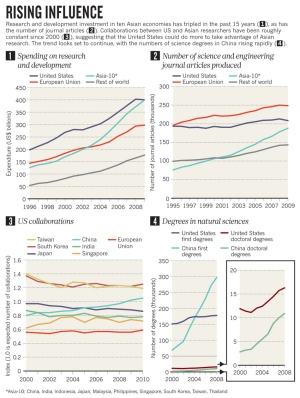
It is a mantra that plays readily to US competitive fears: Asia, led by China, is on track to displace the United States as the world’s science and technology powerhouse. That message is loud and clear in the 2012 edition of Science and Engineering Indicators, a nearly 600-page snapshot of the state of global research that looks at education, academic infrastructure, the knowledge-based workforce and international markets. Yet some policy experts say that the trends reveal opportunities for partnerships that could benefit the United States.

“Our country needs to worry about science and innovation when so much is being done out of the country. Long-term, this might be harmful to our competitiveness,” says Ray Bowen, chairman of the US National Science Board, which produced the report and oversees one of the US government’s main research funding agencies, the National Science Foundation (NSF). The report, released on 17 January, finds that by 2009, the combined research and development (R&D) investment from a group of ten Asian economies including China and India, had caught up with that of the United States (see ‘Rising influence’). “One hopes that the new data will help to reinforce the message that the US government (as well as industry) needs to keep R&D investments at the top of its priorities, despite current fiscal constraints,” says Claude Canizares, vice-president for research at the Massachusetts Institute of Technology in Cambridge.
To read more click...

Friday, January 20, 2012

Chemistry Professor developing sustainable bioplastics

Engineerblogger
Jan 19, 2012


The cover of Angewandte Chemie International Edition that illustrates CSU Professor Eugene Chen's research. Credit: Colorado State

A CSU chemistry professor has developed several patent-pending chemical processes that would create sustainable bioplastics from renewable resources for use on everything from optical fibers and contact lenses to furniture and automobile parts.

Chemistry Professor Eugene Chen and his co-workers have invented a platform of processes to convert small molecules derived from nonedible plant biomass to bioplastics. The molecules can be transformed into different materials depending on the catalyst that is added to them. That catalyst can either be an organic compound or a metal-based compound.

Two related studies were published last year and this month, both in Angewandte Chemie International Edition.

Assisting with patent

Officials with CSU Ventures, the university’s technology transfer arm, are optimistic about the commercial potential of this work and have filed several provisional patent applications on Chen’s processes.

“Each year, the U.S. alone manufactures almost 90 billion pounds of synthetic plastics derived predominantly from fossil fuels, which are not renewable,” Chen said. “There’s a great deal of concern to develop sustainable polymers or materials that can displace those petrochemical polymers. There’s huge interest in academia and industry, so the largest companies such as Dow Chemical, Dupont and BASF are pursuing sustainable chemical feedstocks to make materials.”

The organic process Chen created could be used to produce commodity plastics for everyday uses such as artificial glass, dental resins, automobile parts and furniture. His metal-based process would be used to produce high-performance engineering plastic materials that have superb mechanical and physical properties.

Chen has found in his laboratory that commercially available organic catalysts applied to small molecules derived from plant biomass are very active and efficient – the reaction achieves completion within a minute – and non-toxic. He also has developed a metal-based catalyst system that produces “stereoregular” polymers that exhibit superior physical and mechanical properties, meaning they’re very robust and more resistant to such factors as temperature, liquids, chemicals and scratches.

Creating high-performance materials
Plastic optical fibers, for example, must sustain exposure to the elements and still perform at a high level so they don’t interrupt telecommunications service.

“These materials require high resistance to extreme conditions including high temperature and unexpected environmental invasion,” Chen said.

Chen has done previous research showing that dissolving plant biomass in “green” solvent ionic liquids - salts that melt at low temperatures - converts more sugars needed for biofuel more quickly than traditional methods. The discovery was an important step in the move toward the use of nonedible plant biomass as an alternative source for fuel. Most recently, Chen’s lab has filed a provisional patent for a new catalytic process in ionic liquids to convert plant biomass to platform chemicals.

Chen joined Colorado State in 2000 from Dow Chemical where he researched production of petroleum-based polyolefin plastics. His current research has been supported by grants from the National Science Foundation and the U.S. Department of Energy.

Yuetao Zhang, a research scientist; Yangjian Hu, a postdoctoral fellow; and Garret Miyake, a graduate student, all work with Chen and contribute to the research.

Source: Colorado State

Tuesday, January 17, 2012

Comparing Energy Conversion of Plants and Solar Cells

Engineerblogger
Jan 17, 2012


In studies at Urbana, Illinois, ARS scientists (left to right) Carl Bernacchi, Don Ort, and Lisa Ainsworth work in a facility where photosynthesis efficiency and yield can be measured in response to a simulated variable. Improving photosynthesis could lead to increased food production from soybeans, shown here. Photo courtesy of Institute for Genomic Biology/University of Illinois.

Scientists now have a way to more accurately compare how efficiently plants and photovoltaic, or solar, cells convert sunlight into energy, thanks to findings by a research consortium that included a U.S. Department of Agriculture (USDA) scientist.

The study, published in Science, could help researchers improve plant photosynthesis, a critical first link in the global supply chain for food, feed, fiber and bioenergy production.

Comparing plant and photovoltaic systems is a challenge. Although both processes harvest energy from sunlight, they use that energy in different ways. Plants convert the sun's energy into chemical energy, whereas solar cells produce electricity. The scientists, including Agricultural Research Service (ARS) research leader Donald Ort in the agency's Global Change and Photosynthesis Research Unit in Urbana, Ill., identified specific designs that hold excellent promise for improving efficiency.

ARS is the USDA's chief intramural scientific research agency.

The first step was to facilitate a direct comparison of the two systems. The researchers set a uniform basis for the comparison and examined the major factors that define the efficiencies of both processes, first considering current technology, then looking forward to possible strategies for improvements.

In all cases, the research team considered the efficiency of harvesting the entire solar spectrum as a basis for comparison. Additionally, the researchers compared plants to solar cell arrays that also store energy in chemical bonds. Calculations were applied to a solar cell array that was coupled to an electrolyzer that used electricity from the array to split water into hydrogen and oxygen. The free energy needed to split water is essentially the same as that needed for photosynthesis or a solar cell, so the comparison provided a level playing field.

Using this type of calculation, the annual averaged efficiency of solar-cell-driven electrolysis is about 10 percent. Solar energy conversion efficiencies for crop plants are about 1 percent, which illustrates the significant potential to improve the efficiency of the natural system, according to Ort. While, in the context of the team's efficiency analysis, solar cells have a clear advantage compared to photosynthesis, there is a need to apply both in the service of sustainable energy conversion for the future. This energy-efficiency analysis between plant photosynthesis and solar cells will lay the groundwork for improving the efficiency of plant photosynthesis in agriculture for improved yield.

Source: Agricultural Research Service

Monday, January 16, 2012

Longer-lasting chemical catalysts

Engineerblogger
Jan 16, 2012


A graphical representation of the retrievable and reusable polymer–metal catalyst, showing the palladium (blue) that links two imidazole polymer units (red) through their nitrogen atoms. Copyright : 2011 Yoichi Yamada


Metal-based chemical catalysts have excellent green chemistry credentials—in principle at least. In theory, catalysts are reusable because they drive chemical reactions without being consumed. In reality, however, recovering all of a catalyst at the end of a reaction is difficult, so it is gradually lost. Now, chemists can retain, retrieve, and reuse metal catalysts by trapping them with a polymer matrix, thanks to recent work by Yoichi Yamada at the RIKEN Advanced Science Institute, Wako, Yasuhiro Uozumi at RIKEN and Japan’s Institute for Molecular Science and Shaheen Sarkar, also at RIKEN.

Attaching metal catalysts to an insoluble polymer support, which is recoverable at the end of a reaction by simple filtration, is far from a new idea. Traditionally, chemists attached their metal catalyst to an insoluble polymer resin. However, the metal invariably leached out of the polymer over time so the catalysts were still slowly lost.

Yamada and his colleagues' approach, in contrast, integrated the metal into the polymer matrix, which trapped it much more effectively. The researchers achieved this level of integration by starting with a soluble polymer precursor instead of an insoluble resin. This material contains imidazole units, a chemical structure known to bind strongly to metals such as palladium. An insoluble composite material formed only after the researchers added palladium to the mixture because it causes the imidazole units to self-assemble around atoms of the metal—a process that they call 'molecular convolution'.

Scanning electron microscopy revealed that the resulting polymer–palladium globules ranged from 100 to 1,000 nm in diameter, which aggregated into a highly porous structure reminiscent of a tiny bathroom sponge. "This sponge-like insoluble material can easily capture substrates and reactants from the solution, which readily react with metal species embedded in the sponge," says Yamada.

The researchers showed that the catalyst is highly active as well as reusable; it is the most active catalyst yet reported for a carbon–carbon bond-forming reaction known as an allylic arylation. They also reused the catalyst multiple times with no apparent loss of activity, and detected no leaching of palladium from the polymer into the reaction mixture.

Yamada and colleagues are now developing a range of composite catalysts incorporating different metals that can catalyze many other kinds of reactions. "These extremely highly active and reusable catalysts will provide a safe and highly efficient chemical process, which we hope will be adopted for industrial chemical process," Yamada says.

Source: RIKEN

Additional Information:

Magnetic Memory Miniaturized to Just 12 Atoms

Technology Review
Jan 16, 2012


This scanning tunneling microscope image shows a group of 12 iron atoms, the smallest magnetic memory bit ever made. Credit: IBM


The smallest magnetic-memory bit ever made—an aggregation of just 12 iron atoms created by researchers at IBM—shows the ultimate limits of future data-storage systems.

The magnetic memory elements don't work in the same way that today's hard drives work, and, in theory, they can be much smaller without becoming unstable. Data-storage arrays made from these atomic bits would be about 100 times denser than anything that can be built today. But the 12 atoms making up each bit must be painstakingly assembled using an expensive and complex microscope, and the bits can hold data for only a few hours and at low temperatures approaching absolute zero, so the miniscule memory elements won't be found in consumer devices anytime soon.

As the semiconductor industry bumps up against the limits of scaling by making memory and computation devices ever smaller, the IBM Almaden research group, led by Andreas Heinrich, is working from the other end, building computing elements atom-by-atom in the lab.

The necessary technology for large-scale manufacturing at the single-atom scale doesn't exist yet. Today, says Heinrich, the question is, "What is it you would want to build on the scale of atoms for data storage and computation, in the distant future?"

As engineers miniaturize conventional devices, they're finding that quantum physics, which never had to be accounted for in the past, makes devices less stable. As conventional magnetic memory bits are miniaturized, for example, each bit's magnetic field begins to affect its neighbors', weakening each bit's ability to hold on to a 1 or a 0.

The IBM researchers found that it was possible to sidestep this problem by using groups of atoms that display a different kind of magnetism. The key, says Heinrich, is the magnetic spin of each individual atom.
To read more click here...