Pages

Subscribe:

Labels

038628037504 (1) 10150 (1) 10BURIED (1) 10Count (1) 110011040 (1) 115Ounce (1) 1200mg (1) 12BSN (1) 12Count (2) 12CountNutricor (1) 12CountWWSN (1) 12Fresh (1) 12Stacker (3) 12VPX (1) 140243 (1) 14Servings (1) 158Ounce (1) 15Ounce (1) 16Ounce (2) 1716 (1) 17Skque (1) 1lbinLife (1) 2000Hrs (1) 2000mg (1) 200Watt (1) 2021A (1) 20OunceNatures (1) 2412Ounce (1) 24Count (1) 24EAS59134 (1) 24FRS (1) 24Guru (1) 24Guru01GR124 (2) 24Nestle (2) 24Pediasure (2) 24Peptamen (1) 24PieceDisplay (1) 24Solis (2) 27ReSource (2) 2Biochem (1) 2Dynamic (1) 2Jarrow (1) 2Muscle (1) 2Natures (1) 2Ounce (3) 2Pound (1) 30Day (1) 328601 (1) 334928 (1) 336gOptimum (1) 37Ounce (1) 3Ensure (1) 3M (1) 414 (1) 432500 (1) 48Boost (1) 48Fluid (1) 48ml (1) 4Ensure (1) 4Isopure (1) 5000mg (1) 527408 (1) 5511786 (1) 574400 (1) 5Hour (2) 5Ounces (1) 600Kendall (1) 662380 (1) 6Beneprotein (1) 6Proteinex (1) 70951 (1) 750mlNutriPrima (1) 845Ounce (1) 84Fluid (2) 84OuncesLiquid (1) 89Inch (1) 8nuun (2) 8Ounce (7) 99369FR (1) ABB (3) Academy (1) ACCENTS (1) Acia162Ounces (1) Acsry (1) Active (2) Adapter (1) AdapterBattery (1) Advance (1) Advanced (1) Advantage (1) AdvantEdge (1) Africa (29) African (1) Agaricus (1) AiCoco (1) AIDSTrustex (1) Airbrush (1) Airbus (6) Aircraft (94) AISI (1) Ajmeras (1) Alchohol (1) Alertness (1) Alfalfa (2) Alive (1) Allergy (1) Allspice (8) Alpine (1) Alstom (2) Alternative (1) Amarillo (1) Amazing (3) Amazon (2) American (1) animal (11) Annual Reports (155) Antioxidant (1) Anwar Ibrahim (1) Apple (1) Applied Materials (1) Arrowroot (1) AshtonDrake (1) Asia (72) Assorted (1) Atkins (1) Audi (1) Australia (21) Automotive (250) Automotive Technology (183) Ayurvedic (1) BABIES (1) Babys (1) Bacopa (1) BagAtkins2627 (1) BagsTraditional (1) BagSun (1) Balanced (1) Ballard Power System (1) Banaba (2) Baram Dam (1) Baram Regatta (1) Bariatric (1) Barisan Nasional (2) Barisan Nasional Helps Penan (1) Barista (2) Barley (2) barsBiochem (1) Basement (1) BASF (2) Basics (1) Batu Lawi (1) Bayer (1) BEA1017OZ (1) Beachbody (1) Beaded (1) Beaumont (1) beautiful girl image (19) Beauty (2) Beneprotein (2) Berries (3) Berry (4) BerryLiving (1) Beverage (1) Bicycle (1) BioAstin (1) Biochem (4) Biofuel (12) Biogenesis (2) BlackBlender (1) Blend (1) Blender (4) Blueberry (1) BlueStereo (1) BMF (1) BMW (7) BMX (1) BN (1) Boeing (4) Bombardier (4) Book (1) Borneo (6) Bottle (8) BottleProStat (1) Bottles (15) BottleScivation (1) bottlesEnsure (2) BottlesMio (1) BoxChenille (1) BoxDarice140243 (1) BOXESAmerican (1) BoxesFRSPowder (1) BoxPremier (1) BP (2) Brands (1) Brands833667000102 (1) Brazil (10) Brazilian (1) Breeze (3) BrewersBarista (1) BRIC (118) Brikpaks (3) Brownie (1) Bruno Manser (1) Bruno Manser Fund (3) Bruno Manser Fund Fraud (1) Bruno Manser Fund Frauds (1) Bruno Manser Lies (2) BTL410400 (1) Bubbles (1) Burner (1) business (72) Butchers (1) Butter (1) Butterscotch (1) Cable (1) Cables (1) Calcium (2) California (1) Calorie (3) Camera (1) Canada (11) Candela (1) Canister (2) CanisterCLICK (1) Canisters (1) Canning (1) Capramilk (1) CapsSwanson (1) Capsule (5) Capsules (6) CapsulesEAS (1) Caraway (1) Cardio (1) Carnation (1) CaseEnsure (2) CaseNestle (2) Celebrity (22) CellularFactory (1) Celsius (1) Certification (28) Certified (2) Chameleon (1) Charger (1) Charter/Terms of Reference (27) CHEAP (135) Chenille (1) Cherry (1) CherryZydot (1) Chevron (1) Chewing (1) Chile (1) China (99) Chipotle (1) Chlorophyll (1) Chocolate (7) Chocolate8 (1) Choice (2) Cholesterol (1) Chrome (1) Chrysler (1) Chunho (1) Citrifolia (1) Citroen (1) Citroën (1) Citrus (2) Civil Service (1) CK Morris Associates (1) Clare Rewcastle Brown (2) Class (1) Classic (2) Clinical (1) CNST (1) Coenzyme (1) Coffee (4) Coffee11001105 (1) Coffee7DSC2B (1) Coffeehouse (1) Cold Fusion (1) Coldkicker (1) Collectable (1) Collection (1) Colored (1) Colors (1) Communications (14) Company (2) COMPLETE (4) Complex (1) Computer (1) Concentrate (1) Concentrated (1) Concepts645654 (1) Condoms (1) Container (7) CONTROL20BGSee (1) Corrections (3) CosMedix (1) count (1) countAmscan (1) CountMy (1) Crayola (3) Criminal (4) Cruiser (1) Crunch (1) Cytosport (2) Daimler (3) Dam (1) DAP (1) DAP Lies (1) Darice (1) DARPA (18) Dato Roland Sagah Wee Inn (1) Defence (60) Defense (61) Delight (2) description (1) Desert (7) Design (65) DESIGNER (3) Desktop (1) detail (1) Detroit (1) Development (1) Dexatrim (1) diameter (1) diameterGaming (1) Diecast (1) Dinosaur (1) DISCOUNT (4) Discover (1) Disney (1) Doctors (1) DoE (8) DolphinsSticky (1) DOMAGRON (1) Dow Corning Corp (2) DP9260 (1) DRA6329 (1) Dragon (1) Dressing (1) Drink (11) Drinkin (1) drinksNVE (1) Dupont (2) dv9657clSIBCORP (1) Dymatize (3) DYMMGV (1) DYNAMIC (5) EachHager (1) EADS (12) ecigs (1) Eco-Tourism (1) Economy (14) Education (1404) Electra (1) Electric Grid (1) Electrolyte (4) ELP3STSL (1) Endorush (1) Endurox (2) Energizing (1) Energy (540) English Article (20) Enhanced (1) Enhancer (1) Enlive (2) Ensure (12) Enterprise (1) Environment (170) Enzymatic (1) Eraser (1) ERECTION (1) Ergonomics (4) ESA (4) Espresso (1) Essence (2) Essentials (3) EssentialsHSE (1) ethnic group (1) Europe (201) Executive/External Ombuds (2) Extended (2) ExtenderBadger (1) Extension (1) Extern/Intern (20) Extract (5) Extreme (21) Factor (1) Factors (3) Fantastic (1) Fatigued (1) Faucet (1) feature (9) Featuring (1) Fellowes (1) Fillet (1) First Energy (6) Fitera (2) FlatScreen (1) Flavor (1) FlavorBeachbody (1) Focus28 (1) Ford Motors (7) Foreign NGOs (2) Forest (1) formula (5) Formulas (1) Forts (1) FORUM (1) Fragrance (1) France (12) Frappuccino (1) FreeHubner (1) French (2) Friday Poll (13) Frontier (1) Frost (1) Fruits (1) Ft1140Alessco (1) Ft132Alessco (1) FToys (1) Fudge (1) Fuel Cell (26) Fujitsu (2) funny (19) Gadget (6) Galleries (1) Gallon (1) GameJax2000 (1) Games (1) General Electric (21) General Motors (15) Genesis (1) Georges (1) Germany (28) Go02658 (1) Golden (1) Goldfinch (2) Goodyear (1) Google (6) Gordoni (1) Gourmet (1) Government (333) Grape (2) Grape5 (1) Green Energy (544) Greens (2) GripAlex (1) Ground (7) Guarana (1) Halal Hub (1) Hammer (1) Hardware (1) Hasbro (1) Hawaiian (1) health (19) Health Care (87) Healthy (4) Herbal (5) Herbals (1) Himalayan (1) Holiday (1) Honda (4) Honeywell (1) Hoodia (1) HPCompaq (1) Hubner (1) human capital development (1) Humor (18) Hydration (2) hydration8PKNUUNLL (1) Hydrive (1) Hyundai (2) IBM (2) Illegal Demonstrations (1) iMicro (1) IMMICRP (1) India (23) information (8) Infrastructure (44) inLife (1) Inside Invester Ltd (1) Instantized (1) Institute (1) International (338) Internet (7) Intestinal (2) Investment (187) IOA News (168) ISO (1) ISO100 (1) Isolate (2) Isopure (4) Isotonix (1) Italian (2) Italy (1) Jabatan Penerangan (1) Jameson Ahip Nawie (1) Japan (57) JarALTERNATIVE (1) JarDoctors (1) Jarrow (1) Job Postings (339) Johnson Controls (1) Journey (2) Juice (2) JUICECRANBERRYOG2 (1) JuiceTahitian (1) Kangmei (1) KCups (1) Kerlix (1) Kettler (1) Kettler8852600 (1) Keurig (1) Keyboard (1) Kiddio (1) KitBerg (1) KiteSpiderMan (1) KitGoldfinch (1) Kombucha (2) KombuchaKIT (1) Kraft911501 (1) Kuching (1) Laboratories (1) Langnickel (1) LaptopNotebook (1) lbBioGenesisRICE3 (1) lbsNatural (1) Leading Indicators (450) Lean (10) LeapFrog (3) Learning (1) Leaves (2) Leccino (1) Legislation (65) Lemonade (2) Lemonlime (1) Len Talif (1) License (1) Lifetime (2) Light (1) LightHog (1) LINERBLADDER (1) Liquid (20) LiquidDeSouzas (1) Litigation (45) Living (2) Lockheed Martin (6) Looking (1) Lubricants (1) Lubricated (1) Macbook (1) Malaysia (4) MaleFemale (1) Management (16) Manufacturing (394) Marine Technology (2) Materials (446) Mazda (2) Medical (84) Medicinals (1) MEGAWING (1) Mental (1) Mercedes-Benz (3) Merdeka (2) Metabolic (1) MetaboLife (1) Metallic (1) Metamucil (1) MetersCables (1) Middle East (16) Miniatures (1) MioEnergy (1) Miradent (1) Miri (1) MIRROR (1) Mitsubishi (4) Monkey (2) Monster (1) Morinda (1) Morton (1) Mosacis (1) Mosaics (1) Mothers (1) MountScotty245 (1) MultiPackCELSIUS (1) MultiPackDYNAMIC (2) MultiPackLILY (1) MultiPackLIQUID (1) MultiPackMACA (1) MultiPackONLY (1) Multiracial (1) Mulu (1) Muscle (1) Muscletech (2) Myoplex (1) Nanotechnology (279) NASA (22) National Laboratory (46) Natural (12) natural phenomena (11) Naturally (1) Naturals (3) Natures (6) Naturessunshine (4) nc8000 (1) nc8220 (1) nc8230 (1) Nesting (1) Nestle (2) Netbook (1) New Programs (133) New Zealand (2) NGO's (213) NGOs (1) Nickel Hydrogen (1) Nissan (8) NIST (5) North America (18) Northrop Grumman (1) Norway (1) NovoAndina (2) Noxide (1) NREL (8) NSF (3) NTT Data (1) Nuclear (45) Numbers (1) Nuspeed (1) Nutrex (1) Nutricor (1) Nutrient (2) Nutrients (1) NutriPrima (1) Nutrition (15) Nutritional (5) NutritionON45 (1) nw8000 (1) nw8240 (1) Offshore (7) OilsAWM (1) OintmentWounded (1) Olives (1) Onshore (2) Optical Technology (28) Optimum (4) Optisource (2) Orang Ulu (1) Orange (7) OrangeHigh5 (1) Organic (12) Original (2) Other Ombuds (145) Otomotif (2) ounce (1) Ounces (5) OuncesSea (1) OunceThe (1) Outside the Standards (62) Oxford Business Group (1) OyToys (1) OzAfrican (1) ozNatures (1) Packages (1) Packet (1) Packets (1) PacketsNatures (1) PacketsUltima (1) Packs (2) PackStarbucks (1) PadCrayola (1) Paradise (1) Parazyme (1) Parents (1) Parmigiani (1) Pavilion (1) Pecan (1) Pediasure (3) Pehin Sri Haji Abdul Taib Mahmud (1) Penan (9) Pepper (1) Peppermint (1) Peptamen (1) Peter Jaban (2) Pharma (1) Pharmaceuticals (1) Phillips (1) Pickling (1) Pieces (1) PineappleGU (1) PinkBlender (2) PKR (1) PlantBased (1) Plantiva (1) Plastic (8) PN0223 (1) Pomegranate (1) PomegranateGU (1) Porsche (1) PostCXDNSR105 (1) Poundlb (1) Pounds (1) PoundsClif (1) Powder (20) Powdered (1) PowderEndurox (1) PP1235BBS (1) Practice Pointers (185) Prebio (1) PregNatal (1) Premier (1) Premium (3) preservatives (1) Preston (1) Private Sector (174) Proasis (1) Products (2) Professional Devt. (254) Profiles (257) Projector (1) Proscience (1) ProStat (2) protein (14) Proteinex (1) Protidiet (1) Proxima (1) Pudding (1) Punch (1) Purpose (1) Puzzle (1) R. Palan and Sabariah Putit (1) R4Lemon (1) Rail (41) RAINBOW (1) Rainforest (2) Raspberry (1) REA6048 (1) ReadytoDrink (1) Reaper (1) Recovery (2) Regional Events (101) Regular (2) Release (2) Remedies (1) REMEDIES4582008 (1) Replacement (2) Replenisher (3) ReplenisherUltima (1) Research (1) Research and Development (825) ReSource (4) Results (1) Revitalization (1) Roasted (1) Robotic Technology (124) Rocket (2) Rolls royce (7) Rooibos (1) Rosemary (1) ROSSLARE (1) Russell (1) Russia (17) Safety (15) Sains (20) SaltFree (1) Samalaju (4) Sammons (1) Samsung (1) Sarawak (13) Sarawak 10th State Election (1) Sarawak Borneo (7) Sarawak Budget 2012 (1) Sarawak Corridor of Renewable Energy (SCORE) (8) Sarawak Development (1) Sarawak Economics (1) Sarawak Economy (6) Sarawak ethnic groups (1) Sarawak Forest Corporation (2) Sarawak Politics (4) Sarawak Rainforest (2) Sarawakian (7) Satellite (6) Saudi Aramco (1) ScaledStar (1) Scholarly Articles/Research (102) science (50) Scivation (1) ScottishPower Renewables (1) Scotty (1) Seasoning (1) SEB (1) Secura (1) Seks (12) Senior Citizens (1) Series (1) serving (2) Servings (2) servingsBariatric (1) Shades (1) shake (4) Shaker (1) SHEETSHygloss (1) Shell (1) ShotCL27752 (1) Siemens (8) Silicone (1) Silver (1) Singapore (2) Single (1) Sleeve (1) SlimFast (1) Slimming (1) SlimStyles (1) SM005Grey (1) Smart (1) smartphone (1) Smoke (1) Smoothie (2) Smore (1) SoftCarpets (2) Softgels (1) Sony (1) Souffle (1) Source (2) South Africa (11) South America (11) South Korea (1) Space Technology (69) Sparkling (1) SpiderMan (1) Sponge (1) SpongeSammons (1) Sport (8) Sports (7) Springtime (1) Stacker (4) Starbucks (1) Starwest (2) Stems (1) Stereo (1) Sterile (1) Sticker (1) Sticky (1) Stomach (2) Strawberry (3) Strength (3) Strive (1) SumoMESUMO66897 (1) Sundries (5) Sunkist (1) Sunwarrior (1) SuperGreens (1) Supplement (4) Supplier (1) supply (3) Support (4) Supreme (2) Sustainable Forest Management Policy (2) Switzerland (2) System (3) Tablet (2) Tablets (3) TabletsTwinlab (1) Tahatian (1) Tahitian (1) Taib Mahmud (6) Taisho (1) Tanjung Manis (1) Tanjung Manis Halal Hub (1) Tartar (2) Tata (4) Tattoos (1) Technology (562) Temporary (2) Temptations (1) Tesla (1) Testors (1) Thalgo (1) The Report 2011 (1) Therapeutic (1) TinTea (1) Tips (25) Tokuyama (1) Topical (1) totalBoost (1) Toyota (15) Toys21030000 (1) ToyTote (1) Transitions (255) Transphorm (1) Transport (135) TREASURE (1) TrikeKiddio (1) Tropical (2) Trumans (1) Trustex (1) Tubes30 (1) Twinlab (2) Twistables (1) Two Hats (2) Uganda (1) UK (107) Ulticare (1) Ultima (3) Ultimate (1) Ulu Baram (1) Unflavored (1) Unibody (1) Unique (53) United States (281) University (1) Unknown (1) Uranium (1) USDA (1) Vale (1) Vanilla (10) Vanilla8 (1) Varcho (1) Variety (3) VegCap (3) Vehicle (1) Video (30) Viennese (1) Visitor Advice (70) VIT033 (1) Vitacost (5) Vitalyte (1) Volkswagen (5) Volvo (2) VTL200CIR (1) Warrior (3) WarsATST (1) Water resources (1) Water Technology (28) Watermelon (1) Wedding (1) Weight (2) Whole (2) Wild10650 (1) Wooden (1) World news (67) Worldwide (1) Wounded (1) Xtend (1) Xtreme (1) Xylitol (1) ZeroCherry (1) ZipFizz (1) ZoomOxo4113600 (1) ZZP88103 (1)

Showing posts with label Robotic Technology. Show all posts

Wednesday, March 7, 2012

Robotic surgery popular, expensive, but is it more effective?

Medill Reports
March 7, 2012

Da Vinci surgeries like this one may not be any more effective than the cheaper traditional surgeries. Credit: Lisa Weidenfeld/MEDILL

The new Da Vinci surgical robot is a hit with patients, who request it for all kinds of procedures. But is it really more effective than traditional surgery -- or just more expensive? Some doctors argue that without much authoritative research, the Da Vinci robot is more a marketing tool than an improvement to surgery.

Surgeries performed with the new, high-tech, da Vinci robot use a narrower blade and provide greater precision than traditional open surgeries, which are performed with a scalpel. The machines are maneuvered by a surgeon operating the robotic arms from behind a nearby console.

There are 2,132 da Vinci systems world-wide, said Chris Simmonds, senior director of marketing services for manufacturer Intuitive Surgical, Inc. and that number is growing. But they do not come cheap. The machines each cost between $1.1 million and $2 million, with an additional cost of $100 thousand to $180 thousand for maintenance annually.

In a 2011 study from Johns Hopkins University about the marketing of the da Vinci robot, 41 percent of hospital websites included a description of robotic surgery, with 89 percent of those descriptions claiming clinical superiority. Despite this claim, only 2 percent of those hospitals made a specific comparison to open or laparoscopic surgery, which involves inserting a camera through an incision. The marketing for robotic surgery may win over more converts than the results of the surgeries.

“You start to see this is not just a trivial issue of exuberant marketing, but it is in some cases potentially inaccurate and really harmful, potentially harmful information, wrapped in the glitz and the glamor of a new technology,” said Gary Schwitzer, publisher of HealthNewsReview.org, a site devoted to reviewing media coverage of “medical treatments, tests, products and procedures.” Schwitzer has been reporting on health issues for more than 30 years.
To read more click here...

Tuesday, March 6, 2012

DARPA’s “Cheetah” Sets Land Speed Record for Legged Robots

Engineerblogger
March 6, 2012


The use of ground robots in military explosive-ordinance-disposal missions already saves many lives and prevents thousands of other casualties. If the current limitations on mobility and manipulation capabilities of robots can be overcome, robots could much more effectively assist warfighters across a greater range of missions. DARPA’s Maximum Mobility and Manipulation (M3) program seeks to create and demonstrate significant scientific and engineering advances in robot mobility and manipulation capabilities.

The M3 program pursues four parallel tracks of research and development: tool design, improvement of production methods and processes, improvement in control of robot mobility and manipulation, and prototype demonstration.

This video shows a demonstration of the “Cheetah” robot galloping at speeds of up to 18 miles per hour (mph), setting a new land speed record for legged robots. The previous record was 13.1 mph, set in 1989.

The robot’s movements are patterned after those of fast-running animals in nature. The robot increases its stride and running speed by flexing and un-flexing its back on each step, much as an actual cheetah does.

The current version of the Cheetah robot runs on a laboratory treadmill where it is powered by an off-board hydraulic pump, and uses a boom-like device to keep it running in the center of the treadmill. Testing of a free-running prototype is planned for later this year.

While the M3 program conducts basic research and is not focused on specific military missions, the technology it aims to develop could have a wide range of potential military applications.

The DARPA M3 performer for Cheetah is Boston Dynamics of Waltham, Mass.

Source: DARPA

Developing Robots That Can Teach Humans

Engineerblogger
March 6, 2012


A few years ago, AnthroTronix, Inc., an engineering research and development firm in College Park, Md., introduced Cosmobot, a type of social robot for therapists and educators who work with developmentally and learning disabled children, including those with autism and cerebral palsy. By imitating human joint movement in its shoulders, arms, hands and head, Cosmobot motivates children to develop new skills more quickly than is typical with traditional therapy. But why does this work? Why do children respond so favorably to educational programs taught by technology? And, when the technology is a robot made from inanimate materials, how do children learn to distinguish between the robot and a living thing? Credit: NSF


Researchers are programming robot teachers to gaze and gesture like humans

When it comes to communication, sometimes it's our body language that says the most--especially when it comes to our eyes.

"It turns out that gaze tells us all sorts of things about attention, about mental states, about roles in conversations," says Bilge Mutlu, a computer scientist at the University of Wisconsin-Madison.

Mutlu knows a thing or two about the psychology of body language. He bills himself as a human-computer interaction specialist. Support from the National Science Foundation (NSF) is helping Mutlu and his fellow computer scientist, Michael Gleicher, take gaze behavior in humans and create algorithms to reproduce it in robots and animated characters.

"These are behaviors that can be modeled and then designed into robots so that they (the behaviors) can be used on demand by a robot whenever it needs to refer to something and make sure that people understand what it's referring to," explains Mutlu.

Both Mutlu and Gleicher are betting that there will be significant benefits to making robots and animated characters "look" more like humans. "We can build animated agents and robots that can communicate more effectively by using the very subtle cues that people use," says Gleicher.

Mutlu sets up experiments to study the effect of a robot gaze on humans. "We are interested in seeing how referential gaze cues might facilitate collaborative work such that if a robot is giving instructions to people about a task that needs to be completed, how does that gaze facilitate that instruction task and people's understanding of the instruction and the execution of that task," says Mutlu.

To demonstrate, a three-foot-tall, yellow robot in the computer sciences lab greets subjects, saying: "Hi, I'm Wakamaru, nice to meet you. I have a task for you to categorize these objects on the table into boxes."

In one case, the robot very naturally glances toward the objects it "wants" sorted as it speaks. In another case, the robot just stares at the person. Mutlu says the results are pretty clear. "When the robot uses humanlike gaze cues, people are much faster in locating the objects that they have to move."

Another experiment run by Mutlu and Gleicher's team explores how an animated character's eyes affect human learning. A character projected on a screen says to the viewer, "Today, I'll be telling you a story that comes straight from ancient China." Behind the animated character is a map of China that he'll be referring to in the lecture that runs several minutes.

"The goal of the experiment is to see if we could achieve a high-level outcome, like learning, by controlling an animated character's gaze," says Gleicher. "What we found was when the lecturer looked at the map at appropriate times to indicate to the participant that now I'm talking about something on the map, the participant ended up learning more about spatial locations."

The team hopes their work will transform how humanoid robots and animated characters interface with people, especially in classrooms. "We can design technology that really benefits people in learning, in health and in well-being, and in collaborative work," notes Mutlu.

Now, that's technology worth keeping an eye on!


Source:  National Science Foundation (NSF)

Monday, March 5, 2012

Robotics: Present state and future trends

Engineerblogger
March 5, 2012


Grunt work: This concept for a military robot would continue the tradition of machines taking on jobs that are dirty or dangerous

Contemporary robots are used for jobs that are boring, dirty, or dangerous; or for tasks that require more speed, precision, or endurance than a human can provide.

They perform almost all welding, painting, and assembly tasks in the automotive industry and have become a basic element of production in industries ranging from electronics to wood products. According to World Robotics, a 2008 report published by the International Federation of Robotics, the estimated number of industrial robots installed worldwide is more than one million—50% in Asia and Australia, 33% in Europe, and 17% in North America.

An assessment of the international state of robotics R&D published in 2006 by the nonprofit analysis World Technology Evaluation Center (WTEC), found that the U.S. was leading in robot navigation in outdoor environments, robot architectures (the integration of control, structure, and computation), and in applications to space, defense, underwater systems, and some aspects of service and personal robots.

Japan and Korea lead in technology for robot mobility, humanlike robots, and some aspects of service and personal robots (including entertainment). Europe led in mobility for structured environments, including urban transportation. Europe also has significant programs in elder care and home service robotics. Australia led in commercial applications of field robotics, particularly in such areas as cargo handling and mining, as well as in the theory and application of localization and navigation.

The panel also reported that the U.S. lost its preeminence in industrial robotics at the end of the 1980s, and nearly all its robots for welding, painting, and assembly are imported from Japan or Europe.


Cognitive robots can be used as home helpers, caregivers, or emergency and rescue aids.

U.S. R&D efforts on robotics have focused primarily on military and defense-related applications—unmanned aerial, ground, and maritime systems, both surface and undersea. The Department of Defense plans to develop an increasingly sophisticated force of unmanned systems over the next 25 years and expects to integrate them with manned systems.

In 2009, the DOD published the 25-year, unmanned-systems integrated roadmap to 2034. In July 2008, the Robotics Technology Consortium, Inc., was formed with 70 initial organizations, to speed the creation and deployment of ground robotics technology for the DOD and other U.S. government agencies. It has since grown to more than 200 member organizations.

A congressional robotics caucus was formed in 2007 to broaden awareness among members of Congress and policy analysts of key issues facing the U.S. robotics industry. In May 2009, the caucus published A Roadmap for U.S. Robotics: From Internet to Robotics, a targeted R&D roadmap for nonmilitary applications of robotics in manufacturing, in medical and healthcare, in domestic and professional services, and in emerging technologies.

In 2005, the European Robotics Technology Platform was formed to strengthen links between academia and industry, and to develop a research agenda of European robotics. In 2009, the industry group Coordination Action for Robotics in Europe (CARE) also published the Strategic Research Agenda for Robotics.

In Japan, the Ministry of Economy, Trade, and Industry has sponsored robotics activities for a long time. A 2007 national technology roadmap by the Trade Ministry called for one million robots to be installed throughout the country by 2025.

To alleviate a workforce shortage in the country, robots are expected to fill the jobs of 3.5 million people by 2025. The Japanese government also estimates that the nation may save as much as $21 billion on insurance payments in the same year by using robots to monitor the health of elderly people.

In South Korea, a 10-year robotics initiative was launched along with a detailed roadmap to make the country the second-largest provider of robotics in the world, after Japan. Robot Land, a theme park being built near Seoul, is expected to open in 2013. The country’s forecasts include placing a robot in every household by 2020.

Future Environments

The convergence of technologies involving computing, communication, and intelligent interfaces with autonomous robotics suggests that networks of intelligent, autonomous robots may become the next disruptive technology.

The concept of networking everyday objects and appliances in an ambient intelligent environment is not new. But the focus has usually been on the creation, delivery, and sharing of information, and not on the performance of physical tasks.

Autonomous mobile robots may one day perform complex medical procedures, including surgery, on patients in dangerous or remote locations from battlefields to space, with little human guidance. Advances in miniaturization and bionanotechnology could lead to a new generation of nanorobots, which would revolutionize the medical industry. Nanobots may provide treatment at the cellular level, perhaps clearing clogged arteries, repairing genes, battling cancer cells, and delivering drugs.

Cognitive robots can become available as office helpers or as robotic companions for guiding the blind and assisting the elderly. General-purpose anthropomorphic robots, with human-like hands, can be used in transforming manufacturing from resource-intensive to knowledge-intensive, and creating totally unmanned factories. Agricultural robotic scouts may roam the fields of the future to care for the plants, use sensors to provide detailed real-time information about the status of the crop, and apply data fusion techniques for making management decisions.

Source: ASME

Friday, March 2, 2012

DARPA’s Robotics Simulator/Test Platform Reaches 2nd Milestone

Engineerblogger
March 2, 2012


DARPA's Autonomous Robotic Manipulation (ARM) program is developing software to perform human-level tasks quickly and with minimal direction.

This video shows the ARM robot performing 18 grasping and manipulation tasks using vision, force, and tactile sensing with full autonomy – no active human control. The DARPA-supplied robot was built using commercial components that include an arm, hand, neck, and head sensors.

During rigorous testing in November 2011, the best team achieved 93% success in grasping modeled and unmodeled objects. The ARM program has entered its second phase, where focus turns to complex bimanual manipulation scenarios.

Source: DARPA

Wednesday, February 22, 2012

Researcher Brings Seven Adult-Sized Humanoid Robots Together For First Time in the U.S.

Engineerblogger
Feb 22, 2012


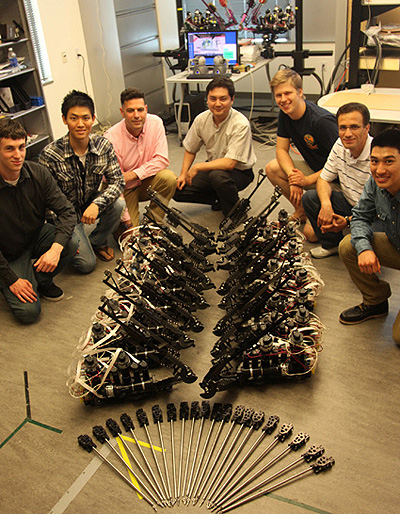
Seven adult-sized humanoid robots took the stage during Drexel University's celebration of National Engineers Week in a first-of-its-kind assembly of robotic technology. Their presence -together in one place- is a unique event that serves as a milestone for a nationwide, collaborative research effort funded by the National Science Foundation.

Seven adult-sized humanoid robots will take the stage during Drexel University’s celebration of National Engineers Week, in a first-of-its-kind assembly of robotic technology. A showcase event on Feb. 20 will introduce all seven of the Korean HUBO robots to the community. Their presence -together in one place- is a unique event that serves as a key milestone for a nationwide, collaborative robotics research effort funded by the National Science Foundation.

Each robot is 1.3 meters, or about 4-feet, 3-inches, tall. They are fully actuated, which means that they have similar joints and movement capabilities to that of a human, including arms, legs and hands with fully functional fingers and an opposable thumb.

“This is an historic event,” said Dr. Youngmoo Kim, an associate professor and assistant dean of media technologies in the College of Engineering and the director of the Music and Entertainment Technology (MET) Lab. “Never before have seven adult-sized, fully actuated humanoids appeared on stage together, so it’s truly a milestone in robotics research.”

Roots of the Robot Project
This gathering of robots is the fruition of seeds planted in 2008 when Drexel received a five-year grant from the National Science Foundation’s Partnership for International Research and Education (PIRE) Program with the goal of training engineers to work in global multi-disciplined design teams. This project, in close collaboration with the Korea Advanced Institute of Science and Technology (KAIST) HUBO Lab, enables Drexel and KAIST researchers to share training and knowledge and to work with the same world-class humanoid robot platform from different continents.

Dr. Paul Oh, the head of the Mechanical Engineering and Mechanics department, who headed the initial HUBO robot research in 2008, helped bring the first humanoid robot, named Jaemi Hubo, to Drexel in the spring of 2009 as part of the NSF PIRE grant. Oh’s students traveled to Korea to work with the HUBO robot platform and learn how to program and operate the robots.


“Humanoids provide an exciting and practical context to both motivate and train American students,” Oh said. “One can argue that humanoids are the epitome of what one perceives to be a robot. As such, they are an attractive area for engineering students to work on. Students quickly learn that Asia is the world-leader in humanoid design. Thus to become humanoid designers, students recognize that working alongside robot engineers in Asia is important.”

“The KAIST Hubo thus served as an effective platform to train students in both complex systems engineering and working in international design teams. The net effect is that humanoids have been an effective medium to make today’s American engineer more effective in a globalized work environment.”

From One to Seven
Since the arrival of Jaemi Hubo in 2009, making Drexel the only institution in the United States to have full-access to an adult-sized humanoid, engineers in Drexel’s Autonomous Systems Lab (DASL) have been accumulating experience, knowledge, and best practices as well as training others for advanced humanoids research.

Drexel engineers have also pursued projects that enable the robot to interact more naturally with humans. Students in Drexel’s Music, Entertainment, Technology Laboratory (MET-lab) introduced algorithms that direct Jaemi Hubo to dance to music, play the piano, and accompany music with a tambourine. These efforts are part of research toward making the robot musically aware, which, according to Kim, places it on the path toward autonomous human interaction.

“Our world is designed by humans for humans. To be truly useful as assistive devices, robots need to be able to deal with all of the various challenges of the real world and must have the skills and abilities to interact appropriately with humans.”

In August of 2010, the NSF awarded a $6 million grant to a group of institutions led by Drexel to further advance humanoid robotics research in the United States. This Major Research Infrastructure (MRI) grant allowed six additional HUBO units to be brought to the United States.

“To date, all adult-sized humanoids have been individual custom-made units, and advances made using one design do not necessarily translate to others,” Kim said.

Since current humanoids are not ready for unconstrained interaction with humans, having a consistent platform will facilitate rapid progress in areas needed for autonomy and natural interaction, including mobility, manipulation, vision, speech communication and cognition, and learning.

Researchers from the seven collaborating schools, MIT, Carnegie Mellon, Virginia Tech, the University of Southern California, Ohio State, Purdue and Penn will travel to Drexel to receive training on operating the robots. Eventually, each robot will be sent off to its new home institution where researchers will be able to work directly the HUBO unit, while continuing to collaborate with their counterpart teams across the country.

“Our partners represent a critical mass of humanoids research and brainpower, and this effort will, for the first time, enable researchers to work with a common instrument,” Kim said. “Building upon the unique expertise we have developed at Drexel in assembling and maintaining HUBO, this project will rapidly advance the state of the art in humanoid robotics research.”

Taking the Next Step
From leading a game of “Simon Says” to recognizing and greeting administrators, the HUBO robot has already taken big steps toward autonomous human interaction. Part of Drexel’s role in the project is to outfit each robot with high fidelity sensors for audio, visual, and tactile sensing, as well as new software to integrate this sensory input from the environment. These new capabilities and the world-class research team involved in this partnership provide an ideal foundation for taking giant steps towards the development of fully interactive humanoids.

Ultimately, this MRI project facilitates potentially transformative advances in robotics, and eventually humanoid robotic assistants may become as commonplace as the Roomba robot vacuum cleaners. But achieving that goal requires advances spanning a broad range of areas and engineering of new technologies. Having access to a state-of-the-art humanoid platform enables US researchers to focus on our national strengths in artificial intelligence and human-robot interaction to make rapid progress towards truly useful robotic assistants.

Source: Drexel University via Newswise 

Thursday, February 16, 2012

In new mass-production technique, robotic insects spring to life

Engineerblogger
Feb 16, 2012


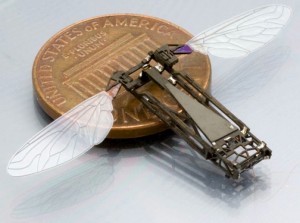
The Harvard Monolithic Bee (or "Mobee") pops up within an assembly scaffold, which performs more than 20 origami assembly folds. Photos courtesy of Pratheev Sreetharan.

A new technique inspired by elegant pop-up books and origami will soon allow clones of robotic insects to be mass-produced by the sheet.

Devised by engineers at Harvard, the ingenious layering and folding process enables the rapid fabrication of not just microrobots, but a broad range of electromechanical devices.

In prototypes, 18 layers of carbon fiber, Kapton (a plastic film), titanium, brass, ceramic, and adhesive sheets have been laminated together in a complex, laser-cut design. The structure incorporates flexible hinges that allow the three-dimensional product—just 2.4 millimeters tall—to assemble in one movement, like a pop-up book.

The entire product is approximately the size of a U.S. quarter, and dozens of these microrobots could be fabricated in parallel on a single sheet.

"This takes what is a craft, an artisanal process, and transforms it for automated mass production," says Pratheev Sreetharan (A.B. '06, S.M. '10), who co-developed the technique with J. Peter Whitney. Both are doctoral candidates at the Harvard School of Engineering and Applied Sciences (SEAS).

Sreetharan, Whitney, and their colleagues in the Harvard Microrobotics Laboratory at SEAS have been working for years to build bio-inspired, bee-sized robots that can fly and behave autonomously as a colony. Appropriate materials, hardware, control systems, and fabrication techniques did not exist prior to the RoboBees project, so each must be invented, developed, and integrated by a diverse team of researchers.

Less than a year ago, the group was using a painstaking and error-prone method to fold, align, and secure each of the minuscule parts and joints.

"You'd take a very fine tungsten wire and dip it in a little bit of superglue," explains Sreetharan. "Then, with that tiny ball of glue, you'd go in under a microscope like an arthroscopic surgeon and try to stick it in the right place."

"Until recently, the manual assembly process was the state of the art in this field," Sreetharan adds.

The same result can now be achieved—without human error—through locking mechanisms and dip soldering. The new process also enables the use of cured carbon fiber, which is rigid and easy to align, rather than uncured carbon fiber, which Sreetharan compares to "wet tissue paper."

"Our new techniques allow us to use any material including polymers, metals, ceramics, and composites," says principal investigator Rob Wood, an Associate Professor of Electrical Engineering at SEAS and a Core Faculty Member at the Wyss Institute for Biologically Inspired Engineering at Harvard.

"The ability to incorporate any type and number of material layers, along with integrated electronics, means that we can generate full systems in any three-dimensional shape," Wood says. "We've also demonstrated that we can create self-assembling devices by including pre-stressed materials."

The implications of this novel fabrication strategy go far beyond these micro-air vehicles. The same mass-production technique could be used for high-power switching, optical systems, and other tightly integrated electromechanical devices that have parts on the scale of micrometers to centimeters.

Moreover, the layering process builds on the manufacturing process currently used to make printed circuit boards, which means that the tools for creating large sheets of pop-up devices are common and abundant. It also means that the integration of electrical components is a natural extension of the fabrication process—particularly important for the size- and weight-constrained RoboBees project.

"In a larger device, you can take a robot leg, for example, open it up, and just bolt in circuit boards. We're so small that we don't get to do that. I can't put a structural mechanism in here and have it serve no electrical function."

Pointing to the carbon-fiber box truss that constitutes the pop-up bee's body frame, Sreetharan says, "Now, I can put chips all over that. I can build in sensors and control actuators."

A small portion of the CAD design for the Harvard Monolithic Bee illustrates the complexity of folds and joints necessary for its assembly. Using the old, manual process, every one of those parts would have to be cut, folded, assembled, and glued by hand. The bottom image illustrates the 18 layers of laser-cut materials that create the pop-up structure. Images courtesy of Pratheev Sreetharan.

Essentially, tiny robots can now be built by slightly bigger robots. Designing how all of the layers will fit together and fold, however, is still a very human task, requiring creativity and expertise. Standard computer-aided design (CAD) tools, typically intended for either flat, layered circuit boards or 3D objects, do not yet support devices that combine both.

Once the design is complete, though, fabrication can be fully automated, with accuracy and precision limited only by the machining tools and materials.

"The alignment is now better than we can currently measure," says Sreetharan. "I've verified it to better than 5 microns everywhere, and we've gone from a 15% yield to—well, I don't think I've ever had a failure."

The full fabrication process will be described in the March issue of the Journal of Micromechanics and Microengineering. Co-authors and collaborators, beside Whitney, Sreetharan, and Wood, include Kevin Ma, a graduate student at SEAS; and Marc Strauss, a research assistant in Wood's lab.

The Harvard Office of Technology Development is now developing a strategy to commercialize this technology. As part of this effort, they have filed patent applications on this work and are engaging with entrepreneurs, venture capitalists, and companies to identify disruptive applications in a range of industries.

The work was supported by the U.S. Army Research Laboratory, the National Science Foundation (through the Expeditions in Computing program), and the Wyss Institute.


Source: Harvard University

New system allows robots to continuously map their environment

Engineerblogger
Feb 16, 2012

The researchers used at PR2 robot, developed by Willow Garage, with a Microsoft's Kinect sensor to test their system. Image: Hordur Johannsson

Robots could one day navigate through constantly changing surroundings with virtually no input from humans, thanks to a system that allows them to build and continuously update a three-dimensional map of their environment using a low-cost camera such as Microsoft’s Kinect.

The system, being developed by researchers at MIT’s Computer Science and Artificial Intelligence Laboratory (CSAIL), could also allow blind people to make their way unaided through crowded buildings such as hospitals and shopping malls.

To explore unknown environments, robots need to be able to map them as they move around — estimating the distance between themselves and nearby walls, for example — and to plan a route around any obstacles, says Maurice Fallon, a research scientist at CSAIL who is developing these systems alongside John J. Leonard, professor of mechanical and ocean engineering, and graduate student Hordur Johannsson.

But while a large amount of research has been devoted to developing one-off maps that robots can use to navigate around an area, these systems cannot adjust to changes in the surroundings over time, Fallon says: “If you see objects that were not there previously, it is difficult for a robot to incorporate that into its map.”

The new approach, based on a technique called Simultaneous Localization and Mapping (SLAM), will allow robots to constantly update a map as they learn new information over time, he says. The team has previously tested the approach on robots equipped with expensive laser-scanners, but in a paper to be presented this May at the International Conference on Robotics and Automation in St. Paul, Minn., they have now shown how a robot can locate itself in such a map with just a low-cost Kinect-like camera.

As the robot travels through an unexplored area, the Kinect sensor’s visible-light video camera and infrared depth sensor scan the surroundings, building up a 3-D model of the walls of the room and the objects within it. Then, when the robot passes through the same area again, the system compares the features of the new image it has created — including details such as the edges of walls, for example — with all the previous images it has taken until it finds a match.

At the same time, the system constantly estimates the robot’s motion, using on-board sensors that measure the distance its wheels have rotated. By combining the visual information with this motion data, it can determine where within the building the robot is positioned. Combining the two sources of information allows the system to eliminate errors that might creep in if it relied on the robot’s on-board sensors alone, Fallon says.

Once the system is certain of its location, any new features that have appeared since the previous picture was taken can be incorporated into the map by combining the old and new images of the scene, Fallon says.

The team tested the system on a robotic wheelchair, a PR2 robot developed by Willow Garage in Menlo Park, Calif., and in a portable sensor suite worn by a human volunteer. They found it could locate itself within a 3-D map of its surroundings while traveling at up to 1.5 meters per second.

Ultimately, the algorithm could allow robots to travel around office or hospital buildings, planning their own routes with little or no input from humans, Fallon says.

It could also be used as a wearable visual aid for blind people, allowing them to move around even large and crowded buildings independently, says Seth Teller, head of the Robotics, Vision and Sensor Networks group at CSAIL and principal investigator of the human-portable mapping project. “There are also a lot of military applications, like mapping a bunker or cave network to enable a quick exit or re-entry when needed,” he says. “Or a HazMat team could enter a biological or chemical weapons site and quickly map it on foot, while marking any hazardous spots or objects for handling by a remediation team coming later. These teams wear so much equipment that time is of the essence, making efficient mapping and navigation critical.”

While a great deal of research is focused on developing algorithms to allow robots to create maps of places they have visited, the work of Fallon and his colleagues takes these efforts to a new level, says Radu Rusu, a research scientist at Willow Garage who was not involved in this project. That is because the team is using the Microsoft Kinect sensor to map the entire 3-D space, not just viewing everything in two dimensions.

“This opens up exciting new possibilities in robot research and engineering, as the old-school ‘flatland’ assumption that the scientific community has been using for many years is fundamentally flawed,” he says. “Robots that fly or navigate in environments with stairs, ramps and all sorts of other indoor architectural elements are getting one step closer to actually doing something useful. And it all starts with being able to navigate.”

Source: MIT News

Wednesday, February 15, 2012

The Future of Robotics in Manufacturing: Moving to the Other Side of the Factory

Industry Week
Feb 15, 2012


A robotic arm prepares to place a door on a BMW at the automaker's Spartanburg, S.C., plant. Using electronic-measuring technology, the robot takes multiple photos of the relationship between the vehicle and the door and adjusts its position to eliminate any potential gaps in the fit caused by variations in the sheet metal.

To boldly go where they've never gone before, robots will need to become smarter, cheaper and easier to use. The industry could turn to an unlikely source to get there.

The birth of a BMW sports-activity vehicle begins with a few pieces of metal and the whirs, thrusts and twists of a robot.

Although BMW employs more than 7,000 people at its sprawling factory complex in Spartanburg, S.C., humans are a rare sight on the X5/X6 line in the body shop. There, a battalion of more than 380 robots -- there are nearly 1,000 of them plantwide -- fashions X5 vehicle bodies from 443 separate pieces of metal, performing 237 stud welds and more than 6,000 spot welds on each one, among a flurry of other tasks. The body shop also boasts BMW's first fully automated hang-on fit line, where robots attach the doors, hoods, hatches and fenders to the vehicles. The "Best Fit" system, which debuted on Spartanburg's X3 line in 2010, automates a process so critical to BMW's quality standards that it once was trusted only to human hands. "It was the one part of our shop that was almost 100% manual operations," says Herman Adams, the plant's body shop maintenance planner. "The rest of our shop was about 95% automation, so it was a really stark contrast."

While robots now do nearly 100% of the work in the body shop at BMW Spartanburg, it's a completely different story on the assembly lines. Walk the floor of Spartanburg's two mammoth assembly halls, observes Erik Nieves, technology director for Yaskawa America Inc.'s Motoman Robotics Division, and you see "an army of biology." Although automation undoubtedly plays a role in vehicle assembly at BMW Spartanburg -- a robotic arm, for example, plunks the sunroof into a hole on top of the BMW X3 -- the final-assembly process is largely the domain of people. And it's no different at any other major automotive plant. Consequently, Nieves believes that the future of robotics is about finding a way to move robots "to the other side of the wall" -- to the assembly line.
To read more click here...

Friday, February 10, 2012

Japan scientist makes 'Avatar' robot

Engineerblogger
Feb 10, 2012


A master-slave robot "Telesar V", developed by Keio University's Graduate School of Media Design professor Susumu Tachi (unseen in this picture) transfers marbles from a cup to another cup for a demonstration at Tachi's laboratory in Yokohama, suburban Tokyo on February 8, 2012. Photo courtesy: AFP

A Japanese-developed robot that mimics the movements of its human controller is bringing the Hollywood blockbuster "Avatar" one step closer to reality.

Users of the TELESAR V don special equipment that allows them not only to direct the actions of a remote machine, but also to see, hear and feel the same things as their doppelganger android.

"When I put on the devices and move my body, I see my hands having turned into the robot hands. When I move my head, I get a different view from the one I had before," said researcher Sho Kamuro.

"It's a strange experience that makes you wonder if you've really become a robot," he told AFP.

Professor Susumu Tachi, who specialises in engineering and virtual reality at Keio University's Graduate School of Media Design, said systems attached to the operator's headgear, vest and gloves send detailed instructions to the robot, which then mimics the user's every move.

At the same time, an array of sensors on the android relays a stream of information which is converted into sensations for the user.

The thin polyester gloves the operator wears are lined with semiconductors and tiny motors to allow the user to "feel" what the mechanical hands are touching -- a smooth or a bumpy surface as well as heat and cold.

The robot's "eyes" are actually cameras capturing images that appear on tiny video screens in front of the user's eyes, allowing them to see in three dimensions.

Microphones on the robot pick up sounds, while its speakers allow the operator to make his voice heard by those near the machine.

The TELESAR -- TELexistence Surrogate Anthropomorphic Robot -- is still a far cry from the futuristic creations of James Cameron's "Avatar", where US soldiers are able to remotely control the genetically engineered bodies of an extra-terrestrial race they wish to subdue.

But, says Tachi, it could have much more immediate -- and benign -- applications, such as working in high-risk environments, for example the inside of Japan's crippled Fukushima nuclear plant, though it is early days.

"I think further research and development could enable this to go into areas too dangerous for humans and do jobs that require human skills," he said.

Japan's famously advanced robot technology was found wanting during the crisis at Fukushima, where foreign expertise had to be called on for the machines that went inside reactor buildings as nuclear meltdowns began.

Tachi said a "safety myth" had grown up around atomic technology, preventing research on the kind of machines that could help in the wake of a disaster.

But he said his kind of robot technology could help with the long and difficult task of decommissioning reactors at Fukushima -- a process that could take three decades.

A remote-controlled android that allows its user to experience what is happening far away may have more than just industrial applications, he added.

"This could be used to talk with your grandpa or grandma living in a remote place and deepen communications," he said.


Source: AFP

Thursday, February 9, 2012

DARPA Legged Squad Support System (LS3) To lighten Troop's Load

Engineerblogger
Feb 9, 2012


Pack mule. Credit: DARPA

Prototype robotic “pack mule” stands up, lies down and follows leader carrying 400 lbs. of squad’s gear

Today’s dismounted warfighter can be saddled with more than 100 pounds of gear, resulting in physical strain, fatigue and degraded performance. Reducing the load on dismounted warfighters has become a major point of emphasis for defense research and development, because the increasing weight of individual equipment has a negative impact on warfighter readiness. The Army has identified physical overburden as one of its top five science and technology challenges. To help alleviate physical weight on troops, DARPA is developing a highly mobile, semi-autonomous legged robot, the Legged Squad Support System (LS3), to integrate with a squad of Marines or Soldiers.

Recently the LS3 prototype underwent its first outdoor exercise, demonstrating the ability to follow a person using its “eyes”—sensors that allow the robot to distinguish between trees, rocks, terrain obstacles and people. Over the course of the next 18 months, DARPA plans to complete development of and refine key capabilities to ensure LS3 is able to support dismounted squads of warfighters.

Features to be tested and validated include the ability to carry 400lbs on a 20-mile trek in 24-hours without being refueled, and refinement of LS3’s vision sensors to track a specific individual or object, observe obstacles in its path and to autonomously make course corrections as needed. Also planned is the addition of “hearing” technology, enabling squad members to speak commands to LS3 such as “stop,” “sit” or “come here.” The robot also serves as a mobile auxiliary power source— troops may recharge batteries for radios and handheld devices while on patrol.

DARPA seeks to demonstrate that an LS3 can carry a considerable load from dismounted squad members, follow them through rugged terrain and interact with them in a natural way, similar to the way a trained animal and its handler interact.

“If successful, this could provide real value to a squad while addressing the military’s concern for unburdening troops,” said Army Lt. Col. Joe Hitt, DARPA program manager. “LS3 seeks to have the responsiveness of a trained animal and the carrying capacity of a mule.”

The 18-month platform-refinement test cycle, with Marine and Army involvement, kicks off this summer. The tests culminate in a planned capstone exercise where LS3 will embed with Marines conducting field exercises.

LS3 is based on mobility technology advanced by DARPA’s Big Dog technology demonstrator, as well other DARPA robotics programs which developed the perception technology for LS3’s “eyes” and planned “ears.”

The DARPA LS3 performer is Boston Dynamics of Waltham, Mass.


DARPA Legged Squad Support System (LS3)


Source: DARPA

Wednesday, February 8, 2012

Allen-Vanguard to co-develop world’s first Wireless Underground Robots for First Responders (WURFR)

Engineerblogger
Feb 8, 2012


A new robot that can communicate wirelessly from underground could be used to rescue people trapped in inaccessible places. Credit: The Engineer


Allen-Vanguard, trusted global leader in providing solutions for defeating terrorist/extremist threats, announced today its collaboration with WFS Defense, leading supplier of through-ground and through-water wireless communications technology, to develop and demonstrate the industry’s first Wireless Underground Robots for First Responders (WURFR) robotic vehicle. The announcement was made on the opening day of the Security & Policing Exhibition 2012, in Farnborough, UK, where Allen-Vanguard is displaying its latest Counter-Threat solutions.

During emergency incidents, First Responders deploy Remotely Operated Vehicles (ROVs) to avoid exposing themselves to unnecessary risks in hostile or challenging environments, such as clandestine tunnels, subway systems and underground structures. The WURFR project, co-funded by the United Kingdom Technology Strategy Board, will alleviate the logistics currently posed by hardwire tethers or multiple repeaters needed to control a robot in these situations. This will be achieved through the seamless integration of WFS’s through-ground wireless communications into Allen-Vanguard’s Digital Vanguard robot.

Allen-Vanguard President & CEO, Dennis Morris, commented, “Our WURFR-generation robot will improve First Responder safety by enabling operators to remain above ground while reliably communicating with their ROV as it conducts visual reconnaissance, detects hazardous substances and mitigates threats.” He continued, “This unprecedented capability will greatly simplify on site operations and reduce costs for
inspecting and clearing high risk underground locations.”

The WURFR-enabled ROV will use WFS’ wireless modems to provide 2-way communications, track its
location, stream video and convey data from sensors. The Digital Vanguard is the ideal platform for this project based on its outstanding operational capabilities and widespread user base of First Responders and
security agencies.

About Allen-Vanguard
Allen-Vanguard is a trusted global leader in providing solutions for defeating terrorist and extremist threats. With an unrivaled expertise in counter-threat solutions, systems, and technologies, we deliver battle-proven equipment for defeating IEDs and other terrorist incidents at the technical, operational, and national policy levels.

About the UK Technology Strategy Board
The UK Technology Strategy Board is a business-led government body which works to create economic growth by ensuring that the UK is a global leader in innovation. Sponsored by the UK government’s Department for Business, Innovation and Skills (BIS), the Technology Strategy Board brings together business, research and the public sector, supporting and accelerating the development of innovative products and services to meet market needs, tackle major societal challenges and help build the future economy.

About WFS Defense
WFS Defense is the world's leading supplier of through-water and through-ground wireless technology for
communication, navigation and power transfer. Utilizing radio, acoustic and inductive power transfer technologies, our field proven expertise in wireless connectivity is delivering cost savings and new capabilities to the Homeland Security and Defense industries.

Source: Allen-Vanguard

Tuesday, February 7, 2012

Manufacturing: Get In "the Assembly" Line

Engineerblogger
Feb 7, 2012


Credit: ASME

The assembly line did nothing short of completely change the history of business—but it didn't end there. Lines are still a vital part of industry and are an area for engineers to consider.

If, when thinking of the assembly lines, you envision those made famous by the Ford Model T, you're not alone. With next year marking the 100th anniversary of that continuous line, it set a standard but might also have inspired unnecessary bulk in future lines, says Trevor Johnson, president of Innomation Technologies, Stony Point, ON, Canada.

Keep It Simple

"The most important assembly lines may be the simplest," he says. "There's a tendency to make things complex because it's impressive, but it's also costly. People see an [automotive] assembly line with tracks 12 miles long on the floor carrying bodies around but much of any production can be subcomponents. For small stuff, [the assembly] may have a motor in it and all it's doing is moving a two-pound box from one spot to the other for a $200,000 investment."

Johnson says it is about stepping back and asking if you can create a line where much of the building of the product is done by hand. This also tends to create a safer line, he says. "When you have a system that's relatively frictionless, you could have something weigh 50 pounds that only requires four to five pounds to push with the 10:1 ratio of moving something on a rolling system," he says.

For Johnson, a good part of creating an assembly line is done before any physical building ever begins. "3D design is vital because, with the pictorial representation of an object, most 3D allows you to see interferences," he says. "If there's a hinge, one can see how far it can swing until it hits something or point out things that are incorrect or incompatible. We use software called Inventor."

Safety First

Robotics also have their place when considering assembly lines, Johnson says, but, selectively. "We would use it typically for jobs that are physically heavy, or dangerous, or inaccessible," he says. "You might use a robot for carrying around a car seat or could use it for loading a mold where exposed to risk. Saving a worker from chemical exposure is really one of its most important uses."

Johnson believes the mechanical engineering components for assembly line success are 25% theory and 75% experience. "There's an art to it that goes beyond what you can learn in school and it comes from a passion for making a successful machine," he says. "When you truly make automation work at its finest, there isn't anything like it."

Of course, that's not to say that Johnson and others don't still have to tip their cap to the innovation of that Old Model T line, which reduced the time it took to make a car to the single digits in hours. A video from the History Channel's web site gives you contrasting visuals on the transition from humble line beginnings to the technology of today.

Source: American Society of Mechanical Engineers(ASME)

Monday, February 6, 2012

Human Waste-Powered Robots May Be Future of Machines

Scientific American
Feb 5, 2012
 
EcoBot-III was able to both eat and crap inside its lab environment. Image: Bristol Robotics Laboratory, UK

Today's robots that fly, jump or roll around must refuel or recharge as does any gadget that runs out of energy. Tomorrow's new generation of self-sustaining robots might keep going nearly forever by grazing on dead insects, rotting plant matter or even human waste.

The vision of robots capable of plugging themselves into the natural world of living organisms has begun taking shape in several labs around the world, and even NASA has shown renewed interest in powering space robots with microbes. But one British lab has already been building on the work of robotics pioneers to create small "EcoBots" that extract energy from microbial fuel cells since 2002.

"Robots that eat biological fuels could find enough fuel almost anywhere," said John Greenman, a microbiologist at the Bristol Robotics Laboratory, a joint venture between the University of the West of England and the University of Bristol. "There is organic matter anywhere on Earth — leaves and soil in the forest, or even human waste such as urine and feces."

The first EcoBot (created in 2003) was powered by E. coli bacteria feeding on refined sugar. Then "EcoBot-II" (2005) harnessed sludge microbes to break down dead flies, prawn shells and rotten apples. Finally, "EcoBot-III" (2010) showed how a "digesting" robot could also dump its leftover waste, so that its microbes wouldn't be poisoned by their own filth and could keep powering the robot.

"EcoBot-III is a robot that collects its own food and water from the environment," said Ioannis Ieropoulos, a roboticist at the Bristol Robotics Laboratory (BRL). "It performs the task we design it to do, and at the end of the day, it gets rid of its own waste. It literally craps into its own 'litter' tray."

Ieropoulos, Greenman and BRL Director Chris Melhuish, give credit to other researchers for first showing how robots could use bacteria, and for pioneering the development of microbial fuel cells powered by sludge. But they have pushed the field forward by making robots capable of performing tasks — such as maintaining a circulatory system and wirelessly reporting on their environment while moving toward food, water or light — when solely powered by microbial fuel cells (MFCs) to digest organic matter and dump any waste.

"We know MFCs will last as long as they're fed; there's nothing mechanical to go wrong with them," Greenman told InnovationNewsDaily. "They could go 20 or 30 years. As long as the microbes grow, they can keep going."

The EcoBot team's work with such technology has not gone unnoticed. They received funding from the Bill & Melinda Gates Foundation in late 2011 so that they could push the limits of stacking microbial fuel cells that help tackle sanitation and energy needs by turning human urine or waste into useful electricity for radios or other gadgets.

Human waste might also someday help power space robots that accompany astronauts on long-distance space missions or to planetary colonies, Ieropoulos said. On Earth, the robots might crawl through the debris of growing cities, or survive on their own for years in the great outdoors.
To read more click here...

Related Information:

Friday, February 3, 2012

Unraveling a Butterfly’s Aerial Antics Could Help Builders of Bug-Size Flying Robots

Engineerblogger
Feb 3, 2012


The butterfly research will aid the development of flying bug-size robots. Pictured is an insect-inspired flapping-wing micro air vehicle under development at Harvard. Photo provided by Robert J. Wood, associate professor, and Pratheev Sreetharan, Harvard Microrobotics Lab, Harvard University.

To improve the next generation of insect-size flying machines, Johns Hopkins engineers have been aiming high-speed video cameras at some of the prettiest bugs on the planet. By figuring out how butterflies flutter among flowers with amazing grace and agility, the researchers hope to help small airborne robots mimic these maneuvers.

U.S. defense agencies, which have funded this research, are supporting the development of bug-size flyers to carry out reconnaissance, search-and-rescue and environmental monitoring missions without risking human lives. These devices are commonly called micro aerial vehicles or MAVs.

“For military missions in particular, these MAVs must be able to fly successfully through complex urban environments, where there can be tight spaces and turbulent gusts of wind,” said Tiras Lin, a Whiting School of Engineering undergraduate who has been conducting the high-speed video research. “These flying robots will need to be able to turn quickly. But one area in which MAVs are lacking is maneuverability.”

To address that shortcoming, Lin has been studying butterflies. “Flying insects are capable of performing a dazzling variety of flight maneuvers,” he said. “In designing MAVs, we can learn a lot from flying insects.”

Lin’s research has been supervised by Rajat Mittal, a professor of mechanical engineering. “This research is important because it attempts to not only address issues related to bio-inspired design of MAVs, but it also explores fundamental questions in biology related to the limits and capabilities of flying insects,” Mittal said.

To conduct this study, Lin has been using high-speed video to look at how changes in mass distribution associated with the wing flapping and body deformation of a flying insect help it engage in rapid aerial twists and turns. Lin, a junior mechanical engineering major from San Rafael, Calif., recently presented some of his findings at the annual meeting of the American Physical Society’s Division of Fluid Dynamics. The student also won second-prize for his presentation of this research at a regional meeting of the American Institute of Aeronautics and Astronautics.

“Ice skaters who want to spin faster bring their arms in close to their bodies and extend their arms out when they want to slow down,” Lin said. “These positions change the spatial distribution of a skater’s mass and modify their moment of inertia; this in turn affects the rotation of the skater’s body. An insect may be able to do the same thing with its body and wings.”

Butterflies move too quickly for someone to see these wing tactics clearly with the naked eye, so Lin, working with graduate student Lingxiao Zheng, used high-speed, high-resolution videogrammetry to mathematically document the trajectory and body conformation of painted lady butterflies. They accomplished this with three video cameras capable of recording 3,000 one-megapixel images per second. (By comparison, a standard video camera shoots 24, 30 or 60 frames per second.)

The Johns Hopkins researchers anchored their cameras in fixed positions and focused them on a small region within a dry transparent aquarium tank. For each analysis, several butterflies were released inside the tank. When a butterfly veered into the focal area, Lin switched on the cameras for about two seconds, collecting approximately 6,000 three-dimensional views of the insect’s flight maneuvers. From these frames, the student typically homed in on roughly one-fifth of a second of flight, captured in 600 frames. “Butterflies flap their wings about 25 times per second,” Lin said. “That’s why we had to take so many pictures.”

The arrangement of the three cameras allowed the researchers to capture three-dimensional data and analyze the movement of the insects’ wings and bodies in minute detail. That led to a key discovery.

Earlier published research pointed out that an insect’s delicate wings possess very little mass compared to the bug’s body. As a result, those scholars concluded that changes in spatial distribution of mass associated with wing-flapping did not need to be considered in analyzing an insect’s flight maneuverability and stability. “We found out that this commonly accepted assumption was not valid, at least for insects such as butterflies,” Lin said. “We learned that changes in moment of inertia, which is a property associated with mass distribution, plays an important role in insect flight, just as arm and leg motion does for ice skaters and divers.”

He said this discovery should be considered by MAV designers and may be useful to biologists who study insect flight dynamics.

Lin’s newest project involves even smaller bugs. With support from a Johns Hopkins Provost’s Undergraduate Research Award, he has begun aiming his video cameras at fruit flies, hoping to solve the mystery of how these insects manage to land upside down on perches.

The insect flight dynamics research was funded by the U.S. Air Force Office of Scientific Research and the National Science Foundation.


Analyzing mechanics of butterflies in flight


Source: Johns Hopkins University


Related Information:

Thursday, February 2, 2012

Robotics in healthcare: challenges and opportunities

Medical Design
Jan 27, 2012


RIVA compounding system installed in a hospital pharmacy.


The healthcare industry is unlikely to adopt robots unless the risk and the investment are small. Concrete evidence of success is needed before taking on the larger opportunities.
  •  Why robots in healthcare
  • Obstacles to adoption
  • Meeting the requirements for success
With all the interest and money being directed towards robotics in healthcare, it may seem like there couldn’t be anything new to say. Everyone knows that robots are the future of healthcare, and it is generally recognized that an increasing number of people will need healthcare, with the impending retirement of “baby boomers” being only one reason, while the number of people providing that care is dropping. Still, we haven’t seemed to have been able to make the leap to mass utilization of robots in any area of the typical hospital. It’s not that there aren’t opportunities. Two factors that contribute to the lack of robots in healthcare are (1) the targeted areas are mission-critical and even modest problems would be catastrophic, and (2) the uncertainties of the robotic solutions outweigh the perceived benefits. Healthcare needs a pathfinder application in which the risk and the investment are small so that the industry can see some concrete evidence of success before taking on the larger opportunities.

Let’s consider a bit of history. The word ‘robot’ was first used by Karl Capek in his play “R.U.R.” (which stands for Rossum’s Universal Robots) that debuted in 1921. He derived the word from the Czech word robota and used it with reference to mechanical humanoids built to perform menial and repetitive tasks. While the play focused on how this intended purpose oppressed the robots, Capek was onto something: repetitive tasks are exactly the type of work where robots surpass humans.

When faced with a repetitive task that requires constant attention to detail, even the most diligent and dedicated human will make an occasional mistake. Once a robot is set up and programmed to perform a task, however, it will perform that task in exactly the same way each and every time without variation. This is not without its own problems, because most robots cannot accommodate even minor changes in the environment that a person would handle without even noticing a problem. An example would be a robot programmed to grip and pick up a soda can from a table while being unable to deal with a can that has fallen over on its side. A great deal of research has gone into making robots more aware or their surroundings and able to handle a limited amount of variation. These robots are neither simple nor cheap.

What may not be obvious is that we are surrounded by robots and use them continuously. In its simplest form, a robot is a device that performs one or more actions in response to one or more stimuli. While there may be a gray area somewhere along the spectrum between a mechanical typewriter and the autonomous vehicles of the DARPA Challenge, a workable definition of a robot is a device that incorporates a programmable processor wherein the actions of the device vary significantly depending on the input received. This excludes a toaster that uses a microprocessor to regulate the temperature of the heating element; however, the vending machine in the cafeteria and the ATM at your bank may qualify as robots. The self-parking cars built by Ford, Lexus, and Toyota definitely qualify as robots. It’s likely that many of the things that you use on a daily basis, from the inkjet cartridges in your printer to the car that you drive, were built on a production line that includes dozens if not hundreds of robots, each performing a specific task.
To read more click here...

Wednesday, February 1, 2012

Robot reconnoiters uncharted terrain

Engineerblogger
Feb 1, 2012


Equipped with multiple sensors and optical cameras, the mobile robot roams over dangerous ground.  © Fraunhofer IOSB

Mobile robots have many uses. They serve as cleaners, carry out inspections and search for survivors of disasters. But often, there is no map to guide them through unknown territory. Researchers have now developed a mobile robot that can roam uncharted terrain and simultaneously map it – all thanks to an algorithm toolbox.

Industrial robots have been a familiar sight in the workplace for many years. In automotive and household appliance manufacture, for example, they have proved highly reliable on production and assembly lines. But now a new generation of high-tech helpers is at hand: Mobile robots are being used in place of humans to explore hazardous and difficult-to-access environments such as buildings in danger of collapsing, caves, or ground that has been polluted by an industrial accident. Equipped with sensors and optical cameras, these robots can help rescue services search for victims in the wake of natural disasters, explosions or fires, and can measure concentrations of hazardous substances. There’s just one problem: Often there is no map to show them the location of obstacles and steer them along navigable routes. Yet such maps are critical to ensuring that the high-tech machines are able to make progress, either independently or guided by remote control. Researchers at the Fraunhofer Institute for Optronics, System Technologies and Image Exploitation IOSB in Karlsruhe have now developed a roaming land robot that autonomously reconnoiters and maps uncharted terrain. The robot uses special algorithms and multi-sensor data to carve a path through unknown territory.

“To be able to navigate independently, our mobile robot has to fulfill a number of requirements. It must be able to localize itself within its immediate surroundings, continuously recalculate its position as it makes its way through the danger area, and simultaneously refine the map it is generating,” says graduate engineer Christian Frey of the IOSB. To make this possible, he and his team have developed an algorithm toolbox for the robot that runs on a built-in computer. The robot is additionally equipped with a variety of sensors. Odometry sensors measure wheel revolutions, inertial sensors compute accelerations, and distance-measuring sensors register clearance from walls, steps, trees and bushes, to name but a few potential obstacles. Cameras and laser scanners record the environment and assist in the mapping process. The algorithms read the various data supplied by the sensors and use them to determine the robot’s precise location. The interplay of all these different elements concurrently produces a map, which is updated continuously. Experts call the process Simultaneous Localization and Mapping, or SLAM.

Mobile robots face an additional challenge: to find the optimal path that will enable them to complete each individual task. Depending on the situation, this may be the shortest and quickest route, or perhaps the most energy-efficient, i.e. the one that uses the least amount of gasoline. When planning a course, the high-tech helpers must take into account restrictions on mobility such as a limited turning circle, and must navigate around obstacles. And should the environment change, for example as a result of falling objects or earthquake aftershocks, a robot must register this and use its toolbox to recalculate its route.

“We made our toolbox modular, so it’s not difficult to adapt the algorithms to suit different types of mobile robot or specific in- or outdoor application scenarios. For example, it doesn’t matter what sensor set-up is used, or whether the robot has two- or four-wheel drive,” says Frey. The software can be customized to meet the needs of individual users, with development work taking just a few months. Frey adds: “The toolbox is suitable for all sorts of situations, not only accident response scenarios. It can be installed in cleaning robots or lawnmowers, for example, and a further possible application would be in roaming robots used to patrol buildings or inspect gas pipelines for weak points.” From March 6-10, the IOSB researchers will be demonstrating their mobile robot technology at the CeBIT trade fair.

Source: Fraunhofer-Gesellschaft

Tuesday, January 24, 2012

Europe's Driverless Car : semi-autonomous BMW car being demonstrated on a German autobahn

Technology Review
Jan 24, 2012
Easy ride: A semi-autonomous BMW car being demonstrated on a German autobahn. It can accelerate, brake, and overtake slower vehicles on its own. Credit: BMW

Tucked away in the basement of an iconic office tower shaped like four engine cylinders, engineer Werner Huber is telling me about the joy of driving. We're here at BMW headquarters, in Munich, Germany—capital of Bavaria, and arguably of driving itself. But Huber oversees strategic planning for advanced driver assistance systems, so in a way, his job is to put an end to driving—at least as we know it.

"I think that in 10 to 15 years, it could be another world," Huber says. He's not willing to predict exactly what driving will look like then, but he's certain humans will be doing a lot less of it.

For many people, automated cars call to mind those high-tech vehicles with a rotating periscope on top that Google has been driving around California. But Huber and executives at other European automakers say the automated driving revolution is already here: new safety and convenience technologies are beginning to act as "copilots," automating tedious or difficult driving tasks such as parallel parking.

"Driverless" technology will initially require a driver. And it will creep into everyday use much as airbags did: first as an expensive option in luxury cars, but eventually as a safety feature required by governments. "The evolutionary approach is from comfort systems to safety systems to automatic driving," says Jürgen Leohold, executive director for research at Volkswagen Group in Wolfsburg, Germany.

Both BMW and Volkswagen are among the companies already demonstrating cars that drive themselves. In 2010, Volkswagen sent a driverless Audi TTS up Pike's Peak at close to race speeds. Like similar vehicles from Google, these automated vehicles use some combination of GPS, radar, lasers, ultrasonic sensors, and optical cameras to create a constantly updated, 360-degree model of the surrounding environment, which an in-car computer can use to navigate.

But European automakers say their strategy is to move toward greater levels of autonomy incrementally, depending on what does well in showrooms.

Buyers of European luxury cars are already choosing from a menu of advanced options. For example, for $1,350, people who purchase BMW's 535i xDrive sedan in the United States can opt for a "driver assistance package" that includes radar to detect vehicles in the car's blind spot. For another $2,600, BMW will install "night vision with pedestrian detection," which uses a forward-facing infrared camera to spot people in the road.

Lasers, cameras, and other sensors are the most expensive part of autonomous driving systems. Some experimental self-driving cars are estimated to carry more than $200,000 worth of cameras and other gear. Those costs are also leading automakers toward a gradual approach that starts with sensor technologies and then extends capabilities to control driving tasks as well. In the high-end Mercedes-Benz CL, for instance, cameras not only tell a driver when he or she is leaving the lane but actually help the vehicle steer itself back. Several automakers already sell cars with so-called adaptive cruise control that automatically applies the brakes during highway driving if traffic slows. Next, BMW plans to extend that idea in its upcoming i3 series of electric cars, whose traffic-jam feature will let the car accelerate, decelerate, and steer by itself at speeds of up to 25 miles per hour—as long as the driver leaves a hand on the wheel.
To read more click here...


Related Article:

Friday, January 20, 2012

Snakes improve search-and-rescue robots: New Robot is Designed to Use Less Energy

Engineerblogger
Jan 20, 2012


Scalybot 2 was designed after Georgia Tech researchers studied the movements of snakes.  Credit: Georgia Tech


Designing an all-terrain robot for search-and-rescue missions is an arduous task for scientists. The machine must be flexible enough to move over uneven surfaces, yet not so big that it’s restricted from tight spaces. It might also be required to climb slopes of varying inclines. Existing robots can do many of these things, but the majority require large amounts of energy and are prone to overheating. Georgia Tech researchers have designed a new machine by studying the locomotion of a certain type of flexible, efficient animal.

“By using their scales to control frictional properties, snakes are able to move large distances while exerting very little energy,” said Hamid Marvi, a Mechanical Engineering Ph.D. candidate at Georgia Tech.

While studying and videotaping the movements of 20 different species at Zoo Atlanta, Marvi developed Scalybot 2, a robot that replicates rectilinear locomotion of snakes. He unveiled the robot this month at the Society for Integrative & Comparative Biology (SICB) annual meeting in Charleston, S.C.

“During rectilinear locomotion, a snake doesn’t have to bend its body laterally to move,” explained Marvi. “Snakes lift their ventral scales and pull themselves forward by sending a muscular traveling wave from head to tail. Rectilinear locomotion is very efficient and is especially useful for crawling within crevices, an invaluable benefit for search-and-rescue robots.”

Scalybot 2 can automatically change the angle of its scales when it encounters different terrains and slopes. This adjustment allows the robot to either fight or generate friction. The two-link robot is controlled by a remote-controlled joystick and can move forward and backward using four motors.

“Snakes are highly maligned creatures,” said Joe Mendelson, curator of herpetology at Zoo Atlanta. “I really like that Hamid’s research is showing the public that snakes can help people.”

Marvi’s advisor is David Hu, an assistant professor in the Schools of Mechanical Engineering and Biology. Hu and his research team are primarily focused on animal locomotion. They’ve studied how dogs and other animals shake water off their bodies and how mosquitos fly through rainstorms.

This isn’t the first time Hu’s lab has looked at snake locomotion. Last summer the team developed Scalybot 1, a two-link climbing robot that replicates concertina locomotion. The push-and-pull, accordion-style movement features alternating scale activity.


Source: Georgia Tech

Friday, January 13, 2012

"Open-source" robotic surgery platform going to top medical research labs

Engineerblogger
Jan 12, 2012


Team members posed with components of the Raven II surgical robotic systems developed in the Bionics Lab at the Baskin School of Engineering. From left to right: Zachary Wells (bioengineering undergraduate), Calvin Yoo (bioengineering undergraduate), lab director Jacob Rosen (associate professor of computer engineering), Ji Ma (postdoctoral researcher), Joshua Schloemer (economics undergraduate), Farhad Ighani (computer engineering undergraduate), and Kyle Fujisawa (computer engineering undergraduate). (Photo by Carolyn Lagattuta)


Robotics experts at UC Santa Cruz and the University of Washington (UW) have completed a set of seven advanced robotic surgery systems for use by major medical research laboratories throughout the United States. After a round of final tests, five of the systems will be shipped to medical robotics researchers at Harvard University, Johns Hopkins University, University of Nebraska, UC Berkeley, and UCLA, while the other two systems will remain at UC Santa Cruz and UW.

"We decided to follow an open-source model, because if all of these labs have a common research platform for doing robotic surgery, the whole field will be able to advance more quickly," said Jacob Rosen, associate professor of computer engineering in the Baskin School of Engineering at UCSC and principal investigator on the project.

Rosen and Blake Hannaford, director of the UW Biorobotics Laboratory, lead the research groups that developed the Raven II robotic surgery system and its predecessor, Raven I. A grant from the National Science Foundation funded their work to create seven identical Raven II systems. Hannaford said the systems will be shipped out from UW by the end of January. After they are delivered and installed, all seven systems will be networked together over the Internet for collaborative experiments.

Robotic surgery has the potential to enable new surgical procedures that are less invasive than existing techniques. For some procedures, such as prostate surgery, the use of surgical robots is already standard practice. In addition, telesurgery, in which the surgeon operates a robotic system from a remote location, offers the potential to provide better access to expert care in remote areas and the developing world. Having a network of laboratories working on a common platform will make it easier for researchers to share software, replicate experiments, and collaborate in other ways.

Even though it meant giving competing laboratories the tools that had taken them years to develop, Rosen and Hannaford decided to share the Raven II because it seemed like the best way to move the field forward. "These are the leading labs in the nation in the field of surgical robotics, and with everyone working on the same platform we can more easily share new developments and innovations," Hannaford said.

According to Rosen, most research on surgical robotics in the United States has focused on developing new software for various commercially available robotic systems. "Academic researchers have had limited access to these proprietary systems. We are changing that by providing high-quality hardware developed within academia. Each lab will start with an identical, fully-operational system, but they can change the hardware and software and share new developments and algorithms, while retaining intellectual property rights for their own innovations," Rosen said.

The Raven II includes a surgical robot with two robotic arms, a camera for viewing the operational field, and a surgeon-interface system for remote operation of the robot. The system is powerful and precise enough to support research on advanced robotic surgery techniques, including online telesurgery.

In addition to Rosen and Hannaford, UCSC postdoctoral researchers Daniel Glozman and Ji Ma, along with a group of dedicated undergraduate students working in Rosen's Bionics Lab, played a key role in developing the Raven II. Rosen and Glozman have also developed a Raven IV surgical robotics system, which includes four robotic arms and two cameras. The system enables collaboration between two surgeons working from separate locations and connected over the Internet.

Source: University of California - Santa Cruz