


Engineerblogger
March 6, 2012
The use of ground robots in military explosive-ordinance-disposal missions already saves many lives and prevents thousands of other casualties. If the current limitations on mobility and manipulation capabilities of robots can be overcome, robots could much more effectively assist warfighters across a greater range of missions. DARPA’s Maximum Mobility and Manipulation (M3) program seeks to create and demonstrate significant scientific and engineering advances in robot mobility and manipulation capabilities.
The M3 program pursues four parallel tracks of research and development: tool design, improvement of production methods and processes, improvement in control of robot mobility and manipulation, and prototype demonstration.
This video shows a demonstration of the “Cheetah” robot galloping at speeds of up to 18 miles per hour (mph), setting a new land speed record for legged robots. The previous record was 13.1 mph, set in 1989.
The robot’s movements are patterned after those of fast-running animals in nature. The robot increases its stride and running speed by flexing and un-flexing its back on each step, much as an actual cheetah does.
The current version of the Cheetah robot runs on a laboratory treadmill where it is powered by an off-board hydraulic pump, and uses a boom-like device to keep it running in the center of the treadmill. Testing of a free-running prototype is planned for later this year.
While the M3 program conducts basic research and is not focused on specific military missions, the technology it aims to develop could have a wide range of potential military applications.
The DARPA M3 performer for Cheetah is Boston Dynamics of Waltham, Mass.
Source: DARPA
Showing posts with label DARPA. Show all posts
Showing posts with label DARPA. Show all posts
Tuesday, March 6, 2012

Friday, March 2, 2012
DARPA’s Robotics Simulator/Test Platform Reaches 2nd Milestone
Engineerblogger
March 2, 2012
DARPA's Autonomous Robotic Manipulation (ARM) program is developing software to perform human-level tasks quickly and with minimal direction.
This video shows the ARM robot performing 18 grasping and manipulation tasks using vision, force, and tactile sensing with full autonomy – no active human control. The DARPA-supplied robot was built using commercial components that include an arm, hand, neck, and head sensors.
During rigorous testing in November 2011, the best team achieved 93% success in grasping modeled and unmodeled objects. The ARM program has entered its second phase, where focus turns to complex bimanual manipulation scenarios.
Source: DARPA
March 2, 2012
DARPA's Autonomous Robotic Manipulation (ARM) program is developing software to perform human-level tasks quickly and with minimal direction.
This video shows the ARM robot performing 18 grasping and manipulation tasks using vision, force, and tactile sensing with full autonomy – no active human control. The DARPA-supplied robot was built using commercial components that include an arm, hand, neck, and head sensors.
During rigorous testing in November 2011, the best team achieved 93% success in grasping modeled and unmodeled objects. The ARM program has entered its second phase, where focus turns to complex bimanual manipulation scenarios.
Source: DARPA
Thursday, February 9, 2012
DARPA Legged Squad Support System (LS3) To lighten Troop's Load
Engineerblogger
Feb 9, 2012
Prototype robotic “pack mule” stands up, lies down and follows leader carrying 400 lbs. of squad’s gear
Today’s dismounted warfighter can be saddled with more than 100 pounds of gear, resulting in physical strain, fatigue and degraded performance. Reducing the load on dismounted warfighters has become a major point of emphasis for defense research and development, because the increasing weight of individual equipment has a negative impact on warfighter readiness. The Army has identified physical overburden as one of its top five science and technology challenges. To help alleviate physical weight on troops, DARPA is developing a highly mobile, semi-autonomous legged robot, the Legged Squad Support System (LS3), to integrate with a squad of Marines or Soldiers.
Recently the LS3 prototype underwent its first outdoor exercise, demonstrating the ability to follow a person using its “eyes”—sensors that allow the robot to distinguish between trees, rocks, terrain obstacles and people. Over the course of the next 18 months, DARPA plans to complete development of and refine key capabilities to ensure LS3 is able to support dismounted squads of warfighters.
Features to be tested and validated include the ability to carry 400lbs on a 20-mile trek in 24-hours without being refueled, and refinement of LS3’s vision sensors to track a specific individual or object, observe obstacles in its path and to autonomously make course corrections as needed. Also planned is the addition of “hearing” technology, enabling squad members to speak commands to LS3 such as “stop,” “sit” or “come here.” The robot also serves as a mobile auxiliary power source— troops may recharge batteries for radios and handheld devices while on patrol.
DARPA seeks to demonstrate that an LS3 can carry a considerable load from dismounted squad members, follow them through rugged terrain and interact with them in a natural way, similar to the way a trained animal and its handler interact.
“If successful, this could provide real value to a squad while addressing the military’s concern for unburdening troops,” said Army Lt. Col. Joe Hitt, DARPA program manager. “LS3 seeks to have the responsiveness of a trained animal and the carrying capacity of a mule.”
The 18-month platform-refinement test cycle, with Marine and Army involvement, kicks off this summer. The tests culminate in a planned capstone exercise where LS3 will embed with Marines conducting field exercises.
LS3 is based on mobility technology advanced by DARPA’s Big Dog technology demonstrator, as well other DARPA robotics programs which developed the perception technology for LS3’s “eyes” and planned “ears.”
The DARPA LS3 performer is Boston Dynamics of Waltham, Mass.
DARPA Legged Squad Support System (LS3)
Source: DARPA
Feb 9, 2012
 |
| Pack mule. Credit: DARPA |
Prototype robotic “pack mule” stands up, lies down and follows leader carrying 400 lbs. of squad’s gear
Today’s dismounted warfighter can be saddled with more than 100 pounds of gear, resulting in physical strain, fatigue and degraded performance. Reducing the load on dismounted warfighters has become a major point of emphasis for defense research and development, because the increasing weight of individual equipment has a negative impact on warfighter readiness. The Army has identified physical overburden as one of its top five science and technology challenges. To help alleviate physical weight on troops, DARPA is developing a highly mobile, semi-autonomous legged robot, the Legged Squad Support System (LS3), to integrate with a squad of Marines or Soldiers.
Recently the LS3 prototype underwent its first outdoor exercise, demonstrating the ability to follow a person using its “eyes”—sensors that allow the robot to distinguish between trees, rocks, terrain obstacles and people. Over the course of the next 18 months, DARPA plans to complete development of and refine key capabilities to ensure LS3 is able to support dismounted squads of warfighters.
Features to be tested and validated include the ability to carry 400lbs on a 20-mile trek in 24-hours without being refueled, and refinement of LS3’s vision sensors to track a specific individual or object, observe obstacles in its path and to autonomously make course corrections as needed. Also planned is the addition of “hearing” technology, enabling squad members to speak commands to LS3 such as “stop,” “sit” or “come here.” The robot also serves as a mobile auxiliary power source— troops may recharge batteries for radios and handheld devices while on patrol.
DARPA seeks to demonstrate that an LS3 can carry a considerable load from dismounted squad members, follow them through rugged terrain and interact with them in a natural way, similar to the way a trained animal and its handler interact.
“If successful, this could provide real value to a squad while addressing the military’s concern for unburdening troops,” said Army Lt. Col. Joe Hitt, DARPA program manager. “LS3 seeks to have the responsiveness of a trained animal and the carrying capacity of a mule.”
The 18-month platform-refinement test cycle, with Marine and Army involvement, kicks off this summer. The tests culminate in a planned capstone exercise where LS3 will embed with Marines conducting field exercises.
LS3 is based on mobility technology advanced by DARPA’s Big Dog technology demonstrator, as well other DARPA robotics programs which developed the perception technology for LS3’s “eyes” and planned “ears.”
The DARPA LS3 performer is Boston Dynamics of Waltham, Mass.
DARPA Legged Squad Support System (LS3)
Source: DARPA
Wednesday, January 11, 2012
Researchers seek high-pressure materials without high-pressure processes
Engineerblogger
Jan 11, 2012
Military missions place tremendous stress on the materials used for defense weapons, vehicles and other applications. As a result, the search for stronger, lighter and more resilient materials is never ending. Some materials have proven to have high pressure phases that could yield performance improvements in a variety of defense applications provided the processes could be scaled to create stable materials in the quantities needed for the defense mission. Applications range from stronger armor, to lighter weights which allow for faster propulsion, to greater resiliency in aerospace, ground and naval platforms. DARPA’s Extended Solids program seeks to identify processes that enable stabilization and production of high pressure phase materials, without the limitations of scale introduced by current high-pressure processes, that exhibit properties far superior to those currently available for DoD applications.
“We seek the ability to access these ultrahigh pressure phases without having to use the ultrahigh pressures currently required to achieve them,” said Judah Goldwasser, DARPA’s program manager for this effort. “In the thermochemical world, the ability to synthesize the vast array of materials available both biochemically and synthetically is predicated on exploitation of multistep synthesis and stabilization strategies, so target materials can be produced through intermediates using methods and conditions mild enough to be viable.”
Through this program, DARPA seeks the development of analogous strategies that can be applied to the barochemistry, or ultrahigh pressure regime. This technology could fundamentally change the way high-pressure polymorphs/phases are synthesized, potentially opening a vast new material design space for exploitation.
Goldwasser stressed that the complex nature of this research effort requires diverse sets of skills and expertise to meet program objectives and milestones, and encouraged potential researchers to team with others to help ensure success.
To increase awareness of this program and attract potential researchers, DARPA has scheduled a Proposers’ Day workshop Feb. 9 at the Executive Conference Center, 4075 Wilson Boulevard, third floor, in Arlington, Va. This meeting is in support of the anticipated release of a Broad Agency Announcement for Extended Solids. The purpose of this workshop is to introduce the research community to this effort and its goals, explain the mechanics of a DARPA research program and the objectives and milestones of this particular effort, and encourage collaborative arrangements among potential proposers who have the required expertise, facilities and capabilities to conduct research and develop in support of Extended Solids. Proposers’ Day details are available through the Special Notice located here. Interested researchers should register soon, as participation is limited to 100 (2 people per organization). Deadline for registration is 5:00 p.m. EST Feb. 6.
Source: DARPA
Related Information:
Jan 11, 2012
 |
| Credit: DARPA |
Military missions place tremendous stress on the materials used for defense weapons, vehicles and other applications. As a result, the search for stronger, lighter and more resilient materials is never ending. Some materials have proven to have high pressure phases that could yield performance improvements in a variety of defense applications provided the processes could be scaled to create stable materials in the quantities needed for the defense mission. Applications range from stronger armor, to lighter weights which allow for faster propulsion, to greater resiliency in aerospace, ground and naval platforms. DARPA’s Extended Solids program seeks to identify processes that enable stabilization and production of high pressure phase materials, without the limitations of scale introduced by current high-pressure processes, that exhibit properties far superior to those currently available for DoD applications.
“We seek the ability to access these ultrahigh pressure phases without having to use the ultrahigh pressures currently required to achieve them,” said Judah Goldwasser, DARPA’s program manager for this effort. “In the thermochemical world, the ability to synthesize the vast array of materials available both biochemically and synthetically is predicated on exploitation of multistep synthesis and stabilization strategies, so target materials can be produced through intermediates using methods and conditions mild enough to be viable.”
Through this program, DARPA seeks the development of analogous strategies that can be applied to the barochemistry, or ultrahigh pressure regime. This technology could fundamentally change the way high-pressure polymorphs/phases are synthesized, potentially opening a vast new material design space for exploitation.
Goldwasser stressed that the complex nature of this research effort requires diverse sets of skills and expertise to meet program objectives and milestones, and encouraged potential researchers to team with others to help ensure success.
To increase awareness of this program and attract potential researchers, DARPA has scheduled a Proposers’ Day workshop Feb. 9 at the Executive Conference Center, 4075 Wilson Boulevard, third floor, in Arlington, Va. This meeting is in support of the anticipated release of a Broad Agency Announcement for Extended Solids. The purpose of this workshop is to introduce the research community to this effort and its goals, explain the mechanics of a DARPA research program and the objectives and milestones of this particular effort, and encourage collaborative arrangements among potential proposers who have the required expertise, facilities and capabilities to conduct research and develop in support of Extended Solids. Proposers’ Day details are available through the Special Notice located here. Interested researchers should register soon, as participation is limited to 100 (2 people per organization). Deadline for registration is 5:00 p.m. EST Feb. 6.
Source: DARPA
Related Information:
Tuesday, November 29, 2011
TIME Magazine recognizes DARPA’s Hummingbird Nano Air Vehicle
Engineerblogger
Nov 29, 2011
Rapidly flapping wings to hover, dive, climb, or dart through an open doorway, DARPA’s remotely controlled Nano Air Vehicle relays real-time video from a tiny on-board camera back to its operator. Weighing less than a AA battery and resembling a live hummingbird, the vehicle could give war fighters an unobtrusive view of threats inside or outside a building from a safe distance. This week, TIME Magazine named the Hummingbird one of the best 50 inventions of the year, featuring it on the November 28th cover.
“The Hummingbird’s development is in keeping with a long DARPA tradition of innovation and technical advances for national defense that support the agency’s singular mission – to prevent and create strategic surprise,” said Jay Schnitzer, DARPA’s Defense Sciences Office director.
Creating a robotic hummingbird, complete with intricate wings and video capability, may not have seemed doable or even imaginable to some. But it was this same DARPA visionary innovation that decades ago led to unmanned aerial vehicles (UAVs), which were, at the time, inconceivable to some because there was no pilot on board. In the past two years, the Air Force has trained more initial qualification pilots to fly UAVs than fighters and bombers combined.
“Advances at DARPA challenge existing perspectives as they progress from seemingly impossible through improbable to inevitable,” said Dr. Regina Dugan, DARPA’s director.
UAVs from the small WASP, to the Predator, to Global Hawk now number in the hundreds in Afghanistan. What once seemed inconceivable is now routine.
“At DARPA today we have many examples of people – national treasures themselves – who left lucrative careers, and PhD programs, to join the fight,” Dugan said. “Technically astute, inspiringly articulate, full of ‘fire in the belly,’ they are hell-bent and unrelenting in their efforts to show the world what’s possible. And they do it in service to our Nation.”
TIME Magazine also recognized DARPA’s innovative breakthrough in 3-D holography, the Urban Photonic Sandtable Display, among its top 50 inventions. The holographic sand table could give war fighters a virtual mission planning tool by enabling color 3-D scene depictions, viewable by 20 people from any direction—with no 3-D glasses required.
Source: DARPA
Nov 29, 2011
Rapidly flapping wings to hover, dive, climb, or dart through an open doorway, DARPA’s remotely controlled Nano Air Vehicle relays real-time video from a tiny on-board camera back to its operator. Weighing less than a AA battery and resembling a live hummingbird, the vehicle could give war fighters an unobtrusive view of threats inside or outside a building from a safe distance. This week, TIME Magazine named the Hummingbird one of the best 50 inventions of the year, featuring it on the November 28th cover.
“The Hummingbird’s development is in keeping with a long DARPA tradition of innovation and technical advances for national defense that support the agency’s singular mission – to prevent and create strategic surprise,” said Jay Schnitzer, DARPA’s Defense Sciences Office director.
Creating a robotic hummingbird, complete with intricate wings and video capability, may not have seemed doable or even imaginable to some. But it was this same DARPA visionary innovation that decades ago led to unmanned aerial vehicles (UAVs), which were, at the time, inconceivable to some because there was no pilot on board. In the past two years, the Air Force has trained more initial qualification pilots to fly UAVs than fighters and bombers combined.
“Advances at DARPA challenge existing perspectives as they progress from seemingly impossible through improbable to inevitable,” said Dr. Regina Dugan, DARPA’s director.
UAVs from the small WASP, to the Predator, to Global Hawk now number in the hundreds in Afghanistan. What once seemed inconceivable is now routine.
“At DARPA today we have many examples of people – national treasures themselves – who left lucrative careers, and PhD programs, to join the fight,” Dugan said. “Technically astute, inspiringly articulate, full of ‘fire in the belly,’ they are hell-bent and unrelenting in their efforts to show the world what’s possible. And they do it in service to our Nation.”
TIME Magazine also recognized DARPA’s innovative breakthrough in 3-D holography, the Urban Photonic Sandtable Display, among its top 50 inventions. The holographic sand table could give war fighters a virtual mission planning tool by enabling color 3-D scene depictions, viewable by 20 people from any direction—with no 3-D glasses required.
Source: DARPA
Thursday, November 24, 2011
Insect cyborgs may become first responders, search and monitor hazardous environment
Engineerblogger
Nov 24, 2011
Research conducted at the University of Michigan College of Engineering may lead to the use of insects to monitor hazardous situations before sending in humans.
Professor Khalil Najafi, the chair of electrical and computer engineering, and doctoral student Erkan Aktakka are finding ways to harvest energy from insects, and take the utility of the miniature cyborgs to the next level.
"Through energy scavenging, we could potentially power cameras, microphones and other sensors and communications equipment that an insect could carry aboard a tiny backpack," Najafi said. "We could then send these 'bugged' bugs into dangerous or enclosed environments where we would not want humans to go."
The principal idea is to harvest the insect's biological energy from either its body heat or movements. The device converts the kinetic energy from wing movements of the insect into electricity, thus prolonging the battery life. The battery can be used to power small sensors implanted on the insect (such as a small camera, a microphone or a gas sensor) in order to gather vital information from hazardous environments.
A spiral piezoelectric generator was designed to maximize the power output by employing a compliant structure in a limited area. The technology developed to fabricate this prototype includes a process to machine high-aspect ratio devices from bulk piezoelectric substrates with minimum damage to the material using a femtosecond laser.
In a paper called "Energy scavenging from insect flight" (recently published in the Journal of Micromechanics and Microengineering), the team describes several techniques to scavenge energy from wing motion and presents data on measured power from beetles.
This research was funded by the Hybrid Insect Micro Electromechanical Systems program of the Defense Advanced Research Projects Agency under grant No. N66001-07-1-2006. The facilities used for this research include U-M's Lurie Nanofabrication Facility.
The university is pursuing patent protection for the intellectual property, and is seeking commercialization partners to help bring the technology to market.
Source: University of Michigan
Nov 24, 2011
 |
| Credit: Image courtesy of University of Michigan |
Research conducted at the University of Michigan College of Engineering may lead to the use of insects to monitor hazardous situations before sending in humans.
Professor Khalil Najafi, the chair of electrical and computer engineering, and doctoral student Erkan Aktakka are finding ways to harvest energy from insects, and take the utility of the miniature cyborgs to the next level.
"Through energy scavenging, we could potentially power cameras, microphones and other sensors and communications equipment that an insect could carry aboard a tiny backpack," Najafi said. "We could then send these 'bugged' bugs into dangerous or enclosed environments where we would not want humans to go."
The principal idea is to harvest the insect's biological energy from either its body heat or movements. The device converts the kinetic energy from wing movements of the insect into electricity, thus prolonging the battery life. The battery can be used to power small sensors implanted on the insect (such as a small camera, a microphone or a gas sensor) in order to gather vital information from hazardous environments.
A spiral piezoelectric generator was designed to maximize the power output by employing a compliant structure in a limited area. The technology developed to fabricate this prototype includes a process to machine high-aspect ratio devices from bulk piezoelectric substrates with minimum damage to the material using a femtosecond laser.
In a paper called "Energy scavenging from insect flight" (recently published in the Journal of Micromechanics and Microengineering), the team describes several techniques to scavenge energy from wing motion and presents data on measured power from beetles.
This research was funded by the Hybrid Insect Micro Electromechanical Systems program of the Defense Advanced Research Projects Agency under grant No. N66001-07-1-2006. The facilities used for this research include U-M's Lurie Nanofabrication Facility.
The university is pursuing patent protection for the intellectual property, and is seeking commercialization partners to help bring the technology to market.
Source: University of Michigan
Friday, November 18, 2011
Researchers develop world’s lightest material
Engineerblogger
Nov 18, 2011
A team of researchers from UC Irvine, HRL Laboratories and the California Institute of Technology have developed the world’s lightest material – with a density of 0.9 mg/cc – about one hundred times lighter than Styrofoam™. Their findings appear in the Nov. 18 issue of Science.
The new material redefines the limits of lightweight materials because of its unique “micro-lattice” cellular architecture. The researchers were able to make a material that consists of 99.99 percent air by designing the 0.01 percent solid at the nanometer, micron and millimeter scales. “The trick is to fabricate a lattice of interconnected hollow tubes with a wall thickness 1,000 times thinner than a human hair,” said lead author Dr. Tobias Schaedler of HRL.
The material’s architecture allows unprecedented mechanical behavior for a metal, including complete recovery from compression exceeding 50 percent strain and extraordinarily high energy absorption.
“Materials actually get stronger as the dimensions are reduced to the nanoscale,” explained UCI mechanical and aerospace engineer Lorenzo Valdevit, UCI’s principal investigator on the project. “Combine this with the possibility of tailoring the architecture of the micro-lattice and you have a unique cellular material.”
Developed for the Defense Advanced Research Projects Agency, the novel material could be used for battery electrodes and acoustic, vibration or shock energy absorption.
William Carter, manager of the architected materials group at HRL, compared the new material to larger, more familiar edifices: “Modern buildings, exemplified by the Eiffel Tower or the Golden Gate Bridge, are incredibly light and weight-efficient by virtue of their architecture. We are revolutionizing lightweight materials by bringing this concept to the nano and micro scales.”
Source: University of California, Irvine
Nov 18, 2011
 |
New metal - which is 99.9 percent air - is so light that it can sit atop dandelion fluff without damaging it. |
The new material redefines the limits of lightweight materials because of its unique “micro-lattice” cellular architecture. The researchers were able to make a material that consists of 99.99 percent air by designing the 0.01 percent solid at the nanometer, micron and millimeter scales. “The trick is to fabricate a lattice of interconnected hollow tubes with a wall thickness 1,000 times thinner than a human hair,” said lead author Dr. Tobias Schaedler of HRL.
The material’s architecture allows unprecedented mechanical behavior for a metal, including complete recovery from compression exceeding 50 percent strain and extraordinarily high energy absorption.
“Materials actually get stronger as the dimensions are reduced to the nanoscale,” explained UCI mechanical and aerospace engineer Lorenzo Valdevit, UCI’s principal investigator on the project. “Combine this with the possibility of tailoring the architecture of the micro-lattice and you have a unique cellular material.”
Developed for the Defense Advanced Research Projects Agency, the novel material could be used for battery electrodes and acoustic, vibration or shock energy absorption.
William Carter, manager of the architected materials group at HRL, compared the new material to larger, more familiar edifices: “Modern buildings, exemplified by the Eiffel Tower or the Golden Gate Bridge, are incredibly light and weight-efficient by virtue of their architecture. We are revolutionizing lightweight materials by bringing this concept to the nano and micro scales.”
Source: University of California, Irvine
Wednesday, November 16, 2011
This Is What DARPA's Robot Ostrich Will Look Like
Engineerblogger
Nov 15, 2011
 I'll bet you didn't know that DARPA was even interested in a robotic ostrich, did you? I sure as heck didn't. But I suppose it shouldn't be that surprising, since DARPA seems to want robotic versions of just about anything that's capable of extreme levels of performance, and an ostrich apparently fits the, uh, bill.
The above image is a rendering of the eventual form of a robot called FastRunner, a project led by the Florida Institute for Human and Machine Cognition (IHMC), in Pensacola. MIT's Robot Locomotion Group is a partner in the project. FastRunner uses a novel* leg design that should allow it to efficiently sprint at speeds of over 30 kilometers per hour while stabilizing itself and only using one actuator per leg. It'll also be able to run over moderately rough terrain, albeit at 15 km/h, which is still probably going to give even a talented human a run for their money. To put the speed of this robot in perspective, a human can sprint at about 40 km/h over short, level distances, while an actual ostrich can hit almost 100 km/h, with sustained speeds in the 70s.
So far, FastRunner consists of legs and body in simulation, plus one full-scale test leg. When completed, the robot will weigh about 30 kilograms, stand 1.4 meters high, and offer fast, efficient, and very robust motion for whatever potentially sinister applications DARPA can dream up:
IHMC has a lot of experience building legged robots. Researchers there have focused on "biologically inspired hardware design, bipedal and quadrupedal walking, balance, and push-recovery control," among other things. They've written locomotion algorithms for the LittleDog program, another DARPA initiative, and they're also developing humanoid robots for operation in urban environments and robotic exoskeletons to assist people with limited mobility.
MIT, for their part, has a whole bunch of experience with making clever robots with legs. In fact, they have (or had, at any rate) a whole lab dedicated to it. Fans of cool robots might remember this Thanksgiving-themed post from 2008, showing a robotic turkey, chicken, and dinosaur walking around MIT back in 2001. Ostriches are functionally very similar to dinosaurs and their descendants (I'm talking about birds, of course), perhaps even more so since the noble ostrich doesn't rely on its wings for much more than providing shade for smaller ostriches.
Anyway, getting back to FastRunner, it's pretty clear that these researchers have a solid foundation for the design of this robot, especially if you think about where they were 10 years ago and all the technological wonderment that's happened between then and now. My only remaining question is this: Those tubes on the sides of the robot in the rendering... Rocket launchers, or turbojets?
Source: Spectrum IEEE
Nov 15, 2011
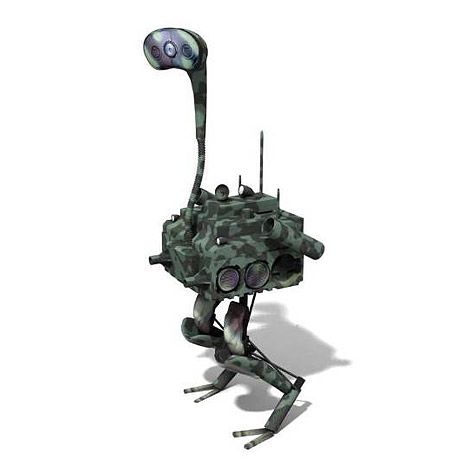
The above image is a rendering of the eventual form of a robot called FastRunner, a project led by the Florida Institute for Human and Machine Cognition (IHMC), in Pensacola. MIT's Robot Locomotion Group is a partner in the project. FastRunner uses a novel* leg design that should allow it to efficiently sprint at speeds of over 30 kilometers per hour while stabilizing itself and only using one actuator per leg. It'll also be able to run over moderately rough terrain, albeit at 15 km/h, which is still probably going to give even a talented human a run for their money. To put the speed of this robot in perspective, a human can sprint at about 40 km/h over short, level distances, while an actual ostrich can hit almost 100 km/h, with sustained speeds in the 70s.
So far, FastRunner consists of legs and body in simulation, plus one full-scale test leg. When completed, the robot will weigh about 30 kilograms, stand 1.4 meters high, and offer fast, efficient, and very robust motion for whatever potentially sinister applications DARPA can dream up:
IHMC has a lot of experience building legged robots. Researchers there have focused on "biologically inspired hardware design, bipedal and quadrupedal walking, balance, and push-recovery control," among other things. They've written locomotion algorithms for the LittleDog program, another DARPA initiative, and they're also developing humanoid robots for operation in urban environments and robotic exoskeletons to assist people with limited mobility.
MIT, for their part, has a whole bunch of experience with making clever robots with legs. In fact, they have (or had, at any rate) a whole lab dedicated to it. Fans of cool robots might remember this Thanksgiving-themed post from 2008, showing a robotic turkey, chicken, and dinosaur walking around MIT back in 2001. Ostriches are functionally very similar to dinosaurs and their descendants (I'm talking about birds, of course), perhaps even more so since the noble ostrich doesn't rely on its wings for much more than providing shade for smaller ostriches.
Anyway, getting back to FastRunner, it's pretty clear that these researchers have a solid foundation for the design of this robot, especially if you think about where they were 10 years ago and all the technological wonderment that's happened between then and now. My only remaining question is this: Those tubes on the sides of the robot in the rendering... Rocket launchers, or turbojets?
Source: Spectrum IEEE
Friday, November 11, 2011
DARPA AIMS TO LAUNCH SMALL SATELLITES FASTER, CHEAPER
Engineerblogger
Nov 11, 2011

Program plans to put 100-pound satellites into orbit for one-third the cost
Today there’s one way to get a satellite into space: launch it from the ground on a booster rocket, which is expensive and can take weeks or months between missions to prepare the launch pad. And a change in weather can scrap the launch at the last minute.
DARPA’s Airborne Launch Assist Space Access (ALASA) program seeks to reduce cost, time and weather constraints for launching small satellites from an aircraft.
“Current small satellite payloads can cost up to $30,000 per pound to launch, which is unsustainable over the long haul. Even when our increasingly capable small satellites are launched, they are obliged to go to orbits selected by the primary payload on current launchers, rather than to the orbits their designers and operators would prefer,” said Mitchell Burnside Clapp, DARPA program manager. “Through this program we’d like to see the cost per flight drop to less than $1 million dollars, including the range support costs, for 100-pound payloads, and to be able to launch each of those satellites into a dedicated orbit.”
The vision is for an aircraft to carry the small satellite and its host-booster either inside the aircraft or externally. At the desired altitude and direction the aircraft releases the satellite and booster, which continue their climb into space.
A key benefit of such a system is responsiveness to an immediate need. Within a day of being called up, a satellite launch mission could be conducted from a runway anywhere in the world. Another advantage is the flexibility of an aircraft to deliver a satellite into any desired orbit at any time.
Innovative technologies and techniques required for the ALASA program may include propellant systems, possible in-flight liquid oxygen production, motor case materials, flight controls, nozzle designs, thrust vectoring, throttling, mission planning techniques and airspace clearance procedures.
Source DARPA
Additional Information:
Nov 11, 2011

Program plans to put 100-pound satellites into orbit for one-third the cost
Today there’s one way to get a satellite into space: launch it from the ground on a booster rocket, which is expensive and can take weeks or months between missions to prepare the launch pad. And a change in weather can scrap the launch at the last minute.
DARPA’s Airborne Launch Assist Space Access (ALASA) program seeks to reduce cost, time and weather constraints for launching small satellites from an aircraft.
“Current small satellite payloads can cost up to $30,000 per pound to launch, which is unsustainable over the long haul. Even when our increasingly capable small satellites are launched, they are obliged to go to orbits selected by the primary payload on current launchers, rather than to the orbits their designers and operators would prefer,” said Mitchell Burnside Clapp, DARPA program manager. “Through this program we’d like to see the cost per flight drop to less than $1 million dollars, including the range support costs, for 100-pound payloads, and to be able to launch each of those satellites into a dedicated orbit.”
The vision is for an aircraft to carry the small satellite and its host-booster either inside the aircraft or externally. At the desired altitude and direction the aircraft releases the satellite and booster, which continue their climb into space.
A key benefit of such a system is responsiveness to an immediate need. Within a day of being called up, a satellite launch mission could be conducted from a runway anywhere in the world. Another advantage is the flexibility of an aircraft to deliver a satellite into any desired orbit at any time.
Innovative technologies and techniques required for the ALASA program may include propellant systems, possible in-flight liquid oxygen production, motor case materials, flight controls, nozzle designs, thrust vectoring, throttling, mission planning techniques and airspace clearance procedures.
Source DARPA
Additional Information:
- For more information on Airborne Launch Assist Space Access (ALASA)
Monday, October 24, 2011
Innovators Sought for DARPA Satellite Servicing Technology Program
Engineerblogger
Oct 24, 2011
More than $300 billion worth of satellites are estimated to be in the geosynchronous orbit (GEO—22,000 miles above the earth). Many of these satellites have been retired due to normal end of useful life, obsolescence or failure; yet many still have valuable components, such as antennas, that could last much longer than the life of the satellite. When satellites in GEO “retire,” they are put into a GEO disposal or “graveyard” orbit. That graveyard potentially holds tens to more than a hundred retired satellites that have components that could be repurposed – with the willing knowledge and sanction of the satellite’s owner. Today, DoD deploys new, replacement satellites at high cost—one of the primary drivers of the high cost is the launch costs, which is dependent on the weight and volume of antennas. The repurposing of existing, retired antennas from the graveyard represents a potential for significant cost savings.
DARPA’s Phoenix program seeks to develop technologies to cooperatively harvest and re-use valuable components from retired, nonworking satellites in GEO and demonstrate the ability to create new space systems at greatly reduced cost. “If this program is successful, space debris becomes space resource,” said DARPA Director, Regina E. Dugan.
This concept will require diverse expertise from the international and nontraditional space communities. For example, today’s ground-based robotics systems allow surgeons to perform telesurgery on a patient thousands of miles away, and advanced remote imaging systems used for offshore drilling view the ocean floor thousands of feet underwater. These types of capabilities, if re-engineered for zero gravity, high-vacuum and harsh radiation, could be used in space to allow the repurposing of valuable antennas from retired GEO satellites.
“Satellites in GEO are not designed to be disassembled or repaired, so it’s not a matter of simply removing some nuts and bolts,” said David Barnhart, DARPA program manager. “This requires new remote imaging and robotics technology and special tools to grip, cut, and modify complex systems, since existing joints are usually molded or welded. Another challenge is developing new remote operating procedures to hold two parts together so a third robotic ‘hand’ can join them with a third part, such as a fastener, all in zero gravity. For a person operating such robotics, the complexity is similar to trying to assemble via remote control multiple Legos at the same time while looking through a telescope.”
To optimally use those repurposed assets, the Phoenix program will develop low-cost, scalable electronics and structural modules that would allow localized control and communication with each other and a master satellite, ala DARPA’s System F6, that together harnesses the repurposed antennas. Phoenix specifically seeks technologies for developing a new class of small “satlets,” or nanosatellites, which can be sent more economically to the GEO region through existing ride-along services with commercial satellite launches and then robotically attached to the antenna of a nonfunctional cooperating satellite to essentially create a new space system. The nanosatellites may leverage the technologies, infrastructure, protocols and architecture developed within the ongoing System F6 program.
Technical expertise is sought to design a payload orbital delivery system, or PODS, to safely house the satlets when they are launched aboard a commercial satellite.
A separate on-orbit “tender,” or satellite servicing station, is planned to be launched into GEO. Once the tender arrives on-orbit, the PODS would be released from its ride-along host and linked with the tender to become part of the satellite servicing station’s “tool belt.” The tender plans to be equipped with grasping mechanical arms and remote vision systems to remove components and satlets from the PODS using unique space tools to be developed in the program.
Critical to the success of the Phoenix program is active participation from both U.S. and international communities involved in vital technical areas such as:
- Radiation tolerant microelectronics and memory storage.
- Distributed wireless mobile platform solutions for ad hoc connectivity and control.
- Industrial electronic control systems.
- Terrestrial microminiature guidance and control measurement units.
- Industrial robotics end effectors and tool changeout mechanisms and techniques.
- Computer-assisted medical robotics microsurgical telepresence, tools and imaging.
- Remote underwater imaging/vision technologies used in the offshore oil and gas drilling industry.
- Terrestrial manufacturing of high volume microelectronics and computer data storage.
- Terrestrial thermal management design technology of electronic devices and systems.
- Low-cost industrial manufacturing of high-volume sheet metal and other structural materials.
- Additive manufacturing on various structural materials
Source: DARPA
Additional Information:
Monday, September 12, 2011
ARPA-E Announces 2012 Energy Innovation Summit Featuring Bill Gates, Fred Smith and Lee Scott
Department of Energy
Sept 9, 2011
The U.S. Department of Energy’s Advanced Research Projects Agency – Energy (ARPA-E) Director, Arun Majumdar, announced yesterday that the Agency will hold its third annual ARPA-E Energy Innovation Summit from February 27 – 29, 2012 at the Gaylord Convention Center just outside Washington, D.C. Bill Gates, founder and chairman of Microsoft; Fred Smith, chairman, president and CEO of FedEx; and Lee Scott, former CEO of Wal-Mart; will join Secretary Chu and Director Majumdar as distinguished keynote speakers.
“After two successful Summits, I’m excited to once again bring some of our nation’s top thought leaders to Washington to discuss the importance of research, development and deployment of game-changing energy technologies.” said Director Majumdar. “Engagement by business executives such as Bill Gates, Fred Smith and Lee Scott in the Summit emphasizes the critical link between the private sector and government funded R&D for innovation in energy technologies and highlights the important role innovation plays in enabling business, economic growth, and national security.”
Now in its third year, the Summit is designed to unite key players from all sectors of the nation’s energy innovation community to share ideas for developing and deploying the next generation of clean energy technologies. The event is co-hosted by ARPA-E and Clean Technology and Sustainable Industries Organization (CTSI).
Last year’s annual ARPA-E Energy Innovation Summit attracted more than 90 speakers and 2,000 attendees from 49 states and 20 countries. Attendees included members of research and development institutions, global corporations, technology entrepreneurs, investors, policymakers and government officials.
The event will feature a technology showcase with more than 150 exhibits from ARPA-E-funded projects and applicants in areas such as grid-scale storage, power electronics, batteries for electric vehicles, building efficiency, advanced carbon capture and electrofuels. The showcase will also feature new ARPA-E programs such as rare earth alternatives, plant engineering for fuel applications, advanced thermal storage, network integration architecture for the electrical grid, and power electronics for PV applications. A wide range of other energy technologies and new topic areas will also be discussed at the Summit.
In addition to an expanded showcase, the 2012 Innovation Summit will once again feature America’s top businesses focused on developing energy technology. The Summit connects top corporate businesses with clean energy researchers and entrepreneurs with the goal of building lasting partnerships for commercialization. Some of last year’s corporate participants include Lockheed Martin, Dow, Dupont, Battelle and Bosch.
Many more speakers will be added in the coming months. To register for the 2012 ARPA-E Energy Innovation Summit and for the latest news on the Summit program, please visit:http://www.energyinnovationsummit.com.
Sept 9, 2011
The U.S. Department of Energy’s Advanced Research Projects Agency – Energy (ARPA-E) Director, Arun Majumdar, announced yesterday that the Agency will hold its third annual ARPA-E Energy Innovation Summit from February 27 – 29, 2012 at the Gaylord Convention Center just outside Washington, D.C. Bill Gates, founder and chairman of Microsoft; Fred Smith, chairman, president and CEO of FedEx; and Lee Scott, former CEO of Wal-Mart; will join Secretary Chu and Director Majumdar as distinguished keynote speakers.
“After two successful Summits, I’m excited to once again bring some of our nation’s top thought leaders to Washington to discuss the importance of research, development and deployment of game-changing energy technologies.” said Director Majumdar. “Engagement by business executives such as Bill Gates, Fred Smith and Lee Scott in the Summit emphasizes the critical link between the private sector and government funded R&D for innovation in energy technologies and highlights the important role innovation plays in enabling business, economic growth, and national security.”
Now in its third year, the Summit is designed to unite key players from all sectors of the nation’s energy innovation community to share ideas for developing and deploying the next generation of clean energy technologies. The event is co-hosted by ARPA-E and Clean Technology and Sustainable Industries Organization (CTSI).
Last year’s annual ARPA-E Energy Innovation Summit attracted more than 90 speakers and 2,000 attendees from 49 states and 20 countries. Attendees included members of research and development institutions, global corporations, technology entrepreneurs, investors, policymakers and government officials.
The event will feature a technology showcase with more than 150 exhibits from ARPA-E-funded projects and applicants in areas such as grid-scale storage, power electronics, batteries for electric vehicles, building efficiency, advanced carbon capture and electrofuels. The showcase will also feature new ARPA-E programs such as rare earth alternatives, plant engineering for fuel applications, advanced thermal storage, network integration architecture for the electrical grid, and power electronics for PV applications. A wide range of other energy technologies and new topic areas will also be discussed at the Summit.
In addition to an expanded showcase, the 2012 Innovation Summit will once again feature America’s top businesses focused on developing energy technology. The Summit connects top corporate businesses with clean energy researchers and entrepreneurs with the goal of building lasting partnerships for commercialization. Some of last year’s corporate participants include Lockheed Martin, Dow, Dupont, Battelle and Bosch.
Many more speakers will be added in the coming months. To register for the 2012 ARPA-E Energy Innovation Summit and for the latest news on the Summit program, please visit:http://www.energyinnovationsummit.com.
Friday, August 12, 2011
Contact lost with hypersonic glider after launch
Associated Press

The small craft is part of a U.S. military initiative to develop technology to respond to threats at 20 times the speed of sound or greater, reaching any part of the globe in an hour.
The HTV-2 is designed to be launched to the edge of space, separate from its booster and maneuver through the atmosphere at 13,000 mph before intentionally crashing into the ocean.
DARPA used Twitter to announce the launch and status of the flight.
The agency said the launch of the Minotaur 4 rocket was successful and separation was confirmed. It next reported that telemetry had been lost.
No further details were immediately reported. There was no immediate response to an email request to DARPA for information on the mission.
The HTV-2 is intended to put theory, simulations and wind tunnel experience to the test in real flight conditions at speeds producing temperatures in the thousands of degrees and requiring extremely fast control systems, according to DARPA.
The first HTV-2 was launched on April 22, 2010. It returned nine minutes of data, including 139 seconds of aerodynamic data at speeds between 17 and 22 times the speed of sound, DARPA said.
That craft detected an anomaly, aborted its flight and plunged into the ocean, the agency said.
SOURCE: The Associated Press
Aug 11, 2011

An unmanned hypersonic glider developed for U.S. defense research into super-fast global strike capability was launched atop a rocket early Thursday but contact was lost after the experimental craft began flying on its own, the Defense Advanced Research Projects Agency said.
There was no immediate information on how much of the mission's goals were achieved.
It was the second of two planned flights of a Falcon Hypersonic Technology Vehicle-2. Contact was also lost during the first mission.There was no immediate information on how much of the mission's goals were achieved.
The small craft is part of a U.S. military initiative to develop technology to respond to threats at 20 times the speed of sound or greater, reaching any part of the globe in an hour.
The HTV-2 is designed to be launched to the edge of space, separate from its booster and maneuver through the atmosphere at 13,000 mph before intentionally crashing into the ocean.
DARPA used Twitter to announce the launch and status of the flight.
The agency said the launch of the Minotaur 4 rocket was successful and separation was confirmed. It next reported that telemetry had been lost.
No further details were immediately reported. There was no immediate response to an email request to DARPA for information on the mission.
The HTV-2 is intended to put theory, simulations and wind tunnel experience to the test in real flight conditions at speeds producing temperatures in the thousands of degrees and requiring extremely fast control systems, according to DARPA.
The first HTV-2 was launched on April 22, 2010. It returned nine minutes of data, including 139 seconds of aerodynamic data at speeds between 17 and 22 times the speed of sound, DARPA said.
That craft detected an anomaly, aborted its flight and plunged into the ocean, the agency said.
SOURCE: The Associated Press
Wednesday, June 29, 2011
DARPA’S Defense Manufacturing Efforts Support White House Vision
Darpa Press Release
June 24, 2011
June 24, 2011
The Defense Advanced Research Projects Agency recognizes that to innovate we must make and to protect we must produce. That understanding has prompted the Agency to plan to invest $1B over five years in manufacturing innovation for defense systems.
During an event today at the National Robotics Engineering Center, President Barack Obama addressed the key roles that advanced research in collaboration with government and industry can play in enhancing the global competitiveness of U.S. manufacturing, jumpstarting job creation and the process of bringing ideas to market.
DARPA’s Experimental Crowd-derived Combat Support Vehicle (XC2V) was highlighted as an example of the power of collaboration and the democratization of innovation at the event. The XC2V is the first crowd-sourced, militarily relevant vehicle design. The DARPA XC2V effort, asked non-traditional DoD performers, small businesses, universities and the general public to contribute innovative ideas for a vehicle body designed to accomplish the critical mission tasks of combat resupply and medical evacuation. More than 150 credible designs were submitted, with the winning design taking less than fourteen-weeks to build.
Tuesday, June 21, 2011
NASA And DARPA Offer Students Chance To Support Future Mission
NASA Press Release
June 19, 2011
NASA and the Defense Advanced Research Projects Agency (DARPA) are offering high school students the opportunity to design experiments that will be tested in space.
The 2011 Zero Robotics challenge is a continuation and expansion of a science, technology, engineering and math (STEM) education program using bowling ball-sized spherical satellites aboard the International Space Station.
The Synchronized Position Hold, Engage, Reorient, Experimental Satellites, or SPHERES, are used inside the station to test maneuvers for spacecraft performing autonomous rendezvous and docking. The three satellites that make up SPHERES fly in formation inside the station's cabin. Each is self-contained with power, propulsion, computing and navigation equipment. Test results support satellite servicing, vehicle assembly and spacecraft that fly in formation.
The challenge requires high school student teams to write their own algorithm to fly the satellites in the station. Teams must register before Sept. 5 at: Click here...
June 19, 2011
 |  |
NASA and the Defense Advanced Research Projects Agency (DARPA) are offering high school students the opportunity to design experiments that will be tested in space.
The 2011 Zero Robotics challenge is a continuation and expansion of a science, technology, engineering and math (STEM) education program using bowling ball-sized spherical satellites aboard the International Space Station.
The Synchronized Position Hold, Engage, Reorient, Experimental Satellites, or SPHERES, are used inside the station to test maneuvers for spacecraft performing autonomous rendezvous and docking. The three satellites that make up SPHERES fly in formation inside the station's cabin. Each is self-contained with power, propulsion, computing and navigation equipment. Test results support satellite servicing, vehicle assembly and spacecraft that fly in formation.
The challenge requires high school student teams to write their own algorithm to fly the satellites in the station. Teams must register before Sept. 5 at: Click here...
Entries will be evaluated using simulations. Massachusetts Institute of Technology (MIT) in Cambridge, Mass., will host a final ground testing competition in October. The top 27 teams will have their code sent to the station, where an astronaut will program the SPHERES satellites to run their tests.
The Zero Robotics challenge, facilitated by MIT, continues the STEM focus of the SPHERES program. The 2011 challenge expands on a pilot program performed in 2009 and 2010. By making the benefits and resources of the space program tangible to high school students, Zero Robotics is designed to inspire future scientists and engineers. Students will have the opportunity to push their limits and develop skills in STEM. This program builds critical engineering skills for students such as problem solving, design thought process, operations training, team work and presentation skills.
MIT's Space Systems Laboratory developed SPHERES in 2006 to provide DARPA, NASA and other researchers with a long-term test bed for validating technologies critical to the operation of future satellites, docking missions and satellite autonomous maneuvers. The satellites provide opportunities to test a wide range of hardware and software at an affordable cost.
Additional Information:
The Zero Robotics challenge, facilitated by MIT, continues the STEM focus of the SPHERES program. The 2011 challenge expands on a pilot program performed in 2009 and 2010. By making the benefits and resources of the space program tangible to high school students, Zero Robotics is designed to inspire future scientists and engineers. Students will have the opportunity to push their limits and develop skills in STEM. This program builds critical engineering skills for students such as problem solving, design thought process, operations training, team work and presentation skills.
MIT's Space Systems Laboratory developed SPHERES in 2006 to provide DARPA, NASA and other researchers with a long-term test bed for validating technologies critical to the operation of future satellites, docking missions and satellite autonomous maneuvers. The satellites provide opportunities to test a wide range of hardware and software at an affordable cost.
Additional Information:
- NASA and MIT's Zero Robotics program, Click here...
- DARPA, Click here...
Wednesday, June 1, 2011
DARPA HIGHLIGHTS NEW VIDEOS
DARPA
June 1, 2011
The DARPA Autonomous Robotic Manipulation (ARM) program
The DARPA Autonomous Robotic Manipulation (ARM) program is developing software that enables robots, given only high-level direction, to autonomously grasp, manipulate and perform complex tasks in unstructured environments. At the Smithsonian National Museum of American History, an ARM robot known as "Robbie" has been playing games with curious and intrigued visitors. The exhibit teaches visitors about how robotics can impact society and encourages young people to pursue careers in science and engineering. DARPA is also offering the public the opportunity to develop and test code to perform tasks in the robot simulator, then upload that code to an actual robot and watch it execute the task in real-time via the web.
To read more on ARM program and how to participate in the Outreach Track click here...
Project GreenVax is a research and development demonstration project funded by the Defense Advanced Research Projects Agency and conducted by the Texas Plant-Expressed Vaccine Consortium located in Bryan, Texas. The goal of this project is to develop a capability to produce 1kg (or approximately 10 million doses) of a recombinant vaccine candidate protein in one month. To succeed in this effort, the project GreenVax team created numerous innovative solutions to maximize efficiencies to both their upstream and downstream processes including new lighting systems capable of doubling plant biomass generated and use of mobile Modular Bioprocessing Facilities, which provide the flexibility to manufacture multiple products at the same time. If this effort is successful, it could provide a strategic resource for the United States and its ability to rapidly produce medical countermeasures against any biothreat.
To read more click here...
In 2005, DARPA announced the Nano Air Vehicle (NAV) program and its goal to develop agile and flyers system that could fit in one hand. This video chronicles the development of a "hummingbird" flyer by Aerovironment from concept to prototype demonstration and introduction to the public. A number of difficult design and engineering challenges were overcome in the course of the program, particularly in the wing structure, propulsion and control actuators. Numerous complete prototypes were built and tested to assess and improve the performance of the systems shown in the video. The final prototype achieves the noteworthy milestone of 2-wing flapping hovering and fast forward flight with all power sources on the aircraft and all controls implemented through modulation of the wing strokes in a shape that resembles a real hummingbird and carries and on-board camera that relays video to the pilot in real time.
To read more click here...
June 1, 2011
The DARPA Autonomous Robotic Manipulation (ARM) program
The DARPA Autonomous Robotic Manipulation (ARM) program is developing software that enables robots, given only high-level direction, to autonomously grasp, manipulate and perform complex tasks in unstructured environments. At the Smithsonian National Museum of American History, an ARM robot known as "Robbie" has been playing games with curious and intrigued visitors. The exhibit teaches visitors about how robotics can impact society and encourages young people to pursue careers in science and engineering. DARPA is also offering the public the opportunity to develop and test code to perform tasks in the robot simulator, then upload that code to an actual robot and watch it execute the task in real-time via the web.
To read more on ARM program and how to participate in the Outreach Track click here...
Project GreenVax
Project GreenVax is a research and development demonstration project funded by the Defense Advanced Research Projects Agency and conducted by the Texas Plant-Expressed Vaccine Consortium located in Bryan, Texas. The goal of this project is to develop a capability to produce 1kg (or approximately 10 million doses) of a recombinant vaccine candidate protein in one month. To succeed in this effort, the project GreenVax team created numerous innovative solutions to maximize efficiencies to both their upstream and downstream processes including new lighting systems capable of doubling plant biomass generated and use of mobile Modular Bioprocessing Facilities, which provide the flexibility to manufacture multiple products at the same time. If this effort is successful, it could provide a strategic resource for the United States and its ability to rapidly produce medical countermeasures against any biothreat.
To read more click here...
DARPA Nano Air Vehicle (NAV) program
In 2005, DARPA announced the Nano Air Vehicle (NAV) program and its goal to develop agile and flyers system that could fit in one hand. This video chronicles the development of a "hummingbird" flyer by Aerovironment from concept to prototype demonstration and introduction to the public. A number of difficult design and engineering challenges were overcome in the course of the program, particularly in the wing structure, propulsion and control actuators. Numerous complete prototypes were built and tested to assess and improve the performance of the systems shown in the video. The final prototype achieves the noteworthy milestone of 2-wing flapping hovering and fast forward flight with all power sources on the aircraft and all controls implemented through modulation of the wing strokes in a shape that resembles a real hummingbird and carries and on-board camera that relays video to the pilot in real time.
To read more click here...
Wednesday, April 20, 2011
U.S. hi-tech energy unit extends life in budget deal
Reuters
April 20, 2011

A high-tech U.S. research agency will get $130 million for programs that could one day decrease the cost of solar power and lessen dependence on rare earth metals used for alternative energy, the U.S. energy secretary said.
The funding, which partially came from this month's federal budget deal, will go to five new programs at the Advanced Research Projects Agency-Energy, or Arpa-E.
To read more click here...
April 20, 2011
The funding, which partially came from this month's federal budget deal, will go to five new programs at the Advanced Research Projects Agency-Energy, or Arpa-E.
To read more click here...
Space Surveillance Telescope To Provide Enhanced View Of Deep Space
DARPA
April 12, 2011

Swirling thousands of miles above earth, military satellites provide critical capabilities to warfighters—which makes protecting them from collision with space debris, meteors and microsatellites a top priority. Until now, monitoring the deep regions of space has been difficult, with spots and gaps in coverage leaving these high-flying machines vulnerable. DARPA’s newly developed Space Surveillance Telescope (SST) aims to change that, ushering in a new era of ground-based space surveillance technology to fill coverage gaps and offer an unprecedented wide-angle view of small objects in deep space.
“Currently we have a ‘soda straw’ view of deep space, where we can only see one narrow segment of space at a time,” said Air Force Lt. Col. Travis Blake, DARPA’s Space Surveillance Telescope program manager. “The Space Surveillance Telescope should give us a much wider ‘windshield’ view of deep space objects, significantly enhancing our space situational awareness.”
To read more click here...
April 12, 2011

Swirling thousands of miles above earth, military satellites provide critical capabilities to warfighters—which makes protecting them from collision with space debris, meteors and microsatellites a top priority. Until now, monitoring the deep regions of space has been difficult, with spots and gaps in coverage leaving these high-flying machines vulnerable. DARPA’s newly developed Space Surveillance Telescope (SST) aims to change that, ushering in a new era of ground-based space surveillance technology to fill coverage gaps and offer an unprecedented wide-angle view of small objects in deep space.
“Currently we have a ‘soda straw’ view of deep space, where we can only see one narrow segment of space at a time,” said Air Force Lt. Col. Travis Blake, DARPA’s Space Surveillance Telescope program manager. “The Space Surveillance Telescope should give us a much wider ‘windshield’ view of deep space objects, significantly enhancing our space situational awareness.”
To read more click here...
Wednesday, March 30, 2011
Darpa Creating Cheetah-Bot to Hunt Humans
Wired.com
March 2, 2011

On Friday, Boston Dynamics has announced that the United States Department of Defense's research agency, DARPA, has awarded them a contract to build a new four-legged robot that will be fast enough to chase, evade, and hunt down the fastest human.
To read more click here...
March 2, 2011

To read more click here...
Subscribe to:
Posts (Atom)


