Pages

Subscribe:

Labels

038628037504 (1) 10150 (1) 10BURIED (1) 10Count (1) 110011040 (1) 115Ounce (1) 1200mg (1) 12BSN (1) 12Count (2) 12CountNutricor (1) 12CountWWSN (1) 12Fresh (1) 12Stacker (3) 12VPX (1) 140243 (1) 14Servings (1) 158Ounce (1) 15Ounce (1) 16Ounce (2) 1716 (1) 17Skque (1) 1lbinLife (1) 2000Hrs (1) 2000mg (1) 200Watt (1) 2021A (1) 20OunceNatures (1) 2412Ounce (1) 24Count (1) 24EAS59134 (1) 24FRS (1) 24Guru (1) 24Guru01GR124 (2) 24Nestle (2) 24Pediasure (2) 24Peptamen (1) 24PieceDisplay (1) 24Solis (2) 27ReSource (2) 2Biochem (1) 2Dynamic (1) 2Jarrow (1) 2Muscle (1) 2Natures (1) 2Ounce (3) 2Pound (1) 30Day (1) 328601 (1) 334928 (1) 336gOptimum (1) 37Ounce (1) 3Ensure (1) 3M (1) 414 (1) 432500 (1) 48Boost (1) 48Fluid (1) 48ml (1) 4Ensure (1) 4Isopure (1) 5000mg (1) 527408 (1) 5511786 (1) 574400 (1) 5Hour (2) 5Ounces (1) 600Kendall (1) 662380 (1) 6Beneprotein (1) 6Proteinex (1) 70951 (1) 750mlNutriPrima (1) 845Ounce (1) 84Fluid (2) 84OuncesLiquid (1) 89Inch (1) 8nuun (2) 8Ounce (7) 99369FR (1) ABB (3) Academy (1) ACCENTS (1) Acia162Ounces (1) Acsry (1) Active (2) Adapter (1) AdapterBattery (1) Advance (1) Advanced (1) Advantage (1) AdvantEdge (1) Africa (29) African (1) Agaricus (1) AiCoco (1) AIDSTrustex (1) Airbrush (1) Airbus (6) Aircraft (94) AISI (1) Ajmeras (1) Alchohol (1) Alertness (1) Alfalfa (2) Alive (1) Allergy (1) Allspice (8) Alpine (1) Alstom (2) Alternative (1) Amarillo (1) Amazing (3) Amazon (2) American (1) animal (11) Annual Reports (155) Antioxidant (1) Anwar Ibrahim (1) Apple (1) Applied Materials (1) Arrowroot (1) AshtonDrake (1) Asia (72) Assorted (1) Atkins (1) Audi (1) Australia (21) Automotive (250) Automotive Technology (183) Ayurvedic (1) BABIES (1) Babys (1) Bacopa (1) BagAtkins2627 (1) BagsTraditional (1) BagSun (1) Balanced (1) Ballard Power System (1) Banaba (2) Baram Dam (1) Baram Regatta (1) Bariatric (1) Barisan Nasional (2) Barisan Nasional Helps Penan (1) Barista (2) Barley (2) barsBiochem (1) Basement (1) BASF (2) Basics (1) Batu Lawi (1) Bayer (1) BEA1017OZ (1) Beachbody (1) Beaded (1) Beaumont (1) beautiful girl image (19) Beauty (2) Beneprotein (2) Berries (3) Berry (4) BerryLiving (1) Beverage (1) Bicycle (1) BioAstin (1) Biochem (4) Biofuel (12) Biogenesis (2) BlackBlender (1) Blend (1) Blender (4) Blueberry (1) BlueStereo (1) BMF (1) BMW (7) BMX (1) BN (1) Boeing (4) Bombardier (4) Book (1) Borneo (6) Bottle (8) BottleProStat (1) Bottles (15) BottleScivation (1) bottlesEnsure (2) BottlesMio (1) BoxChenille (1) BoxDarice140243 (1) BOXESAmerican (1) BoxesFRSPowder (1) BoxPremier (1) BP (2) Brands (1) Brands833667000102 (1) Brazil (10) Brazilian (1) Breeze (3) BrewersBarista (1) BRIC (118) Brikpaks (3) Brownie (1) Bruno Manser (1) Bruno Manser Fund (3) Bruno Manser Fund Fraud (1) Bruno Manser Fund Frauds (1) Bruno Manser Lies (2) BTL410400 (1) Bubbles (1) Burner (1) business (72) Butchers (1) Butter (1) Butterscotch (1) Cable (1) Cables (1) Calcium (2) California (1) Calorie (3) Camera (1) Canada (11) Candela (1) Canister (2) CanisterCLICK (1) Canisters (1) Canning (1) Capramilk (1) CapsSwanson (1) Capsule (5) Capsules (6) CapsulesEAS (1) Caraway (1) Cardio (1) Carnation (1) CaseEnsure (2) CaseNestle (2) Celebrity (22) CellularFactory (1) Celsius (1) Certification (28) Certified (2) Chameleon (1) Charger (1) Charter/Terms of Reference (27) CHEAP (135) Chenille (1) Cherry (1) CherryZydot (1) Chevron (1) Chewing (1) Chile (1) China (99) Chipotle (1) Chlorophyll (1) Chocolate (7) Chocolate8 (1) Choice (2) Cholesterol (1) Chrome (1) Chrysler (1) Chunho (1) Citrifolia (1) Citroen (1) Citroën (1) Citrus (2) Civil Service (1) CK Morris Associates (1) Clare Rewcastle Brown (2) Class (1) Classic (2) Clinical (1) CNST (1) Coenzyme (1) Coffee (4) Coffee11001105 (1) Coffee7DSC2B (1) Coffeehouse (1) Cold Fusion (1) Coldkicker (1) Collectable (1) Collection (1) Colored (1) Colors (1) Communications (14) Company (2) COMPLETE (4) Complex (1) Computer (1) Concentrate (1) Concentrated (1) Concepts645654 (1) Condoms (1) Container (7) CONTROL20BGSee (1) Corrections (3) CosMedix (1) count (1) countAmscan (1) CountMy (1) Crayola (3) Criminal (4) Cruiser (1) Crunch (1) Cytosport (2) Daimler (3) Dam (1) DAP (1) DAP Lies (1) Darice (1) DARPA (18) Dato Roland Sagah Wee Inn (1) Defence (60) Defense (61) Delight (2) description (1) Desert (7) Design (65) DESIGNER (3) Desktop (1) detail (1) Detroit (1) Development (1) Dexatrim (1) diameter (1) diameterGaming (1) Diecast (1) Dinosaur (1) DISCOUNT (4) Discover (1) Disney (1) Doctors (1) DoE (8) DolphinsSticky (1) DOMAGRON (1) Dow Corning Corp (2) DP9260 (1) DRA6329 (1) Dragon (1) Dressing (1) Drink (11) Drinkin (1) drinksNVE (1) Dupont (2) dv9657clSIBCORP (1) Dymatize (3) DYMMGV (1) DYNAMIC (5) EachHager (1) EADS (12) ecigs (1) Eco-Tourism (1) Economy (14) Education (1404) Electra (1) Electric Grid (1) Electrolyte (4) ELP3STSL (1) Endorush (1) Endurox (2) Energizing (1) Energy (540) English Article (20) Enhanced (1) Enhancer (1) Enlive (2) Ensure (12) Enterprise (1) Environment (170) Enzymatic (1) Eraser (1) ERECTION (1) Ergonomics (4) ESA (4) Espresso (1) Essence (2) Essentials (3) EssentialsHSE (1) ethnic group (1) Europe (201) Executive/External Ombuds (2) Extended (2) ExtenderBadger (1) Extension (1) Extern/Intern (20) Extract (5) Extreme (21) Factor (1) Factors (3) Fantastic (1) Fatigued (1) Faucet (1) feature (9) Featuring (1) Fellowes (1) Fillet (1) First Energy (6) Fitera (2) FlatScreen (1) Flavor (1) FlavorBeachbody (1) Focus28 (1) Ford Motors (7) Foreign NGOs (2) Forest (1) formula (5) Formulas (1) Forts (1) FORUM (1) Fragrance (1) France (12) Frappuccino (1) FreeHubner (1) French (2) Friday Poll (13) Frontier (1) Frost (1) Fruits (1) Ft1140Alessco (1) Ft132Alessco (1) FToys (1) Fudge (1) Fuel Cell (26) Fujitsu (2) funny (19) Gadget (6) Galleries (1) Gallon (1) GameJax2000 (1) Games (1) General Electric (21) General Motors (15) Genesis (1) Georges (1) Germany (28) Go02658 (1) Golden (1) Goldfinch (2) Goodyear (1) Google (6) Gordoni (1) Gourmet (1) Government (333) Grape (2) Grape5 (1) Green Energy (544) Greens (2) GripAlex (1) Ground (7) Guarana (1) Halal Hub (1) Hammer (1) Hardware (1) Hasbro (1) Hawaiian (1) health (19) Health Care (87) Healthy (4) Herbal (5) Herbals (1) Himalayan (1) Holiday (1) Honda (4) Honeywell (1) Hoodia (1) HPCompaq (1) Hubner (1) human capital development (1) Humor (18) Hydration (2) hydration8PKNUUNLL (1) Hydrive (1) Hyundai (2) IBM (2) Illegal Demonstrations (1) iMicro (1) IMMICRP (1) India (23) information (8) Infrastructure (44) inLife (1) Inside Invester Ltd (1) Instantized (1) Institute (1) International (338) Internet (7) Intestinal (2) Investment (187) IOA News (168) ISO (1) ISO100 (1) Isolate (2) Isopure (4) Isotonix (1) Italian (2) Italy (1) Jabatan Penerangan (1) Jameson Ahip Nawie (1) Japan (57) JarALTERNATIVE (1) JarDoctors (1) Jarrow (1) Job Postings (339) Johnson Controls (1) Journey (2) Juice (2) JUICECRANBERRYOG2 (1) JuiceTahitian (1) Kangmei (1) KCups (1) Kerlix (1) Kettler (1) Kettler8852600 (1) Keurig (1) Keyboard (1) Kiddio (1) KitBerg (1) KiteSpiderMan (1) KitGoldfinch (1) Kombucha (2) KombuchaKIT (1) Kraft911501 (1) Kuching (1) Laboratories (1) Langnickel (1) LaptopNotebook (1) lbBioGenesisRICE3 (1) lbsNatural (1) Leading Indicators (450) Lean (10) LeapFrog (3) Learning (1) Leaves (2) Leccino (1) Legislation (65) Lemonade (2) Lemonlime (1) Len Talif (1) License (1) Lifetime (2) Light (1) LightHog (1) LINERBLADDER (1) Liquid (20) LiquidDeSouzas (1) Litigation (45) Living (2) Lockheed Martin (6) Looking (1) Lubricants (1) Lubricated (1) Macbook (1) Malaysia (4) MaleFemale (1) Management (16) Manufacturing (394) Marine Technology (2) Materials (446) Mazda (2) Medical (84) Medicinals (1) MEGAWING (1) Mental (1) Mercedes-Benz (3) Merdeka (2) Metabolic (1) MetaboLife (1) Metallic (1) Metamucil (1) MetersCables (1) Middle East (16) Miniatures (1) MioEnergy (1) Miradent (1) Miri (1) MIRROR (1) Mitsubishi (4) Monkey (2) Monster (1) Morinda (1) Morton (1) Mosacis (1) Mosaics (1) Mothers (1) MountScotty245 (1) MultiPackCELSIUS (1) MultiPackDYNAMIC (2) MultiPackLILY (1) MultiPackLIQUID (1) MultiPackMACA (1) MultiPackONLY (1) Multiracial (1) Mulu (1) Muscle (1) Muscletech (2) Myoplex (1) Nanotechnology (279) NASA (22) National Laboratory (46) Natural (12) natural phenomena (11) Naturally (1) Naturals (3) Natures (6) Naturessunshine (4) nc8000 (1) nc8220 (1) nc8230 (1) Nesting (1) Nestle (2) Netbook (1) New Programs (133) New Zealand (2) NGO's (213) NGOs (1) Nickel Hydrogen (1) Nissan (8) NIST (5) North America (18) Northrop Grumman (1) Norway (1) NovoAndina (2) Noxide (1) NREL (8) NSF (3) NTT Data (1) Nuclear (45) Numbers (1) Nuspeed (1) Nutrex (1) Nutricor (1) Nutrient (2) Nutrients (1) NutriPrima (1) Nutrition (15) Nutritional (5) NutritionON45 (1) nw8000 (1) nw8240 (1) Offshore (7) OilsAWM (1) OintmentWounded (1) Olives (1) Onshore (2) Optical Technology (28) Optimum (4) Optisource (2) Orang Ulu (1) Orange (7) OrangeHigh5 (1) Organic (12) Original (2) Other Ombuds (145) Otomotif (2) ounce (1) Ounces (5) OuncesSea (1) OunceThe (1) Outside the Standards (62) Oxford Business Group (1) OyToys (1) OzAfrican (1) ozNatures (1) Packages (1) Packet (1) Packets (1) PacketsNatures (1) PacketsUltima (1) Packs (2) PackStarbucks (1) PadCrayola (1) Paradise (1) Parazyme (1) Parents (1) Parmigiani (1) Pavilion (1) Pecan (1) Pediasure (3) Pehin Sri Haji Abdul Taib Mahmud (1) Penan (9) Pepper (1) Peppermint (1) Peptamen (1) Peter Jaban (2) Pharma (1) Pharmaceuticals (1) Phillips (1) Pickling (1) Pieces (1) PineappleGU (1) PinkBlender (2) PKR (1) PlantBased (1) Plantiva (1) Plastic (8) PN0223 (1) Pomegranate (1) PomegranateGU (1) Porsche (1) PostCXDNSR105 (1) Poundlb (1) Pounds (1) PoundsClif (1) Powder (20) Powdered (1) PowderEndurox (1) PP1235BBS (1) Practice Pointers (185) Prebio (1) PregNatal (1) Premier (1) Premium (3) preservatives (1) Preston (1) Private Sector (174) Proasis (1) Products (2) Professional Devt. (254) Profiles (257) Projector (1) Proscience (1) ProStat (2) protein (14) Proteinex (1) Protidiet (1) Proxima (1) Pudding (1) Punch (1) Purpose (1) Puzzle (1) R. Palan and Sabariah Putit (1) R4Lemon (1) Rail (41) RAINBOW (1) Rainforest (2) Raspberry (1) REA6048 (1) ReadytoDrink (1) Reaper (1) Recovery (2) Regional Events (101) Regular (2) Release (2) Remedies (1) REMEDIES4582008 (1) Replacement (2) Replenisher (3) ReplenisherUltima (1) Research (1) Research and Development (825) ReSource (4) Results (1) Revitalization (1) Roasted (1) Robotic Technology (124) Rocket (2) Rolls royce (7) Rooibos (1) Rosemary (1) ROSSLARE (1) Russell (1) Russia (17) Safety (15) Sains (20) SaltFree (1) Samalaju (4) Sammons (1) Samsung (1) Sarawak (13) Sarawak 10th State Election (1) Sarawak Borneo (7) Sarawak Budget 2012 (1) Sarawak Corridor of Renewable Energy (SCORE) (8) Sarawak Development (1) Sarawak Economics (1) Sarawak Economy (6) Sarawak ethnic groups (1) Sarawak Forest Corporation (2) Sarawak Politics (4) Sarawak Rainforest (2) Sarawakian (7) Satellite (6) Saudi Aramco (1) ScaledStar (1) Scholarly Articles/Research (102) science (50) Scivation (1) ScottishPower Renewables (1) Scotty (1) Seasoning (1) SEB (1) Secura (1) Seks (12) Senior Citizens (1) Series (1) serving (2) Servings (2) servingsBariatric (1) Shades (1) shake (4) Shaker (1) SHEETSHygloss (1) Shell (1) ShotCL27752 (1) Siemens (8) Silicone (1) Silver (1) Singapore (2) Single (1) Sleeve (1) SlimFast (1) Slimming (1) SlimStyles (1) SM005Grey (1) Smart (1) smartphone (1) Smoke (1) Smoothie (2) Smore (1) SoftCarpets (2) Softgels (1) Sony (1) Souffle (1) Source (2) South Africa (11) South America (11) South Korea (1) Space Technology (69) Sparkling (1) SpiderMan (1) Sponge (1) SpongeSammons (1) Sport (8) Sports (7) Springtime (1) Stacker (4) Starbucks (1) Starwest (2) Stems (1) Stereo (1) Sterile (1) Sticker (1) Sticky (1) Stomach (2) Strawberry (3) Strength (3) Strive (1) SumoMESUMO66897 (1) Sundries (5) Sunkist (1) Sunwarrior (1) SuperGreens (1) Supplement (4) Supplier (1) supply (3) Support (4) Supreme (2) Sustainable Forest Management Policy (2) Switzerland (2) System (3) Tablet (2) Tablets (3) TabletsTwinlab (1) Tahatian (1) Tahitian (1) Taib Mahmud (6) Taisho (1) Tanjung Manis (1) Tanjung Manis Halal Hub (1) Tartar (2) Tata (4) Tattoos (1) Technology (562) Temporary (2) Temptations (1) Tesla (1) Testors (1) Thalgo (1) The Report 2011 (1) Therapeutic (1) TinTea (1) Tips (25) Tokuyama (1) Topical (1) totalBoost (1) Toyota (15) Toys21030000 (1) ToyTote (1) Transitions (255) Transphorm (1) Transport (135) TREASURE (1) TrikeKiddio (1) Tropical (2) Trumans (1) Trustex (1) Tubes30 (1) Twinlab (2) Twistables (1) Two Hats (2) Uganda (1) UK (107) Ulticare (1) Ultima (3) Ultimate (1) Ulu Baram (1) Unflavored (1) Unibody (1) Unique (53) United States (281) University (1) Unknown (1) Uranium (1) USDA (1) Vale (1) Vanilla (10) Vanilla8 (1) Varcho (1) Variety (3) VegCap (3) Vehicle (1) Video (30) Viennese (1) Visitor Advice (70) VIT033 (1) Vitacost (5) Vitalyte (1) Volkswagen (5) Volvo (2) VTL200CIR (1) Warrior (3) WarsATST (1) Water resources (1) Water Technology (28) Watermelon (1) Wedding (1) Weight (2) Whole (2) Wild10650 (1) Wooden (1) World news (67) Worldwide (1) Wounded (1) Xtend (1) Xtreme (1) Xylitol (1) ZeroCherry (1) ZipFizz (1) ZoomOxo4113600 (1) ZZP88103 (1)

Showing posts with label Europe. Show all posts

Thursday, March 8, 2012

Introducing plug-and-play nanoelectromechanical systems (NEMS)

Engineerblogger
March 8, 2012


Silicon nitride beam flanked by two gold electrodes.  Schematic illustration of the 55-µm long silicon nitride beam (green) flanked by two gold electrodes (yellow). Artwork by Christoph Hohmann, Nanosystems Initiative Munich (NIM).

The measurement of very low concentrations of various agents plays an important role in medicine, pharmacology and food technology. So-called “nanomechanical resonators” – vibrating nanostrings – represent promising candidates for suitable detectors, because their oscillating motion is extremely sensitive to the binding of substances of interest. In recent years scientists have refined these techniques to the point where single atoms can now be detected. These analyses, however, have their shortcomings. They tend to be time-consuming, require expensive instrumentation and frequently operate only at temperatures near absolute zero. Recently, a group of physicists at the LMU developed a compact sensor architecture on the nanometer scale, which is easy to handle and works at room temperature.

The group is led by Dr. Eva Weig, who is also a member of the Nanosystems Initiative Munich (NIM). The new work builds on their initial demonstration of an efficient electrical interface for nanomechanical resonators which was published in Nature in 2009. They now describe a fully integrated nanomechanical sensor platform that permits robust and sensitive detection of tiny displacements.

The most important part of the nanosensor is a thin beam of highly stressed silicon nitride, about 50 micrometers in length and 200 nanometers wide, suspended between two silica supports. The large pre-stress on this “nano guitar string” allows one to drive its resonant motion with low excitation energy and gives rise to a high mechanical quality factor. The beam is flanked on each side by slightly elevated, parallel gold electrodes. An electric voltage is applied to the two gold electrodes, which act as a capacitor. The resulting electric field couples to the resonator. In the preceding 2009 Nature publication, this effect was employed to control and drive the vibration of the beam. In the new work, it is utilized to sense its motion. The measurement scheme is based on a simple effect: when the nanobeam oscillates up and down within the electric field, the capacitance between the two electrodes varies slightly. In order to pick up this tiny signal, the scientists devised an elegant extension of the existing setup. They incorporated a so-called microwave cavity into the design, which allows them to detect even the thermal motion of the suspended nanobeam.
The microwave cavity can be described as an electrical circuit formed by an inductor and a capacitor, which is connected to the gold electrodes. It is powered by a microwave signal and transmits the combined response of nanobeam and microwave cavity. This effectively allows one to employ the microwave cavity as an amplifier to enhance the signal generated by the moving nanoresonator. The measurement scheme combines two major advantages. Besides considerably enhancing the sensitivity, the microwave cavity can be easily connected to a whole set of nanobeams, which dramatically simplifies operation.

“This will enable the development of highly integrated sensors in the future,” says Thomas Faust, who is first author of the publication. In addition, the scientists have also demonstrated a back-action of the microwave cavity field on the oscillation of the nanomechanical resonator. In this way it is possible to directly drive the resonator motion into self-oscillation and to narrow the width of the peak down to only a few Hz. This offers a means of further enhancing the sensitivity of any future sensor. Furthermore, this latest version of the device is much easier to utilize than other existing solutions. “You only need to connect two cables and, in principle, you can obtain the read-out from thousands of resonators at the touch of a button.” explains Eva Weig. Because the system is simple to operate and is not susceptible to external influences, the new method should be suitable for use even under the non-ideal conditions found outside physics labs. (bige, NIM)

The work has been funded by the German Research Foundation (DFG) and the FET-Open project QNEMS of the European Commission.

Source:  Nanosystems Initiative Munich

Additional Information:

Friday, March 2, 2012

An electrical switch for magnetic current

Engineerblogger
March 2, 2012


View of a ferroelectric tunnel junction: This image created by the atomic force microscope shows the extremely regular structure of the ferroelectric lead zirconate titanite layer. The yellow bumps are the ferromagnetic cobalt electrodes. Each tunnel junction can be targeted via the cobalt electrodes.
© Marin Alexe / MPI of Microstructure Physics

A new mechanism will make it possible to switch data storage in the future. Researchers at the Max Planck Institute of Microstructure Physics in Halle use a short electric pulse to change the magnetic transport properties of a material sandwich consisting of a ferroelectric layer between two ferromagnetic materials. It could be assumed that an electric pulse only influences the electric transport properties. With the help of the new switching mechanism, information can be placed in four instead of just two states of a storage point. This consequently increases storage density. This mechanism may also prove useful in spintronics. This type of electronics should be particularly efficient at processing data, as it does not just utilise the electrons’ charge, but also their spin, which could be regarded as their own spin momentum.

Such behaviour would have quite curious effects for a light switch: In the case of a lamp dimmer switch, the connection, which the physicists at the Max Planck Institute of Microstructure Physics in Halle have discovered, would not only cause the light to change brightness, but also to change colour – from green to red, for instance. Although both properties are characteristics of light, they cannot be manipulated with one switch simultaneously. However, the researchers in Halle have now succeeded in doing something similar with the tunnel current that flows between two ferromagnetic electrode layers of a multiferroic material sandwich.

In this case, multiferroic means that the parcel includes the two ferromagnetic substances, as well as a ferroelectric substance. In ferroelectric materials, voltage switches between the two directions of an electric polarisation – depending on its polarity – not unlike when a magnetic field permanently reverses the polarity of a ferromagnet. As ions shift within the material structure during this process, the polarisation remains intact, even after the voltage has been reduced. It is possible, however, to reverse the switch again with a similarly large voltage with reversed polarity.

Changing the direction of the polarisation with electric and magnetic effects

The Halle-based researchers prepared their multiferroic material sandwich by steaming an extremely accurately structured ferromagnetic lanthan strontium manganate (LSMO) layer on a base. The thickness of this layer is just under 30 nanometres − that is one millionth of a millimetre. On top of that, they deposited a layer of ferroelectric lead zirconate titanite (PZT) only three nanometres thick and with a very regular structure; a top layer of ferromagnetic cobalt finished the sandwich.

The physicists then placed the tip of an atomic force microscope over the cobalt cover of the material stack to create voltage at the multiferroic sandwich. Although the non-conductive PZT layer prevents current flow in the traditional sense between cobalt and LSMO, some electrons may overcome the barrier in the quantum-physical tunnel process. The researchers in Halle were interested in precisely these properties of tunnel current.

The strength of this tunnel current depends on the polarisation of the ferroelectric PZT. The polarisation impacts the height of the tunnel barrier, meaning that the tunnel resistance is different for both polarisation directions. The physicists also used electrical voltage to switch between the two polarisation directions. To do this, they applied a voltage pulse, which was considerably stronger than the voltage needed for the tunnel current but lasted less than a millisecond.

“Surprisingly, not only the component of the tunnel junction resistance that depends on the direction of the polarisation, but also the component that usually only depends on the direction of the magnetisation of the electrodes, the so-called tunnel magnetoresistance, changes when reversing the polarity of the ferroelectric fluid,” says Dietrich Hesse, who heads the research team together with Marin Alexe. This tunnel magnetoresistance (TMR) always appears when electrons are tunnelling between two different ferromagnets. It is usually smaller for two ferromagnetic electrodes that are magnetised in the same direction than for two electrodes that are magnetised in opposite directions – in this case, physicists talk of normal tunnel magnetoresistance.

The physicists in Halle actually observed the normal tunnel magnetoresistance in one of the two electric polarisation directions in the ferroelectric PZT layer. In the case of the other electric polarisation direction, however, the conditions surprisingly reversed themselves – now there was inverted TMR. The tunnel connection conducts current with little resistance when both ferromagnets are magnetised in the opposite direction.

Apart from the effect on the electric resistance, the TMR also acts as an electron spin filter. In simple terms, the spin is the direction in which the electrons are spinning; it provides every electron with its own magnetic momentum, which may go one way, then the other. In the simplest case of normal TMR, only electrons whose magnetic momentum is going in the same direction as the magnetisation of the two ferromagnetic electrodes manage to get through the PZT layer. “A change in the electric polarisation direction therefore influences the strength of the tunnel current and also results in electrons with a certain spin being filtered out,” explains Marin Alexe. “We can achieve the same effect by changing the magnetisation in both ferromagnetic layers with an external magnetic field, but this method uses a lot more energy.”

The influence of the electric polarisation on the filter effect of the tunnel junction for electron spins and the electric resistance are interesting for applications, because, all in all, the multiferroic tunnel connection can take four differently sized electric resistances: two for each electric polarisation direction, one for the same magnetisation and one for opposite magnetisation of both ferromagnets. “This enables us to deposit three times as much information in a multiferroic tunnel junction than in ordinary binary magnetic storage,” comments Marin Alexe. This means that the size of magnetic random access memories (MRAM) can be considerably reduced. MRAMs provide an alternative to conventional electrically operated RAMs. They would make it unnecessary to load data from the hard drive to a user memory when booting up a computer, and the device would be ready to use at the push of a button.

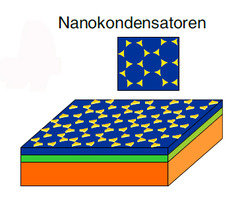
Diagram of a multiferroic material sandwich: The orange-red base carries a green layer of ferromagnetic lanthan strontium manganate (LSMO). Above that is the isolating ferroelectric lead zirconate titanite (PZT) layer. The nano condensers are closed by ferromagnetic cobalt electrodes. They get their shape from correspondingly structured shadow masks. In reality, the PZT layer is considerably thinner than the LSMO layer; it is barely three nanometres thick.
© Marin Alexe / MPI of Microstructure Physics

Better understanding to pave the way for spintronics

“As a filter that can be simply switched and sort electrons according to their spin direction, the multiferroic tunnel junction could also find use in spintronics,” says Dietrich Hesse. This could be a possible future development of electronics, which is why many physicists around the world are researching its basic principles. Spintronics uses both the charge and spin of the electrons to process data with a higher density than is possible in conventional electronics.

In order to advance the multiferroic material sandwich as a spin filter, physicists are first striving to understand precisely how a change of the PZT’s electric polarisation direction affects the magnetic tunnel resistance. Up to now, they only know the details of what happens in the case of the electric polarisation direction that goes hand in hand with the normal tunnel magnetoresistance. “We are unable as yet to explain exactly why the inverted tunnel magnetoresistance appears when the polarisation direction is reversed,” comments Dietrich Hesse. One reason could be the interaction between the ferromagnetic cobalt and the adjoining titan ions in the PZT. The latter change their position with the polarisation direction. When they get closer to the cobalt layer, they take on their own magnetic momentum on account of the intensive interaction. This magnetic momentum affects the spin direction of the tunnelling electrons.

To explain this connection in detail, Dietrich Hesse and Marin Alexe asked theoretical physicists at the Institute and at the University of Halle for help. They will now calculate the magnetoelectric coupling due to the interaction between the titan ions of the PZT and the cobalt. However, the help of Dietrich Hesse’s and Marin Alexe’s team is still needed to draw a better comparison between the results of this calculation and the experiments. They are currently trying to steam the cobalt cover of their multiferroic material sandwich with a structure that is as regular as that of the other two layers. “Only if we understand exactly how the magnetoelectric coupling works in multiferroic tunnel junctions can we also use it for electronic applications.”

Source: Max-Planck-Gesellschaft

Thursday, March 1, 2012

Generating electricity from vibrations in road surface works

Engineerblogger
March 1, 2012


Credit: University of Twente

A pilot research project into vibration energy on the N34 provincial motorway near Hardenberg in the eastern Netherlands has shown that vibration energy as a local energy source is a sustainable alternative for the batteries of roadside sensors and other applications. The trial project has provided valuable insights into this innovative form of energy production.

In the autumn of 2011, a piezoelectric material that converts vibrations from passing vehicles into energy was applied to the surface of the N34 motorway. The piezoelectric material was applied to the road surface in a rural area where the speed limit is 100 km per hour. The aim of the pilot project was to investigate the feasibility of piezo technology in road construction. The research was carried out by the Tauw advice and engineering agency and the University of Twente in partnership with the Dutch province of Overijssel.

The aim of the pilot project was to establish whether electrical energy can be generated from traffic vibrations using piezoelectric material and, if so, how much energy can be generated. The trial system was tested in various weather conditions between October and December 2011. A measurement device was used to continually monitor the system and collect data.

Results
Tauw and the University of Twente have concluded that energy can indeed be generated using piezoelectric material in the road surface. The amount of energy generated depends on the number of passing vehicles and the number of piezo elements in the road. Vehicles that are moving more slowly appear to generate slightly more energy than faster-moving vehicles, but further research is needed to confirm this.

The amount of energy generated during the pilot project was too small to be used for traffic lights or street lighting, but it was enough for devices that need less energy, such as wireless motion sensors, which detect vehicles and send a signal to, for example, traffic lights. Currently these are mainly powered by batteries or solar panels. Vibration energy is a sustainable alternative for these power sources.

The project partners also concluded that integrating piezo elements in an existing road surface is problematic. For the pilot research, a narrow groove was cut into the road and a steel housing containing the piezo elements was fitted into it. Ultimately it turned out that the housing was not strong enough to withstand the forces of the passing traffic, and it came loose in December. This did not cause a traffic hazard, but it did mean that the research ended a few weeks earlier than planned.

Applications
The project partners are hopeful about other applications. Project leader Simon Bos says: “The application of vibration energy in existing roads did turn out to be difficult, but we do see possibilities for existing and new bridges and viaducts, for example at expansion joints. Of course further research into a good, strong design has to be carried out before this can be applied on a large scale.”

Next steps
Following the pilot project, various interested parties have contacted Tauw and the University of Twente to carry out further research into vibration energy. Piezo elements can not only be fitted under bridges and viaducts, but also under concrete road slabs and speed bumps, or alongside railway lines or water drainage channels. The application of piezo elements beneath concrete slabs is at an advanced stage, while the other possible applications are still in the research phase.

Source: University of Twente

Material Flow and Logistics technology: Swarming and transporting

Engineerblogger
March 1, 2012


The autonomous transporters perform their work in a swarm.  Source:  Fraunhofer IML

On its own, an ant is not particularly clever. But in a community, the insects can solve complicated tasks. Researchers intend to put this „swarm intelligence“ to use in the logistics field. Lots of autonomous transport shuttles would provide an alternative to traditional materials-handling technology.

The orange-colored vehicle begins moving with a quiet whirr. Soon afterwards the next shuttles begin to move, and before long there are dozens of mini-transporters rolling around in the hall. As if by magic, they head for the high-rack storage shelves or spin around their own axis. But the Multishuttle Moves® – is the name given to these driverless transport vehicles – are not performing some robots‘ ballet. They are moving around in the service of science. At the Fraunhofer Institute for Material Flow and Logistics IML in Dortmund, Germany, researchers are working to harness swarm intelligence as a means of improving the flow of materials and goods in the warehouse environment. In a research hall 1000 square meters in size, the scientists have replicated a small-scale distribution warehouse with storage shelves for 600 small-part carriers and eight picking stations. The heart of the testing facility is a swarm of 50 autonomous vehicles. “In the future, transport systems should be able to perform all of these tasks autonomously, from removal from storage at the shelf to delivery to a picking station. This will provide an alternative to conventional materials-handling solutions,“ explains Prof. Dr. Michael ten Hompel, executive director at IML.

But how do the vehicles know what they should transport, and where, and which of the 50 shuttles will take on any particular order? “The driverless transport vehicles are locally controlled. The ›intelligence‹ is in the transporters themselves,“ Dipl.-Ing. Thomas Albrecht, head of the Autonomous Transport Systems department explains the researchers‘ solution approach. “We rely on agent-based software and use ant algorithms based on the work of Marco Dorigo. These are methods of combinational optimization based on the model behavior of real ants in their search for food.“ When an order is received, the shuttles are informed of this through a software agent. They then coordinate with one another via WLAN to determine which shuttle can take over the load. The job goes to whichever free transport system is closest.

The shuttles are completely unimpeded as they navigate throughout the space – with no guidelines. Their integrated localization and navigation technology make this possible. The vehicles have a newly developed, hybrid sensor concept with signal-based location capability, distance and acceleration sensors and laser scanners. This way, the vehicles can compute the shortest route to any destination. The sensors also help prevent collisions.

The vehicles are based on the components of the shelf-bound Multishuttle already successfully in use for several years. The researchers at IML have worked with colleagues at Dematic to develop the system further. The special feature about the Multishuttle Move®: the transporters can navigate in the storage area and in the hall. To accomplish this, the shuttles are fitted with an additional floor running gear. But what benefits do these autonomous transporters offer compared with conventional steady materials-handling technology with roller tracks? “The system is considerably more flexible and scalable,“ Albrecht points out. It can grow or contract depending on the needs at hand. This is how system performance can be adapted to seasonal and daily fluctuation. Another benefit: It considerably shortens transportation paths. In conventional storage facilities, materials-handling equipment obstructs the area between high-rack storage and picking stations. Packages must travel two to three times farther than the direct route. “It also makes shelf-control units and steady materials-handling technology,“ Albrecht adds. Researchers are now trying to determine how these autonomous transporters can improve intralogistics. “We want to demonstrate that cellular materials-handling technology makes sense not only technically but also economically as an alternative to classic materials-handling technology and shelf-control units,“ institute executive director ten Hompel observes. If this succeeds, the autonomous vehicles could soon be going into service in warehouses.

Source: Fraunhofer-Gesellschaft

Materials: Building lightweight trains

Engineerblogger
March 1, 2012


These diesel trains for housing is manufactured from a light polyurethane-based material, yet extremely durable. Source:  Fraunhofer ICT

The less trains weigh, the more economical they are to run. A new material capable of withstanding even extreme stresses has now been developed. It is suitable for a variety of applications, not least diesel engine housings on trains – and it makes these components over 35 percent lighter than their steel and aluminum counterparts.

In their efforts to render cars and trains more economical, manufacturers are trying to find lighter materials to replace those currently used. But there is a problem: Lighter materials tend not to be as tough as steel or aluminum, so they cannot simply be used in place of these metals. Rather, it is a question of manufacturers deciding which components can really afford to have weight shaved off and how to integrate them into the overall systems.

Working together with Bombardier GmbH, KraussMaffei Kunststofftechnik GmbH, Bayer MaterialScience AG, DECS GmbH, the DLR’s Institute for Vehicle Concepts, the University of Stuttgart and the Karlsruhe Institute for Technology, researchers at the Fraunhofer Institute for Chemical Technology ICT in Pfinztal have now developed a polyurethane-based sandwich material that is extremely resilient. “To demonstrate the material, we manufactured a component that is subject to significant stresses and which has to fulfill a number of requirements – the diesel engine housing for a train,” says Jan Kuppinger, a scientist at the ICT. This housing is located beneath the passenger compartment, i.e. between the car and the tracks. Not only does it shield the engine against flying stones and protect the environment from any oil that might escape, but in the event of a fire, it also stops the flames from spreading, thus meeting the flame retardant and fire safety standards for railway vehicles. Kuppinger adds: “By using this new material, we can reduce the component’s weight by over 35 percent – and cut costs by 30 percent.”

The researchers opted for a sandwich construction to ensure component stability: Glass fiber reinforced polyurethane layers form the outer facings, while the core is made of paper honeycomb. Polyurethane is a bulk plastic combining two substances. Since it can be adapted to fulfill various requirements, it is referred to as a ‘customizable material’. In foamed form it is soft, and can be used for example as a material for mattresses; in compact form it is strong and hard. The researchers began by incorporating various additives into their polyurethane, altering it in such a way as to ensure it would meet fire safety standards. Then, the partners optimized the standard manufacturing process, fiber spraying, by developing a mixing chamber which allows even more complex structures to be produced in any required size. The diesel engine housing they made is approximately 4.5 meters long and more than 2 meters wide. “This is the first time it has proved possible to use this process to manufacture such a large and complex component that also satisfies the structural requirements,” states Kuppinger. Previously, one problem encountered with fiber spraying was that it was impossible to determine the precise thickness of the polyurethane top layers. But now the researchers have found a way to do this, using computer tomography to inspect the manufactured layers and then applying a specially-adapted evaluation routine to establish their exact thickness. This information helps to simulate the strength of the component, as well as its ability to withstand stresses.

The scientists produced their diesel engine housing demonstrator as part of the PURtrain project, which is funded by the German Federal Ministry of Education and Research (BMBF). The demonstrator passed its first strength test – in which the scientists placed it in a test rig and then applied forces to it at various locations, measuring the extent to which it deformed – with flying colors. In the next stage, the researchers want to trial the component in a proper field test. If that, too, proves successful, it will then be possible to use the material to make roof segments, side flaps and wind deflectors for the automobile and commercial vehicle industry, and to ramp up the manufacturing process to produce medium volumes of between 250 and 30,000 units.

Source: Fraunhofer-Gesellschaft

Monday, February 27, 2012

New energy storage device based on water: Solution for increasing energy demand

Engineerblogger
Feb 27, 2012


Semiconductor and Energy Conversion”-group (pictured left to right): Alberto Battistel (Ph.D. Student), Dr. Edyta Madej (PostDoc), Dr. Fabio La Mantia (Junior Group Leader), Dr. Jelena Stojadinovic (PostDoc), Mu Fan (Ph.D. Student)

The global energy demand is still increasing. However, today's concepts for power generation aren't able to deliver the amount of electricity, which is needed in the future. Dr. Fabio La Mantia, junior group leader of the “Semiconductor and Energy Conversion”-group (Center for Electrochemical Sciences) of the Ruhr-Universität Bochum, is working on a solution for the problem. In March he and his team are going to start a project, with the ambition to develop an aqueous lithium-ion battery. They want to produce an accumulator, which is working at two volt with a three times decreased cost, compared to conventional ones. The Federal Ministry of Education and Research is going to support the project with 1.424.000 Euro for a duration of five years.

Renewable energies fall short

The current world-wide consumption is predicted by experts to rise up from 13 to 25 terawatt by 2050. Renewable energies are only able to supply ten percent of the need, because they are expensive and not always available in the same extent. This applies especially for solar and wind energy. “Fast and economical systems, to cache the current, are in demand”, explains La Mantia. The idea is to produce batteries, which are appropriate for the application in the power grid.

Higher performance and lifespan

General lithium-ion batteries are based on organic solvents. They are the standard for all portable devices. However, for the use in power supply systems, they are too expensive and unsafe. They overheat too quickly, which can cause short circuits. To improve the performance, lifespan, energy density and the price-performance ratio, the young scientists concentrate themselves on the combination of appropriate materials, separators, cells and aqueous electrolytes (liquid conductor of electricity).

Source: Ruhr-University Bochum

Thursday, February 16, 2012

Gas2 to build next generation plant for liquid hydrocarbon conversion

Engineerblogger
Feb 16, 2012


Scottish gas reforming company Gas2 has secured £5.5 million of funding to further the development of the next generation of gas-to-liquids (GTL) technology including the construction of a pilot reactor plant.

Gas2’s proprietary technology enables the conversion of natural gas to liquid hydrocarbon more economically and cleanly than has previously been possible with conventional large scale GTL technologies.

The company has developed a catalytic ceramic based porous membrane (pMRTM) that is used in its gas reforming (Syngas) reactors and fluid forming (Fischer Tropsch) reactors to create liquid hydrocarbons. This is an alternative technical solution to other developers of small to medium GTL who are using micro-channel technology.

The Gas2 approach is expected to result in considerably lower capital (CAPEX) and operational (OPEX) expenditure and a smaller environmental footprint compared to conventional GTL technologies.

Simmons & Company International Ltd were corporate finance advisors to the fundraising from existing shareholders including Lime Rock Partners LLP, Robert Gordon University and a group of private investors with substantial interests in the oil, gas and hydrocarbons processing industries

The investment will leverage further funding that will enable the construction of a pilot reactor plant to further test and demonstrate the technology on a 0.4 acre site at the specialist petrochemical research Wilton Centre in Cleveland in the North-east of England, and further laboratory work and computerised modelling in Aberdeen.

The company has recently increased its employee numbers to 16 people in Aberdeen. A further four operative jobs will be created in Wilton as the plant is commissioned. Existing Gas2 staff will work between the pilot plant and the operations in Aberdeen.

Mike Fleming, co founder & managing director of Gas2 said: “We are entering a new and exciting phase with the build of the pilot plant which will validate on a larger scale the commercial viability of the Gas2 process. We have a unique technology and process, and the commercial prize is great for a successful outcome.”

Applications for the Gas2 GTL technology include:
  • stranded gas: transforming the economic viability of smaller, more remote gas reserves as well as shale and unconventional reservoirs;
  • offshore ‘associated’ gas: offering a ‘gas disposal’ solution for unwanted associated gas thereby preventing flaring and enabling the development of remote oilfields where flaring is prohibited and /or gas reinjection wells are expensive or detrimental to reservoir performance;
  • gas conversion to alternative end products including gasoline, diesel, waxes, ammonia, methanol, hydrogen and ethylene for industrial use.

Saad Bagach, managing director of Lime Rock said: “Gas2 has a new technology that has the potential to fundamentally disrupt the gas-to-liquids market. The global demand for new solutions is vast and the ability of Gas2 to secure this level of funding in today’s economic climate is a powerful indicator of confidence in the company and the potential of its technology.”

The pilot plant will be constructed in 2012 with testing underway by the end of the year. The commercialisation phase will commence in 2013. The technology will be commercialised as an integrated GTL system and as standalone Syngas and Fischer Tropsch reactors available on the market.

Source: Gas2

European project investment in nuclear waste recycling

Engineerblogger
Feb 16, 2012


Christian Ekberg Credit:Chalmers University of Technology


With a 9,4 million euro budget, a group of European researchers are collaborating to investigate nuclear fuel manufacturing and recycling for the fourth generation nuclear power systems. The aim is to produce safe fuel that can be 80 per cent recycled, compared to the current 1 per cent. Chalmers University of Technology is in charge of the initiative.

Fourth generation nuclear power systems can lead to a reduction of the amount of high-level, long-lived nuclear waste to a tenth of what it is today, while energy output can increase hundredfold. Many researchers believe the new technology will have a commercial breakthrough within 20 years. Germany is at present the only European country that has decided to phase out nuclear power.

"The technology needed for the fourth generation already exists," says Christian Ekberg, professor and nuclear chemistry research team leader at Chalmers. "What is needed now is for the different parts to be connected. One important aspect involves integrating nuclear waste recycling into the cycle so that nuclear power plants can be built with facilities to recycle waste and produce new nuclear fuel on site."
Christian Ekberg is also the inaugural holder of Stena Metall’s professorship in Industrial Materials Recycling, and is the coordinator of the new research project called Asgard, which has received 5,5 million euro in EU grants. Around 50 European researchers will take part in the project over four years.

"Traditionally, three different groups have worked separately on the fourth generation nuclear power systems: reactor physicists, fuel chemists and separation chemists. The groups will cooperate within the Asgard project to tie their previous findings together. We will also perform research on entirely new reactor fuels that are safer, use resources more effectively and that enable a more comprehensive approach to the waste issue."

Oxides currently dominate among the nuclear fuels that are produced from recycled nuclear waste. One example is MOX fuel. During the course of the Asgard project, researchers will examine other types of chemical compounds with uranium or plutonium. Examples include nitrides and carbides. These chemical compounds are safer to use in reactors, amongst other things because their high melting point and thermal conductivity offer a higher safety margin in terms of a nuclear meltdown.

Researchers will now investigate whether the new fuels' qualities are as positive in terms of recycling and production. At Chalmers – the European university best equipped to perform research on the entire nuclear fuel cycle – researchers will primarily concentrate on nitrides.

"If it is possible to recycle as much as we think, at least 80 per cent of nuclear waste will be possible to recycle," says Christian Ekberg. "This would also mean that eight times as much of the remaining waste could be included in the final repository, since heat generation is reduced. In addition, the amount of long-lived nuclides in residual waste is reduced, which results in a significantly shorter storage period. However, it is important to remember that the final repository is still an important part of the fuel cycle."


Information about the Asgard project
Asgard is a four-year EU project that is addressing new and innovative fuels for nuclear reactors. Of the budgeted 9,4 million euro, 5,5 million euro is being provided by EU grants. The project got started in January and comprises 16 organisations in 10 countries across Europe. In addition to Chalmers, other Swedish participants include the Royal Institute of Technology and Westinghouse.

From an overall financial perspective, the Asgard project is the biggest project ever at Chalmers' largest department, the Department of Chemical and Biological Engineering. Christian Ekberg (professor and Asgard coordinator), Gunnar Skarnemark (professor), Teodora Retegan (PhD) and Emma Aneheim and Marcus Hedberg (doctoral students) are the Chalmers researchers taking part in the project.

Information about the Genius project
The nuclear chemistry research team at Chalmers is also involved in the Swedish Genius cooperation project with the Royal Institute of Technology and Uppsala University. They are working on developing advanced nuclear fuel, performing research on materials for lead cooled reactors and performing safety analyses. The project aims to develop fourth generation nuclear power systems.
Read more about Genius

Source: Chalmers University of Technology

Tuesday, February 14, 2012

Ordered planar polymers created for the first time

Engineerblogger
Feb 14, 2012


The structural difference between chain-like polymers with linear repeat units (blue boxes) and their two-dimensional counterparts with areal repeat units (orange triangles). (Image: Schlüter Research Group / ETH Zurich)


Scientists under the direction of ETH Zurich have created a minor sensation in synthetic chemistry. They succeeded for the first time in producing regularly ordered planar polymers that form a kind of “molecular carpet” on a nanometre scale.

At ETH Zurich in 1920, the chemist Hermann Staudinger postulated the existence of macromolecules consisting of many identical modules strung together like a chain. For this he was initially rewarded with mockery and incomprehension in professional circles. But Staudinger was to be proved right: today the macromolecules described as polymers are known as plastics, and by 1950 one kilogram of them was already being produced per capita worldwide.

Today, more than ninety years after Staudinger’s discovery – for which the chemist was honoured with the Nobel Prize in 1953 – about 150 million tons of plastics are manufactured every year. A gigantic industry developed, without whose products our daily life is no longer imaginable.

A research group led by Professor A. Dieter Schlüter and Senior Lecturer Junji Sakamoto at the Polymers Institute of ETH Zurich has now succeeded in making a decisive breakthrough in the synthetic chemistry of polymers: they have created two-dimensional polymers for the first time.

Intensive discussions led to success

Polymers are formed when small single molecules known as monomers join together by chemical reactions like the links of a chain to form high molecular weight substances. Since qualifying as a lecturer, Schlüter was already occupied by the question of whether polymers can only polymerise linearly. Although graphene counts as a natural representative of a two-dimensional polymer – the carbon atoms in graphene form a honeycomb-like pattern through triple bonds – it cannot be synthesised in a controlled way.

Nevertheless, he said, if it is possible to produce giant molecules “one-dimensionally” from monomers, or for example molecules in pharmacology that are so small that they are practically “zero-dimensional”, why then should it not be possible to develop a synthetic chemistry that generates two-dimensional molecules? When Schlüter and Sakamoto met at ETH Zurich a few years ago, they discussed this topic intensively and together they looked for answers.

The crux of the matter was to create oligofunctional monomers in such a way that they join together purely two-dimensionally instead of linearly or even three-dimensionally. Polymers of this kind must have three or more covalent bonds between the regularly repeating units. The scientists had to find out which bonding chemistry and environment was most suitable for producing this kind of “molecular carpet”.

After intensive analyses of previous studies and the possible ways of generating two-dimensional polymers synthetically, they considered the synthesis at a water-air interface or in a single crystal, i.e. a crystal with a homogeneous layer lattice.

The researchers decided in favour of the second alternative: the doctoral student Patrick Kissel successfully used this to crystallise special monomers which he had prepared into layered hexagonal single crystals. For this he generated photochemically sensitive molecules for which such an arrangement is energetically optimum. When irradiated with light with a wavelength of 470 nanometres, the monomers polymerised in all the layers.

Sheet-like polymers with regular structures

After this the researchers boiled the crystal in a suitable solvent to separate the individual layers from one another. Each layer represents a two-dimensional polymer. The fact that the team really had succeeded in producing sheet-like polymers with regular structures was shown by special studies in an electron microscope carried out by Empa researcher Rolf Erni and Marta Rossell from ETH Zurich at the Empa (Swiss Federal Laboratories for Materials Science and Technology).

The polymerisation method that was developed is so gentle that all the monomer’s functional groups are also preserved at defined positions in the polymer. The researchers have complete structural control over the monomers in a way that would never be possible with graphene, for example, because that process would need to be carried out at enormously high temperatures. Sakamoto says, “Our synthetically manufactured polymers are not conductive like graphene, but on the other hand we would be able to use them for example to filter the tiniest molecules.”

In fact there are small defined holes with a diameter in the sub-nanometre range in the regularly arranged polymers. Moreover, tiny hexagons in the polymers, formed by benzene rings with three ester groups, can be removed by a simple hydrolytic process. This would form a “sieve” with an ordered structure suitable for the selective filtration of molecules.

Unresearched physics

However, before the researchers can think about practical applications, the task now is to characterise the material’s properties. According to Schlüter, this is mainly a job for the physicists. One of the exciting questions in this respect will be how a two-dimensional polymer behaves compared to a linear polymer, for which a good physical and technological understanding is available. Schlüter assumes that two-dimensional polymers could have a different physics and will therefore also find different applications.

He mentions the property of “elasticity” as an example: intertwined linear polymers enable a stretched rubber band to snap back as soon as it is released. But because flat sheets can hardly entangle together, this would probably not work with planar polymers. However, the researchers must first of all find a way to produce larger amounts and even larger sheet sizes.

The size of the crystals is currently only 50 micrometres. Sakamoto stresses that “those, however, are already enormous degrees of polymerisation at a molecular level.”


Source: ETH Zurich

Thursday, February 9, 2012

A 3D Printed Jawbone: Woman received an unusual implant

Engineerblogger
Feb 9, 2012


A computer model of the fitted 3D-printed jaw is shown next to an image of the manufactured part.  Credit BBC

I’ll set aside, for the moment, the question of whether 3-D printing can revolutionize manufacturing--a topic that Christopher Mims and Tim Maly have already taken up quite effectively in these web pages--and instead point my finger again to one incontrovertible fact: that the technology is yielding incredibly interesting applications. The latest? An 83-year-old Dutch woman has received a 3-D printed lower jaw.

This happened back in June, but was only announced now; the University of Hasselt in Belgium calls it (somewhat grandiosely) “a world première.” In June, the woman presented with a terrible infection of the lower jaw, or mandible, forcing doctors to surgically remove it. Traditionally, such a patient would simply have to endure life without a proper mandible, or perhaps submit to “complex microsurgical reconstruction” (more or less out of the question for an 83-year-old). And so her team of doctors decided it was time to try something new: a 3-D printed implant.

The implant was a coproduction of sorts, involving researchers from Hasselt, several other colleges, a Dutch company called Xilloc Medical (which handled the 3-D design), and another one called LayerWise (which managed the production).

The implant took just a few hours to print, according to the BBC, with a laser beam melting thin layers of titanium powder, one on top of the other. Thousands of layers were necessary to build the jawbone (33 layers translate to about 1 mm of height). The printed jaw then got a bioceramic coating, and was surgically attached to the woman in about four hours. Old-school reconstructive surgery would have taken 20 hours.

After just a day, the woman was talking and swallowing, and she was able to leave the hospital after four days. Her new jaw weighed about a third heavier than her old one, said the doctors, though they claim that won’t be too difficult to adjust to. Further surgery is planned to remove healing implants and to insert screw-in teeth.

A considerable amount of big talk accompanied the announcement--though admittedly, it seems that much of it was earned. The Hasselt surgeon who performed the operation, Jules Poukens, likened it to the first steps on the moon. “Doctors and engineers together around the design computer and the operation table: that’s what we call being truly innovative,” he also said.

This team was not the first to envision potentially transformative effects of 3-D printing on medicine. Surgeon Anthony Atala recently gave a TED talk on “printing a human kidney.” He’s already made some early prototypes.

But Ruben Wauthle, the medical applications engineer of LayerWise, cautioned to the BBC that we weren’t ready to print biomaterial just yet. “To print organic tissue and bone you would need organic material as your 'ink,’” he said. “Technically it could be possible - but there is still a long way to go before we're there.”

Source: Technology Review

Wednesday, February 8, 2012

Scientists 'record' magnetic breakthrough

Engineerblogger
Feb 8, 2012


Experimental images showing the repeated deterministic switching of nano islands. Initially the two nano islands have different magnetic orientation (black and white respectively). After the application of a single pulse, the magnetic direction of both islands changes. Further pulses repeat the process, switching the magnetic state back and forth.  Credit: Johan Mentink and Alexey Kimel, Radboud University Nijmegen; Richard Evans, University of York

An international team of scientists has demonstrated a revolutionary new way of magnetic recording which will allow information to be processed hundreds of times faster than by current hard drive technology.

The researchers found they could record information using only heat – a previously unimaginable scenario. They believe this discovery will not only make future magnetic recording devices faster, but more energy-efficient too.

The results of the research, which was led by the University of York’s Department of Physics, are reported in the February edition of Nature Communications.

York physicist Thomas Ostler said: “Instead of using a magnetic field to record information on a magnetic medium, we harnessed much stronger internal forces and recorded information using only heat. This revolutionary method allows the recording of Terabytes (thousands of Gigabytes) of information per second, hundreds of times faster than present hard drive technology. As there is no need for a magnetic field, there is also less energy consumption.”

The multinational team of scientists included researchers from Spain, Switzerland, Ukraine, Russia, Japan and the Netherlands. Experimental work was carried out at the Paul Scherrer Institut in Switzerland, the Ioffe Physical Technical Institute of the Russian Academy of Sciences and Radboud University Nijmegen, Netherlands.

Dr Alexey Kimel, from the Institute of Molecules and Materials, Radboud University Nijmegen, said: “For centuries it has been believed that heat can only destroy the magnetic order. Now we have successfully demonstrated that it can, in fact, be a sufficient stimulus for recording information on a magnetic medium.”

Modern magnetic recording technology employs the principle that the North pole of a magnet is attracted to the South pole of another and two like poles repulse. Until now it has been believed that in order to record one bit of information – by inverting the poles of a magnet – there was a need to apply an external magnetic field. The stronger the applied field, the faster the recording of a magnetic bit of information.

However, the team of scientists has demonstrated that the positions of both the North and South poles of a magnet can be inverted by an ultrashort heat pulse, harnessing the power of much stronger internal forces of magnetic media.

Source: University of York

Additional Information:
Design of new, highly efficient catalysts: Bronze-Matryoshka, the metal in the metal in the metal

Engineerblogger
Feb 8, 2012


Metal cluster built up like a Russian matryoshka


A doll in a doll, and then one more, enveloping them from the outside – this is how Thomas Faessler explains his molecule. He packs one atom in a cage within an atom framework. With their large surfaces these structures can serve as highly efficient catalysts. Just like in the Russian wooden toy, a hull of twelve copper atoms encases a single tin atom. This hull is, in turn, enveloped by 20 further tin atoms. Professor Faessler’s work group at the Institute of Inorganic Chemistry at the Technische Universitaet Muenchen (TUM) was the first to generate these spatial structures built up in three layers as isolated metal clusters in bronze alloys.

Particularly fascinating are the images the researchers use to explain these chemical compounds and their properties. In the laboratory the substance is an unimpressive, fine, grayish-black powder, yet the structure models are in color and in various nested shapes. These powders, with their large surfaces, are interesting as an interim step for catalysts that transfer hydrogen, for instance. Similar structures made of silicon could be used in solar cells to capture light from the sun more effectively.

Most people view metals as uniform materials with a rather unspectacular structure. The metal compounds from Faessler’s institute are quite the opposite. His desk is piled high with various multicolored cage models with yellow spheres representing copper atoms and blue ones for tin. The analogy to the carbon spheres that caused a sensation as Buckyballs can not be overlooked. Here, too, there are geometric structures made up of triangles, pentagons and hexagons. However, they are not made of carbon: heavier metals such as tin and lead can also form such isolated cage structures.

“We are basically interested in alloy structures that are out of the ordinary,” says Faessler. Bronze, for example: this mixture of copper and tin, which was discovered early on and lent its name to an entire age of humanity, has a crystalline structure; the atoms of the two components are distributed evenly throughout the entire crystal and are densely packed together.

The new bronzes from the Faessler laboratory are different. The PhD candidate Saskia Stegmaier melted a particularly pure form of copper wire and tin granulate under special conditions – protected from air and moisture in an argon atmosphere. The bronze produced in this manner was then sealed into an alkali metal such as potassium in an ampoule made of tantalum. The melting point of tantalum is 3,000 degrees Celsius, making it particularly well suited as a vessel for binging other metals into contact with each other.

This is how the new metal clusters, nested inside each other just like the Russian doll, came into existence. When bronze is heated, together with potassium or sodium, to 600 to 800 degrees Celsius, the alkali metals act like scissors that cut up the alloy grid and then edge their way between the pieces, thereby stabilizing the isolated atomic clusters. On their own, these clusters cannot organize themselves into dense, uniformly structured layers to form crystals. They are made up of pentagons with 20 tin atoms in all – a constellation in which repetitive patterns are not possible under normal conditions. But “cheating” a little and using potassium atoms as glue can produce a seemingly normal crystal. Last year the Israeli scientist Dan Shechtman received the Nobel Prize for chemistry for the discovery of a similar phenomenon – the so-called quasi-crystals with five-fold symmetry.

“Our clusters are small units. They are, so to speak, piles of atoms that are not connected to their neighbors.” That makes them ideal for catalytic applications: “Because they are consistent in size,” explains Faessler, “they are much better at steering chemical reactions than classical catalysts.” Hydration reactions in which hydrogen atoms dock to organic molecule chains with oxygen atoms, e.g. in the synthesis of artificial flavors, are examples of such processes. Typically, expensive precious metals like rhodium are used for this. However, novel polar alloys with magnesium, cobalt and tin can serve the same purpose. “What we need for an efficient reaction is a catalyst with very large surface area.” The classical method of achieving this is to mix solutions of two metal salts to precipitate extremely small nanoparticles. “This results in an entire spectrum of particle sizes,” explains Faessler. With metal clusters we can tailor the catalyst to our needs, as it were.”


However, Stegmaier’s and Faessler’s reaction vessel contained more surprises. Aside from the clusters, the scientists noticed a fiber-like material – like thin needles – whose ends could be bent a little. “We suspected,” says Stegmaier, “this could turn out to be exiting.” In the meantime the yield of the fibers has been improved by using sodium as scissors to cut up the bronze. This time the result was not spheres, but multilayered rods. In the middle is a string of tin atoms, surrounded by a layer of copper atoms, and around that yet another tube of tin atoms. Just as the hollow Matryoshka molecules are reminiscent of Buckyballs, the new fibers with their tubes are akin to carbon nanotubes. Analogously, such fibers could one day be used as molecular wires with various electrical properties.

Source:  Technische Universitaet Muenchen (TUM)

Additional Information:

  • A Bronze Matryoshka – The Discrete Intermetalloid Cluster [Sn@Cu12@Sn20]12– in the Ternary Phases A12Cu12Sn21 (A = Na, K) S. Stegmaier, T. F. Fässler J. Am. Chem. Soc. 2011, 133, 19758–19768 – DOI: 10.1021/ja205934p
  • Na2.8Cu5Sn5.6 – A Crystalline Alloy Featuring Intermetalloid 1∞{Sn0.6@Cu5@Sn5} Double-Wall Nano Rods with Five-Fold Symmetry S. Stegmaier, T. F. Fässler Angew. Chem, Early View Online, 1. Feb. 2012 – DOI: 10.1002/ange.201107985

Monday, February 6, 2012

Harnessing nature’s solar cells: Photovoltaic panels made from plant material could become a cheap, easy alternative to traditional solar cells

Engineerblogger
Feb 5, 2012


Within a few years, people in remote villages in the developing world may be able to make their own solar panels, at low cost, using otherwise worthless agricultural waste as their raw material.

That’s the vision of MIT researcher Andreas Mershin, whose work appears this week in the open-access journal Scientific Reports. The work is an extension of a project begun eight years ago by Shuguang Zhang, a principal research scientist and associate director at MIT’s Center for Biomedical Engineering. Zhang was senior author of the new paper along with Michael Graetzel of Switzerland’s École Polytechnique Fédérale de Lausanne.

In his original work, Zhang was able to enlist a complex of molecules known as photosystem-I (PS-I), the tiny structures within plant cells that carry out photosynthesis. Zhang and colleagues derived the PS-I from plants, stabilized it chemically and formed a layer on a glass substrate that could — like a conventional photovoltaic cell — produce an electric current when exposed to light.

But that early system had some drawbacks. Assembling and stabilizing it required expensive chemicals and sophisticated lab equipment. What’s more, the resulting solar cell was weak: Its efficiency was several orders of magnitude too low to be of any use, meaning it had to be blasted with a high-power laser to produce any current at all.

Now Mershin says the process has been simplified to the point that virtually any lab could replicate it — including college or even high school science labs — allowing researchers around the world to start exploring the process and making further improvements. The new system’s efficiency is 10,000 times greater than in the previous version — although in converting just 0.1 percent of sunlight’s energy to electricity, it still needs to improve another tenfold or so to become useful, he says.

The key to achieving this huge improvement in efficiency, Mershin explains, was finding a way to expose much more of the PS-I complex per surface area of the device to the sun. Zhang’s earlier work simply produced a thin flat layer of the material; Mershin’s inspiration for the new advance was pine trees in a forest.

Mershin, a research scientist in the MIT Center for Bits and Atoms, noticed that while most of the pines had bare trunks and a canopy of branches only at the very top, a few had small branches all the way down the length of the trunk, capturing any sunlight that trickled down from above. He decided to create a microscopic forest on a chip, with PS-I coating his “trees” from top to bottom.

Turning that insight into a practical device took years of work, but in the end Mershin was able to create a tiny forest of zinc oxide (ZnO) nanowires as well as a sponge-like titanium dioxide (TiO2) nanostructure coated with the light-collecting material derived from bacteria. The nanowires not only served as a supporting structure for the material, but also as wires to carry the flow of electrons generated by the molecules down to the supporting layer of material, from which it could be connected to a circuit. “It’s like an electric nanoforest,” he says.

As an bonus, both zinc oxide and titanium dioxide — the main ingredient in many sunscreens — are very good at absorbing ultraviolet light. That’s helpful in this case because ultraviolet tends to damage PS-I, but in these structures that damaging light gets absorbed by the support structure.

Mershin thinks that because he and his colleagues have now lowered the barrier to entry for further work on these materials, progress toward improving their efficiency should be rapid. Ultimately, once the efficiency reaches 1 or 2 percent, he says, that will be good enough to be useful, because the ingredients are so cheap and the processing so simple.

“You can use anything green, even grass clippings” as the raw material, he says — in some cases, waste that people would otherwise pay to have hauled away. While centrifuges were used to concentrate the PS-I molecules, the team has proposed a way to achieve this concentration by using inexpensive membranes for filtration. No special laboratory conditions are needed, Mershin says: “It can be very dirty and it still works, because of the way nature has designed it. Nature works in dirty environments — it’s the result of billions of experiments over billions of years.”

Because the system is so cheap and simple, he hopes this will become a “way of getting low-tech electricity to people who have never been thought of as consumers or producers of solar-power technology.” He hopes the instructions for making a solar cell will be simple enough to be reduced to “one sheet of cartoon instructions, with no words.” The only ingredient to be purchased would be chemicals to stabilize the PS-I molecules, which could be packaged inexpensively in a plastic bag.

Essentially, Mershin says, within a few years a villager in a remote, off-grid location could “take that bag, mix it with anything green and paint it on the roof” to start producing power, which could then charge cellphones or lanterns. Today, the most widely used source of lighting in such locations is kerosene lanterns — “the most expensive, most unhealthy” form of lighting there is, he says. “Nighttime illumination is the number one way to get out of poverty,” he adds, because it enables people who work in the fields all day to read at night and get an education.

Babak Parviz, an associate professor of electrical engineering at the University of Washington who specializes in bionanotechnology, says this is “a very exciting paper and a very nice step toward integrating biomolecules for building solar cells. This shows a very promising and creative first step toward building organic photovoltaic cells that can use biologically (naturally) produced cores.” He adds that while the present system still needs further development, “further work in the field can perhaps improve the stability and performance of these devices.”

The research was funded in part by an unrestricted grant from Intel Corp., and also included researchers at the University of Tennessee.

Source: MIT News

Saudi Aramco develops fuel formula to cut gas engines’ CO2 emissions

Engineerblogger
Feb 5, 2012


Credit: Saudi Aramco

A team from Saudi Aramco’s Research & Development Center (R&DC) and FEV, an engine design company in Germany, recently participated in a technology demonstration event in Aachen, Germany. The event marked the culmination of a project that was developed as a means of showcasing the potential of specific fuel formulas in lowering the carbon dioxide (CO2) emissions in modern gasoline engines.


The scientists of R&DC’s Fuel Team chose an innovative approach in fuel development by not working on future fuels in isolation, but rather looking at the fuel and the engine as a single system to be optimized synergistically. For the purpose of this research, R&DC has partnered with FEV, which brought the engine testing expertise to the table.

“The joint research has resulted in experimental fuels that enable future engines to be even smaller and capable of running on higher boosting pressures, without compromising performance,” said Faisal M. Al-Faqeer, manager of R&DC. “The greatest achievement though is that this fuel/engine combination consumes significantly less fuel per kilometer travelled and consequently will emit less CO2, while it is expected that it will not increase the cost of motoring.”

During the event, the first prototype car using this fuel/engine concept was presented by the project scientists. Members of the management of R&DC and FEV were able to get firsthand experience by driving a car fueled by Saudi Aramco’s new experimental fuel. “FEV’s own test track provided the ideal environment for such a test, where driving patterns from city cruising to high speed motorway travel could be realized in a safe and controlled way,” said Amer A. Amer, Fuel Technology R&D Team leader.

The experience showed that this future fuel concept could be achieved without compromising car performance. The car was driven with the experimental fuel, showing that this new crude oil-based product developed by Saudi Aramco is compatible with existing engine technology. For R&DC, this marks the first step toward becoming a leading force in research and development of future fuels for transportation.

“As a next step, the Saudi Aramco team has started to assess implications from producing such fuels, looking at energy needs and consequently the CO2 footprint of manufacturing and associated cost,” said Amer.

Al-Faqeer commented on the unique approach adopted by R&DC in taking research on future fuels as “a system approach in cooperation with a competent partner from the field of engine research and development.” He continued “this has proven to be very successful, demonstrating the potential benefit, both in terms of CO2 reduction and potential cost.”

The skills of Saudi Aramco’s scientists complement perfectly those of their FEV counterparts. The teams have now set their sights on another challenge for the coming year: focusing on demonstration of economic and ecological benefits in a diesel type fuel/engine system.

Source: Saudi Aramco

Friday, February 3, 2012

New zeolite material may solve diesel shortage

Engineerblogger
Feb 3, 2012

The microporous molecular structure of a zeolite, ZSM-5. Credit: Wikipedia

A recently published article in Nature Chemistry by a research team at Stockholm University and the Polytechnic University of Valencia in Spain presents a new porous material that evinces unique properties for converting gasoline directly into diesel

World fuel consumption is shifting more and more to diesel at the expense of gasoline. A recently published article in Nature Chemistry by a research team at Stockholm University and the Polytechnic University of Valencia in Spain presents a new porous material that evinces unique properties for converting gasoline directly into diesel. The material has a tremendously complex atomic structure that could only be determined with the aid of transmission electron microscopy.

The aluminosilicate, which has been named ITQ-39, belongs to the zeolite class and has a porous structure that enables sufficiently small molecules to pass through it. On their way through, they can react with other molecules and create a desired product. The new material has channels of varying size and shape in different directions. These variously shaped channels entail that a molecule that is transported inside the material can be limited in different ways, depending on the direction it travels.

ITQ-39 is the most complex zeolite material ever discovered. Its structure was determined by a research team at Stockholm University headed by Professor Xiaodong Zou, with the help of electron crystallography. On an electron microscope, extremely small crystals can be studied, in this case down to a couple of nanometers. What makes ITQ-39 such a complicated material is that, unlike most other crystalline material, it is not perfectly ordered. The material studied has a type of chaotic order. To be able to understand the material in the smallest detail requires both a model of how the atoms are arranged in the minimal ordered areas and a model of how these domains are then linked together into crystals. This disorder can be studied with the aid of high-resolution images taken with an electron microscope that can then serve as a basis for creating a model of the atomic structure of the material. This is what researchers Tom Willhammar, Junliang Sun, Wan Wei, Peter Oleynikov, Daliang Zhang, and Xiaodong Zou at Stockholm University present in the latest issue of the scientific journal Nature Chemistry.

The material, which was produced by a research team headed by Professor Avelino Corma in the Polytechnic University of Valencia, has proven to be an excellent catalytic converter for turning gasoline into diesel. This is a process that has become ever more important with the marked growth in the demand for diesel in recent years.

The project is funded by the Swedish Research Council, VINNOVA, the Göran Gustafsson Foundation, and the Knut and Alice Wallenberg Foundation.

Facts about zeolites:

Zeolite means 'boiling stone' in Greek. Zeolite is a collective name for a group of natural and synthetic minerals with an open crystal structure. They mainly consist of aluminum silicate and comprise some 60 naturally occurring minerals and about a hundred synthetic counterparts.

Zeolites contain masses of nanometer-sized pores and channels and can be used as catalytic converters, ion-exchangers, and adsorbents. Because zeolites have so many pores and intersecting channels, they have a huge internal surface area; one gram of a zeolite can have a surface about the size of half a football field.

Source: Eurek Alert

Additional Information:
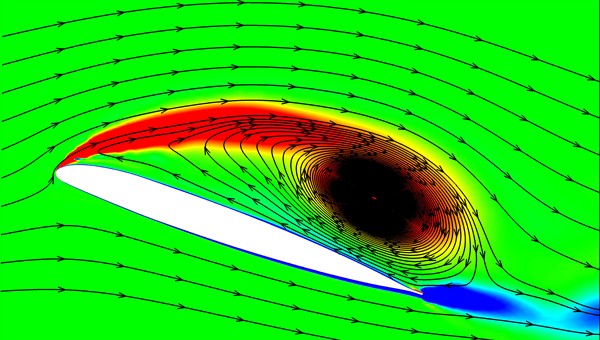
Scratching away at automotive surfaces: Characterising new materials and coatings for clean and easy-to-maintain surfaces

Engineerblogger
Feb 3, 2012


Stephanie Baron and Gerard Liraut of Renault presented a paper at the 2011 VDI plastics in automotive conference on characterising new materials and coatings for clean and easy-to-maintain surfaces. They addressed issues of maintaining high gloss, avoiding dust attraction and ongoing concerns over visibility of scratches on through-coloured automotive interior mouldings.

Baron pointed out that while PP compounds are considered materials with good cost performance and recyclability, talc fillers in PP are still thought to cause scratches to become visible, with white marks that are especially noticable on dark mouldings.

"Some competitors use materials improved by sliding agents," Baron said. "But a known inconvenience is that this kind of agent with a base of amides exudes with heat and creates a sticky effect." Baron did, however, admit that some improved additives are available that are said to have resolved this problem of migration to the surface.

Similarly with dust attraction, some of Renault's competitors are using additives with anti-static action. But a sticky effect is generated here, too, as UV agents and anti-static agents interact in the presence of air.

And in order to have permanent anti-dust effects, the concentration of additive needed is so high that "the prices increase and mechanical properties decline", Baron complained. She pointed out that Asian automotive OEMs have found an easy solution by making their interiors in light colours, so that the dust - or scratches for that matter - is not so visible.

Renault, on the other hand, has tested permanent anti-static additives, only to find that the plastics tested were just as dirty as other parts after nine months. A more durable anti-static effect or one that could be reactivated would therefore be of interest to Renault.

Looking ahead, Renault seeks to make interior plastic parts with anti-adherent hydrophobic and oleophobic surfaces, to limit soiling. Otherwise, adapting the architecture of the cockpit for easy, simple and efficient cleaning would be at least "an important preliminary step", Baron concluded.

One of the latest measures to address scratch visibility has been applied by Styron for the UV-stable PP-based Inspire compounds used on the new Range Rover Evoque. The compounds are used in interior parts such as the shrouds around the steering column, centre console cladding and trim panels in the rear load space compartment.

Source: European Plastics News

Wednesday, February 1, 2012

Helicopters set to become more manoeuvrable - using humpback whales as the prototype

Engineerblogger
Feb 1, 2012
Photomontage of a humpback whale and the DLR helicopter Bo 105. Credit: DLR/istockphoto.com/Josh Friedmann


Modern helicopters could be significantly faster and more manoeuvrable - if aerodynamics did not impose limitations on them. Researchers at the German Aerospace Center (Deutsches Zentrum für Luft- und Raumfahrt; DLR) in Göttingen have now discovered and flight-tested a way to increase manoeuvrability using an idea they got from observing humpback whales.

Unwanted turbulence

Helicopters owe their special ability to vertically take off and land to their main rotor, but this also contributes to aerodynamic disadvantages. The airflow over a backward-moving main rotor blade separating from the aerofoil during fast forward flight or manoeuvring, referred to as a 'dynamic stall', creates turbulence, loss of lift and exerts large forces on the rotor. Drag increases and the rotor head control rods are subjected to large dynamic loads. "This limits the top speed of helicopters at high altitude and, in particular, their manoeuvrability," explains Kai Richter from the DLR Institute of Aerodynamics and Flow Technology in Göttingen. In addition, the resulting vibration compromises passenger comfort. Modern engines would be able to deliver significantly better flight performance were it not for these limitations. "Stalling is one of the most serious problems in helicopter aerodynamics – and one of the most complex," says Richter. Generating a computer simulation of a moving rotor is significantly more complicated than modelling a fixed-wing aircraft.


A computer simulation shows turbulence around a rotor blade when the airflow separates from the aerofoil. This phenomenon, referred to as a 'dynamic stall', occurs on a backward-moving main rotor blade during fast forward flight or manoeuvring.  Credit: DLR

Acrobatic marine mammals

When looking for ways to delay the onset of stalling in helicopters, researchers at Göttingen struck gold with humpback whales - which is somewhat surprising at first glance. "These marine mammals are renowned for their great speed and acrobatic skills," says Holger Mai from the DLR Institute of Aeroelasticity. This is due to their unusually large pectoral fins, which have characteristic bumps along the front edge. "Research has shown that these bumps cause stalling to occur significantly later underwater and increase buoyancy."

DLR researchers translated the idea of using bumps for delaying the onset of stalling to helicopter rotors, and patented it as Leading-Edge Vortex Generators (LEVoGs) "Flow phenomena in water are similar to those in air; they just need to be scaled accordingly," says Mai. The artificial bumps on helicopters are smaller than those on a humpback whale; they have a diameter of six millimetres and weigh just 0.04 grams.

Experiments conducted in the wind tunnel were promising, enabling a test flight using the DLR Bo 105 research helicopter in Braunschweig to be successfully carried out, as part of the DLR SIMCOS (Advanced Simulation and Control of Dynamic Stall) project. 186 rubber LEVoGs were glued to each of the helicopter’s four rotor blades.

"The pilots have already noticed a difference in the behaviour of the rotor blades," says Richter. The main objective of the initial test flight was to demonstrate the safety of this new technique. "The next step is a flight using special measuring equipment to accurately record the effects," Richter explains.

If the concept proves successful, DLR researchers hope that existing helicopters could be retrofitted at little expense. For new helicopters, contours could be milled into the front edges of existing titanium blade designs during the manufacturing process.

Source:  German Aerospace Center (DLR)

No future without scarce metals: the scarcity of raw materials

Engineerblogger
Feb 2012


It is not just in laptop computers, mobile telephones and LED screens that scarce metals are to be found but also in solar cells, batteries for mobile technologies and many other similar applications. The rising demand for these metals increases the risk of a bottleneck in supplies.

Empa researchers and representatives from industry explained at the "Technology Briefing" why scarce metals are essential for many key technologies and how an impending scarcity might be avoided.

There is no future without scarce metals! This was the very clear message with which Peter Hofer, a member of Empa's Board of Directors, greeted guests at the recent Technology Briefing on scarce metals held at the Empa Academy. After all, it is scarce metals in batteries and motors that keep electric vehicles rolling and which, in automobile catalytic converters, clean up the exhaust gases. Hofer again: "Materials with special properties are essential if we are to find solutions to the problems caused by our ever-increasing mobility requirements."

The term scarce metals includes gallium, indium, cobalt and the platinum metals, in addition to the rare earth metals which are used (together with iron and boron), for example, to make the very strong magnets needed in wind turbines. And manufacturers like to use tantalum for the capacitors on mobile telephone printed circuit boards (PCBs) because this transition metal, when used in these tiny components, enables them to store and release large amounts of electrical energy. The demand is high, with more than 60 per cent of the tantalum mined being used for this application.

The darker side
But, as Patrick Wäger, the initiator of this Technology Briefing and an expert on scarce metals, explained, everything has a darker side to it. Raw materials which can only be mined and refined in a few countries, for which alternatives are not easy to find and which have a low rate of recycling must are considered to be critical. China, for example, almost completely controls the supply of rare earth metals from which high-performance permanent magnets are manufactured. Wäger, who is a staff member of Empa’s Technology and Society laboratory, added that by imposing export restrictions the Chinese government has forced prices to rise, leading to delivery bottlenecks. Currently great efforts are being made to reduce this dependency by expanding supply capacities outside of China, such as in the USA, Australia or Greenland – with implications also for the environment.

Tantalum, required for high-performance micro-capacitors, is viewed in the microelectronics industry as a material which is difficult to substitute, and to date it has not been possible to recover it from end-of-life products. Particularly worrying are the facts that tantalum is illegally mined in certain Central African countries under degrading conditions, and the profits from its sale are used to finance civil wars.

Swiss companies also need to think closely about how they can reduce this dependency and avoid the possibility of delivery bottlenecks, » remarked Jean-Philippe Kohl, the head of Swissmem's Economic Policy Group. A recent survey of the industry association's members in the Swiss mechanical engineering, electrical and metal sectors showed that every single company contacted used at least one of the critical raw materials. In order to protect themselves from possible shortages many of the companies had signed long-term delivery contracts with their suppliers. The others are cooperating with research institutions, either to develop alternative raw materials and technologies, or to optimize existing processes.

Alternatives from research labs
As an example of this approach, Stephan Buecheler explained how Empa's Thin-Films and Photovoltaic laboratory was working to reduce the thickness of the critical tellurium layer in flexible solar cells which use cadmium telluride (CdTe) as the active material. Similarly, efforts are being made in solar cells based on copper-indium-gallium-diselenide (CIGS) to replace the critical indium oxide with zinc oxide. In making these changes no loss of performance is expected. Quite the opposite, in fact – the aim is to increase the efficiency of these devices by optimal use of raw materials and fast processes. Researchers have already shown that this is possible, having set a new efficiency record last year.

Again with the aim of reducing scarce metal usage, the institution’s Internal Combustion Engine laboratory has developed an extremely efficient and economic foam catalyst. Changing the form of the ceramic substrate has enabled the use of less of the noble metals palladium and rhodium in comparison to conventional catalysts. In collaboration with Empa's Solid-State Chemistry and Catalysis laboratory, the motor scientists are conducting research work on regenerative exhaust gas catalysts which employed perovskites instead of scarce metals. The former are multifunctional metal oxides which, because of their special crystal structure, are capable of transforming heat directly into electrical energy.

The "recycling" challenge
Despite all the doom and gloom, we will not have to do without scarce metals entirely. As Heinz Boeni, head of the Technology and Society laboratory, maintained there is of course a reserve of scarce metals to be found in end-of-life electrical and electronic products. While natural primary deposits are being used up, the «anthropogenic» secondary deposits created by man are increasing continuously. In a ton of natural ore as mined there is typically about 5 g of gold. In a ton of discarded mobile telephones, on the other hand, there is about 280 g, while the same weight of scrap PCBs contains as much as 1.4 kg of the precious metal!


But recovering scarce metals is anything but easy. "You can't just pull them out from electronic waste with a screwdriver and a hammer. The recovery process is at least as complex as the design and development of the old appliances themselves," recycling expert Christian Hagelüken made clear. A large percentage of scarce metals are to be found in the form of very thin layers or mixed with other substances in the form of alloys, added Hagelüken, whose employer, Umicore, is one of the largest recycling companies involved in the recovery of precious metals from complex waste material. Recycling scarce metals demands the use of complicated recovery processes.

Furthermore, suitable recovery processes alone are not enough to guarantee high recycling rates. According to the experts it is necessary to keep an eye on the whole recycling chain, from collection, disassembly and sorting of the scrap to the actual recovery process itself. The greatest efforts are in vain if, as is the case in certain countries, end-of-life computers and other electronic appliances are exported to developing and threshold countries where the scarce metals are lost through the inappropriate treatment of the electronic waste, which also represents a danger to human health and the environment. Or, if with a mechanical disassembly - which is common today in Switzerland – the scarce metals are dissipated into fractions from which they cannot be recovered.

Source: Swiss Federal Laboratories for Materials Science and Technology (Empa)